
// Creative Agency
B2B SEO Strategy 2026: 7 Steps to Win Qualified Leads

A B2B SEO strategy works when it puts your pages in front of the few people who approve a purchase, at the moment they research it, and then gives them a reason to talk to you. Google has no separate B2B algorithm. The ranking mechanics are the same as for consumer sites. What changes is the audience, the search volumes and the length of the buying process. This guide walks through seven steps, in the order we would run them for a business that wants pipeline, not just traffic.
TL;DR
- B2B SEO uses the same ranking rules as any SEO, but targets small groups of decision-makers and low-volume, high-intent searches.
- Start with the buying committee, not keywords: each role searches for different things.
- Map every keyword to a stage (problem, comparison, provider) and give it the right page type.
- Fix technical basics, publish people-first content, and build third-party credibility, which now also shapes AI-assisted vendor shortlists.
- Measure leads and qualified conversations, not sessions, and plan for a months-long horizon.
Table of Contents
- Why SEO still earns its place in B2B
- How B2B SEO differs from B2C SEO
- Step 1: Map the buying committee
- Step 2: Research keywords by intent, not volume
- Step 3: Map keywords to the funnel and to page types
- Step 4: Get the technical foundation right
- Step 5: Publish content buyers actually trust
- Step 6: Build authority beyond your own site
- Step 7: Measure pipeline, not just traffic
- Five B2B SEO mistakes to avoid
- Our take on B2B SEO
- Put the strategy to work with Depeche Code
- FAQ
- Sources
Why SEO still earns its place in B2B
Search is where business buyers still begin. A Google and National Research Group study of 2,063 senior B2B buyers found that 94% of those who searched for a product online used Google Search. The same study reported that 77% of surveyed buyers said their buying journey took 12 weeks or less. That is a short window, and the vendors who show up early in it tend to be the ones on the shortlist.
B2B search also looks different from consumer search. Audiences are narrow, and the keywords that matter can be tiny. Search Engine Land notes that targets with 50 or even 10 monthly searches can be worth pursuing when they reach a small, relevant group of decision-makers. If you judge a keyword only by its volume, you will skip the queries that actually produce contracts.
If you need the fundamentals first, our 2026 business guide to search engine optimization covers them. The rest of this article assumes you are ready to build a plan.
How B2B SEO differs from B2C SEO
The differences are operational, not algorithmic. Here is how they show up in practice.
| Factor | B2B | B2C |
|---|---|---|
| Audience | A small group of workplace decision-makers | Broad consumer segments |
| Search volume | Lower, more specialized queries | Higher, more general queries |
| Decision process | Several stakeholders, research-heavy, technical validation and internal approval | Often one buyer, faster purchase |
| Content job | Support comparison, risk reduction, ROI review | Prompt a direct purchase |
| Success metric | Qualified leads and sales conversations | Orders and revenue per visit |
The practical consequence: a B2B page has to satisfy more than one reader. The person who finds it may be an analyst who will forward it to a finance lead and an operations manager. Write for all three.
Step 1: Map the buying committee
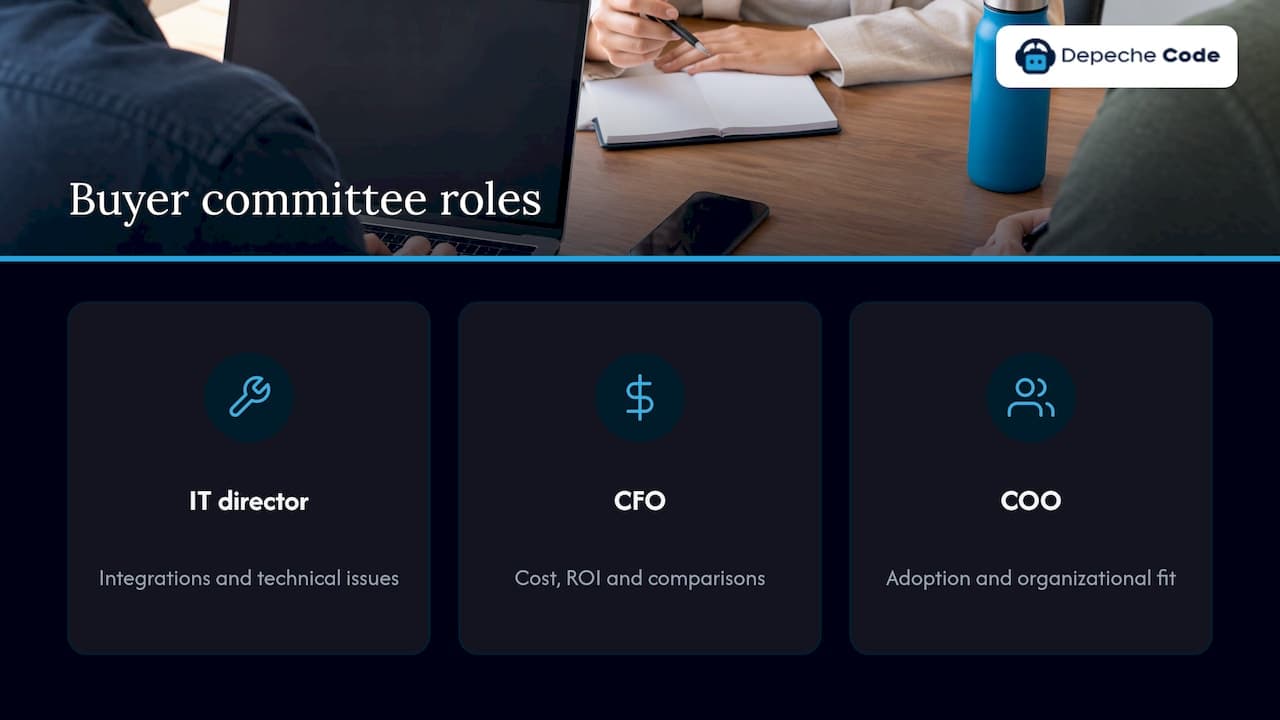
Start with people. Identify who is involved in a purchase and build a profile for each role: industry, job title, location, budget, company size, tools in use and the outcome they want. MarTech’s guide on building a B2B SEO strategy recommends using each role’s concerns to drive keyword research.
Its example is a useful template. An IT director tends to care about integrations and technical issues. A CFO looks at cost, ROI and comparisons. A COO weighs adoption and organizational fit. Each of those concerns is a set of searches and a set of pages you need.
A quick exercise: write down the last five deals you won. For each, list who signed, who evaluated and who raised objections. Then write the questions each person asked before the first call. Those questions are your content backlog.
Step 2: Research keywords by intent, not volume
B2B keyword research should lean toward niche, industry-specific phrases tied to an operational problem. Low volume is normal. Our view matches the approach Search Engine Land describes: focus on whether a keyword can bring solid leads and customers, not on how big its audience looks in a tool.
Group what you find into three intent buckets:
- Problem searches. The buyer knows something is wrong and wants to understand it. Example: why a client portal is slow, or how to reduce manual invoice entry.
- Solution and comparison searches. The buyer is weighing approaches or categories.
- Provider and pricing searches. The buyer is choosing who to hire or buy from.
Provider searches usually have the lowest volume and the highest value. Do not leave them for last. Many teams start with the bottom bucket for exactly that reason: a handful of well-built pages there can produce more pipeline than a year of broad blog posts.
Step 3: Map keywords to the funnel and to page types
Once keywords are grouped, assign each one a stage and a format. MarTech’s guidance is to send educational problem searches to awareness content, solution and comparison searches to consideration content, and provider or pricing searches to decision-stage content. It also advises matching queries to suitable formats such as articles, landing pages, comparison guides or case studies.
A simple working map:
| Stage | Typical query | Best page type |
|---|---|---|
| Awareness | “how to reduce [operational problem]” | Educational article or guide |
| Consideration | “[approach A] vs [approach B] for [industry]” | Comparison guide, explainer |
| Decision | “[service] company for [industry]” | Service landing page, case study |
The common mistake is forcing every intent into a blog post. A buyer searching for a provider wants a service page with proof, not a 1,500-word essay. A buyer searching for a problem does not want a sales pitch. One query, one intent, one page.
Step 4: Get the technical foundation right
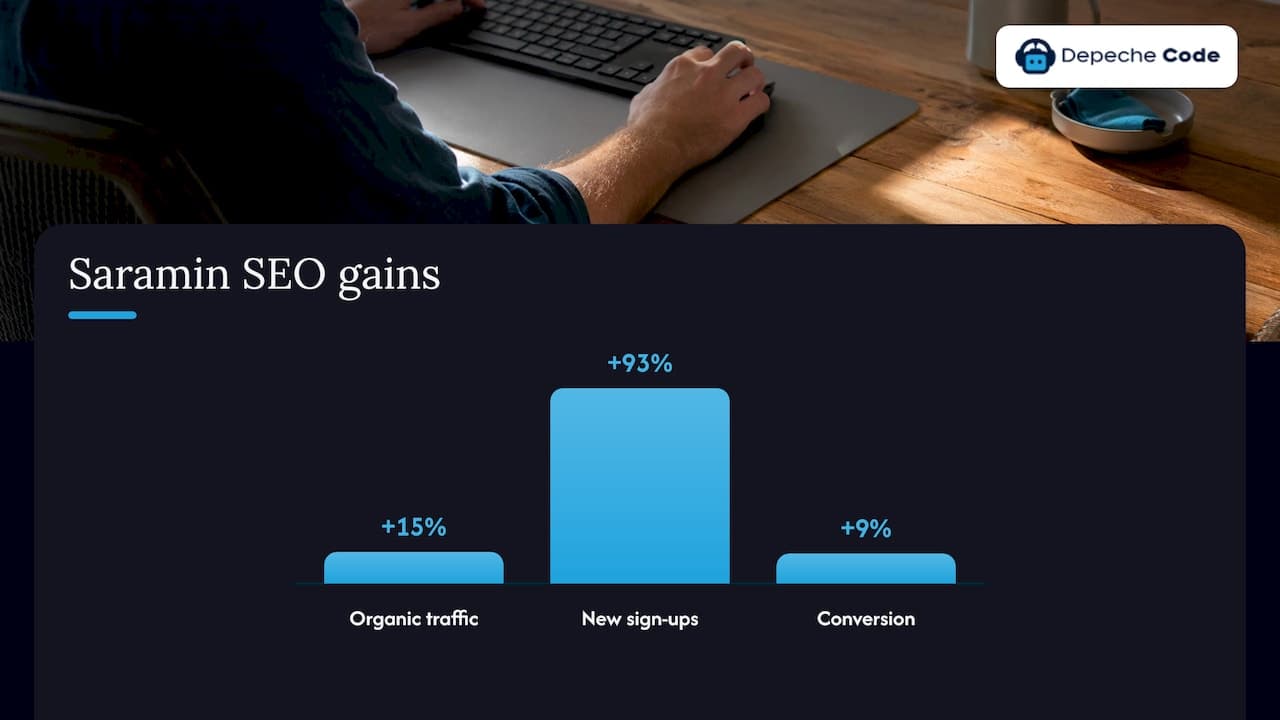
Technical problems quietly cap everything above. Google’s own case study of the Korean job platform Saramin is a clear illustration. Fixing crawling issues produced a 15% increase in organic traffic. After further SEO changes, traffic doubled in September 2019 compared with the prior year, with a 93% increase in new sign-ups and a 9% increase in conversion.
For most B2B sites the priorities are the same:
- A logical site structure and clean internal linking, so service pages are not buried.
- Fast load times and a layout that works on phones. Buyers research on mobile between meetings.
- Clean XML sitemaps, sensible canonical tags and no orphan pages or redirect chains.
- Titles, meta descriptions, image alt text and headings written for the page’s single intent.
Our practical guides on technical SEO and on-page SEO go through each item, and the SEO best practices checklist turns them into an audit you can run against your own site.
If your site is being rebuilt, protect what already ranks. Our website redesign checklist for SEO preservation covers redirects, URL mapping and content carry-over.
Step 5: Publish content buyers actually trust
B2B content has one job: help a skeptical professional make a defensible decision. Google’s guidance supports that direction. It says SEO is most helpful when applied to people-first content, and that content created primarily for search traffic correlates with unsatisfying results.
For B2B pages that means:
- Answer the specific question first. Buyers skim. Put the answer at the top, then the detail.
- Show experience. Google recommends original, high-quality content that demonstrates expertise, experience, authoritativeness and trustworthiness. Use real project details, named processes and numbers you can stand behind.
- Cover objections. Cost, risk, implementation time and integration are what committees argue about. Write the page that settles the argument.
- Use AI as an assistant, not an author. Google states that using automation primarily to manipulate rankings violates its spam policies. Drafting and research help is fine. Mass-produced pages with no point of view are not.
What to do about gated assets
Whitepapers and reports are common in B2B. Gating them hides them from search. Keep an open, indexable summary page that explains the topic and what the report contains, and route qualified visitors to the form from there. You keep discoverability and still capture the lead.
Nurture the research-stage reader
Top-of-funnel visitors rarely convert on the first visit. That is expected. Offer something useful in exchange for an email address, then keep sending relevant material. Do not hard-sell on the first visit. Once they are ready to talk, your site needs to make that easy: see our guide on B2B website conversion for how to turn existing traffic into pipeline.
Step 6: Build authority beyond your own site
Backlinks and external mentions tell search engines, and increasingly AI tools, that others vouch for you. This matters more now that buyers use AI to shortlist vendors. Bain reported that 44% of surveyed US online buyers mostly began their journey in an LLM or split it between AI tools and traditional search. In its analysis, 89% of unbranded prompts were fulfilled by third-party sources. Bain’s conclusion is that classic search optimization is necessary but not sufficient, and that fresh, well-structured content that AI crawlers can parse helps.
The takeaway for B2B teams is that your reputation off your site is part of the strategy. Practical ways to build it:
- Publish original data or a client result worth citing.
- Earn reviews on the platforms your buyers check.
- Contribute expert commentary to industry publications.
- Keep your business details consistent everywhere you are listed.
Our explainer on off-page SEO goes deeper on link building and authority. Social channels also feed discovery and credibility in B2B, and our LinkedIn B2B strategy shows how to pair it with search.
Step 7: Measure pipeline, not just traffic
Traffic is a vanity number in B2B if the visitors are the wrong people. Track:
- Qualified leads from organic search, meaning form fills, demo requests and calls from your target roles.
- Rankings for provider and comparison keywords, which signal buying-stage visibility.
- Assisted conversions, because research-stage content often starts a journey that closes through another channel.
- Sales feedback. Ask your team how many conversations mention finding you through search.
Set expectations on time. SEO compounds, and early months are mostly foundation, content and indexing. Plan in quarters, review monthly, and judge success by pipeline contribution. For a longer view of how the work unfolds, read our step-by-step SEO process and our piece on SEO strategies that deliver measurable growth.
Five B2B SEO mistakes to avoid
- Chasing volume. Broad terms bring readers who will never buy.
- Writing for one persona. A committee has several readers, and each needs an answer.
- Ignoring service pages. Blogs get the attention, but decision-stage pages close deals.
- Hiding everything behind forms. Search engines and buyers cannot see what is gated.
- Treating SEO as a one-off project. Rankings and AI-driven discovery shift, so content needs regular updates.
Our take on B2B SEO
We build websites and run SEO for businesses, and the pattern we see in the strategy is simple: the plan only works when the site underneath it is sound. A well-written article on a slow, badly structured site wastes its effort.
That is why our work treats the website and the search plan as one job. We pair website development, redesign, WordPress hosting and maintenance with SEO and AEO plans, so that technical performance, content and visibility are handled together. We measure technical performance with Google PageSpeed and SEO scores, and we deliver with in-house directed AI so projects move faster. You also own every deliverable.
Our advice to B2B owners: pick a small set of provider-stage keywords, make those pages excellent, and add content around them. Then keep going, because search rewards the companies that keep improving.
Donovan Wells - Founder and CEO
Put the strategy to work with Depeche Code
If you would rather have a team run this plan than build it yourself, our search engine optimization services are built around it. We offer Organic, Local and Combo SEO/AEO plans, so the approach can fit a national B2B company or a business that serves a specific region. Because we also design, develop and maintain websites, the technical fixes and the content work happen in the same place.
To see everything we offer, from redesign to hosting and maintenance, visit our services page.
FAQ
Does SEO work for B2B?
Yes. In Google’s 2025 study of senior B2B buyers, 94% of those who searched for a product online used Google Search. B2B SEO reaches fewer people than consumer SEO, but those people are the decision-makers. The value comes from qualified leads, not large visitor counts.
What is the difference between B2B SEO and B2C SEO?
The ranking mechanics are the same, and Google has no separate B2B algorithm. The difference lies in the audience and the buying process. B2B targets smaller groups, lower-volume searches and several stakeholders, so content must support comparison, risk reduction and internal approval.
What are the best B2B SEO tactics?
Identify the buying committee, target provider-stage keywords first, then add educational content for earlier stages. Fix technical basics, publish people-first content that shows real expertise, and build credibility through reviews and mentions elsewhere. Match each query to the right page type instead of using blog posts for everything.
Should B2B keywords with very low search volume be targeted?
Often, yes. Keywords with 50 or even 10 monthly searches can be worthwhile if they reach a small, relevant group of decision-makers. Judge a keyword by the quality of the buyer behind it and by the page type that will answer it.
Sources
- Google B2B Buyer Journey Whitepaper
- A complete B2B SEO strategy for 2026, Search Engine Land
- B2B SEO strategy: How to drive qualified organic leads, MarTech
- Showcasing the value of SEO, Google Search Central Blog
- Google’s helpful content update guidance
- Google Search’s guidance about AI-generated content
- Your Next Customer Will Find You Using AI. Now What? Bain