

TL;DR:
- Business web solutions are comprehensive systems designed to drive leads, automate workflows, and support growth.
- They include custom design, integrations, security, SEO, performance optimization, and ongoing maintenance.
- Investing in a tailored web solution offers better scalability and ROI than basic websites or templates long-term.
Most business owners assume that having a website means they have a digital strategy. That assumption costs real money. A standard website is a brochure. A business web solution is an engine, one that drives leads, automates workflows, integrates your tools, and scales with your growth. Many organizations underinvest in this area simply because they do not fully understand what a business web solution actually includes. This guide breaks down exactly what these solutions are, why they outperform basic websites, what they cost, and how to approach building one that delivers measurable results for your business.
Table of Contents
- Defining business web solutions: Beyond a basic website
- The life cycle and methodologies for enterprise web solutions
- Key features for scalability, security, and business results
- Cost, timeline, and edge cases in business web solutions
- Why custom web solutions beat templates for serious businesses
- Bring your business web solution to life
- Frequently asked questions
Key Takeaways
| Point | Details |
|---|---|
| Comprehensive scope | Business web solutions go well beyond basic websites, including strategy, architecture, integrations, and growth support. |
| Strategic process | A proven lifecycle—planning, architecture, development, ongoing optimization—maximizes results and limits risks. |
| Essential features | Performance, security, and integration are non-negotiable for ROI and competitiveness in business web solutions. |
| Custom vs. template | Custom solutions are best for long-term growth while templates can serve quick or simple needs. |
| Careful investment | Expect substantial, justified investment for enterprise solutions; timelines and flexibility vary by complexity. |
Defining business web solutions: Beyond a basic website
The term “business web solution” gets used loosely, but the distinction matters. Business web solutions refer to comprehensive, often customized web development services that go far beyond a simple online presence. They combine strategy, design, development, hosting, security, SEO, and ongoing maintenance into a single, cohesive system built around your specific business goals.
Think of it this way: a basic website tells people you exist. A business web solution makes things happen. It can qualify leads, process transactions, sync with your CRM, serve personalized content, and report on every interaction. The scope is fundamentally different.
Here is what a full business web solution typically includes:
- Custom website design and development
- Content management system (CMS) integration
- eCommerce functionality and payment processing
- Search engine optimization (SEO) built into the architecture
- API integrations with third-party tools (CRM, ERP, marketing platforms)
- Hosting, performance optimization, and uptime monitoring
- Ongoing maintenance, updates, and security patches
- Digital strategy and analytics reporting
You can explore the full range of digital business web services to see how these components come together for businesses across industries.
| Feature | Basic website | Business web solution |
|---|---|---|
| Design | Template or simple custom | Fully custom, brand-aligned |
| CMS | Basic or none | Advanced, role-based access |
| SEO | Minimal | Architected from the ground up |
| Integrations | Few or none | CRM, ERP, APIs, automation |
| Security | Standard SSL | OAuth, SAML, enterprise-grade |
| Analytics | Basic traffic data | Full funnel, conversion tracking |
| Maintenance | Ad hoc | Scheduled, proactive |
| Scalability | Limited | Built to grow with the business |
“A business web solution is not a product you buy once. It is an ongoing digital infrastructure that evolves as your business evolves.”
Businesses that invest in true web solutions consistently report benefits like higher lead generation, reduced manual workload through automation, and stronger customer retention. For example, companies offering Seattle business web design at the enterprise level routinely build in workflow automation that saves dozens of staff hours each month.

The life cycle and methodologies for enterprise web solutions
Knowing what a business web solution includes is only part of the picture. Understanding how one gets built is what separates successful projects from expensive failures.
Core methodologies involve a structured lifecycle: requirements gathering and planning, architecture design, development, testing, deployment, and ongoing maintenance. Skipping or rushing any phase is one of the most common reasons projects go over budget or miss the mark entirely.
Here is the standard lifecycle broken into clear steps:
- Discovery and requirements gathering — Define business goals, user needs, and technical constraints before writing a single line of code.
- Architecture and planning — Choose the right tech stack, data structure, and system integrations.
- Design and prototyping — Build wireframes and visual mockups for stakeholder approval.
- Development — Front-end and back-end coding, database setup, and API integrations.
- Quality assurance and testing — Performance testing, security audits, cross-device compatibility checks.
- Deployment — Staged rollout to minimize risk, with rollback protocols in place.
- Maintenance and iteration — Ongoing updates, security patches, and feature additions based on real user data.
Two methodologies dominate serious web solution projects. Agile breaks development into short sprints, allowing for frequent feedback and course correction. DevOps integrates development and operations teams to speed up deployment and improve reliability. For most business web solutions, a hybrid approach works best.
The modern website design process at a professional agency will walk you through each phase with clear milestones and deliverables.
| Factor | Custom web solution | Template-based site |
|---|---|---|
| Upfront cost | Higher | Lower |
| Build time | 3 to 20+ months | Days to weeks |
| Scalability | High | Limited |
| Integrations | Unlimited | Restricted by platform |
| Long-term ROI | Strong | Often requires rebuild |
| Brand control | Complete | Constrained by template |
For businesses exploring budget-friendly entry points, there are also free web development options worth reviewing before committing to a full custom build.
Pro Tip: Always invest in a formal discovery phase before development begins. It typically adds 2 to 4 weeks upfront but can save months of rework and tens of thousands of dollars by catching scope issues early.
Key features for scalability, security, and business results
Once the methodology is set, the features you build into your solution determine whether it delivers real ROI or just looks good on a screen.
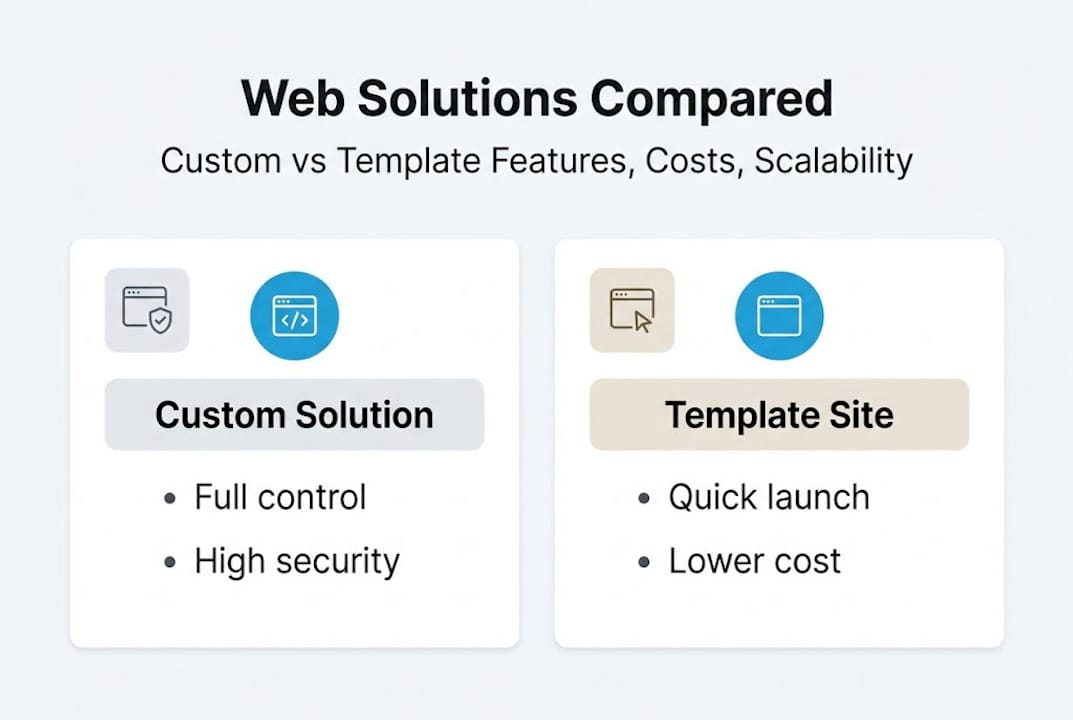
For enterprises, key features include scalability, security (OAuth/SAML), integrations (CRM/ERP), mobile responsiveness, performance, and API-first design. Each of these is not a nice-to-have. They are the difference between a solution that grows with your business and one that becomes a liability within two years.
Here are the features every serious business web solution needs:
- Scalability — Cloud infrastructure that handles traffic spikes without downtime
- Security — Role-based access, encrypted data, and compliance with relevant regulations
- Mobile responsiveness — Seamless experience across all screen sizes and devices
- Performance optimization — Sub-2.5 second load times targeting a strong Core Web Vitals score
- SEO architecture — Clean URLs, schema markup, fast server response, and crawlable structure
- API-first design — Connects your site to any third-party tool without custom workarounds
- Analytics and tracking — Full-funnel visibility from first visit to closed deal
- Accessibility — WCAG compliance to serve all users and reduce legal risk
The numbers back this up. Mobile LCP reduced, conversion +15%, failed checkouts under 1%; PageSpeed improved, repeat purchases +22% in a documented 90-day replatforming case study. Performance is not a technical detail. It is a revenue lever.
For a deeper breakdown, the web development tips resource covers performance optimization strategies that apply directly to business web solutions. You can also review the full list of must-have website features that drive measurable impact in 2026.
Pro Tip: Prioritize performance before aesthetics. A beautiful site that loads in 4 seconds will lose customers to an average-looking site that loads in 1.5 seconds. Target a Largest Contentful Paint (LCP) under 2.5 seconds and a PageSpeed score above 90 before launch.
If your audience is primarily mobile, responsive web design is not optional. It is the baseline expectation for any credible business web solution in 2026.
Cost, timeline, and edge cases in business web solutions
Setting realistic expectations before you start a project is one of the most valuable things you can do. Underscoping a web solution is as dangerous as overspending on features you do not need.
Costs range from $10K to $50K for business websites, $30K to $400K+ for enterprise apps; timelines 4 to 20+ months depending on complexity. Those ranges are wide because the variables are significant.
| Business type | Typical cost range | Typical timeline |
|---|---|---|
| Small business website | $10,000 to $30,000 | 2 to 4 months |
| Mid-market web solution | $30,000 to $100,000 | 4 to 8 months |
| Enterprise web application | $100,000 to $400,000+ | 8 to 20+ months |
| eCommerce platform | $20,000 to $150,000 | 3 to 12 months |
Several factors drive cost up quickly:
- Degree of customization — Every unique feature adds design and development time
- Number of integrations — Each API connection requires testing and maintenance
- Security and compliance requirements — HIPAA, PCI-DSS, and similar standards add significant overhead
- Content volume — Large catalogs, multilingual support, and complex taxonomies increase scope
- Scalability targets — Building for 10,000 concurrent users costs more than building for 500
Edge cases are real and common. High-traffic seasonal sites, B2B custom quoting engines, and crypto payment integrations all require specialized planning that standard web projects do not account for. If your business has unusual operational requirements, surface them in the discovery phase, not after development starts.
“Aligning your web solution scope with your three-year growth plan is not optional. A site built for where you are today will become a bottleneck by tomorrow.”
For a practical look at how the right investment pays off, the boost business success guide covers ROI frameworks that apply directly to web solution projects.
Why custom web solutions beat templates for serious businesses
Here is the uncomfortable truth most agencies will not say directly: templates are not a cost-saving strategy for growing businesses. They are a cost-deferral strategy.
Custom solutions offer superior scalability, security, performance, and ROI long-term, but templates are faster and cheaper initially and often lead to bloat and rebuilds. We have seen this pattern repeatedly. A business launches on a popular template platform, saves $20,000 upfront, and then spends $60,000 two years later migrating off it because the platform cannot support their integrations, their traffic, or their brand requirements.
The real cost of a template is not the monthly subscription. It is the ceiling it puts on your growth. Every workaround you build on top of a template is technical debt that compounds over time. Custom website design and dev eliminates that ceiling from day one.
That said, templates are not always wrong. For MVPs, early-stage startups testing a concept, or businesses with genuinely simple needs, a template can be the right call. The key is knowing when you have outgrown that option. If your business requires CRM integration, custom user roles, advanced eCommerce logic, or serious SEO performance, a template will slow you down more than it helps.
The businesses that win long-term are the ones that treat their web solution as infrastructure, not decoration.
Bring your business web solution to life
You now have a clear picture of what business web solutions actually involve, from lifecycle and features to cost and the real trade-offs between custom and template approaches. The next step is working with a team that can translate that knowledge into a solution built specifically for your business.
At Depeche Code, we build custom web design solutions for businesses that are serious about growth. Whether you need a high-performance website, AI-powered SEO to drive organic traffic, or smart social media growth to expand your reach, we deliver solutions that are built around your goals, not a generic template. Our team is ready to help you move from confusion to clarity to results.
Frequently asked questions
What is the difference between a business web solution and a standard website?
A business web solution includes custom strategy, integrations, security, and ongoing digital growth support, while a standard website is simply an online presence with limited functionality and no strategic infrastructure behind it.
How long does it take to launch a business web solution?
Most projects take 4 to 20+ months depending on scope, complexity, and the number of integrations required. Simpler business sites can launch in as little as two months with a focused scope.
What should I budget for a custom business web solution?
Costs start around $10,000 for small business web solutions, while enterprise-level applications typically range from $30,000 to $400,000 or more depending on features and complexity.
Why pick a custom web solution over a template?
Custom solutions offer more scalability, security, and long-term ROI, while templates are best suited for basic needs or early-stage MVPs where speed to market matters more than flexibility.
What unique features are possible with a business web solution?
Custom features include eCommerce, real-time booking, CRM integration, mobile app connectivity, secure payment processing, multi-language support, and advanced user role management tailored to your specific operations.