
// Creative Agency
Franchise SEO: 9 Strategies for Multi-Location Brands in 2026

Franchise SEO works when the brand and every individual location are optimized as two connected layers. The brand site builds authority and ranks for broad terms. Each unit gets its own useful location page, its own Google Business Profile and its own reviews, so it shows up for people searching in its city. Below are nine strategies for 2026, in the order we would tackle them, plus how to govern the work between head office and franchisees and how to measure it.
TL;DR
- Franchise SEO has two levels: national visibility for the brand and hyper-local visibility for each unit. You need both.
- Give every real location its own page with genuinely local details, not a template with the city name swapped.
- Run one verified Google Business Profile per location, linked to that location’s page, with identical name, address and phone everywhere.
- Let head office control architecture and templates, and let local teams supply current facts, photos and reviews.
- Measure calls, direction requests, form fills and leads by location, not just keyword positions.
Table of Contents
- What franchise SEO is and how it differs from regular SEO
- 9 franchise SEO strategies for 2026
- Who does what: franchisor and franchisee roles
- Common franchise SEO mistakes
- A 90-day rollout plan
- Our perspective on franchise SEO
- Get help building your multi-location SEO
- FAQ
- Sources
What franchise SEO is and how it differs from regular SEO
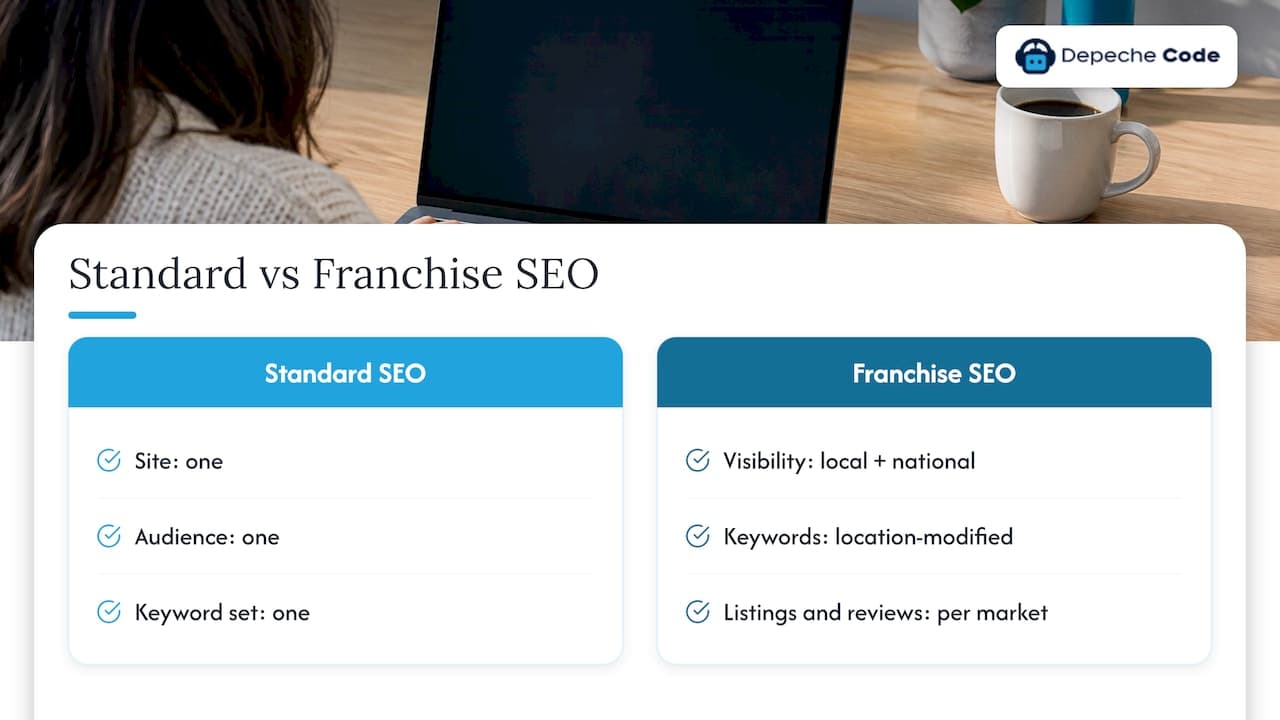
Franchise SEO improves a franchise’s visibility in search at two levels: hyper-local visibility for each location and national visibility for the overall brand. At the local level, each unit has to appear in search results and on maps for the suburb or city it serves.
A standard SEO campaign has one site, one audience and one keyword set. Franchise SEO multiplies those variables by the number of units. Every market needs its own keywords with a location modifier, its own listing and its own reviews, while the brand still has to look and sound like one company.
That multiplication is why franchises stumble. Ten locations means ten pages, ten profiles, ten review streams and ten sets of facts that must stay accurate. The strategies below are designed to keep that manageable.
9 franchise SEO strategies for 2026
1. Build the national layer first
The brand domain carries the authority that every location page inherits. That means clean technical SEO, fast pages, core service pages written well, and evergreen content that earns links. If the main site is slow, poorly structured or thin, your location pages start from behind.
If the site itself needs work, a rebuild or redesign is often the cheapest moment to fix architecture. Our website design and redesign services cover exactly that kind of foundation.
2. Use one domain with a clear location structure
Keep every branch inside the main site rather than spinning up separate domains. Semrush recommends a single domain with location pages in subfolders, such as /locations/state/city/, because it keeps internal linking and authority flowing through one site.
A practical structure looks like this:
- A locations hub page listing every state or region.
- State or region pages for brands with many units.
- One page per location beneath them.
- Links from each location page back up to the hub and across to nearby units.
Set the URL rules once, centrally, so franchisees cannot create inconsistent addresses later.
3. Create a unique page for every real location
This is the single biggest lever in multi-location SEO. Semrush advises a page for each real location with address, phone, hours, services, staff, directions, photos, reviews, neighborhoods served, local FAQs, events and embedded maps, using a consistent template but information specific to each branch.
MarTech’s enterprise guidance makes the same point: the more customized each page is, the more it resonates with local audiences. It also recommends deciding in advance which sections must be customized per location.
A workable split between template and local content:
| Element | Who controls it | Example |
|---|---|---|
| Page layout, headings, schema | Head office | Same template for all units |
| Brand claims, legal text, service names | Head office | Locked fields |
| Address, phone, hours | Location register | Single source of truth |
| Team bios and photos | Local team | Real staff, real storefront |
| Local testimonials | Local team, approved centrally | Customers from that city |
| Community and event content | Local team | Sponsorships, local partnerships |
If you cannot add meaningful local information for a unit, do not publish a page for it. A page that only swaps the city name is the pattern to avoid. We go deeper on page design in our guide to building landing pages that convert.
4. Claim one Google Business Profile per location
For most local searches, the map pack decides who gets the call. Each eligible unit needs its own verified profile with accurate details. Semrush lists the essentials: business name, address and phone, regular and holiday hours, primary and secondary categories, services, photos and a website link to the matching location page rather than the homepage, plus booking or ordering links where relevant.
The profile and the page should describe the same location. If the hours, categories or services disagree between them, customers get confused and your data quality suffers. Our 45-minute Google Business Profile audit and monthly plan is a good template for the recurring checks.
5. Keep name, address and phone identical everywhere
Maintain one master list of location data and feed every directory, listing and page from it. Consistent NAP (name, address, phone) across your site, profiles and citations helps search engines trust that each unit is who it says it is. When a unit moves or changes hours, update the master list first, then push the change outward.
This is also where franchises with franchisee turnover get into trouble. Old listings for closed or rebranded units linger. Build a closing and transfer checklist into your operations manual.
6. Scale reviews with a system
Reviews are a ranking and conversion factor at every location, so they need a routine rather than occasional pushes. Backlinko suggests giving each branch its own short review link or QR code and centralizing monitoring, with alerts for negative reviews and a dashboard that pulls feedback into one place.
A simple operating model:
- Corporate watches trends across all units and flags patterns, such as one unit with slow replies.
- Local teams reply to their own reviews, quickly and in a human voice.
- Each location asks for reviews at the moment of a good experience, using its own link.
- Great local reviews are reused, with permission, as testimonials on that unit’s page.
7. Earn local links and local proof
National link building lifts the brand, but local links lift individual units. Give franchisees a short monthly playbook: one local sponsorship or event, a few fresh photos, one post on the profile, and one local organization to ask for a mention. Chambers of commerce, school and charity partnerships and local press are realistic targets.
This also feeds the content on location pages. A page that mentions a real community event in that city reads very differently from a template.
8. Write for both the brand and the neighborhood
Match keywords to intent at each layer. The national site targets broader queries about the service. Location pages target the service plus the city or neighborhood, and answer local questions: parking, service areas, local pricing factors, seasonal needs. Our local business SEO workflow walks through that keyword and content planning for a single location, which you then repeat per unit.
Franchisors have a second audience too. If you also recruit new franchisees through search, that is a separate set of pages aimed at prospective owners, and it should not compete with consumer location pages.
9. Report by location, then roll up
Aggregate numbers hide problems. Track each unit on its own: profile views from Search and Maps, calls, direction requests, website clicks, form fills and organic leads. Then compare units to decide where to invest. A location with strong demand but a thin page is a higher priority than one that already performs.
Be careful with rank tracking as a headline metric. Results shift with the searcher’s position, so a single ranking number for a city can mislead. Treat rankings as a diagnostic and treat calls, bookings and leads as the scoreboard. For a wider view on connecting SEO to revenue, see SEO for business and ROI.
Who does what: franchisor and franchisee roles
The most common failure in franchise SEO is not technical. It is that nobody owns the work. Search Engine Land’s multi-location guide says brands should prepare three things: brand standards, access permissions, and monitoring and reporting for each branch.
In practice that becomes a hybrid model:
- Head office owns site architecture, templates, URL rules, technical SEO, brand-sensitive fields and publishing standards.
- Local teams supply current hours, photos, staff updates, promotions, events and community proof through a structured form.
- Approval workflow lets corporate review local submissions before they go live.
- Access levels on Google Business Profiles keep ownership with the brand, while location managers can edit hours, photos, posts and replies.
Lock the fields that affect brand identity, legal claims, technical SEO and data quality. Open the fields where first-hand knowledge makes the page better. Keep a location register and a written procedure for openings, closings, moves and ownership changes.
Common franchise SEO mistakes
- Near-identical location pages. Swapping only the city name produces thin pages that give searchers no reason to choose them. Add real staff, photos, testimonials and local details or do not publish.
- Linking profiles to the homepage. Each profile should point to its own location page.
- Inconsistent business data. Different phone numbers or suite formats across listings weaken trust signals.
- No ownership of profiles. If a franchisee created a profile under a personal account and leaves, the brand can lose control. Set ownership rules from day one.
- Unanswered reviews. Silence at one unit drags down the perception of the whole brand.
- Reporting only totals. The network can look healthy while several units stall.
- Ignoring page speed and mobile experience. Most local searches happen on phones, and a slow template slows every location at once.
A 90-day rollout plan
Days 1 to 30: audit and foundations. Build the location register. Claim or recover every profile. Fix NAP inconsistencies. Audit the site for speed, indexing and duplicate content.
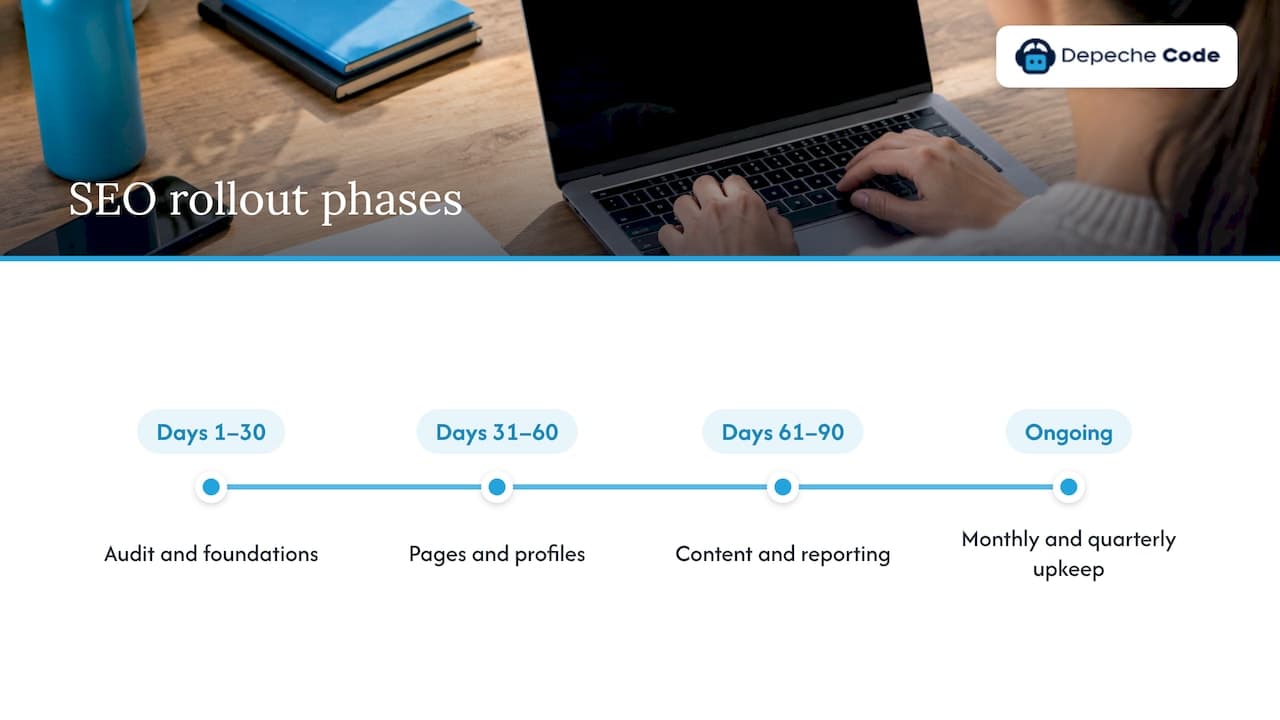
Days 31 to 60: pages and profiles. Launch the location template, then publish the first wave of fully populated pages. Connect each profile to its page. Set up review links and the response routine.
Days 61 to 90: content and reporting. Roll out the monthly local playbook. Build the per-location dashboard. Review which units are lagging and decide where to focus the next quarter.
After that, the work is a rhythm: monthly profile checks, quarterly page refreshes and ongoing review management.
Our perspective on franchise SEO
We see the same pattern with multi-location businesses: the brand has a decent website, and then the locations are an afterthought. A few pages with copied text, profiles nobody checks, and no way to tell which unit is actually bringing in calls.
Our view is that franchise SEO is mostly a systems problem. The strongest approach is one fast, well-built site, a clear location structure, and a repeatable process that local teams can follow without breaking the brand. We design our work around that: technical performance measured with Google PageSpeed and SEO scores, clear ownership of everything we deliver, and in-house directed AI that helps us move faster on production work.
If you run a handful of units, start with the foundation and the first location pages. If you run dozens, standardize the template and the reporting before you scale content. Either way, get the data right once and let every unit benefit from it.
Donovan Wells - Founder and CEO
Get help building your multi-location SEO
If you would rather not build this system alone, we can help. Depeche Code is an Orlando-based agency offering website design and redesign, search engine optimization with organic, local and combined plans, WordPress hosting and maintenance, and ongoing technical support. We can set up the site structure, the location pages and the local SEO plans your units need.
See everything we offer on our services page, or read how we approach SEO strategies for measurable growth before you decide. If you are comparing agencies, our guide to choosing an SEO firm lays out what to look for.
FAQ
How is franchise SEO different from multi-location SEO?
The tactics are nearly identical: location pages, one Google Business Profile per unit, consistent listings and reviews. The difference is governance. Franchises have independent owners, so you also need access rules, locked brand fields and an approval workflow so local edits do not break brand standards.
Should every franchise location have its own page?
Yes, for every real, staffed location that serves customers. Each page needs genuinely local information such as address, hours, staff, photos, reviews and neighborhoods served. If you cannot add that, hold off on publishing the page rather than posting a near-copy of another location.
Should I use separate websites for each location?
Usually no. A single main domain with locations in subfolders keeps authority, internal links and brand consistency in one place, and it is the structure Semrush recommends for scalability. Separate sites multiply maintenance and split your link equity.
How long does franchise SEO take to work?
Profile and listing fixes can improve local visibility within weeks, while new location pages and links typically take a few months to gain traction. Results differ by market competition and by how complete each page is. Plan on judging progress quarterly, location by location.
What should we measure?
Track calls, direction requests, website clicks, form fills and leads for each location, along with review volume and rating. Rankings help you diagnose problems but vary by searcher location, so do not use them alone to judge a unit.
Sources
- Franchise SEO: Local and National Growth Strategies for Franchises (Ahrefs)
- Multi-location SEO: How to build a scalable strategy (Semrush)
- Enterprise Multi-Location SEO: Scale Local Search Success (MarTech)
- Multi-Location SEO: How to Scale Without the Chaos (Backlinko)
- Multi-Location SEO: Boost Local Visibility for Each Location (Search Engine Land)