
// Creative Agency
HIPAA Compliant Chatbot: 9 Checks Before You Deploy (2026)

A HIPAA compliant chatbot is not a product category with an official stamp. It is a chatbot that you deploy, configure and contract for in a way that meets HIPAA’s Privacy and Security Rules, which means a signed business associate agreement (BAA), safeguards around protected health information (PHI), and a risk analysis of your own setup. If a vendor says “HIPAA compliant” and nothing more, treat that as the start of your due diligence, not the end. Below are nine checks you can run on any chatbot before a patient types a word into it.
TL;DR
- No federal agency certifies or pre-approves chatbots for HIPAA. “HIPAA compliant” on a vendor site is a self-assessment, so you verify it.
- If a chatbot creates, receives, maintains or transmits PHI for your practice, the vendor needs a BAA with you, and so does every downstream AI provider that sees that data.
- Encryption, multifactor authentication, access controls, audit logs and identity verification are the safeguards to look for.
- A chatbot that never collects PHI (hours, services, general questions) carries far less risk, and many practices start there.
- Ask your compliance officer or healthcare attorney to review the final design before launch.
Table of Contents
- What “HIPAA compliant” really means for a chatbot
- When HIPAA applies to your chatbot (and when it does not)
- The 9 checks to run on any HIPAA compliant chatbot
- Is there a medical version of ChatGPT?
- Safe uses that do not require handling PHI
- Questions to put to every vendor in writing
- Build the compliance program around the bot
- Our perspective
- Plan a chatbot that fits your practice
- FAQ
- Sources
What “HIPAA compliant” really means for a chatbot
HIPAA compliance is not a certification, seal or registry. According to a Fisher Phillips analysis of how organizations should vet AI vendors, no federal agency approves or pre-clears chatbot products, vendor claims are self-assessments, and the organization using the tool should run a deployment-specific risk analysis and secure a BAA where one is required.
The same source makes a point that catches many buyers out: security badges such as SOC 2 Type II or HITRUST are valuable, but they do not mean a product is HIPAA compliant. They show that a vendor runs good security controls. They say nothing about whether the vendor will sign a BAA, whether its terms of service let it reuse your data, or whether your particular configuration protects PHI.
The practical meaning: compliance is a property of how a chatbot is used, not a label on the box. The same software can be fine in one deployment and a violation in another.
When HIPAA applies to your chatbot (and when it does not)
HIPAA applies to covered entities (most providers, health plans and clearinghouses) and to their business associates. An academic review in PMC, AI Chatbots and Challenges of HIPAA Compliance, explains the split: when a chatbot vendor acts on behalf of a covered entity, HIPAA requirements apply, while information a patient shares on their own with an external chatbot may fall outside HIPAA altogether.
That same paper flags a regulatory gap. PHI processed by certain AI vendors can sit outside the traditional HIPAA framework if the vendor does not meet the legal definition of a business associate. For you, that is a reason to be deliberate. Do not rely on the law to protect patient data after it leaves your control; rely on your contract and your configuration.
| Situation | Does HIPAA likely apply? | What you do |
|---|---|---|
| Your practice deploys a chatbot that collects symptoms, appointment details tied to a name, or insurance info | Yes, the vendor is acting for you | BAA, safeguards, risk analysis |
| A chatbot on your site answers only general questions (hours, parking, services) and collects no health details | Usually no PHI involved | Keep it from collecting PHI, with clear on-screen instructions |
| A patient uses a public chatbot on their own | Often outside HIPAA | Nothing to contract, but do not send patients there for care questions |
| A staff member pastes patient notes into a general-purpose chatbot | Yes, it is a disclosure by your workforce | Block it by policy and by tooling |
This table is a starting map, not legal advice. Edge cases, such as an appointment reminder that mentions a specialty, can turn ordinary data into PHI, so have counsel confirm where your lines fall.
The 9 checks to run on any HIPAA compliant chatbot
1. Will the vendor sign a BAA?
This is the gate. HHS states in its guidance on HIPAA and cloud computing that a provider needs a BAA when it creates, receives, maintains or transmits PHI on behalf of a covered entity to carry out its functions. A chatbot that handles patient messages fits that description. No BAA, no PHI. Full stop.
2. Does the BAA contain what HHS expects?
HHS’s business associates FAQ says a compliant BAA must describe the permitted uses of PHI, prohibit unauthorized further disclosure, and require compliance with the applicable Security Rule provisions. Read the document itself. A one-line “we are HIPAA compliant” in a sales deck is not an agreement.
3. Does the BAA conflict with the standard terms of service?
Fisher Phillips notes that many vendor BAAs clash with standard terms of service that give the vendor broad rights to use customer data for other purposes, which is not permitted for PHI without authorization. Ask which document controls if they disagree, and whether the vendor can use your conversations to train models.
4. Is there an unbroken chain of BAAs?
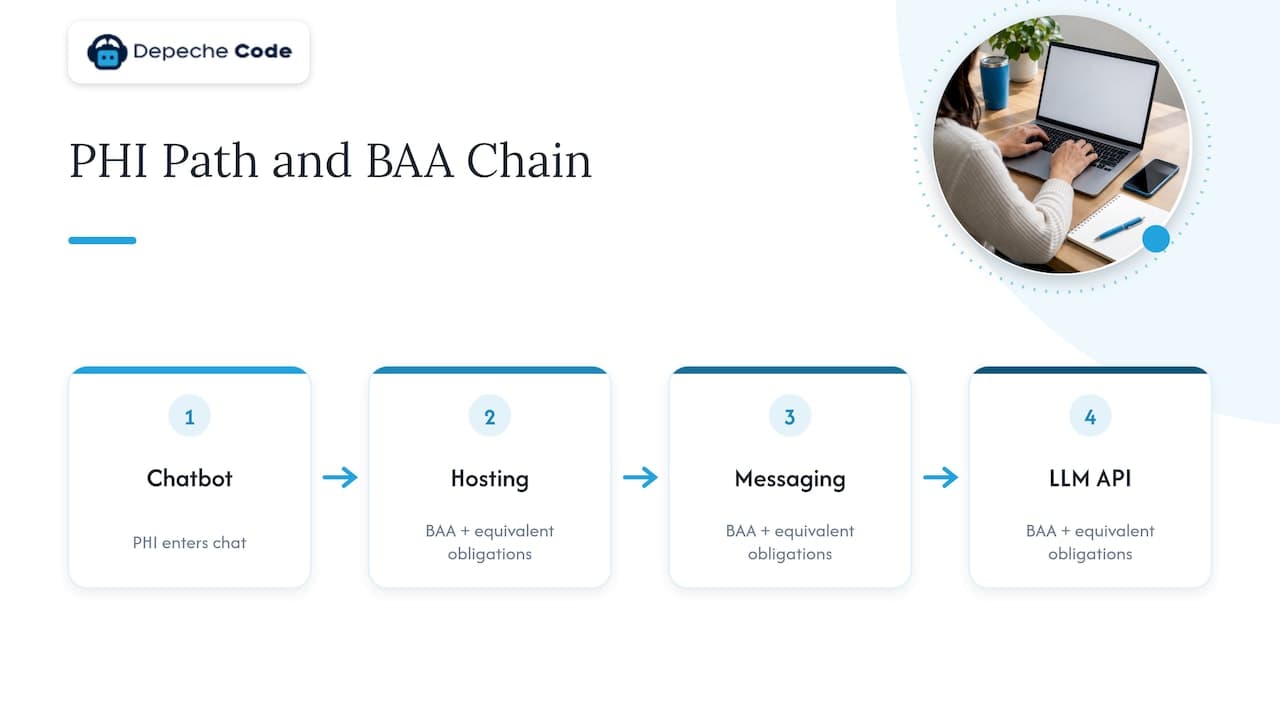
A chatbot is rarely one company. It may sit on a hosting provider, a messaging layer and a large language model API. The same Fisher Phillips piece explains that downstream AI providers, including LLM API providers, need a BAA and equivalent obligations in the chain whenever PHI passes to them. Ask for a list of every subprocessor that touches message content and confirm each one is covered.
5. Is PHI encrypted in transit and at rest?
A 2023 academic paper on security implications of AI chatbots in health care lists encryption of PHI at rest and in transit among the core safeguards. Ask where transcripts are stored, for how long, and who at the vendor can read them.
6. Are access controls and multifactor authentication enforced?
The same paper points to multifactor authentication and strict identity and access management. In practice: named user accounts for your staff, role-based access to transcripts, MFA on every admin login, and prompt removal of access when someone leaves. Your IT environment matters as much as the chatbot itself. A security-focused provider such as security-focused IT support can help tighten identity controls and threat detection around the systems your chatbot connects to.
7. Are there audit logs and regular security reviews?
You need a record of who accessed what, and a vendor that audits its own controls on a schedule. The PMC authors recommend regular security audits as part of mitigating chatbot risk. Ask to see how logs are kept and whether you can export them if a patient requests an accounting or you investigate an incident.
8. Does the bot verify identity before it shares anything?
This is where the headline failures happen. Google currently surfaces a discussion of a chatbot marketed as HIPAA compliant that reportedly handed out personal details in response to a simple “who am I?” prompt. Whatever the full story, the lesson is sound: a bot that retrieves records must confirm who is asking before it reveals a single field, using something stronger than a name or a date of birth. Test this yourself with adversarial prompts before launch, and again after every major update.
9. What happens to PHI you did not want?
Patients will type things you never asked for. Decide in advance how the bot responds (a plain notice that it cannot take medical details, and a route to a phone line or secure portal), how long stray transcripts are kept, and who reviews them. A JAMA analysis of privacy risks of AI chatbots notes that even benign comments or casual references that identify a patient can be PHI, and that removing every nuance from transcripts is difficult. Design for prevention, not clean-up.
Is there a medical version of ChatGPT?
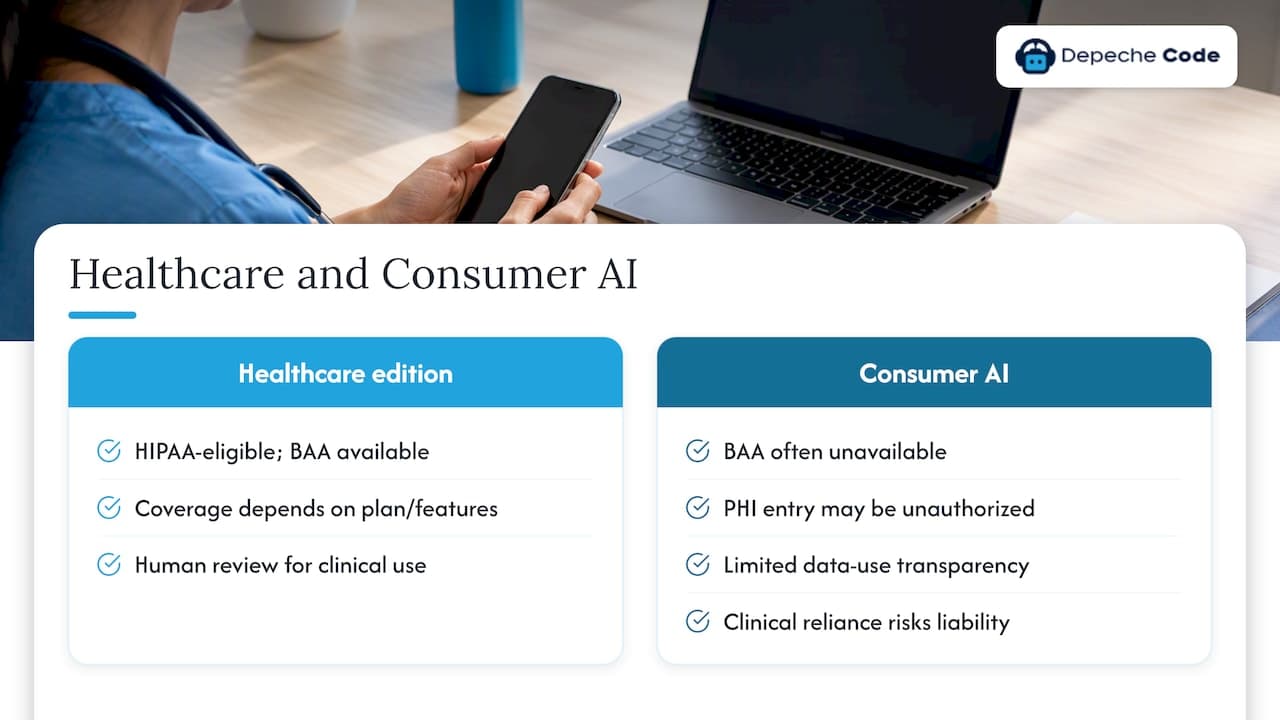
People ask this constantly, and the answer is a qualified yes. Some general-purpose AI vendors now offer healthcare editions that are described as HIPAA-eligible and available under a BAA, and a number of specialist products are built for clinical settings. “Eligible” is the important word: whether your use is covered depends on the workspace, the plan and which features are switched on for each user role. The vendor’s own help documentation sets those limits, so read it and have it written into your agreement.
The contrast is the consumer version. The JAMA analysis argues that, given the likelihood that no BAA exists between a provider and a consumer AI service, entering PHI there is an unauthorized disclosure under HIPAA. The American Medical Association’s guidance on generative AI for physicians adds two cautions: limited transparency over how entered data is used, and potential liability for patient harm if clinicians rely on model output. A BAA solves the first only partly and the second not at all, so keep a human in the loop for anything clinical.
Safe uses that do not require handling PHI
The lowest-risk way to get value from a chatbot is to keep it on the non-clinical side of the house:
- Answering questions about office hours, locations, accepted insurance networks and parking.
- Explaining how to prepare for a visit, using content your staff has already approved.
- Routing people to the right phone number, patient portal or scheduling tool.
- Capturing a name and callback preference from prospective patients, with a clear notice not to describe symptoms in the chat.
Even here, the line is thinner than it looks. If a bot asks “what are you coming in for?”, you have invited PHI. Write the prompts and the guardrails deliberately, and keep the chat flow away from anything that identifies a person together with a health condition.
If you are planning one of these assistants, our notes on common mistakes in AI chat bot implementation and best practices for designing an effective AI chat bot cover scoping, tone and fallback paths, and our chatbot privacy policy guide walks through the disclosures a chatbot should show visitors.
Questions to put to every vendor in writing
A short written questionnaire often reveals more than a demo. Send these and keep the answers with your compliance file:
- Will you sign our BAA, or only yours, and can we see it before purchase?
- Which subprocessors and model providers receive message content, and are they under BAA?
- Do you use customer conversations to train or improve models?
- Where is data stored, how long is it kept, and how is it deleted at contract end?
- How does the bot verify a user before sharing account or record details?
- What logs do you keep, and can we export them?
- How do you notify us of a breach, and within what time frame?
- What happens to our data and configuration if we leave?
Vague answers are an answer. A vendor that is serious about healthcare will have these ready.
Build the compliance program around the bot
The chatbot is one control inside a larger program. Before launch, complete a risk analysis that includes the bot, train staff on what never goes into a chat window, and document your decisions. Many practices also fold the project into a wider cybersecurity review. A guide to cybersecurity compliance services explains what those engagements usually cover and how to choose one, which helps when your team lacks in-house security staff.
Re-check after changes. A new integration, a model upgrade or a new vendor terms update can quietly alter where PHI flows. Put a recurring review on the calendar, and treat any change to a subprocessor as a trigger to re-confirm the BAA chain.
Our perspective
We build AI chat bots for businesses every week, and the first thing we tell healthcare-adjacent clients is that no chatbot is “HIPAA compliant” on its own. Compliance lives in the contract, the configuration and the habits of your staff. Anyone who sells you a badge is skipping the real work.
That is why we start with scope. What should the bot do, what must it never collect, and where does a human take over? A well-scoped assistant that answers common questions, points people to the right place and hands off to your team can remove a lot of routine load without ever touching patient records. We write our own claims as design goals, not guarantees, and we put the same expectation on our work: you should be able to see exactly what you are getting.
We also believe you should own what we build for you. Transparent ownership of deliverables, a clean handoff and documented flows make it far easier for your compliance officer and attorney to review a project. We use AI inside our own delivery process, directed by our team, to move faster, and we measure the websites we build with tools such as Google PageSpeed so that performance is not a guess.
If your project will handle PHI, bring your counsel into the first meeting. If it will not, we can get you live quickly and keep the cost sensible.
Donovan Wells - Founder and CEO
Plan a chatbot that fits your practice
If you want an assistant for your website that answers routine questions and routes patients to your staff, our AI chat bot plans start at $49 per month (Starter), with Growth from $99 per month and Prime from $149 per month, plus a one-off $299 setup and integration fee. You can see what each tier includes on our AI chat bot services page. Where PHI is involved, we scope the project with your compliance team before anything is built.
If the chatbot is part of a larger refresh, see everything we offer on our services overview, from website redesign and SEO to hosting and maintenance.
FAQ
Which AI chatbots are HIPAA compliant?
No chatbot is compliant by itself, because HIPAA is not a certification and no federal agency approves products. A chatbot can be used for PHI when the vendor will sign a BAA, the configuration includes the required safeguards, and your organization has done its own risk analysis. Check the BAA and the subprocessor chain, not the marketing page.
Is there a HIPAA compliant ChatGPT?
Some vendors offer healthcare editions of general-purpose AI that are described as HIPAA-eligible under a BAA, but eligibility depends on the plan, workspace and features enabled for each user. The free or standard consumer version should not receive patient information. Confirm the exact scope in the vendor’s own documentation and in your signed agreement.
Do I need a BAA for a website chatbot?
You need one if the chatbot creates, receives, maintains or transmits PHI on your behalf. If the bot only answers general questions and is built so it never collects health details, it may not handle PHI at all. Because a stray symptom typed into a chat box can become PHI, ask your attorney to confirm the approach.
Can a patient use any chatbot to ask about their own health information?
A patient is free to use outside tools, and information they share on their own may not be covered by HIPAA. That is a privacy risk for them, not protection. If you want patients to ask questions about their care, offer a channel under your own BAA and tell them clearly which tool to use.
Can staff paste patient notes into a chatbot to save time?
Not unless the tool is covered by a BAA and approved by your organization. Even small details can identify a patient, and entering PHI into a service without a BAA is an unauthorized disclosure. Set a written policy, train your team, and provide an approved tool so people are not tempted to improvise.
Sources
- AI Chatbots and Challenges of HIPAA Compliance for AI Developers and Vendors (PMC)
- How Healthcare Organizations Must Vet AI Vendors That Overstate Their Compliance (Fisher Phillips)
- Guidance on HIPAA and Cloud Computing (HHS)
- Business Associates Frequently Asked Questions (HHS)
- Security Implications of AI Chatbots in Health Care (PMC)
- Health Care Privacy Risks of AI Chatbots (JAMA)
- ChatGPT and Generative AI: What Physicians Should Consider (AMA)
- Security-focused IT support
- Cybersecurity compliance services