
// Creative Agency
Local vs National SEO: Which Strategy Fits Your Business in 2026

Local SEO helps you show up when people in a specific city, county or neighborhood search for what you sell. National SEO helps you rank for broad searches with no place attached, so customers anywhere in the country can find you. If your customers come to you or you travel to them, start local. If you sell to buyers across the country, start national. Many businesses end up doing both, and the two do not fight each other.
TL;DR
- Local SEO targets a defined area and leans on your Google Business Profile, reviews, listings and location pages. National SEO targets a country-wide audience and leans on content, technical quality and authoritative links.
- Local competition is smaller. National competition is usually far stiffer, so results take longer and cost more.
- Choose by where your customers live and how they search, not by which strategy sounds bigger.
- You can run both: local work for each location, national work for your brand and expertise.
- Check what Google shows for your priority searches (map pack or national results) before you commit budget.
Table of Contents
- What is the difference between local and national SEO?
- How keywords differ
- How the search results differ
- Local SEO tactics
- National SEO tactics
- Competition, cost and timelines
- Which businesses need which strategy
- How to choose: look at what Google shows
- Can you do both without hurting either?
- Perspective
- Getting help with local, national or both
- Common mistakes to avoid
- FAQ
- Sources
What is the difference between local and national SEO?
The core difference is audience and geography. According to Search Engine Land’s guide to local versus traditional SEO, local SEO targets customers in a county, city or neighborhood, while traditional (national) SEO generally seeks visibility with a national or even international audience.
That single difference changes almost everything downstream: the keywords you chase, the pages you build, the places you need to be listed, the links you earn and the competitors you face.
| Local SEO | National SEO | |
|---|---|---|
| Audience | People in a defined area | People anywhere in the country |
| Typical search | “plumber near me”, “dentist in Orlando” | “project management software”, “ergonomic office chair” |
| Where you appear | Map pack and local organic results | Standard organic results |
| Key assets | Google Business Profile, reviews, citations, location pages | Content depth, technical performance, authoritative links |
| Competition | Other businesses in your area | Every company in your category nationwide |
| Speed of results | Usually faster | Usually slower |
If you want the basics of the local side first, we cover them in our plain-language guide to local SEO.
How keywords differ
National keyword research generally targets product or service phrases without a geographic qualifier. Local research targets the same kinds of phrases with local intent, such as “boutique near me” or “Dallas boutique,” as Forbes Agency Council describes.
In practice, this means a local business builds its keyword list around three kinds of terms:
- Service plus city: “HVAC repair Winter Park”.
- Proximity phrases: “near me” and “open now”.
- Neighborhood or landmark terms: useful for restaurants, salons and retail.
A national business builds around category and problem terms: what the product is, what it does, how it compares, how to choose it. Those searches have no city in them, and the results pages look very different as a result.
How the search results differ
When Google decides a search has local intent, it often shows a map pack with three businesses above the regular results. Google states that local results are based mainly on relevance, distance and prominence. Prominence can reflect links to your business and your number of reviews, and more reviews with positive ratings can help your local ranking.
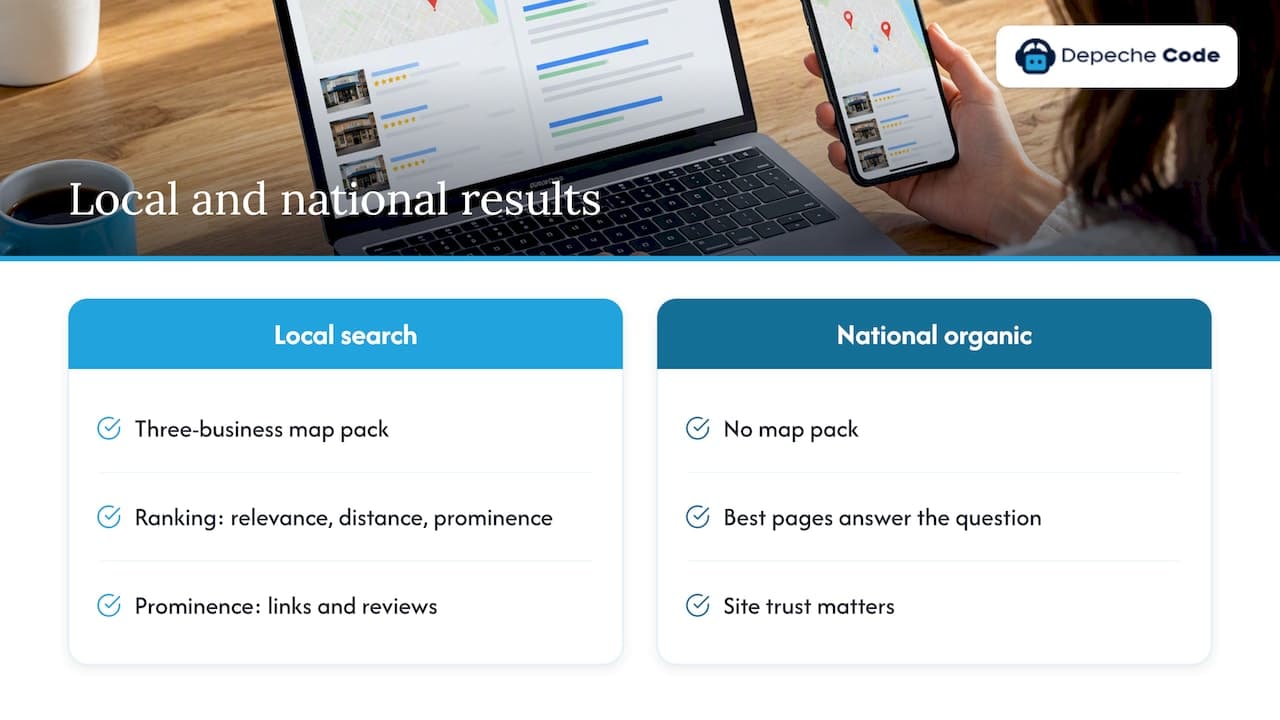
National searches skip the map and send traffic to the best pages from the best sites. There, no one cares how close you are. They care whether your page answers the question better than the other pages and whether your site is trusted.
Local SEO tactics
Local SEO sits on top of ordinary organic SEO. Search Engine Land lists the additions: Google Business Profiles, local listings, service-city landing pages, community involvement and locally relevant content. Here is what that looks like when you do the work.
Your Google Business Profile
This is the single most important local asset for most businesses. Google tells businesses to provide complete and accurate information, including address where applicable, hours, category and attributes, to improve their chances of appearing for relevant local searches. We walk through a practical routine in our Google Business Profile audit and monthly plan, and a simple weekly posting habit in our guide to Google Business Profile posts.
Location pages and local content
If you serve several cities, give each its own page with real details: the services you offer there, local staff or projects, directions, and customer feedback. Copying one page and swapping the city name is the quickest way to create pages that help no one.
Structured data
Google’s documentation says LocalBusiness structured data can communicate hours, departments, reviews where applicable and other details. It recommends defining each location as a LocalBusiness using the most specific subtype possible.
Reviews, listings and local links
Keep your name, address and phone number identical across directories, ask happy customers for reviews as part of your normal process, and earn links from local sources: chambers of commerce, sponsorships, neighborhood groups and local press.
National SEO tactics
National SEO is less dependent on listings and reviews. It leans on the same fundamentals every website needs, applied at a larger scale and against stronger opponents.
- Broad keyword research. Find the topics buyers search for across the country and be honest about which ones you can compete for.
- Expertise-led content. Search Engine Land advises building thought-leadership content around popular but realistically competitive topics rather than chasing only the biggest head terms.
- Authoritative links and mentions. The same source points to industry publications, major news sites and active communities as places to earn them.
- Technical performance. Fast pages, clean architecture and mobile usability matter more when you cannot rely on proximity to win.
- On-page fundamentals. Titles, headers and internal links that make each page’s topic obvious.
Our overview of SEO strategies that produce measurable growth covers the fundamentals that apply on both sides.
Competition, cost and timelines
National SEO usually faces substantially stiffer competition because you compete across the country, not against a smaller set of local businesses. Search Engine Land makes the same point with an example: ranking for “track shoes in Boise” is likely easier than ranking nationally for “track shoes”, since the geographic audience is smaller.
That has practical consequences for your budget:
- Local work tends to pay back sooner because you are measured against a handful of nearby rivals. A complete profile, steady reviews and a few good location pages can move the needle.
- National work is a longer investment. You are building a content library and a link profile that has to outweigh established brands.
Neither is “better.” They are different bets, and the right one depends on how your customers buy.
Which businesses need which strategy
Local SEO fits businesses where location is part of the sale: restaurants, retail stores, home services such as plumbers and electricians, clinics, law and accounting offices, salons, and any company with a physical location or a defined service area.
National SEO fits businesses whose customers are not confined to one area: e-commerce brands, software companies, online education, remote or nationwide service providers and publishers.
There is a large gray zone between them:
- A regional service company covering a few counties needs local SEO with strong city pages.
- A franchise or multi-location brand needs local SEO per location and a national brand presence.
- A specialist consultant who works remotely but is known in one metro area may want both.
How to choose: look at what Google shows
The most reliable method is to let Google tell you. Search Engine Journal’s enterprise framework recommends analyzing priority queries across locations to see whether they produce map packs and state- or city-specific pages. Then match your effort to what you find:
- National-intent terms: invest most in your main website and backlinks.
- Semi-local terms: optimize your Google Business Profile.
- Local or hyper-local terms: build locator, state, city and location pages.
Try this in about 30 minutes. List your ten most valuable searches. Run each in a private browser window. Note whether you see a map pack, local business pages or national brands. Count the results of each type. If most show maps, your market is local. If most show national publishers and brands, your market is national. If it is mixed, you need both.
Then add three business questions:
- Where are your best customers? Pull ZIP codes from your last 50 sales.
- Can you serve people outside your area? If shipping, remote delivery or travel is part of the model, national opens up.
- What can you sustain? A national content program needs months of steady output. A local program needs ongoing review requests and profile upkeep.
Can you do both without hurting either?
Yes. Search Engine Land notes a business can maintain local visibility for its stores while pursuing national visibility for its brand: location pages, profiles, listings and local content serve local audiences, while expertise-led content and authoritative national links serve the broader goal.
A practical way to split the work:
| Layer | What it covers | Owner |
|---|---|---|
| Foundation | Fast, mobile-friendly site, clean structure, tracking | Shared |
| Local layer | Profile, reviews, citations, city pages, local links | Per location |
| National layer | Topic content, comparisons, guides, press and industry links | Brand |
Build the foundation first, then add the layer your customers need most. A site rebuild is a common moment to get the foundation right, and our website redesign checklist for preserving SEO explains how to avoid losing rankings along the way.
Perspective
We see the same mistake often: a business picks “national” because it sounds bigger, then spends a year competing against brands with ten times its budget for searches that never bring in a customer. Or the reverse, a company that could sell across the country keeps itself in a three-mile radius because that is where its profile happens to rank.
Our view is that SEO should follow the customer, not the ambition. We start by looking at how your buyers actually search and what Google shows them. Then we build the foundation, a fast and technically sound website, and layer on the work that fits: local visibility for the places you serve, topic authority for the audiences you want to reach.
We use in-house directed AI to speed up research, auditing and production, and we measure technical performance with tools like Google PageSpeed and SEO scores so you can see what changed. You own everything we deliver. For many of our clients the strongest answer is a combination: local first for quick wins, then national content once the base is working.
Donovan Wells - Founder and CEO
Getting help with local, national or both
If you would rather hand this to a team, we offer Organic, Local and Combo SEO/AEO plans, so the scope can match the strategy you choose. We start with your customers and your search results, then recommend the mix. You can see how we work on our SEO services page.
If you are still choosing a provider, our guide on hiring a local SEO firm lists what to ask. When you are ready to talk about your own market, get in touch through our services page and tell us where your customers are.
Common mistakes to avoid
- Treating a city name as a strategy. One page per city with duplicated text will not rank and does not help visitors.
- Ignoring the profile. Out-of-date hours or a wrong category cost you map visibility on searches you should win.
- Chasing national head terms too early. Start with topics where you can realistically compete, then widen.
- Inconsistent business details. Different names or phone numbers across listings confuse both customers and search engines.
- Not measuring by channel. Track calls, direction requests and form fills from local search separately from national organic sessions, so you know which effort pays.
FAQ
Does local SEO hurt my national rankings?
No. Rankings depend on how relevant your content is to each specific search. Local work such as a profile, location pages and reviews serves local searches, while your broader content serves national ones. A well-organized site can do both.
What is the difference between local SEO and regular SEO?
Regular SEO aims to rank your website for searches from a broad audience, with no geographic boundary. Local SEO adds location-focused work, such as a Google Business Profile, local listings and city pages, to win searches tied to an area and to appear in the map pack.
Is local SEO easier than national SEO?
Usually, yes. You compete against fewer businesses and a smaller audience, so a strong profile and good reviews can produce results sooner. It still takes consistent work, and results depend on your market and how many nearby competitors are active.
Which should a small business start with?
If customers come to you or you travel to them, start with local SEO. If you sell online to the whole country, start with national. Check what Google shows for your ten most important searches to confirm, then add the other layer when the first is working.
Can a multi-location business use both?
Yes. Give each location its own profile and page, then build national visibility for the brand through expert content and authoritative links. Keep the details consistent across every listing so each location supports the others.
Sources
- Local vs. traditional SEO, Search Engine Land
- National SEO Vs. Local SEO, Forbes Agency Council
- Tips to improve your local ranking on Google, Google Business Profile Help
- Local Business structured data, Google Search Central
- 5 Top Enterprise Local SEO Challenges and How To Solve Them, Search Engine Journal