

Search engine optimization is not a luxury reserved for Fortune 500 companies. For small and medium businesses, it may be the single most powerful marketing investment available, with averages around 748% ROI and returns as high as 22:1. Yet most SMB owners still treat SEO as optional, something to revisit “when things slow down.” That mindset is costing real revenue. This article breaks down the hard numbers behind SEO’s return on investment, explains exactly what makes it work, compares it honestly to paid advertising, and gives you a clear action plan to start seeing results.
Table of Contents
- Why SEO delivers exceptional ROI for small & medium businesses
- What makes SEO work: Key components for measurable results
- SEO compared to paid advertising: Cost, results, and risk
- How to maximize SEO success: Actionable steps for SMBs
- The uncomfortable truth about SEO: Why most businesses never realize its full value
- Ready to amplify your business with expert SEO?
- Frequently asked questions
Key Takeaways
| Point | Details |
|---|---|
| SEO offers unmatched ROI | SEO can return up to 22:1 for small businesses, far exceeding most paid channels. |
| Long-term value builds | SEO establishes an asset that grows traffic and leads year over year with consistent effort. |
| Key components matter | Success depends on blending on-page, technical, and local SEO—plus ongoing measurement. |
| Treat SEO as an investment | Those who view SEO as a long-term strategy, not a one-time task, see the highest returns. |
Why SEO delivers exceptional ROI for small & medium businesses
Let’s start with something that surprises most business owners. SEO does not just compete with other marketing channels. It routinely beats them. Up to 22:1 ROI, outperforming pay-per-click advertising in the long run, is not a rare outlier. It is what consistent, well-executed SEO looks like over time.
Real case studies back this up. SMBs that committed to structured SEO campaigns have seen 5X ROI, 150% lead growth, and traffic increases of 250% within 12 to 18 months. Those are not vanity metrics. Those are leads, sales, and customers.
Here is a quick comparison of average ROI across common digital marketing channels:
| Channel | Average ROI | Results duration |
|---|---|---|
| SEO | 748% average, up to 22:1 | Long-term, compounding |
| Pay-per-click (PPC) | 200% average | Stops when budget stops |
| Email marketing | 3,600% (list-dependent) | Medium-term |
| Social media ads | 95-250% | Short-term |
Email marketing looks impressive on paper, but it requires an existing audience. SEO builds that audience from scratch, pulling in people who are actively searching for what you sell. That intent-driven traffic is why SEO strategies for business convert at higher rates than most paid channels.
Key reasons SEO outperforms other channels for SMBs:
- Compounding returns: Content ranked today keeps earning traffic for years.
- Intent-based traffic: Visitors arrive already looking for your solution.
- Lower cost per lead over time: Initial investment spreads across growing traffic.
- Brand authority: High rankings signal trust to potential customers.
- No pay-to-play ceiling: You do not need a bigger budget to maintain top positions.
Pro Tip: Invest in content quality from day one. A single well-researched article that ranks for a competitive keyword can improve search rankings and generate leads for years without additional spend.
What makes SEO work: Key components for measurable results
Knowing the numbers is motivating. But understanding what drives those numbers is what separates businesses that see results from those that spin their wheels.
Effective SEO for SMBs covers six core disciplines. Each one plays a distinct role in getting your website found, trusted, and clicked.
- On-page SEO: Optimizing titles, headers, meta descriptions, and content on each page so search engines understand what you offer.
- Technical SEO: Fixing site speed, mobile responsiveness, crawlability, and structured data so Google can index your site properly.
- Local SEO: Optimizing your Google Business Profile, local citations, and location-based keywords to capture nearby customers.
- Off-page SEO: Building backlinks and brand mentions from other reputable sites to increase your domain authority.
- Content SEO: Creating articles, guides, and pages that answer real questions your customers are searching for.
- Analytics and tracking: Measuring what works so you can double down on winning tactics and cut what does not.
A meta-analysis of SEO effectiveness confirmed a high effect size (d=1.049) on rankings and traffic, with content quality, keyword targeting, and backlinks identified as the strongest drivers. That is academic confirmation of what experienced practitioners already know.
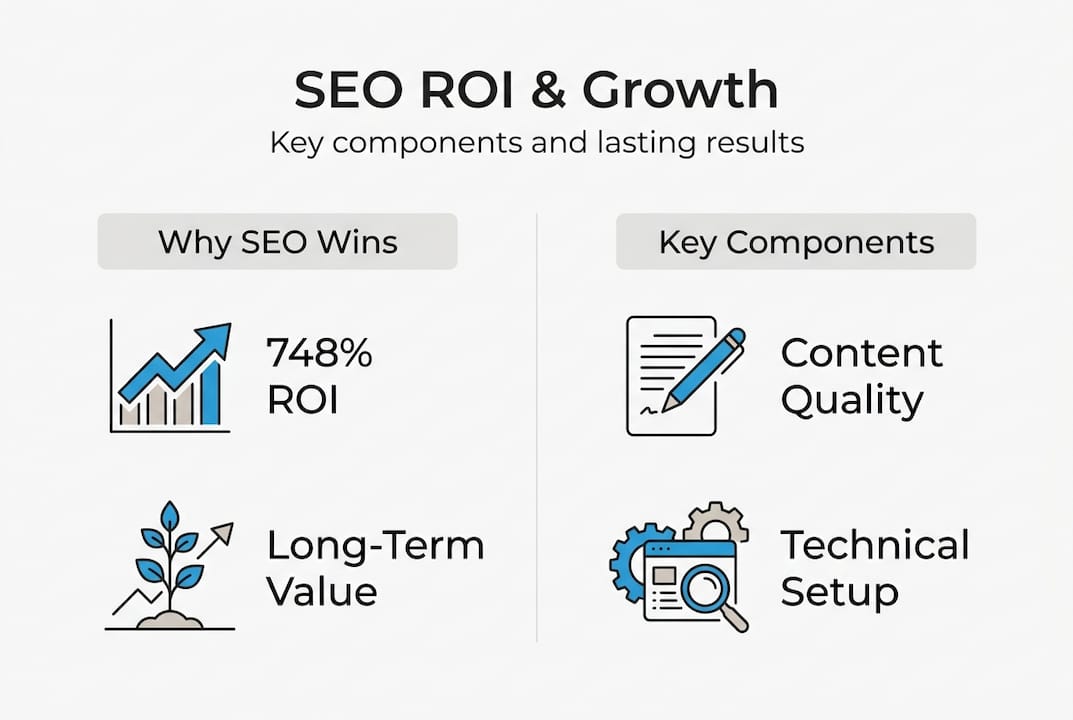
Here is how the three most critical types compare for a typical SMB:
| SEO type | What it fixes | Time to see impact |
|---|---|---|
| Technical SEO | Crawl errors, speed, mobile issues | 4-8 weeks |
| Local SEO | Map pack rankings, local visibility | 4-12 weeks |
| On-page SEO | Keyword relevance, content quality | 8-16 weeks |
For businesses with a physical location or service area, enhancing website redesign with SEO during a site overhaul is one of the smartest moves you can make. You are already touching the site. Optimize it properly from the start.

Pro Tip: If you are new to SEO, start with technical and local fixes. They tend to produce the fastest measurable wins and create a solid foundation for everything else. Tools like AI for SEO improvements can also accelerate your initial audit process significantly.
SEO compared to paid advertising: Cost, results, and risk
Here is the clearest way to think about this: SEO is an asset you build. PPC is rent you pay. The moment you stop paying for ads, your traffic disappears. The moment you stop investing in SEO, your rankings do not vanish overnight. They hold, sometimes for years.
“SEO builds compounding, long-term value. PPC delivers immediate visibility at ongoing cost. For SMBs with limited budgets, SEO’s long-term asset value almost always wins over time.”
That does not mean PPC is useless. It has genuine advantages. But understanding the tradeoffs helps you allocate your budget wisely.
SEO pros for SMBs:
- Builds lasting organic traffic that compounds over time
- Lower cost per lead after the initial ramp-up period
- Increases brand credibility and trust through organic rankings
- Works 24/7 without ongoing ad spend
SEO cons for SMBs:
- Results typically take 6 to 12 months to reach break-even
- Algorithm updates can temporarily affect rankings
- Requires consistent content and technical upkeep
PPC pros for SMBs:
- Immediate visibility and traffic from day one
- Highly targeted audience control
- Easy to test offers and messaging quickly
PPC cons for SMBs:
- Traffic stops the moment your budget runs out
- Cost per click rises in competitive industries
- No lasting asset is built from ad spend
The smartest approach for most SMBs is to use PPC for short-term campaigns and immediate launches, while building SEO as the long-term engine. Explore SEO pricing options that fit your current budget so you can start building that asset without overextending.
The 6 to 12 month break-even window is the biggest reason businesses abandon SEO too early. They expect ad-like speed and quit right before the compounding effect kicks in. That is a costly mistake.
How to maximize SEO success: Actionable steps for SMBs
Knowing what SEO is and why it works is only useful if you act on it. Here is a prioritized sequence that works for most small and medium businesses.
- Audit your current site: Identify technical errors, broken links, slow load times, and missing meta tags. Free tools like Google Search Console are a solid starting point.
- Claim and optimize your Google Business Profile: For local businesses, this is the single fastest win available. Fill out every field, add photos, and collect reviews consistently.
- Research your target keywords: Focus on terms your customers actually use, not industry jargon. Long-tail keywords (3 to 5 words) are easier to rank for and often convert better.
- Optimize your top pages first: Update title tags, headers, and page content on your highest-traffic or highest-value pages before creating new content.
- Build a consistent content calendar: Publish one to two quality articles per month that answer real customer questions. Consistency beats volume.
- Earn backlinks from local and industry sources: Sponsor local events, contribute guest posts, or get listed in relevant directories.
- Track everything from the start: Set up Google Analytics and Search Console before you begin so you have baseline data to measure progress against.
Common pitfalls that stall SEO results:
- Targeting keywords that are too broad or too competitive for your domain
- Publishing thin content that does not fully answer the searcher’s question
- Ignoring mobile optimization when most searches now happen on phones
- Skipping structured data markup, which is increasingly important as algorithm and AI shifts require conversational keywords and schema to rank in AI-driven results
- Neglecting improving local search signals when your business serves a specific geographic area
Pro Tip: Set up conversion tracking before you launch any SEO campaign. Knowing which keywords drive actual leads, not just traffic, is what lets you boost your website SEO with precision instead of guesswork.
The uncomfortable truth about SEO: Why most businesses never realize its full value
We have worked with hundreds of businesses across industries, and the pattern is almost always the same. The companies that fail with SEO do not fail because SEO does not work. They fail because they treat it like a light switch instead of a garden.
Most SMBs either quit after three months when rankings have not moved, or they do a one-time optimization and expect it to hold forever. Neither approach works. SEO rewards consistency. Every new article, every technical fix, every earned backlink adds to a growing asset. It is the compound interest of digital marketing.
The businesses that win are the ones that commit to tailored SEO plans and treat SEO as a core business function, not a one-time project. They review their analytics monthly, adapt to algorithm changes, and keep publishing content that serves their audience. Over 24 to 36 months, those businesses often dominate their local or niche markets in ways that paid ads simply cannot replicate. The mindset shift from “SEO is an expense” to “SEO is an asset” is what separates the businesses that plateau from the ones that keep growing.
Ready to amplify your business with expert SEO?
The data is clear. SEO delivers some of the strongest returns available to small and medium businesses, but only when it is done consistently and strategically. If you are ready to stop leaving organic traffic on the table, Depeche Code is here to help.
Our team in Orlando specializes in professional SEO services built specifically for businesses like yours. From technical audits to content strategy and local SEO growth, we create plans that fit your budget and your goals. Getting started is simple. Reach out today and let us show you what a focused, data-driven SEO strategy can do for your bottom line.
Frequently asked questions
How long does it take for SEO to show results for a small business?
Most businesses reach break-even in 6 to 12 months, though local and technical fixes can produce visible improvements in as little as four to eight weeks.
Is SEO really worth it compared to running ads?
For long-term growth, yes. SEO can deliver up to 22:1 ROI and keeps working after you stop spending, while paid ads deliver zero traffic the moment your budget runs out.
What are the main types of SEO my business should focus on?
Begin with technical, local, and on-page SEO for the fastest initial returns, as confirmed by best practices for SMBs, then layer in content and analytics as your strategy matures.
Can I do SEO myself or do I need an expert?
Basic tasks like Google Business Profile setup and meta tag updates are very DIY-friendly, but technical audits, link building, and ongoing strategy typically deliver better results with professional support.
Does AI or voice search change how SEO works for my business?
Absolutely. Modern SEO now requires structured data and conversational keywords to perform well in AI-generated answers and voice search results.