

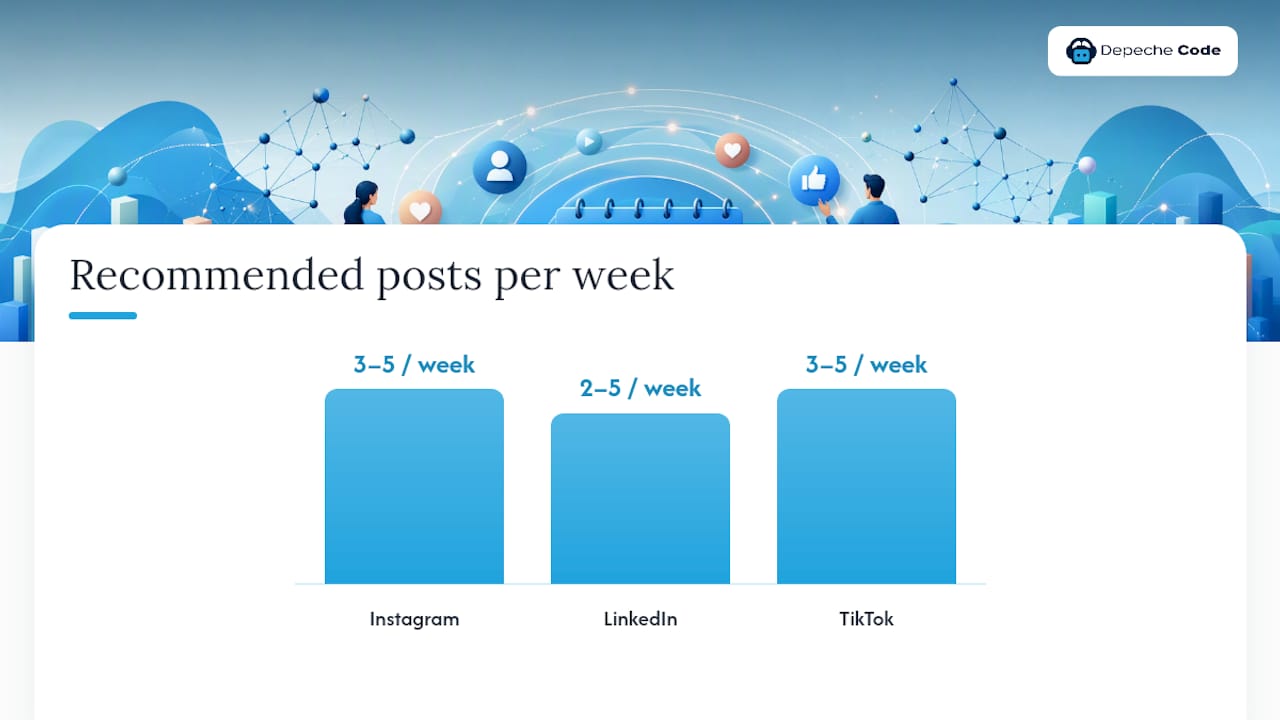
Post 3 to 5 times a week on Instagram and TikTok, 1 to 2 times a day on Facebook, 2 to 3 times a day on X, 2 to 5 times a week on LinkedIn, 1 to 3 times a day on Threads, once a week on Pinterest, and once a week to once a month on YouTube. Those are starting points, not laws. Run a 3 to 6 week test on your own audience and let reach, engagement rate, click-through rate, and profile views tell you whether to hold, raise, or cut your cadence.
TL;DR:
- Testing your own audience with a 3 to 6 week pilot is essential to determine optimal posting frequency rather than relying solely on industry benchmarks.
- Platforms like Instagram and TikTok perform best with three to five posts per week, focusing on native short-form content and quality over quantity.
- Posting more than once a day on LinkedIn or Facebook often leads to diminishing returns, while ephemeral formats like Stories allow for higher frequency without harming feed engagement.
- Tracking key KPIs such as reach, impressions, engagement rate, click-through rate, profile views, and conversions helps assess whether increased frequency is effective.
- Maintaining content quality through batching, repurposing, and a balanced content mix is critical when raising posting cadence to avoid audience fatigue.
Table of Contents
- How Often Should You Post on Social Media by Platform?
- How Do You Test to Find Your Ideal Posting Frequency?
- What Metrics Should You Track to Judge Post Frequency?
- How Do You Keep Content Quality High at a Higher Frequency?
- What’s the Best Way to Schedule and Manage Posting Cadence?
- How Depeche Code Approaches Posting Frequency for Clients
- Why Most Posting Frequency Advice Misses the Point
- Ready to Turn Cadence Into Consistent Growth?
- Sources
- FAQ
How Often Should You Post on Social Media by Platform?
There’s no single number that works across every platform, and treating “how often to post on social media” as one universal answer is the fastest way to waste a content calendar. Each platform rewards a different rhythm because each one handles distribution, post lifespan, and format differently. Below is a practical starting range for each major platform, based on current posting schedule benchmarks and how each algorithm actually treats frequency.
- Instagram: 3 to 5 feed posts per week, with Reels prioritized over static images. Stories can run daily since they live outside the main feed algorithm and don’t compete with grid posts for attention.
- Facebook: 1 to 2 posts per day is the sweet spot for pages with an active community. Facebook Stories and Groups content can run more often without hurting feed performance.
- X (formerly Twitter): 2 to 3 posts per day, sometimes more. Posts on X have a short shelf life, often just minutes of real visibility, so the platform tolerates a much higher cadence than Instagram or LinkedIn without triggering fatigue.
- LinkedIn: 2 to 5 posts per week for most brand pages. This is the platform where over-posting backfires fastest. LinkedIn’s algorithm spreads reach unevenly across a single organization’s posts, so daily corporate posting often just cannibalizes your own best content.
- TikTok: 3 to 5 videos per week, with 1 per day as an upper practical limit for most teams. TikTok rewards volume more than any other platform, but only when quality holds. A thin daily upload schedule underperforms a tighter 4 video-per-week schedule with better hooks.
- Threads: 1 to 3 original posts per day, plus active replies. Threads behaves more like a conversation feed than a broadcast one, so engagement through replies often matters as much as original posting frequency.
- Pinterest: Around 1 fresh Pin per week for most small businesses, though larger catalogs can post more. Pinterest content has an unusually long lifespan, some Pins keep generating traffic for months, so raw frequency matters less than keyword-rich descriptions and fresh imagery.
- YouTube: Posting about once a week is a common baseline for YouTube; less frequent posting may be suitable if videos are high quality and evergreen.
The format detail matters more than the raw post count. On Instagram and TikTok, short-form video generally outperforms static content in reach because the algorithm is actively trying to compete with pure short-video platforms. On Facebook, native video and Stories often get more distribution than link posts. On LinkedIn, document carousels and personal-voice text posts tend to beat polished graphics.
Two warnings worth flagging before you build a calendar around these numbers. First, LinkedIn and Instagram feed posts both suffer from diminishing returns when you post too close together: publish twice in one day on either platform and you’re often just splitting your own audience’s attention rather than growing it. Second, ephemeral formats change the math entirely. Instagram Stories, Facebook Stories, and Threads replies don’t compete with your feed posts for algorithmic real estate, so a business posting 4 times a week to the main feed can still run daily Stories without any frequency penalty.
How Do You Test to Find Your Ideal Posting Frequency?
Platform benchmarks are a starting hypothesis, not a verdict. The only way to know your real optimal post frequency strategy is to run a controlled pilot on your own audience, because engagement patterns vary by industry, follower size, and content quality far more than any generic benchmark accounts for.
- Pick one platform and set a hypothesis. Something specific: “Posting 5 times a week instead of 3 will raise Instagram reach by a meaningful margin without hurting engagement rate.”
- Timebox the test to 3 to 6 weeks. Shorter windows get skewed by algorithm noise; longer windows drift into seasonal changes that muddy the read.
- Control every other variable. Same content types, same posting windows, same caption style. Frequency should be the only thing changing.
- Test one platform at a time. Running simultaneous frequency changes across Instagram and LinkedIn at once makes it impossible to know which change caused which result.
- Collect leading indicators weekly (reach, impressions, early engagement) and deeper KPIs monthly (engagement rate trend, follower growth, conversions).
- Apply a decision rule. If engagement rate holds steady or climbs and reach grows, keep the higher frequency. If engagement rate drops more than it would from normal variance while reach stays flat, pull back.
A cleaner version of this test structure: pick a baseline cadence and a higher cadence, run each for roughly three weeks with identical content types and timing, then compare per-post engagement and conversions before deciding anything.
Pro Tip: Don’t judge a frequency change by your best-performing post. Average the whole test window, because one viral post in a low-frequency week can make three-times-a-week look better than it actually is.
What Metrics Should You Track to Judge Post Frequency?
Frequency decisions are only as good as the metrics behind them, and the core KPIs worth tracking are reach, impressions, engagement rate, click-through rate, saves and shares, profile views, follower growth, and conversions.
- Reach: Unique accounts that saw your content. This is your best early signal for whether raising frequency is actually expanding your audience.
- Impressions: Total views, including repeat views. A gap between rising impressions and flat reach usually means the algorithm is showing your existing followers more, not finding you new ones.
- Engagement rate: Likes, comments, shares, and saves divided by reach or followers. This is the number that tells you if quality is holding up as volume increases.
- Click-through rate: The share of viewers who click a link. Falling CTR alongside rising post count is a classic sign of content fatigue.
- Saves and shares: Often a stronger signal of content value than likes, since engagement quality matters more than raw volume for long-term growth.
- Profile views and follower growth: Track whether increased posting is converting attention into actual audience growth.
- Conversions: Website clicks, sign-ups, or sales tied back to social posts. This is the metric that ultimately justifies the resourcing.
A useful reporting rhythm to build here: weekly checks for anomalies, monthly reviews for content-type trends, and quarterly reviews for whether social is actually moving business results. Weekly is for catching a sudden reach drop before it snowballs. Monthly is for spotting which content format is quietly winning. Quarterly is for deciding if the whole strategy still makes sense.
Conflicting signals show up constantly, so read them as a pair, not in isolation. Higher reach with lower CTR usually means you’re reaching people outside your core audience. Higher engagement rate with flat follower growth often means your existing fans are happy but you’re not attracting anyone new.
How Do You Keep Content Quality High at a Higher Frequency?
Raising frequency without a content-mix plan is the single most common way brands burn out their own audience. A simple ratio worth adapting: roughly 4 parts value or educational content, 1 part curated or third-party content, and 1 part direct promotion for every 6 posts. The exact ratio matters less than having one at all, since consistency and relevance outperform raw volume almost every time.
- Batch production: Film or write a week’s worth of content in one sitting instead of scrambling daily. This alone is often what separates a sustainable 5-post-a-week cadence from a stressed, inconsistent one.
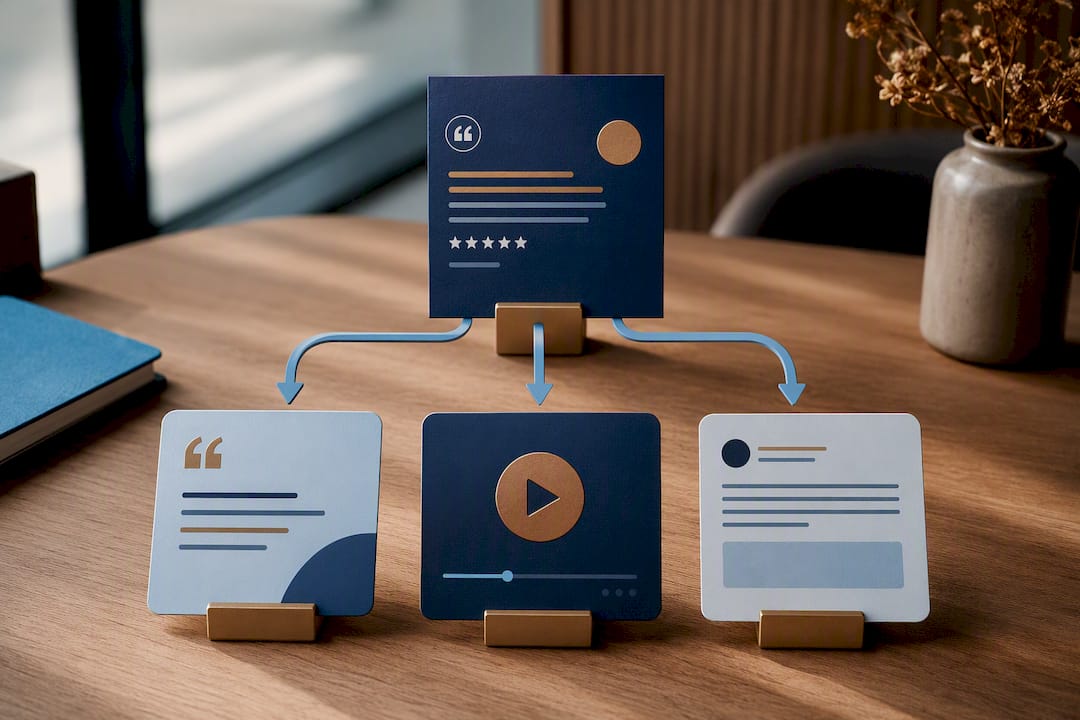
- Repurpose across formats: One long-form video can become 3 Reels, a LinkedIn carousel, and a Twitter thread. This is how lean teams hit platform-specific frequency targets without a proportional increase in production hours.
- Use micro-content: Behind-the-scenes clips, quick polls, and text-only updates fill gaps in the schedule without demanding full production value.
Scale frequency up when engagement rate is holding steady or climbing and your team has the bandwidth to sustain quality. Scale it down the moment engagement rate drops meaningfully or the content starts looking rushed, because a thin, inconsistent feed does more brand damage than a slower, sharper one.
Pro Tip: Build your content mix around what you already have. A single client testimonial can become a quote graphic, a video clip, and a caption story, three posts from one asset, without inventing new work.
What’s the Best Way to Schedule and Manage Posting Cadence?
Consistency depends less on inspiration and more on a workflow that doesn’t collapse the moment someone gets busy. A practical scheduling horizon: plan regular content 1 to 2 weeks ahead and map campaign content 4 to 6 weeks out. The shorter window keeps regular posts responsive to trends; the longer one gives campaigns time for proper creative and approval.
Clear roles prevent the most common breakdown in cadence: someone assumes someone else posted.
- Creator drafts the content and caption.
- Editor reviews for brand voice, accuracy, and format fit.
- Approver signs off, especially for anything client-facing or paid.
- Publisher schedules or posts at the confirmed time.
- Engager replies to comments and DMs within the first hour, which matters more for algorithmic reach than most teams realize.
A workable weekly loop looks like this: plan the week’s themes on Monday, batch-produce content Tuesday or Wednesday, schedule everything by Thursday, engage daily as posts go live, then report on performance the following Monday before planning starts again. This is a helpful content planning framework to build a calendar around if you’re setting this up for the first time.
How Depeche Code Approaches Posting Frequency for Clients
A top-rated agency treats every platform benchmark as a hypothesis to test, not a rule to follow blindly. The approach is to pilot a small change, usually a 3 to 6 week window on one platform, measure reach, engagement rate, and profile views against the client’s baseline, then scale whatever is actually working.
A common scenario for small businesses with limited internal bandwidth is a lighter, founder-managed posting cadence that then increases once a managed service handles the content, reaching platform-appropriate levels such as 3 to 5 posts per week on Instagram and TikTok, thanks to a dedicated team’s ability to manage batching and reporting efficiently.
Why Most Posting Frequency Advice Misses the Point
The conventional advice on posting frequency treats it as a volume problem: post more, grow faster. The research doesn’t actually support that. Consistency and content quality move the needle more reliably than raw post count, and a business posting 3 times a week with sharp, format-native content will usually outperform one posting daily with rushed, generic updates.
Where most guides fall short is stopping at the benchmark table. A range like “Instagram 3 to 5 times a week” is only useful once you’ve tested it against your own audience, because a B2B consulting firm and a skincare brand can hit wildly different engagement patterns at the exact same frequency. The number that matters isn’t the industry average. It’s what your own three-week pilot shows.
If you take one thing from this article, prioritize building the test before you build the calendar. Pick one platform, run the pilot described above, and let your own click-through rate and profile views decide your cadence, not a chart.
— Donovan Wells – Founder and CEO
Ready to Turn Cadence Into Consistent Growth?
Running a proper frequency pilot takes real hours: planning, batching, publishing on schedule, engaging fast, and reporting monthly. Depechecode’s Social Media plan is built for businesses that need a starter cadence in place without pulling a team member off their real job to manage it. For brands ready to scale past the pilot stage, Social Media Growth adds managed posting volume and performance reporting so frequency decisions are backed by real monthly data instead of guesswork. Businesses that want deeper analytics and content production support alongside their cadence can step up to Social Media Prime.
Hiring a managed service changes what you should expect from reporting too: instead of checking numbers when you remember to, you get scheduled weekly and monthly performance reviews tied directly to the KPIs this guide covers. If your website also needs work to support the traffic your social channels send it, Depechecode’s website design and development team can handle that side too. Reach out to Depechecode to scope a starter cadence built around your platforms and your budget.
Sources
- How to create a social media posting schedule | Hootsuite Blog
- Social media reporting best practices | Supermetrics Blog
FAQ
What Is the Best Frequency to Post on Social Media?
There’s no single best frequency across platforms; Instagram and TikTok work well at 3 to 5 posts a week, Facebook at 1 to 2 a day, and LinkedIn at 2 to 5 a week. Treat these as starting points and confirm them with a short test on your own audience.
What Is the 4-1-1 Rule in Social Media?
The 4-1-1 rule suggests posting 4 pieces of value or educational content, 1 curated or third-party piece, and 1 promotional post for every 6 updates. It’s a starting ratio to keep frequency from tipping into constant self-promotion, not a fixed requirement.
Is Posting 3 Times a Week Too Much?
No, 3 times a week is a reasonable baseline for most platforms, including Instagram and TikTok, and it’s within the range many businesses already use. Whether it’s “too much” depends entirely on whether your engagement rate holds steady at that pace during a test period.
How Long Should a Posting Frequency Test Run?
Run each frequency test for 3 to 6 weeks on one platform at a time, using the same content types and posting windows throughout. This gives enough data to separate a real trend from normal week-to-week noise.
How Often Should I Report on Social Media Performance?
Check for anomalies weekly, review content trends monthly, and assess overall strategy quarterly. This cadence keeps your frequency decisions grounded in fresh data instead of a single good or bad week.