

TL;DR:
- Custom website design offers tailored branding, functionality, and scalability for growth-oriented businesses.
- The development process includes discovery, planning, wireframing, design, development, testing, and launch phases.
- Investing in a custom site is ideal for competitive, brand-focused, and complex businesses seeking long-term digital assets.
Most business owners assume their competitors are using the same cookie-cutter website templates they are. That assumption is costing them customers. Custom website design is not just about aesthetics. It is a strategic decision that shapes how visitors perceive your brand, how search engines rank your pages, and how well your site converts browsers into buyers. If you have ever wondered why some websites feel instantly trustworthy while others feel generic, the answer almost always comes down to whether the site was built from scratch with your specific business goals in mind.
Table of Contents
- What is custom website design?
- Key features of custom website design
- The custom website design process explained
- Is custom website design right for your business?
- Custom website design: Our take on what really matters
- How Depeche Code can help you build the ideal custom website
- Frequently asked questions
Key Takeaways
| Point | Details |
|---|---|
| Custom vs. template | Custom design delivers unique branding and flexibility, unlike standard templates. |
| Key features | Expect mobile-first, SEO-friendly interfaces and a process tailored to your goals. |
| Who benefits | Growing, brand-focused, or complex businesses gain the most from custom websites. |
| Investment | Custom sites require more investment but offer greater long-term value and scalability. |
| Choosing a partner | Working with a strategic developer is key to leveraging all custom design advantages. |
What is custom website design?
Custom website design means building a website from the ground up, tailored specifically to your brand, audience, and business objectives. Unlike template-based sites that use pre-built layouts with limited flexibility, a custom site is designed and coded to match exactly what your business needs. Every element, from the navigation structure to the color palette and functionality, is intentional.
Template sites like those built on basic drag-and-drop builders are fast and cheap to launch. But they come with real limitations. You share design patterns with thousands of other businesses, you often cannot integrate specialized tools, and scaling becomes painful as your company grows. Custom website design offers unique branding and tailored user experiences that template sites simply cannot replicate.
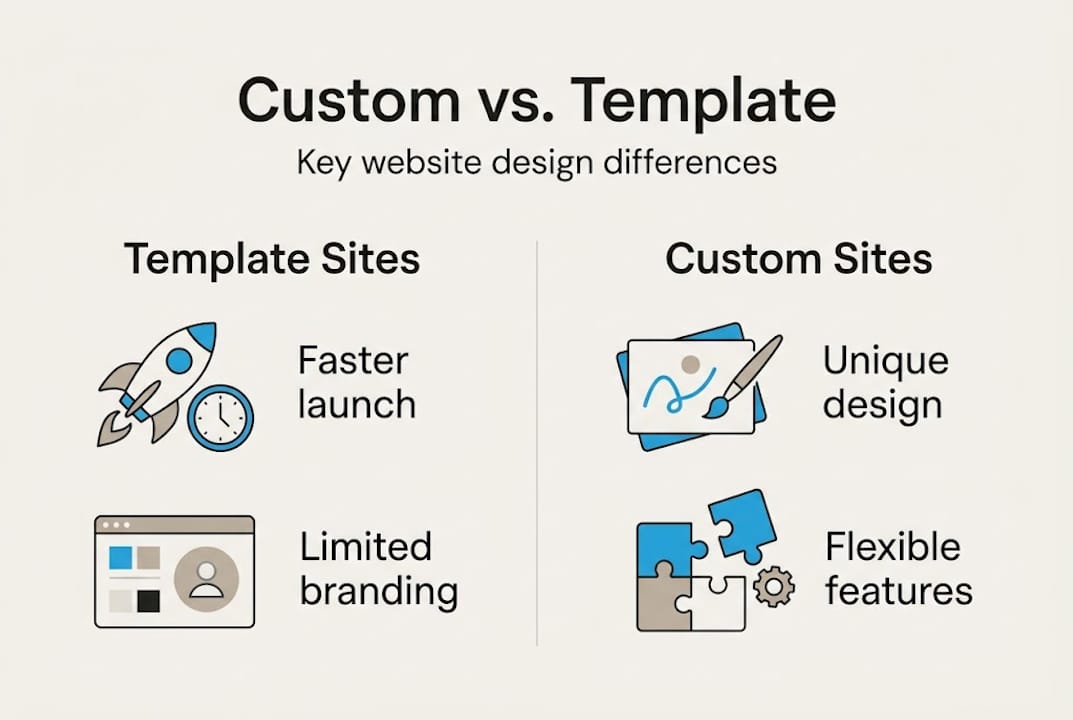
Here is a quick comparison to make this concrete:
| Feature | Template site | Custom website |
|---|---|---|
| Branding | Limited | Fully unique |
| Functionality | Pre-set options | Built to spec |
| Scalability | Often restricted | Designed to grow |
| SEO control | Moderate | Full control |
| Cost (upfront) | Low | Higher |
| Long-term value | Lower | Higher |
Businesses that invest in custom design typically fall into a few categories: those with complex service offerings, those competing in crowded markets, and those who understand that their website is their most important sales tool. A law firm, a healthcare provider, or a growing e-commerce brand cannot afford to look like everyone else.
The custom website design workflow at a quality agency starts with understanding your business before a single pixel is placed. That discovery-first approach is what separates a site that performs from one that just exists.
“First impressions happen in milliseconds online. If your site does not immediately communicate trust and relevance, visitors leave and rarely come back.”
The business benefits of website design go well beyond looks. A custom site is a revenue-generating asset when built correctly.

Key features of custom website design
Understanding what makes a website truly custom means knowing which features actually move the needle for your business. Not all custom sites are created equal, so here is what you should expect from a quality build.
Personalized branding. Your logo, fonts, color system, and visual language are woven into every page. Visitors instantly recognize your brand, not the platform you used to build the site.
Unique user interface (UI). The layout, navigation, and interactive elements are designed around how your specific audience thinks and behaves. This reduces friction and keeps people engaged longer.
Seamless integrations. Need a CRM, booking system, payment gateway, or AI chatbot? A custom site is built to connect with the tools your business actually uses, without clunky workarounds.
Future scalability. As your product line expands or your traffic grows, a custom site can be extended without rebuilding from scratch. This is a major advantage over template platforms that hit walls quickly.
Beyond features, the technical foundation matters enormously. Custom websites are optimized for performance and conversion, which means faster load times, cleaner code, and better search engine visibility right from launch.
Mobile-first design is not optional anymore. Over 60% of web traffic now comes from mobile devices, and Google ranks mobile performance as a core signal. A custom site is coded with mobile behavior in mind from day one, not retrofitted after the fact.
SEO-friendly coding is another area where custom sites shine. Template platforms often inject bloated code that slows your site and confuses search engines. Clean, purposeful code gives you a structural advantage before you even publish your first blog post.
Reviewing website redesign essentials can help you understand whether your current site is holding you back technically. The web development process matters as much as the final design.
Pro Tip: Build scalability into your requirements from day one. The features you need in year three are easier and cheaper to accommodate if your developer plans for them upfront.
The custom website design process explained
After seeing the vital features, the next question is: how is a custom site actually built? Knowing the process helps you ask better questions and set realistic expectations.
A thorough discovery phase ensures alignment with business goals before any design work begins. This is where your agency learns about your audience, competitors, and conversion targets.
Here is how a typical custom website project unfolds:
- Discovery. Define goals, audience personas, competitor landscape, and technical requirements.
- Planning. Create a sitemap, content strategy, and project timeline with clear milestones.
- Wireframing. Build low-fidelity layout blueprints to map user flows before visual design begins.
- Design. Apply branding, typography, and visual elements to the wireframes for client review.
- Development. Translate approved designs into clean, functional code with all integrations in place.
- Testing. Check performance, cross-browser compatibility, mobile responsiveness, and security.
- Launch. Deploy the site, configure analytics, and verify all systems are running correctly.
Each phase has a clear objective and deliverable:
| Phase | Objective | Deliverable |
|---|---|---|
| Discovery | Align on goals | Project brief |
| Planning | Map structure | Sitemap and timeline |
| Wireframing | Define layout | Wireframe mockups |
| Design | Visual execution | Approved design files |
| Development | Build functionality | Coded website |
| Testing | Verify quality | QA report |
| Launch | Go live | Live website |
Feedback loops between phases are critical. Projects that skip client reviews at key stages tend to drift from the original vision and require expensive rework. Communication is not overhead. It is part of the product.
If budget is a concern, exploring a free website development option can be a smart starting point. For businesses with specific goals around growth, investment planning for web design is worth discussing early.
Pro Tip: Insist on a structured review at the end of each phase. Approving wireframes before design begins saves you from costly revisions later.
Is custom website design right for your business?
Now that you know the process, how do you decide if it is the right move for your organization? The honest answer is that custom design is not the right choice for every business at every stage.
Custom website design tends to deliver the strongest results for:
- Growth-focused businesses that need their site to scale with new services, locations, or traffic volume.
- Brand-centric companies where visual identity and customer trust are core competitive advantages.
- Businesses with complex needs such as custom booking flows, member portals, or multi-step calculators.
- Companies in competitive markets where standing out visually and technically is a real differentiator.
- Organizations investing in SEO who need clean code and full technical control to rank effectively.
On the other hand, not every business needs a custom website. Weigh costs and needs carefully. A solo consultant just launching a personal brand, or a business testing a new market with minimal budget, may be better served starting with a solid template and upgrading later.
“The best website is the one that actually gets built and serves your customers. A custom site sitting in development limbo helps no one.”
There is also a middle path. Hybrid approaches, where a template platform is heavily customized with bespoke code and design elements, can offer meaningful differentiation at a lower cost. This is a smart entry point for businesses that are not yet ready for a full custom build.
Looking at examples from top web design firms or specialized verticals like custom law firm websites can help you benchmark what is possible in your industry.
Pro Tip: If you are uncertain whether custom is right for you, map out your three-year growth plan first. If your website needs to support that growth, custom is almost always the smarter investment.
Custom website design: Our take on what really matters
Here is what years of building websites for businesses across industries has taught us: custom design is not automatically better. It is better when it is paired with a clear strategy and ongoing optimization after launch.
Most guides will tell you custom always wins. The reality is more nuanced. We have seen beautifully designed custom sites underperform because the business never invested in SEO, content, or conversion rate optimization after launch. The design was excellent. The strategy was absent.
Unexpected costs and timeline extensions are real. Scope creep happens when goals are not locked down early. That is on both the client and the agency to manage.
The importance of professional design is not just about looking good. It is about building a platform that earns trust and drives action over time. The real ROI from custom design comes from treating your website as a living asset, not a one-time project. Regular updates, A/B testing, and performance monitoring are what separate sites that grow with your business from ones that stagnate.
How Depeche Code can help you build the ideal custom website
If you are ready to move beyond generic templates and build something that actually works for your business, Depeche Code is built for exactly that.
Our team specializes in custom website design and development that aligns with your brand, your audience, and your growth goals. We also offer a free website development option for qualifying businesses, so getting started does not have to mean a massive upfront investment. Every site we build is paired with our SEO services to ensure your new site gets found. Reach out today for a custom consultation and let us show you what a purpose-built website can do for your business.
Frequently asked questions
How long does custom website design typically take?
A custom website can range from several weeks to months based on requirements, but most projects complete within 8 to 16 weeks depending on complexity and how quickly feedback is provided.
How much does custom website design cost compared to a template site?
Custom sites cost more upfront than template sites, but they deliver better long-term value through stronger branding, scalability, and strategic alignment with your business goals.
Is a custom website harder to maintain?
Solid web development ensures easier future updates, and with the right development partner, maintaining a custom site can be just as streamlined as managing a template-based one.
Can I add new features easily to a custom website?
Yes. Custom sites allow for future growth and features, meaning new functionality can be added without rebuilding the entire site from scratch.