
// Creative Agency
AEO vs SEO: What Differs and How to Win Both in 2026

SEO gets your pages ranked in search results so people click through to your site. AEO (answer engine optimization) gets your business named or cited inside the answers that AI tools write. For a business owner the practical answer is that you do not choose between them. The two share most of their foundation, so one well-run program should earn you both rankings and AI citations. That is how we plan it at Depeche Code, and our Organic, Local and Combo SEO/AEO plans are built around it.
TL;DR
- SEO ranks pages; AEO earns mentions. SEO aims at positions and clicks. AEO aims at being quoted or recommended in AI answers, sometimes with no click at all.
- They overlap heavily. Google says optimizing for its generative AI features is still SEO, and an analyst firm calls AEO significantly but not fundamentally different.
- Content shape is the main practical change. Clear, direct answers to real customer questions, backed by solid technical SEO, serve both.
- Measure both. Keep rankings, traffic and conversions, and add AI citations, brand mentions and AI referrals.
- Skip the shortcuts. Mass-producing pages for every question variation can violate Google’s spam policies.
Table of Contents
- What each term means
- The core differences, side by side
- Is AEO part of SEO, and will it replace it?
- What actually helps you get cited
- AEO for local businesses
- How to measure AEO next to SEO
- Which should you prioritize?
- Choosing an AEO or SEO provider
- Our approach
- Put one program behind both
- FAQ
- Sources
What each term means
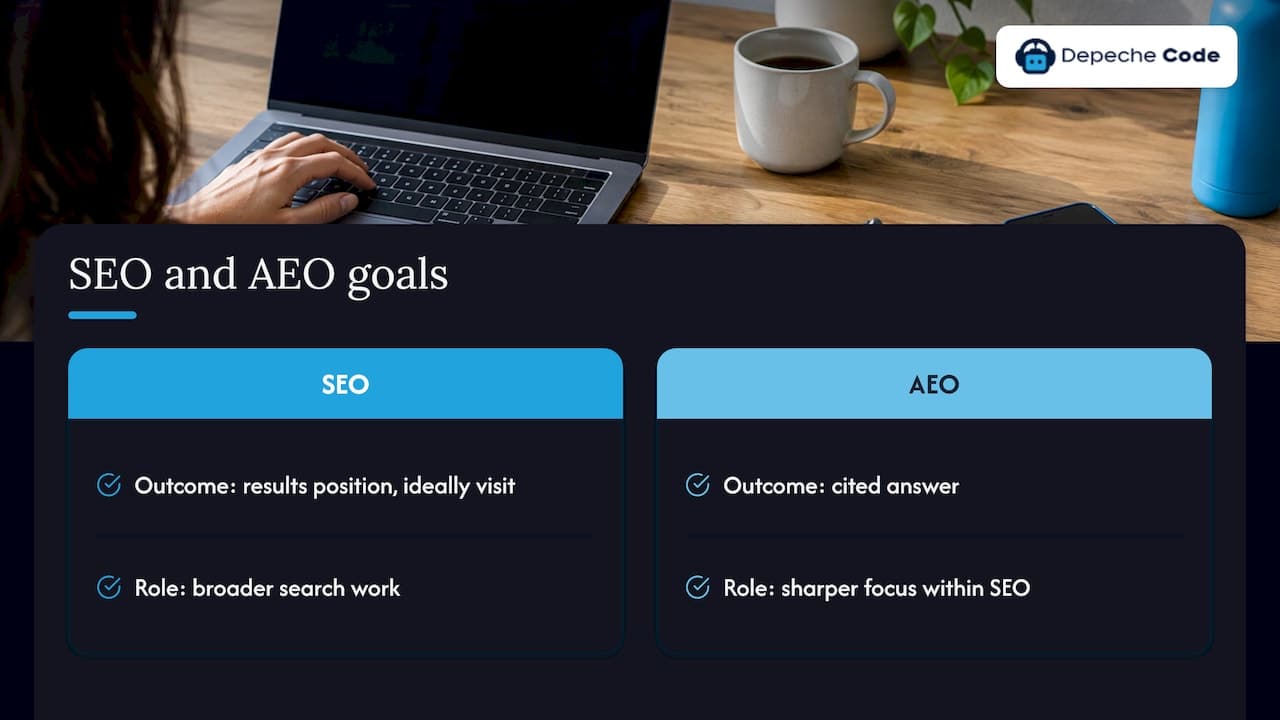
SEO (search engine optimization) is the work of making your website easy for search engines to find, understand and rank: technical health, useful content, links from other sites and a good experience on the page. The payoff is a position in the results list and, ideally, a visit. If you want the full background, our business guide to SEO covers it from the start.
AEO (answer engine optimization) is the work of making your business the source an answer engine uses. Answer engines are tools such as Google’s AI Overviews and AI Mode, ChatGPT and other assistants that respond to a question with a written answer instead of a list of links. You will also see the term GEO (generative engine optimization) for nearly the same thing. Google’s own guidance defines AEO and GEO as terms for work seeking visibility in AI search, and then adds an important point: Google treats optimizing for its generative AI features as part of SEO.
That sentence explains most of the confusion. AEO is not a rival discipline with its own secret rulebook. It is a sharper focus on one outcome, being the cited answer, within a search landscape that now includes AI.
The core differences, side by side
The differences are real, but they are mostly about the goal, the shape of the content and the way you report results.
| SEO | AEO | |
|---|---|---|
| Main goal | Rank pages and earn clicks | Be cited or mentioned in AI-written answers |
| Unit of work | The whole page | The specific answer inside the page |
| Content style | Comprehensive pages with topical depth | Direct, self-contained answers placed early, inside deeper pages |
| Where results appear | Search results lists | AI Overviews, AI Mode, chat assistants, voice answers |
| What you report | Rankings, impressions, clicks, traffic, conversions | Citations, mentions, answer visibility, AI referrals, plus the same conversions |
| Click behavior | Visit is the goal | Visit may never happen; influence shows up later as branded search or a direct inquiry |
A Forrester report from November 2025 puts it well: AEO is significantly, but not fundamentally, different from SEO, and both need content and technical work, customer understanding and cooperation across teams. In plain terms, if your SEO is weak, AEO will not rescue it, and if your SEO is strong, you already own most of what AEO needs.
Is AEO part of SEO, and will it replace it?
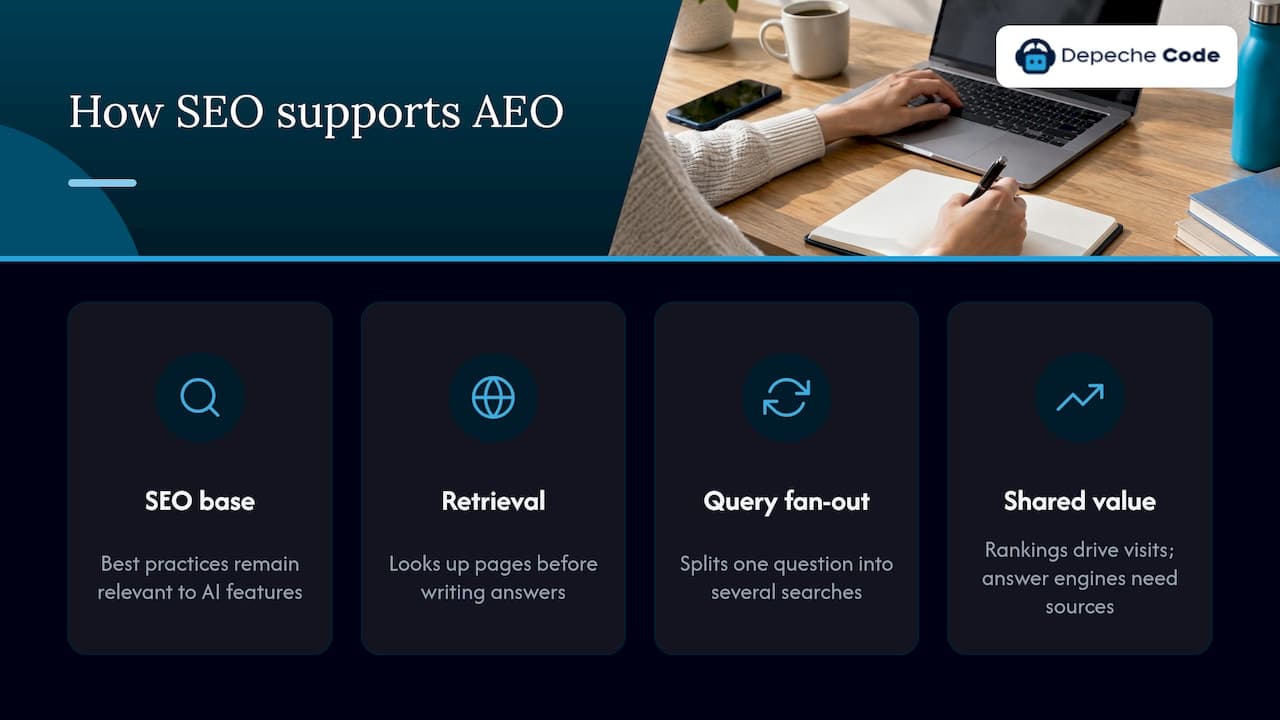
Google’s guidance says SEO best practices remain relevant for its generative AI features. It also states that AI Overviews and AI Mode draw on the core Search ranking and quality systems, including techniques such as retrieval-augmented generation (the AI looks up pages first, then writes the answer from them) and query fan-out (it splits a question into several searches behind the scenes).
For you, that means the pages the AI looks up are the ones Google already finds, understands and trusts. A site that is slow, thin or hard to crawl is a poor candidate to be looked up in the first place.
As for replacement, no. Rankings still drive visits, and answer engines still need sources to draw from. What has changed is that a growing share of the customer journey now ends, or at least begins, in an answer box. That is why we treat AEO as an extension of a solid SEO program rather than a separate purchase. Our own piece on why SEO matters for business growth in 2026 lays out the case for the foundation.
What actually helps you get cited
There is no switch to flip, but a few habits consistently serve both goals.
Answer the question first
When a customer asks “how much does a kitchen remodel cost in Orlando?” or “how long does a website redesign take?”, an AI tool wants a clear passage it can lift. Put a short, direct answer under a heading that matches the question, then add the detail, the exceptions and the examples. People skim, and so do machines.
Write for real customer questions
Start from the questions your sales team hears, the ones in your inbox and the ones people type into search. Each one deserves an honest, specific answer on your site: price ranges you can stand behind, timelines, what is included, who it is for. Vague marketing copy is the least quotable content there is.
Keep the technical foundation clean
Fast pages, a logical structure, mobile-friendly layouts, working internal links and structured data that accurately describes your business all help machines read your site. If an answer engine cannot fetch or parse a page, it cannot cite it. This is the unglamorous part, and it is also where most sites lose ground. Our AI search optimization playbook walks through the practical steps, and our guide to optimizing for AI Overviews goes deeper on Google’s version.
Build credibility that exists beyond your own site
Answer engines favor sources that look trustworthy and that other sources agree with. Consistent business details across your site and profiles, genuine reviews, mentions in industry publications and clear expertise on your pages all contribute. This is classic SEO and reputation work, and it is exactly what AEO inherits.
Do not manufacture pages
It is tempting to publish hundreds of near-duplicate pages, one per phrasing of a question. Google’s guidance warns that creating many pages for query variations to manipulate search or AI visibility violates its scaled-content-abuse policy and is not a reliable quality strategy. One excellent page per topic, with the questions answered inside it, is safer and stronger.
AEO for local businesses
A local business has a particular advantage. Many questions put to AI tools are local in intent: “best HVAC company near me,” “which dentist in Winter Park takes new patients.” The answer depends on whether the AI can confirm who you are, where you work, what you do and what customers say about you.
That makes the local basics more valuable, not less: a complete and accurate business profile, consistent name, address and phone details everywhere, service pages for each area you cover, and a steady flow of real reviews. Layer on pages that answer the questions locals ask, and you give both Google and AI assistants something concrete to cite. Our Local SEO/AEO plans are designed for this combination.
How to measure AEO next to SEO
This is where businesses most often stumble, because AEO results do not always arrive as clicks. The practical approach is to keep your existing SEO measures and add a small set of AI measures beside them.
Keep: organic traffic, keyword rankings, click-through rate, conversions such as calls and form submissions.
Add:
- How often your brand is mentioned or cited for a fixed list of buyer questions you track over time
- Which of your pages get cited
- Where in the answer you appear and how you are described
- Visits that arrive from AI tools, as a separate segment in your analytics
- Branded search and direct inquiries, which often rise when people meet your name in an answer first
Search Engine Land’s zero-click measurement guide recommends tracking brand mentions in AI results through measures such as the number of prompts that mention you, the citations, how prominent you are, sentiment and your share of voice, alongside traditional search presence.
The tooling is also catching up. A November 2026 report says Google Search Console now shows impressions in generative AI features, AI Overviews and AI Mode, by page, country and device, while Bing Webmaster Tools shows citations and cited pages. That lets you view AI visibility next to your regular search data in tools you may already use.
Two habits keep the numbers honest. First, look at trends over weeks, not days, since AI answers shift with wording and freshness. Second, tie everything back to leads and revenue. A mention that never leads to an inquiry is a vanity metric, and a quiet month of clicks can hide a growing number of customers who found you through an answer.
Which should you prioritize?
Use your situation to decide where the first effort goes.
- Your site is slow, outdated or hard to navigate. Fix that first. A redesign built with search in mind improves both rankings and how readable you are to AI. Our website redesign checklist shows how to protect existing rankings while you do it.
- Your site is healthy but your content is thin. Build pages that answer your customers’ real questions directly. This is the highest-leverage AEO move and it helps SEO at the same time.
- You rank well but see fewer clicks. AI answers may be absorbing some of those searches. Make sure your best pages hold the clearest answer, and start tracking citations and branded search.
- You are a local service business. Lead with your profile, reviews, location pages and question-led content.
In every case the answer is a hybrid. The order changes; the combination does not.
Choosing an AEO or SEO provider
When you compare agencies, look past the acronym. Useful questions:
- Does the plan include technical SEO and content, or only “AI visibility” reporting? Answer engines draw on the same fundamentals as search.
- Will you receive clear reporting that combines rankings, traffic, conversions and AI mentions?
- Do you own your website, content and accounts? Ownership should be transparent.
- Is the team realistic about timelines? Both SEO and AEO build over months, and no provider controls what an AI tool says.
- Can they also handle the website itself, hosting and maintenance, so speed and structure issues are fixed instead of merely reported?
We built our offer around those questions. Our positioning is faster delivery through in-house directed AI, transparent ownership of every deliverable and technical performance measured by Google PageSpeed and SEO scores.
Our approach
Most of the businesses we talk to arrive asking whether they need to “switch” from SEO to AEO. We tell them the same thing: you are building one visibility program, and answers are now one of the places it shows up.
The work that gets you cited is work you should want anyway: a fast, well-structured website, pages that answer customer questions plainly, accurate local information and a reputation that is easy to verify. When those are in place, search engines rank you and AI tools have good reasons to quote you.
That is why we offer Organic, Local and Combo SEO/AEO plans instead of treating AI visibility as a separate product. We also run the website side, including design, redesign, WordPress hosting and maintenance, so technical issues get fixed in the same place the strategy is set. Our goal is a program you can measure in leads, with every deliverable owned by you.
Donovan Wells - Founder and CEO
Put one program behind both
If you want rankings and AI citations without running two projects, our team builds the website, the content and the search plan together. Our SEO/AEO plans come in Organic, Local and Combo versions, with prices quoted for your business, and we pair them with WordPress hosting and maintenance when the site needs ongoing care.
See how the plans work on our search engine optimization page, or look at everything we do on the services overview. For more reading on where search is heading, our 2026 SEO trends article is a good next step.
FAQ
Is AEO the same as SEO?
Not exactly, but they are closely linked. SEO aims to rank your pages and earn clicks, while AEO aims to get your business cited in AI-written answers. Google’s guidance treats optimization for its generative AI features as part of SEO, so most of the work overlaps.
Will AEO replace SEO?
No. AI tools look up pages before they write an answer, and Google’s AI features use its core ranking and quality systems. Strong SEO is what makes your pages worth looking up, so it stays the foundation.
How do I get my business cited by ChatGPT and other AI tools?
Publish clear, specific answers to the questions customers ask, keep your site fast and easy to crawl, and make your business details and reviews consistent and credible across the web. No one can guarantee a citation, so track a fixed list of buyer questions over time and watch the trend.
How do I know if AEO is working?
Track brand mentions and citations for your key questions, AI referral traffic, branded search and inquiries, next to your usual rankings and conversions. Look at weeks or months of data, because AI answers vary with wording and freshness.
Do local businesses need AEO?
Yes, because many AI questions are local. An accurate business profile, consistent contact details, location pages and genuine reviews give answer engines the facts they need to recommend you.
Sources
- Google Search Central: Optimizing for generative AI features
- Forrester: Best Practices For Answer Engine Optimization (AEO)
- Search Engine Land: Measuring zero-click search
- Search Engine Land: Introducing SEO+ reporting