
// Creative Agency
Local Citations SEO: A 2026 Guide to Building Them Right

A local citation is any online mention of your business’s name, address and phone number, usually shortened to NAP. For local SEO, the job is to make sure every place that lists your business tells the same, correct story. If you run a business that depends on customers finding you nearby, accurate citations are cheap insurance. They keep customers from driving to the wrong address, and they give Google consistent evidence that you are a real, established business. Getting them right takes an audit, a priority order and steady upkeep, and that is the kind of work our local SEO team handles for clients.
TL;DR
- A citation is a mention of your NAP (name, address, phone) on a third-party site, either in a structured directory listing or in an unstructured mention such as a news article or blog post.
- Consistency matters more than volume: the same business name, suite number, phone number and website everywhere.
- Start with the platforms that control the most visibility (Google, Apple, Bing, Yelp), then move to industry and local directories.
- Citations and backlinks overlap but are not the same thing: a citation is a business mention, a backlink is a link that passes authority to a page.
- Treat citations as a foundation of a local SEO plan, not the whole plan.
Table of Contents
- What local citations are and what they contain
- Why citations still matter for local SEO
- Citations vs. backlinks
- How to build accurate local citations, step by step
- How many citations do you need?
- Common mistakes to avoid
- Where citations fit in a local SEO plan
- Let us take the citation work off your plate
- Our perspective
- FAQ
- Sources
What local citations are and what they contain
Think of a citation as a reference to your business on a site you do not own. Search Engine Land’s guide splits them into two kinds. Structured citations are standardized directory listings that generally include NAP and may add a website, hours or a business category. Unstructured citations are mentions in places such as local news stories, blog roundups, sponsor pages and press releases, where your details are not in a formal listing.
Most of the work you control is structured. Google Business Profile, Yelp, Apple Business Connect, YP.com and TripAdvisor, for example, let you create a free listing, verify that you own it and manage it over time. Unstructured mentions are earned: a local reporter covers your grand opening, a charity lists you as a sponsor, a neighborhood blogger recommends you.
A complete listing usually carries more than NAP:
- Business category and description
- Website URL
- Hours of operation
- Photos
- Social profiles
- Payment methods accepted
The more complete and identical these fields are across sites, the less room there is for confusion.
Why citations still matter for local SEO
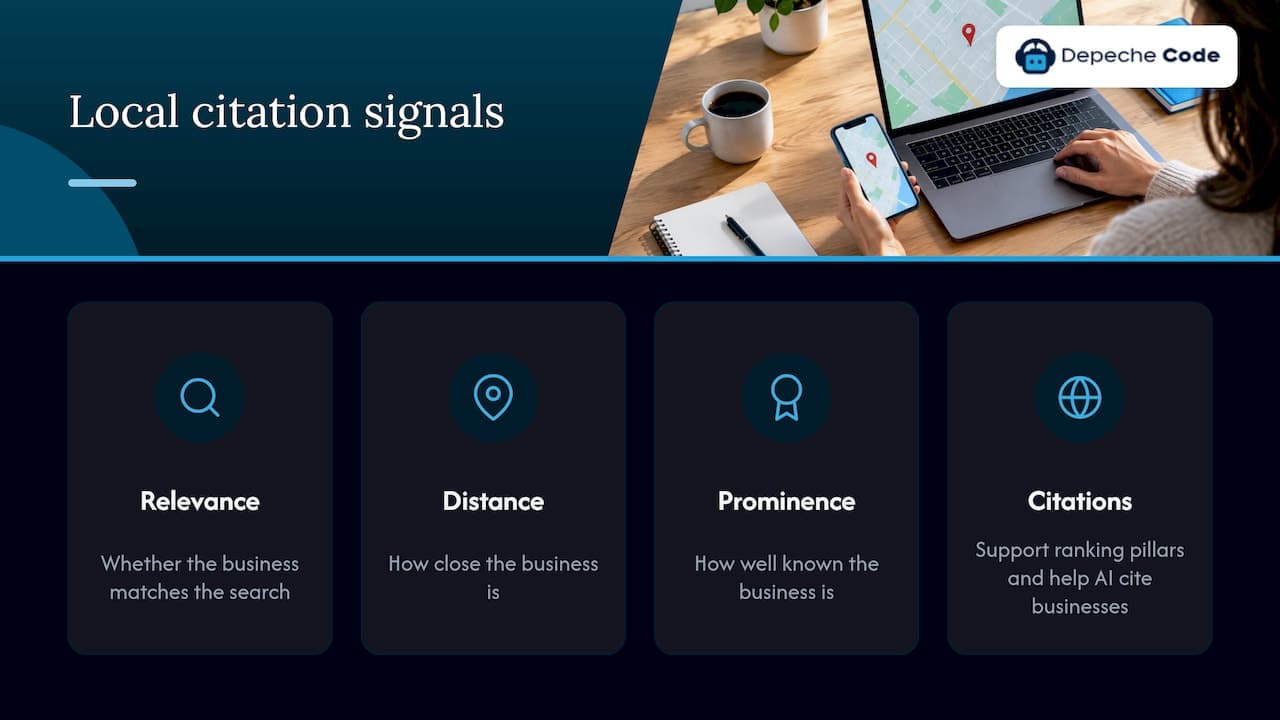
Google’s local results lean on three ideas: relevance (does your business match the search), distance (how close it is) and prominence (how well known it is). Search Engine Land explains that citations support those three pillars, and that they also help businesses get picked up and cited by AI applications such as ChatGPT. That second point is new and worth noting: AI assistants answering “best plumber near me” draw on information found across the web, so consistent business data gives them something dependable to repeat.
It is fair to be precise about how much weight citations carry. The same guide says NAP consistency was once treated as a top local pack ranking factor, and that many local SEOs now see Google as less dependent on third-party platforms. It remains important for a trustworthy customer experience. A local SEO panelist in a Search Engine Land roundup went further and called citation accuracy a form of customer service, pointing to negative reviews from people who drove to a closed location because the listed hours were wrong.
That framing is the practical one. A citation is a business asset: it sends real people to the right door at the right time, and it lines up the signals Google uses to decide you are legitimate.
A quick example
Imagine a dental practice in Orlando that moved from Suite 200 to Suite 310 two years ago. Google Business Profile says 310. Yelp says 200. An old chamber of commerce page lists the former phone number. A patient who finds the Yelp listing walks into the wrong office, and Google sees three versions of the same practice. None of that is dramatic, but it quietly costs appointments and weakens trust. Fixing it is a few hours of work, once, plus a habit of checking.
Citations vs. backlinks
People confuse these because many citations include a link. The difference is purpose:
| Local citation | Backlink | |
|---|---|---|
| What it is | A mention of your business details (NAP, often more) | A link from another site to a page on yours |
| Main job | Confirms who you are, where you are and how to reach you | Passes authority and sends referral traffic |
| Needs a link? | No, an unlinked mention still counts | Always |
| Typical sources | Directories, listings, local mentions | Editorial articles, partners, local organizations |
| Where the effort goes | Accuracy and consistency | Relevance and quality |
Building citations often produces links as a side effect, so the two work together. But a directory listing with your website attached is not the same as an editorial link from a respected local publication. If you want to go deeper on the link side, our guide to local link building tactics covers the approaches that suit local businesses.
How to build accurate local citations, step by step
The sequence matters. Working top-down means each correction sits on the most influential platforms first, so you are not repairing minor sites that will be overwritten later.
Step 1: Write down your master NAP record
Decide, in one document, exactly how your business is presented:
- Legal or operating name, spelled exactly as customers see it on your sign and website
- Street address with suite or unit number, formatted one way (“Suite” or “Ste.”, never both)
- One primary local phone number
- Website URL, with or without “www” and “https” chosen once
- Hours, categories and a short business description
Use a real local number, not a call-tracking number, as your primary. Tracking numbers are a common source of mismatches, so list them only as secondary numbers where a platform allows. Every future listing copies from this record. This is the step most businesses skip, and it is the reason their data drifts.
Step 2: Audit what already exists
You almost certainly have citations you never created. Data aggregators and directories collect business information automatically, and previous addresses, old phone numbers and prior owners leave traces.
Search Google for your business name in quotes, your phone number in quotes and your street address in quotes. Search the old versions too: a previous phone number or former address is usually where the stale listings hide. Record each result in a spreadsheet with the site, the URL, what it shows and whether it is correct.
Watch for the usual inconsistencies:
- Name variants (“Smith & Co” vs. “Smith and Company”)
- Missing suite numbers
- Typos in street names
- An outdated phone number
- A wrong website URL
- Duplicate listings for the same location
Step 3: Fix the major platforms first
Claim and complete these in order of visibility:
- Google Business Profile, the listing that feeds Google Search and Maps. Keep it active with fresh content: see our piece on Google Business Profile posts for a simple weekly routine.
- Apple Business Connect, which supplies business information to Apple Maps.
- Bing Places, which covers Microsoft’s search and maps results.
- Yelp, which ranks well in local searches for many categories.
- Facebook, plus any other social profile you actually use.
Verify ownership on each so that you, not a stranger, control edits.
Step 4: Handle the data aggregators
Behind many smaller directories sit companies that collect business records and distribute them downstream. Correcting a small directory alone can be undone at the next data refresh, because the aggregator pushes the old record back in. Fixing the source record is what makes corrections stick. After the major platforms, check the main U.S. data suppliers and submit your master record to them.
Step 5: Add industry and local directories
The best additional citations are the ones your customers actually use. Think about the sites that rank for your category in your city:
- Industry directories: legal, medical, home services, restaurants, automotive and similar categories each have their own
- Your local chamber of commerce and city or neighborhood business associations
- The Better Business Bureau
- Local news sites, event pages and sponsor lists
To find them, search the way a customer would, for example “Orlando roofing contractor”, and note which directories appear on page one. Those are the citations worth having for that market. Skip generic directories that exist only to sell listings and that no customer would visit.
Step 6: Deal with duplicates carefully
When a second listing exists for your location, do not simply abandon it. Claim it where possible and ask the platform to merge or remove it through its own process. Duplicates split your reviews and your data, and they confuse the systems that read them. Work from the most visible platform downward, and keep a log of every request.
Step 7: Earn unstructured mentions
Once your listings are consistent, look for mentions that people notice. Sponsor a local youth team, speak at a chamber event, offer a quote to a regional publication, join a local business roundup. These cost time rather than fees, and they tie your name to your area. Make sure your website shows your NAP exactly as your master record does, ideally in the footer and on a contact page, so that every mention matches the source.
Step 8: Recheck on a schedule
Citations decay. A move, a new number, new hours or a rebrand all create fresh mismatches. Set a calendar reminder to repeat the quoted-search audit at least twice a year, and any time your business details change. When something changes, update the master record first, then the platforms in the same order as above.
How many citations do you need?
There is no magic number. WordStream’s guidance, in a 2026 update on local citations, is that businesses in low-competition categories with limited resources can stick to the core listings, while businesses in crowded markets should build steadily and measure the effect on Maps and organic rankings. A single-location plumber in a small town may be well served by twenty accurate listings. A multi-location clinic competing in a large metro needs a broader footprint and a more regular review process.
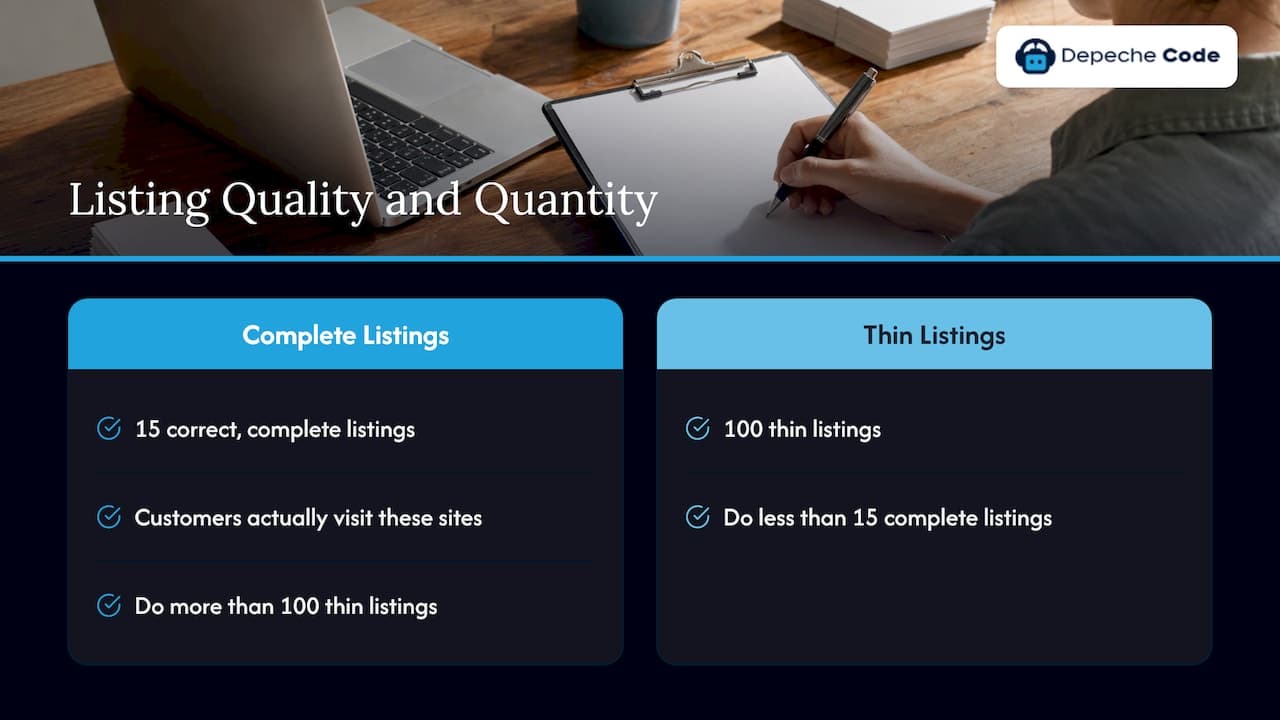
Quality beats quantity. Fifteen correct, complete listings on sites that customers actually visit do more than a hundred thin ones.
Common mistakes to avoid
- Using different names in different places. Adding a keyword or a tagline to your business name on one directory creates a mismatch and can break platform rules.
- Listing a tracking number as the primary phone. Use your real local line.
- Leaving old locations live. A closed or moved address should be updated or marked accordingly.
- Paying for dozens of low-quality listings. Volume without relevance adds maintenance and little else.
- Never checking again. One cleanup does not stay clean on its own.
Where citations fit in a local SEO plan
Citations lay the groundwork. Alongside them, a local business needs a website that clearly states its services and service area, reviews that are collected and answered, a Google Business Profile that stays current, and links from local sources. Our SEO best practices checklist shows how those pieces fit together, and if you are weighing who should run the work, our guide to hiring a local SEO firm lays out what to look for.
Let us take the citation work off your plate
Auditing dozens of listings, chasing duplicates and rechecking them every few months is steady, detail-heavy work that is easy to put off. Depeche Code is a digital agency based in Orlando, and we offer Local SEO/AEO plans as well as Organic and Combo plans, alongside website design and WordPress hosting and maintenance, so your site and your local presence can be handled by one team. Pricing for the SEO plans is not published, so the best way to see what fits is to look at our search engine optimization services and get in touch.

Our perspective
We think of citations as housekeeping with real consequences. A customer who finds the wrong phone number or hours does not blame a directory, they blame your business. That is why we start local SEO work with the basics: one master record for your name, address and phone, accurate listings on the platforms people actually use, and a website that says the same thing.
Local search is also changing. AI assistants now answer questions about nearby businesses, and they rely on the information scattered across the web. Our SEO plans cover both traditional search and answer-engine visibility (AEO), which is why we pair consistent business data with clear website content and ongoing optimization.
Our approach is to make the work transparent: you own the deliverables, and your site’s performance is measured with tools such as Google PageSpeed and SEO scores. For a business owner, the value is simple. You get a local presence that is accurate and maintained, and you spend your time running the business.
Donovan Wells - Founder and CEO
FAQ
What are local citations in SEO?
They are online mentions of your business’s name, address and phone number on sites you do not own. Structured citations appear in directory listings, while unstructured ones appear in articles, blog posts and sponsor pages. Both help people and search engines confirm who you are and where to find you.
Do local citations still help rankings?
They support Google’s relevance, distance and prominence signals, and they help build the consistent business data that AI tools draw on. Many local SEOs now treat them less as a headline ranking factor and more as a trust and customer-experience foundation, which is still a strong reason to keep them accurate.
Are citations the same as backlinks?
No. A citation is a mention of your business details, and it may or may not include a link. A backlink is a link to your site that passes authority. Building good citations often brings some links along with it, but the two goals are different.
How do I find citations that are wrong?
Search Google for your business name, phone number and street address, each in quotes, and include old numbers and addresses. Log every listing in a spreadsheet, note what is wrong, and fix the major platforms first, then the data aggregators, then smaller directories.
Sources
- Structured vs Unstructured Citations for Local SEO, Search Engine Land
- Do local citations matter anymore? Five local SEOs sound off, Search Engine Land
- How to Build Local Citations & Boost Your Visibility Online, WordStream