

TL;DR:
- SEO remains the most effective long-term channel, driving 53% of website traffic.
- Google’s focus is now on content quality, authenticity, and expertise, not just keywords.
- Consistent SEO efforts, local niche targeting, and proper monitoring build lasting authority.
You’ve invested time and money into your website, yet the traffic numbers barely move. Sound familiar? Most business websites sit in digital obscurity, not because they lack quality products or services, but because they’re missing the right SEO foundation. Organic search drives 53% of all website traffic, making it the single largest channel available to your business. This guide cuts through the noise and gives you a structured, actionable path to building SEO that generates real, measurable results, even as search engines and AI continue to reshape the landscape.
Table of Contents
- Understanding SEO in 2026: What’s changed and why it matters
- SEO essentials: Tools, resources, and first steps
- Step-by-step: Building and optimizing your SEO strategy
- Tracking success: Monitoring, troubleshooting, and adapting your SEO
- Our take: The truth most guides won’t tell you about SEO in 2026
- Ready to scale your SEO results?
- Frequently asked questions
Key Takeaways
| Point | Details |
|---|---|
| SEO foundations matter | Modern SEO requires strong basics like quality content, keyword research, and proper site structure. |
| AI complements great SEO | Original and effective SEO boosts visibility in both traditional and AI-driven search. |
| Quality outlasts quick wins | Avoid shortcuts and invest in proven strategies for sustainable, long-term results. |
| Track and adapt consistently | Regularly track SEO metrics and update strategies to stay ahead of algorithm changes. |
Understanding SEO in 2026: What’s changed and why it matters
SEO has never been static, but the pace of change has accelerated sharply. Google’s recent algorithm updates, combined with the rise of AI-generated content, have forced a hard reset on tactics that worked just a few years ago. The good news? The fundamentals that always mattered now matter even more.
Google’s focus has shifted decisively toward content quality, authenticity, and demonstrated expertise. The E-E-A-T framework (Experience, Expertise, Authoritativeness, and Trustworthiness) is no longer optional. It’s the filter through which your content gets evaluated. Sites that built their authority on thin, keyword-stuffed pages are losing ground fast.
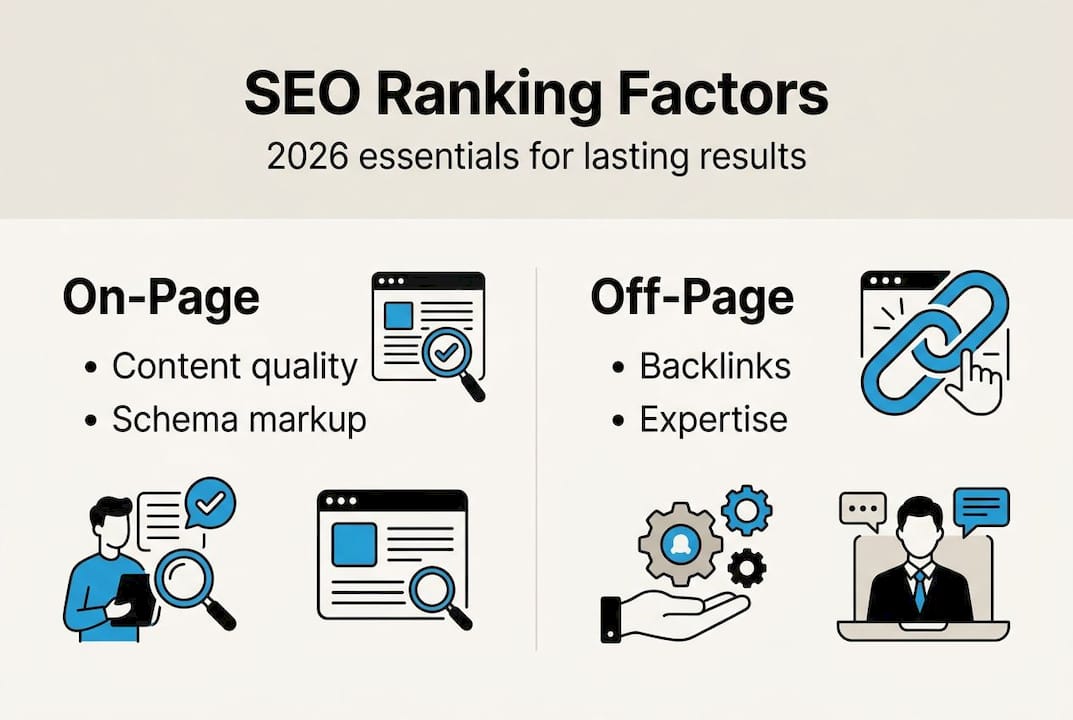
You’ve probably heard terms like Generative Engine Optimization (GEO) and Answer Engine Optimization (AEO) thrown around. As one SEO expert reflects on SEO and AI search, most of these so-called new disciplines are rebranded versions of SEO fundamentals. Schema markup, long-tail keyword targeting, quality backlinks, and structured content have always been the engine. The labels just changed.
For small and medium businesses, this is actually good news. You don’t need to chase every new trend. You need a solid foundation. And SEO delivers rankings and traffic with a high effect size when applied consistently, meaning the effort compounds over time.
Here’s a snapshot of why SEO still dominates as a growth channel:
| Channel | Average traffic share | Long-term ROI |
|---|---|---|
| Organic search | 53% | Very high |
| Paid search | 15% | Medium |
| Social media | 5% | Low to medium |
| Direct | 22% | N/A |
Small businesses also hold a structural advantage: local and niche SEO. Competing nationally against enterprise brands is hard. Competing in your city or your specific service niche? That’s very winnable. Local intent searches convert at high rates, and Google continues to prioritize proximity and relevance for local queries.
Key reasons SEO still dominates in 2026:
- Organic traffic is free at the click level, unlike paid ads
- Top-ranking pages build authority that compounds over years
- Local SEO gives small businesses a real edge over national competitors
- AI-powered search still pulls from indexed, well-structured web content
- Strong SEO plans reduce dependence on paid acquisition budgets
Understanding the long-term ROI of SEO investment is what separates businesses that treat SEO as an expense from those that treat it as an asset.
SEO essentials: Tools, resources, and first steps
Now that you know why SEO matters, let’s make sure you have the essentials in place. Before you can improve your rankings, you need visibility into your current performance. Most businesses skip this step and jump straight to content creation, which is like repainting a house with a cracked foundation.
Start with these baseline assets. Every site needs them before any optimization makes sense:
- Google Search Console: Shows which queries bring you traffic, which pages rank, and where technical errors exist
- Google Analytics 4: Tracks user behavior, conversions, and traffic sources
- Keyword tracking tool: Platforms like Semrush, Ahrefs, or Moz track your ranking positions over time
- XML sitemap: Helps search engines crawl and index your pages efficiently
- Mobile-first design: Google indexes the mobile version of your site first, so performance on phones is non-negotiable
Here’s a quick comparison of the most common SEO tools and what they do best:
| Tool | Best for | Price range |
|---|---|---|
| Google Search Console | Technical audits, indexing | Free |
| Semrush | Keyword research, competitor analysis | Paid |
| Ahrefs | Backlink analysis, content gaps | Paid |
| Screaming Frog | Site crawls, technical errors | Free/Paid |
| Yoast SEO | On-page optimization (WordPress) | Free/Paid |
Once your tools are in place, run a technical audit. Look for broken links, slow page load times, duplicate content, and missing meta tags. Then run a content audit. Identify which pages get traffic, which get none, and which could be improved or consolidated.

Content quality, keyword research, and backlinks consistently drive the highest SEO impact. So your audit should prioritize these three areas above everything else.
Pro Tip: Add schema markup (structured data) to your key pages right now. It helps both traditional search engines and AI-powered tools understand your content, which directly supports visibility in AI-generated answers and featured snippets. Our organic SEO starter and local SEO starter packages include schema setup as part of the foundation.
Step-by-step: Building and optimizing your SEO strategy
With the tools and audit done, you’re ready to take action. Here’s how to build and execute a high-impact SEO strategy.
-
Research modern keywords. Focus on long-tail and conversational phrases, not just short, competitive head terms. Think about how your customers actually ask questions. “Best plumber near me open now” will outperform “plumber” for local conversions every time.
-
Create original, E-E-A-T-driven content. 66% of SEO experts say original content has the most positive impact on rankings. Write content that reflects real experience, cites credible sources, and answers specific questions your audience is asking. Generic content no longer cuts it.
-
Build authoritative backlinks. Reach out to local business directories, industry publications, and partner websites. Guest posting, digital PR, and creating genuinely useful resources that others want to link to are still among the most effective link-building tactics available.
-
Optimize on-page and technical elements. Every page should have a focused title tag, a clear meta description, proper header hierarchy (H1, H2, H3), fast load times, and clean mobile rendering. These aren’t optional extras. They’re table stakes.
-
Integrate local and AI-search optimization. Claim and optimize your Google Business Profile. Build consistent NAP (Name, Address, Phone) citations across directories. As GEO and AEO tactics are often evolved SEO strategies, applying solid local SEO principles covers both traditional and AI-driven search simultaneously. Our local SEO growth and AI organic SEO growth plans are built around exactly this approach.
SEO investment drives long-term ROI that outperforms paid ads. The businesses that commit to it consistently are the ones that own their market in three to five years.
Pro Tip: If you’re a small business, resist the urge to target broad national keywords early. Dominate your local niche first. That authority then transfers when you’re ready to expand. Also, explore how AI chatbots support SEO improvement by increasing engagement signals on your site, which feeds back into your rankings.
Tracking success: Monitoring, troubleshooting, and adapting your SEO
A solid strategy needs maintenance and adaptation. Monitoring ensures you stay ahead of changes and competitors.
Start by defining your KPIs before you start optimizing. Without clear benchmarks, you won’t know if your work is paying off. Here are the metrics that matter most:
- Organic traffic: Total sessions from search engines, tracked monthly
- Keyword rankings: Position tracking for your target terms
- Click-through rate (CTR): Percentage of impressions that result in a click
- Bounce rate and engagement: Are visitors staying and reading?
- Conversions: Form fills, calls, purchases attributed to organic traffic
- AI visibility: Are you appearing in AI-generated answers and featured snippets?
| Metric | Healthy benchmark |
|---|---|
| Organic CTR | 3% to 10% depending on position |
| Bounce rate | Under 60% for service pages |
| Page load time | Under 2.5 seconds |
| Monthly ranking improvements | 5 to 15 positions for new content |
When rankings drop, don’t panic. Work through a structured troubleshooting checklist: check for manual penalties in Search Console, audit for duplicate content, verify that your site is still indexed, and review recent content changes. The March 2026 update hit 60 to 90% of sites using scaled AI content, so if you’ve been leaning on bulk AI-generated pages, that’s likely your culprit.
Pro Tip: Set up a monthly review calendar. Check Search Console, review your top 10 ranking pages, and identify one or two pages to update or improve each month. This habit alone puts you ahead of most competitors who set and forget their SEO.
Our Local SEO Prime plan includes ongoing monitoring and reporting, so you always know where you stand. And if you’re comparing service tiers, our SEO options page breaks down exactly what’s included at each level.
Our take: The truth most guides won’t tell you about SEO in 2026
Here’s what years of running real SEO campaigns taught us: most businesses fail at SEO not because they lack knowledge, but because they lack patience and consistency.
Every few months, a new tactic gets hyped as the future of search. GEO, AEO, AI overviews, zero-click optimization. Businesses chase each one, abandoning what was working. The result is a fragmented strategy that never compounds. The businesses we see win consistently are the ones who pick a direction, execute it well, and stay the course.
Quick-win tactics and content automation can backfire badly, as the March 2026 update demonstrated. But the deeper issue is that shortcuts signal a misunderstanding of what SEO actually is. It’s not a trick. It’s a long-term investment in your site’s authority and relevance.
The “new” tactics are almost always old fundamentals with new names. Resist the shiny objects. Focus on building SEO that compounds over time, and you’ll be positioned well no matter what the next algorithm update brings.
Ready to scale your SEO results?
If you want faster results or expert guidance with any step above, here’s how we can help.
At Depeche Code, we’ve built SEO programs specifically for small and medium businesses that want real growth without wasted budget. Whether you’re just starting out or looking to expand your reach nationally, we have structured plans that match where you are right now.
From our AI organic SEO starter for businesses building their foundation, to our Local SEO Prime plan for dominating your local market, every package is built around measurable outcomes. Explore all SEO options and plans or reach out for a free consultation to find the right fit for your goals.
Frequently asked questions
How long does SEO optimization take to show results?
Most small and medium businesses see measurable SEO improvements in 3 to 6 months when following best practices consistently. Keep in mind that top-ranking pages are typically over three years old, so early wins build toward much stronger long-term authority.
Is AI content safe for SEO in 2026?
Scaled, low-quality AI content is risky and the March 2026 update penalized scaled AI content heavily. Original, high-quality content supported by AI tools is effective, as long as it reflects real expertise and adds genuine value.
What are the most important SEO ranking factors now?
Content quality, relevant keyword targeting, and quality backlinks remain the top drivers. Content quality, keywords, and backlinks consistently show the highest effect size in SEO performance research.
How do I track if my SEO is working?
Use Google Search Console, Google Analytics, and a keyword tracking tool to monitor rankings, traffic, and conversions on a monthly basis. You should also monitor AI visibility specifically, since AI visibility complements traditional SEO tracking and reflects how your content performs in AI-generated answers.