
// Creative Agency
SEO Agency Questions: 15 to Ask Before You Hire in 2026

The best SEO agency questions are the ones that force a specific answer: what work they would do first on your site, how they will prove it is working, what it costs and what you own when the contract ends. Below are 15 questions to ask in 2026, grouped by what they uncover, with the answers that should reassure you and the ones that should make you keep looking.
TL;DR
- Ask for proof from businesses like yours, and ask how they would start on your site specifically, not on a generic one.
- No one can guarantee a #1 ranking. Google says so directly, and a guarantee is a reason to walk away.
- Settle reporting, timelines and out-of-scope work in writing before the first invoice.
- You are responsible for what your agency does to your site, so ask exactly which tactics they use.
Table of Contents
- How to use these questions
- Questions about experience and proof
- Questions about strategy and your website
- Questions about measurement and timelines
- Questions about price and contract
- The question that exposes bad actors
- Red flags and green flags at a glance
- Our perspective
- Working with Depeche Code on SEO
- A simple way to score your shortlist
- FAQ
- Sources
How to use these questions
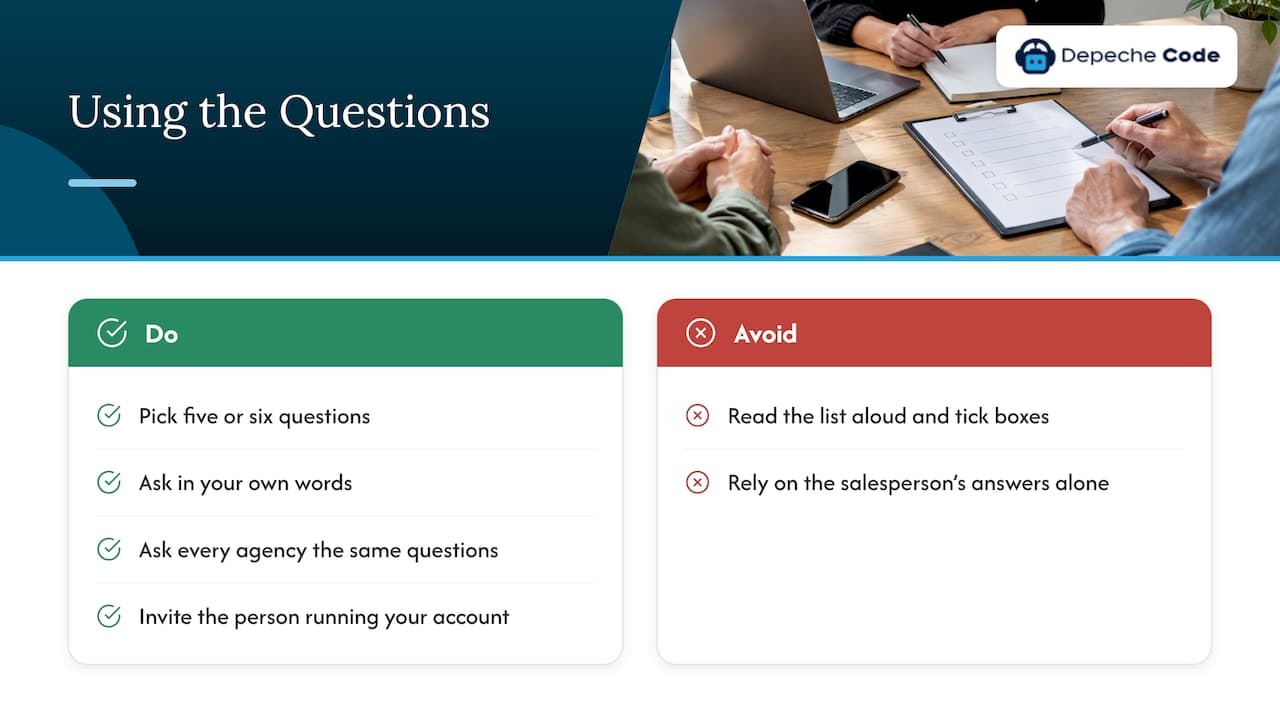
Do not read the list aloud on a sales call and tick boxes. Pick the five or six that matter most for your situation, ask them in your own words, and listen for specifics. A good agency answers with examples, numbers and trade-offs. A weak one answers with vocabulary.
Two habits help. First, ask every agency on your shortlist the same questions so you can compare answers side by side. Second, ask the person who will actually run your account to join the call. The salesperson’s answers only matter if the strategist or account lead can repeat them.
Google’s own guidance on hiring an SEO is a good baseline. It suggests asking about previous work and success stories, how the agency follows Google Search Essentials, how it sets expectations and measures results, whether it has experience in your industry and country, and how communication will work. That guidance shaped the groups below.
Questions about experience and proof
1. Which clients like mine have you worked with?
An agency that has grown a dental practice does not automatically know how to grow a B2B software company. Ask about your industry, your business size and your market: national, regional or a single city. Local SEO, ecommerce SEO and lead generation for service businesses behave differently.
What you want to hear: named types of clients, the problem each one had and what the agency changed. If they cannot discuss anything close to your situation, ask how they would learn it and who would teach them.
2. Can you show results and talk me through how you got them?
A screenshot of a traffic graph is not a case study. Ask what the starting point was, what the agency did, how long it took and what business result followed: leads, calls, orders or revenue, not just visits.
Also ask what did not work. Every real SEO program has tests that fizzled. An agency that can describe one and what it learned from it is usually more trustworthy than one with a spotless story.
3. Can I speak with a current or former client?
References cost the agency a little effort and tell you a lot. When you call, ask the client how quickly the agency responded, whether the reports were understandable and whether they would hire again. Third-party reviews are a useful second check, so read the recent ones as well as the best ones.
4. Who will actually work on my account?
Some agencies sell with senior people and deliver with juniors, or outsource the work entirely. Neither is automatically bad, but you should know. Ask who writes the content, who handles technical fixes and who you will talk to every month. Ask whether any work is done by subcontractors or overseas partners, and whether anyone who touches your site follows the same standards.
Questions about strategy and your website
5. What would you do in the first 90 days?
This is the single most revealing question. A credible answer includes an audit of your site, keyword and competitor research tied to what you sell, a list of technical problems ranked by importance and a first batch of content or page improvements. A vague answer such as “we will optimize your site” tells you the agency has no plan yet.
Ask to see a sample roadmap. According to Search Engine Land’s guide to SEO roadmaps, strategy defines objectives, value, timelines, budget and resources, and the roadmap turns that into prioritized actions. Each action should record its business KPI opportunity, effort, goal alignment, SEO impact and target timeline. If an agency’s plan is a flat list of tasks with no priorities or expected impact, push for more.
6. How does your strategy connect to my business goals?
Rankings are a means. Your goal might be booked appointments, qualified demo requests or online sales. Ask the agency to describe how a keyword on its list leads to revenue for you. Ask which pages would convert the traffic and what happens if the traffic arrives but nobody buys.
A good agency will ask you questions in return: your best customers, your margins, your seasonality, what a lead is worth. If the call is all about them and none about you, that is your answer. For a deeper look at tying search work to business outcomes, see our piece on SEO for business and lasting growth.
7. Will you need to change my website, and who controls those changes?
SEO often touches page speed, site structure, titles, internal links, mobile layout and sometimes the platform itself. Ask which changes they expect to recommend, who will make them and whether you will need a developer. Ask how they will test changes so a fix does not break your checkout or contact form.
If your site is old or poorly built, the honest answer may be that a redesign comes first. That is not an upsell if it is explained with evidence. If a redesign is on the table, make sure the agency has a plan to protect the rankings you already have. Our website redesign checklist for SEO preservation covers what that plan should include.
8. How do you handle content and link building?
Ask who writes the content, how they research topics and what quality control looks like. Then ask how they earn links. You are looking for answers about useful content, partnerships, local citations and genuine outreach.
This matters beyond quality. Google notes that you are responsible for the actions of any SEO company you hire, and that if a provider creates deceptive content, your site could be removed from Google’s index. Ask directly: “Which tactics do you use that Google would object to?” The right answer is none, and the agency should be able to explain why.
Questions about measurement and timelines
9. Which metrics will you report, and how often?
Insist on business-level numbers next to SEO numbers. Useful reports include organic traffic to the pages that matter, leads or sales from organic search, rankings for a defined set of terms, and technical health. Ask whether you will have direct access to your own analytics and Search Console data, not only a PDF.
Ask for a sample report. If it is mostly charts that go up and to the right without explaining what changed and why, it will not help you make decisions.
10. How long before I see results?
Be wary of a precise promise. Timelines depend on how competitive your market is, how healthy your site is and how much content needs to be created. A realistic agency will describe stages: technical fixes show up first, content takes longer to gain traction, and competitive terms take longer still. Ask what early signals, such as more pages indexed, more impressions or better click-through, indicate the work is on track before revenue shows.
11. What happens if the results are not there?
No one can promise outcomes, but a good agency has a process for when progress stalls. Ask how often strategy is reviewed, who decides to change course and whether you can adjust the scope. This question also tells you how the agency behaves under pressure.
Questions about price and contract
12. How do you price, and what exactly is included?
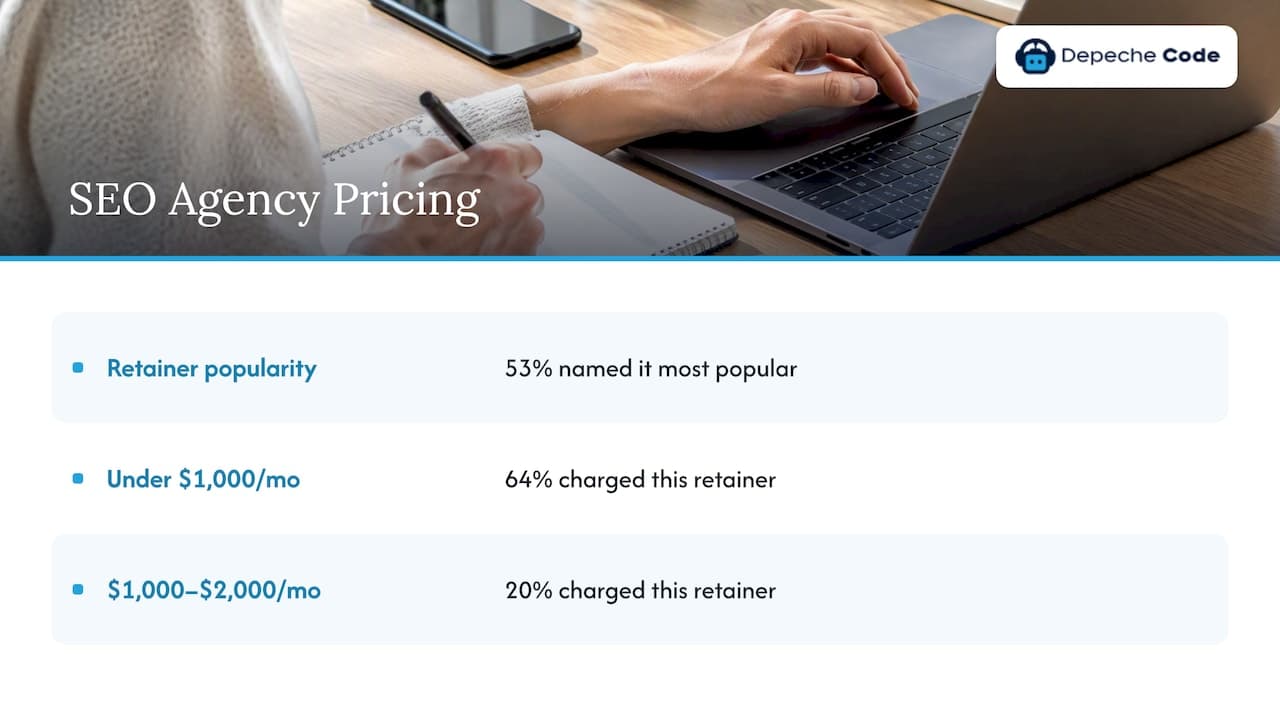
Monthly retainers are the most common model. In a 2025 survey of SEO agencies, 53% of participants said retainers were their most popular pricing model, and 64% charged under $1,000 per month for retainers while 20% charged between $1,000 and $2,000. Those figures come from a survey of agencies, not a quote for your project, so use them to see how wide the range is, not to set your budget. For a U.S.-focused breakdown of what different spend levels buy, read our guide to SEO pricing in the U.S. and our overview of affordable SEO strategies.
Whatever the number, get the deliverables listed: how many pages optimized, how many pieces of content, which technical work, how many hours of strategy and reporting.
13. What counts as out of scope, and what will it cost?
Scope creep is common. A Marketing Charts report on agency pricing found that 78% of agencies say they rarely or only sometimes charge for out-of-scope work. That sounds generous, but it can also mean the work quietly gets squeezed or the agency recovers the cost elsewhere. Ask for the boundary in writing, including what happens when you request an extra landing page or a site fix mid-month.
14. What do I own, and how do I leave?
Check the contract for three things: ownership of content, accounts and reports; the minimum term and cancellation notice; and what you receive when you leave. You should own your website, your analytics and Search Console access, your content and any tracking accounts. If an agency holds these in its own accounts, you are renting your marketing.
The question that exposes bad actors
15. Can you guarantee rankings?
The right answer is no. Google states that no one can guarantee a #1 ranking and warns against SEOs who claim to guarantee rankings, allege a special relationship with Google or advertise priority submission. Its SEO Starter Guide adds that there are no secrets that automatically rank a site first.
The same caution applies to badges. Google Search Central advises skepticism toward tools or agencies that claim an “approved” or “acceptable” status from Google, because Google does not endorse them. An agency may be a certified partner of an advertising platform, but that is different from an SEO endorsement.
Red flags and green flags at a glance
| Topic | Green flag | Red flag |
|---|---|---|
| Proof | Case studies with starting point, actions and business results | Traffic screenshots with no context |
| Strategy | A prioritized plan for your site and goals | A standard package for every client |
| Rankings | Honest about uncertainty | Guaranteed #1 or a special Google relationship |
| Reporting | Leads and revenue next to rankings, with your own data access | A monthly PDF you cannot verify |
| Contract | Clear deliverables, scope and exit terms | Long lock-in, unclear ownership |
| Team | You know who does the work | Vague about subcontracting |
Our perspective
Most bad SEO relationships do not fail because the agency was dishonest on day one. They fail because nobody defined what success was, what was included or who owned what. We would rather lose a deal in the first meeting by being specific than win it with vague promises.
We lean on a few principles. Everything we build or produce for a client should belong to the client, transparently. Technical performance should be measurable, which is why we point to Google PageSpeed and SEO scores rather than adjectives. And we use directed AI inside our own workflow to move faster on research, drafts and production, with people steering the strategy and checking the output, so clients get timely delivery without paying for slow manual steps.
We also think the market has shifted. Customers now find answers through traditional search results and through AI-generated answers, so our SEO plans cover both SEO and AEO (answer engine optimization). When you interview an agency, ask how they approach that shift. Their answer will tell you whether they are still selling a 2015 playbook.
— Donovan Wells - Founder and CEO
Working with Depeche Code on SEO
If you are ready to compare plans, we are an Orlando-based digital agency, and our SEO work is organized into Organic, Local and Combo SEO/AEO plans so you can match the scope to your market. Organic plans suit businesses that sell nationally or online, Local plans suit businesses that serve a specific area, and Combo plans cover both. You can see how they are put together on our SEO options and plans page.
If you want to hold us to the same 15 questions, please do. Start with our search engine optimization services, then ask us for the first 90 days, the reporting you will receive and what you will own at the end. If your business is local, our local business SEO workflow shows how we approach it, and our guide to finding an SEO firm near you explains how to judge a local provider.
A simple way to score your shortlist
After each call, score every agency from 1 to 5 on the same six areas: relevant proof, quality of the 90-day plan, clarity of reporting, honesty about timelines, contract fairness and how well they listened to you. Add the scores, but also write one sentence on what surprised you. The surprise is often the deciding factor.
If two agencies tie, ask each for a short written outline of their first month on your site. The one that produces a specific, thoughtful outline without being paid for it usually shows how they will work once you are a client.
FAQ
What are the most important questions to ask an SEO agency?
Start with proof of similar work, what they would do in the first 90 days, how they report results and how they handle guarantees. Those four reveal experience, planning, transparency and honesty. Add price and contract questions before you sign.
What do SEO agencies charge?
It varies widely. A 2025 agency survey found most agencies charging retainers, with 64% of them under $1,000 per month and 20% between $1,000 and $2,000. Ask for a written list of deliverables so you can compare quotes on what you receive, not just the monthly figure.
Can an SEO agency guarantee first-page rankings?
No. Google says no one can guarantee a #1 ranking, and it advises caution toward anyone who promises it. A trustworthy agency commits to a process, reporting and effort, not to a position on a results page.
How long does SEO take to work?
It depends on your competition, your site’s condition and how much content is needed. Ask the agency to describe the stages and the early signals you should see, such as better indexing and more impressions, before leads grow. Treat any exact promise with suspicion.
Sources
- Do You Need an SEO? Tips for Hiring an SEO, Google Search Central
- SEO Starter Guide: The Basics, Google Search Central
- Google Search’s Guidance on Third-Party SEO Tools and Advice
- How to build an SEO roadmap that drives performance, Search Engine Land
- SEO Pricing: How Much Does SEO Cost in 2025, agency survey
- Agencies Split on Pricing Models, Marketing Charts