
// Creative Agency
Social Media Customer Service: 7 Steps That Work in 2026

Social media customer service means answering questions, fixing problems and handling complaints on the networks where your customers already are: comments, direct messages, mentions and reviews. Done well, it is a speed game played in public. The businesses that win set a clear response target, decide who owns each type of message, and let automation handle the repetitive questions so people can handle the hard ones. This guide gives you the seven steps to build that, with the numbers behind each.
TL;DR
- Customers expect fast replies: 45% of people who use social for support expect an answer within an hour, and 86% set 24 hours as the absolute limit.
- Aim for a first response in under 15 minutes on your key platforms, and acknowledge publicly before moving sensitive issues to a private message.
- Pick one owner for social support, write an escalation map, and use templates for common questions but personal replies for complaints.
- Track first response time, resolution time and sentiment, and review three months of messages to decide where to staff.
- An AI chatbot can cover frequently asked questions around the clock, with a clear handoff to a human.
Table of Contents
- Why social customer service matters to your business
- What customers expect, in numbers
- Step 1: Choose the channels you will actually staff
- Step 2: Set service hours and a response target
- Step 3: Decide who owns social support
- Step 4: Build priority tiers and an escalation map
- Step 5: Reply in public, resolve in private
- Step 6: Let automation take the repetitive questions
- Step 7: Measure, review and adjust
- What the job looks like day to day
- Where we come in
- Perspective: why we pair people with automation
- FAQ
- Sources
Why social customer service matters to your business
Social is the only support channel where everyone can watch you work. A phone call or email stays between two parties. A comment on your Facebook page or Instagram post stays visible to every follower and to anyone who finds it later.
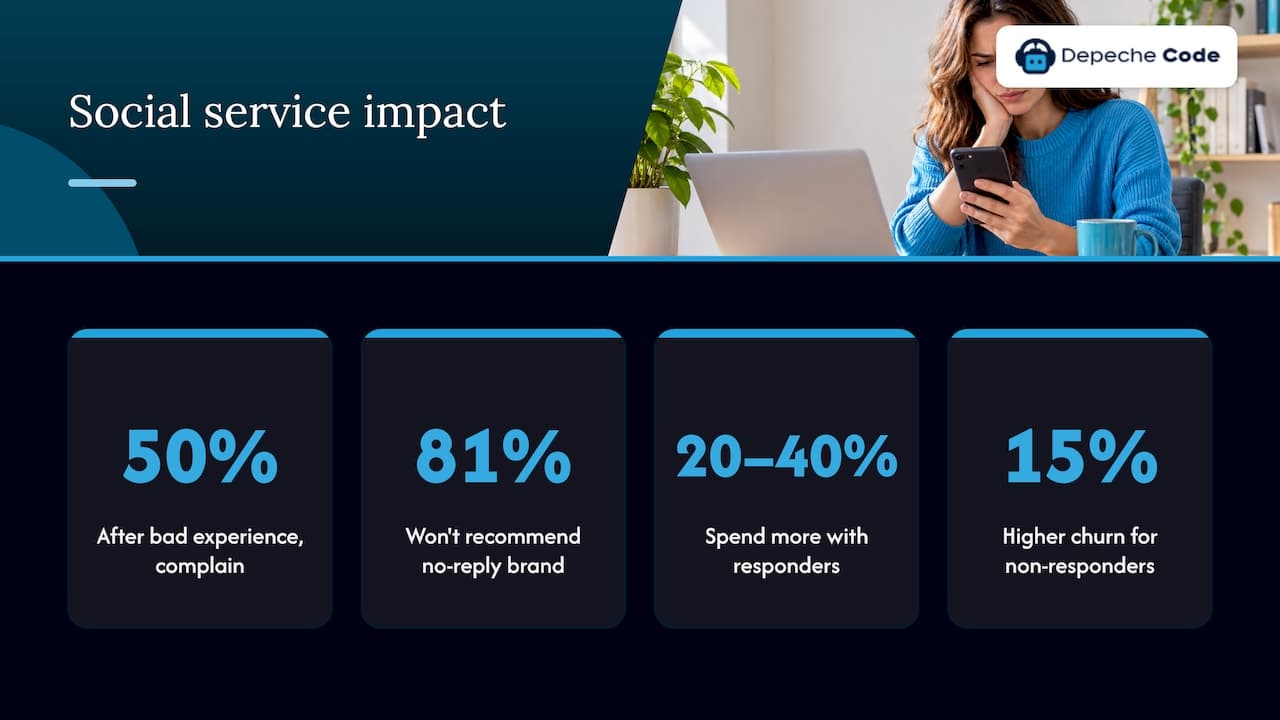
That visibility cuts both ways. McKinsey’s research on social servicing reports that when consumers have a bad experience, half will complain publicly on social media, and 81% won’t recommend a company that gives no answer at all. The same report finds customers spend 20 to 40% more with companies that respond to service requests on social, while non-responders see a 15% higher churn rate. Only about half of businesses meet response-time expectations, so a fast, helpful reply is a real advantage.
It is also a channel you cannot ignore even if you would like to. The American Customer Association’s State of CX 2026 report finds that 24% of customers have never used social media to contact a company for support. That means roughly three in four have, or are willing to. If your profile exists, people will write to it.
What customers expect, in numbers
The same ACA report puts the average time customers are willing to wait for a social media response at 5.1 hours. Look closer and the picture is tougher:
| Expectation | Share of social-support users |
|---|---|
| Reply within 1 hour | 45% |
| Reply within 2 hours | 57% |
| Reply within 24 hours | 86% (the absolute limit) |
McKinsey’s figures point the same way: 40% of consumers expect a brand to respond within the first hour and 79% within 24 hours. For a small business, the practical reading is simple. A same-day reply is the minimum. A reply inside an hour during your open hours puts you ahead of most competitors.
Step 1: Choose the channels you will actually staff
You do not need to be everywhere. Every channel you list as a place to reach you is a promise to answer. Start with the one or two networks where your customers already write to you, and say clearly on every other profile where to go for help.
Look at the evidence from your own accounts. Pull at least three months of comments, mentions and direct messages and count them by platform. The volume tells you where to put people. If most questions arrive on Facebook and Instagram, those two get staffed first. If you are still deciding which networks suit your business, our guide to choosing social media platforms for business walks through the top options.
Where it goes wrong: opening a TikTok or X account for brand reasons and then letting support messages pile up there. An unanswered message is worse than no channel at all, because the silence is visible.
Step 2: Set service hours and a response target
Decide when you answer and how fast. McKinsey describes best practice as a service window that runs around the clock on key platforms with a first response in under 15 minutes, and it notes that service windows can also be 12-hour or business-hours models. Most small and mid-sized businesses will not staff 24/7, and that is fine, as long as you say so.
A workable ladder for most teams:
- Open hours: first reply within 15 to 60 minutes.
- Outside open hours: an automatic or scheduled message saying when a person will reply.
- Weekends and holidays: the same message, with a firm next-business-day promise.
Publish the hours in your profile bio or a pinned post. A customer who knows to expect a reply by 9 a.m. is far calmer than one who is guessing.
Step 3: Decide who owns social support
This is where most programs stall. Marketing owns the accounts, support owns the customers, and messages fall between them.
McKinsey recommends a combined response-and-resolution team rather than leaving social solely in marketing or solely in customer service. Its argument is that single ownership and accountability for the customer’s issue, plus a consistent tone, produce a better experience. The team needs the authority to make exceptions and direct access to billing, fulfillment, technical and other functions that can fix the problem.
For a smaller business, that translates into three rules:
- Name one person who is accountable for social replies each day, with a backup.
- Give that person permission to issue refunds, replacements or credits up to a set limit without asking.
- Make sure they can reach the person in operations, billing or IT who can resolve what they cannot.
Forrester’s research on scaling social customer care notes that not all brands are set up to respond to social inquiries as swiftly and effectively as on phone, chat or email. Clear ownership is what closes that gap.
Step 4: Build priority tiers and an escalation map
Not every message is equal. The ICMI guide to social customer service suggests tiers: direct questions and customer dissatisfaction come first, potential crisis issues are escalated at once, and positive mentions sit lower. It also recommends an escalation map that spells out which messages agents can answer, which team owns each type they cannot, and how to pass a case along with its full history so the customer never has to repeat themselves.
A one-page version looks like this:
| Message type | Who answers | Escalate to |
|---|---|---|
| Hours, pricing, order status | Social support person | None |
| Billing dispute or refund | Social support person within set limit | Finance or owner |
| Product defect, safety concern | Social support person, acknowledge publicly | Operations lead, same day |
| Legal threat, press, viral complaint | Hold with a prepared message | Owner and legal or PR |
ICMI also advises that the team leader is the first level of escalation, and that a crisis plan should include holding messages, template responses and clear criteria for when PR or legal gets involved. If you want a ready-made framework for the worst days, see our social media crisis management playbook.
Step 5: Reply in public, resolve in private
The most common model is a two-part reply. Acknowledge the message publicly so everyone watching sees you responded, then move anything involving account details, payment or personal information into a direct message or a secure form.
A good public reply does three things: names the customer, says what you are doing, and says when they will hear back. A good private follow-up gets the facts it needs in one message rather than five. Ask for the order number and a description in the same note, not one at a time.
ICMI argues that first response time matters more on social than on any other channel, because even when you cannot solve the issue immediately, you are showing the customer and everyone watching that you have heard them and are working on it.
Templates or personal replies?
Both, in the right places. An analysis of more than 1 million messages between 167 American brands and their customers on X, in a Bocconi University doctoral thesis, found that standardized responses typically lower customer satisfaction, yet work well for complaints from highly dissatisfied customers. Its recommendation is a hybrid: templates for common inquiries, personalized replies for unusual or complex issues.
In practice, write templates as starting points for opening lines, hours, links and policy wording. Then add the customer’s name and one detail from their message before you send.
Step 6: Let automation take the repetitive questions
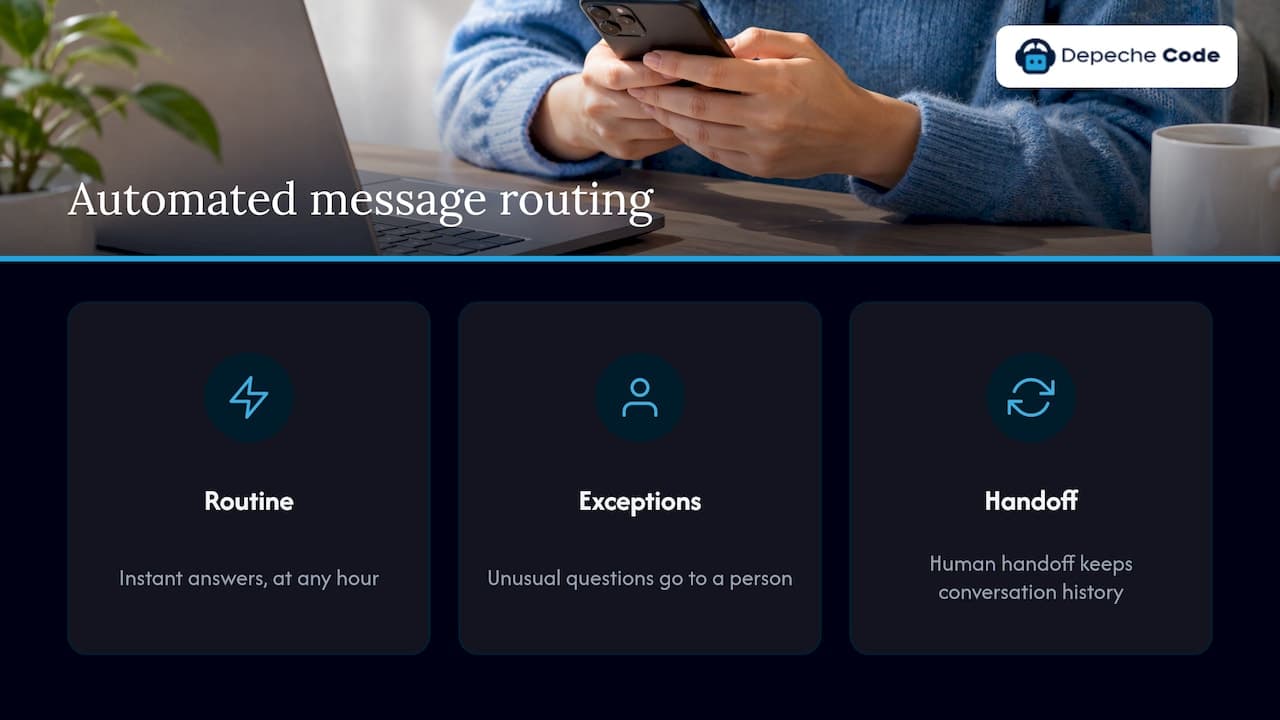
Most social inboxes are dominated by a handful of questions: when are you open, where is my order, how much does it cost, how do I reset my account. These are ideal for an AI chatbot, which can answer instantly at any hour and pass anything unusual to a person.
The design rule is the same as with templates: automation for the routine, humans for the exceptions, and an easy way to reach a person. If a customer asks for a human, the bot should hand over the conversation with its history, and your team should be ready to pick it up.
This also solves the after-hours problem from Step 2. Instead of a “we’ll get back to you” message that leaves customers waiting until morning, a bot can resolve the simple questions overnight and flag the rest for your first-hour queue.
Step 7: Measure, review and adjust
What you do not measure will drift. ICMI lists the core metrics for social support:
- Volume: inbound messages, responses and cases by platform.
- First response time and average response time: the foundation of any service-level promise.
- Handling time: how long each case takes, useful for comparing against other channels.
- Sentiment conversion: how often a negative exchange ends positive.
The same guide notes Forrester research finding that 20% of companies do not measure social customer service success at all. Simply tracking these four numbers monthly puts you ahead of them.
Review them with a short monthly routine: which platform had the slowest replies, which question type came up most, which cases were escalated and why. The answers tell you what to add to your templates, your chatbot and your help pages. A periodic social media audit is a handy way to check profiles, bios and response paths in one sitting, and a one-page branding guidelines card keeps your tone consistent when several people reply under the same name.
What the job looks like day to day
People often ask what a social media customer service person actually does. Job postings for the role describe a consistent pattern. The person monitors the brand’s profiles and review sites, replies to questions and complaints, spots trends and potential crises, flags critical issues to a community manager or other internal teams, and writes everyday posts in the brand’s voice. Employers typically want experience managing social media and reviews for customer care, and availability for after-hours or crisis coverage.
For a small business, this is often a part of someone’s job. For a growing one, it becomes a dedicated seat, and that is the point at which handing the daily monitoring to a managed team starts to pay off.
Where we come in
Social support asks for steady attention that many owners cannot spare. At Depeche Code we offer social media management alongside AI chat bots, so the routine questions and the daily monitoring can sit with one team.
Our AI chat bot plans start at $49 per month for Starter, $99 per month for Growth and $149 per month for Prime, with a one-off setup and integration fee of $299.
If you want to talk through which channels to cover and what to automate, start from the services page and tell us what your inbox looks like today.
Perspective: why we pair people with automation
We build websites, run social media accounts and set up AI chat bots for businesses, and one thing connects all three: customers do not care which department owns their question. They care how long they wait.
That is why we treat social support as part of the whole online presence, not a side task for whoever has a spare minute. Your website, your profiles and your chat bot should give the same answer in the same voice.
Our view is that the strongest setup is simple. Let an AI chat bot handle the repeat questions around the clock, keep a named person accountable for everything that needs judgment, and review the numbers every month. Speed and a human touch are not in conflict when each is used for what it does best.
The businesses that do this well tend to start small: two channels, one owner, one escalation page. Then they build.
Donovan Wells - Founder and CEO
FAQ
How fast should a business reply on social media?
Aim for a first reply in under 15 minutes during your open hours, which McKinsey describes as best practice, and never slower than the same day. The ACA’s 2026 report finds 45% of social-support users expect an answer within an hour, so an hour is a sensible outer limit for your staffed hours.
Should I answer complaints publicly or in a private message?
Both. Reply publicly first so other customers see that you responded, then move anything with personal or payment details into a direct message or secure form. Leaving a complaint unanswered is the riskier choice, since half of consumers with a bad experience complain publicly.
Which team should handle social media customer service?
McKinsey recommends a combined response-and-resolution team rather than leaving it only to marketing or only to customer service. For a small business, name one accountable person, give them authority to fix common problems, and set a clear path to the people who can solve the rest.
Can an AI chatbot handle social media support?
It can handle repetitive questions such as hours, pricing and order status at any hour. Pair it with a simple way to reach a person, so complex or emotional cases move to your team with the conversation history intact.
Which metrics should I track first?
Start with first response time, average response time, handling time and message volume by platform, then add sentiment conversion once you have a few months of data. These are the core measures ICMI lists for social support.
Sources
- Effective end-to-end customer service with social media, McKinsey
- State of CX 2026, American Customer Association
- How (And When) To Scale Social Customer Care, Forrester
- The Definitive Guide to Social Customer Service, ICMI
- Exploring Customer-Firm Interactions on Social Media, Bocconi University