
// Creative Agency
Social Media for Franchises: 9 Strategies for 2026
Social media works for a franchise when corporate controls what protects the brand and each location controls what only a local owner can know. Get that split right and the rest follows: shared guidelines, a content calendar with room for local posts, approvals that match risk, and reporting tied to sales rather than likes. Below are nine strategies we use to think about franchise social media in 2026.
TL;DR
- Give corporate the brand voice, visuals and compliance, and give franchisees local events, community replies and day-to-day posting.
- Write guidelines made for social media, and spell out what each location may change.
- Blend national and local content on one shared calendar. A common starting point is roughly 80% brand content and 20% local.
- Review only risky posts (offers, pricing, press, system claims) and let local posts go out without a queue.
- Measure sales, customer feedback and in-store traffic first. Treat franchise sales recruitment as a separate funnel with its own metrics.
Table of Contents
- What social media for franchises actually means
- 1. Divide ownership by who has the context
- 2. Write guidelines made for social media
- 3. Blend national and local content on one calendar
- 4. Choose channels by customer fit, not habit
- 5. Tier your approvals by risk
- 6. Handle customer messages locally and fast
- 7. Measure business results, not applause
- 8. Keep franchise development separate from consumer marketing
- 9. Tie social to local search and your website
- Perspective: why franchises need a system, not more posting
- How we help franchise brands
- FAQ
- Sources
What social media for franchises actually means
Franchise social media is the use of social networks to promote the brand and its individual locations at the same time. Corporate accounts carry broad campaigns and brand storytelling, while local pages share community updates and promotions and talk directly to nearby customers. The brand’s voice stays the same at both levels, and the local connection is what changes.
That is harder than it sounds. A single-location business has one owner, one voice and one feed. A franchise has a headquarters team that is accountable for the brand and dozens or hundreds of owner-operators who know their own streets better than anyone in the head office does. Every strategy below is a way of letting both sides do what they do best without stepping on each other.
The workload is real. The ACHQ Research Report identified social media management as the most time-consuming task for franchise marketers, with over half of respondents calling it a challenge. If your team feels stretched, that is normal, and it is a sign the system needs structure rather than more effort.
1. Divide ownership by who has the context
The cleanest rule we know is this: corporate decides what protects the brand in every market, and stays out of what requires knowing one market. A reviewer in another state cannot tell whether a local fundraiser post is timely. A franchisee cannot tell whether a discount claim meets the offer rules your legal team approved. Each decision belongs to the party that has the context to make it.
In practice, that usually looks like this:
| Corporate owns | Franchisees own |
|---|---|
| Brand voice and visual identity | Local events and sponsorships |
| Approved and banned language | Community moments and staff highlights |
| Account ownership and naming | Local photos and day-to-day posting |
| Escalation path for crises | Replies to comments and reviews |
| Network-level reporting | Local offers within approved rules |
Put this table in writing and make it part of the franchise agreement’s onboarding, or at least the operations manual. Ambiguity about who owns an account is the root of most franchise social media problems, from abandoned pages to a departing owner taking an audience with them. Decide on naming conventions and admin access before the first location launches.
2. Write guidelines made for social media
A brand book built for print and signage rarely answers the questions a franchisee has at 4 p.m. on a Tuesday. Social-specific guidelines should cover visual consistency, tone of voice, which elements a location may change, hashtags, and how to handle complaints in public replies.
The best guidelines are short. We favor a one-page card that a busy owner will actually open. If you want a template, our guide to social media branding guidelines walks through a one-page format that helps stop brand drift.
Ask of every rule: what does the franchisee do with it? “Be friendly” is not a rule. “Greet by first name, never use sarcasm in complaint replies, and move billing issues to direct message” is one.
As more teams use generative tools for images and captions, it also helps to write rules that both people and software can follow. Clear AI brand guidelines keep the standards firm while leaving locations room for authentic local content.
There is also a mindset point. Guidelines are not a restriction. They are the reason a customer can walk into any location and recognize the brand at once, whether they found it through a national ad or a neighborhood post. Tension between central marketing and local teams is structural, not a sign that either side is failing. The real question is how much freedom locations get, and within what boundaries.
3. Blend national and local content on one calendar
Local content tends to resonate because customers respond to posts that reflect their own community. But building fully custom content for hundreds of locations is not realistic. The answer is a system where national content adapts for local context without being rebuilt from scratch at every location.
Many franchise systems land on a hybrid. A widely used rule of thumb is about 80% headquarters content (campaigns, seasonal promotions, product launches, evergreen tips) and about 20% local content from franchisees. Another way to frame it uses three layers:
- Locked national content. Campaigns, launches and compliance posts that no one edits.
- Customizable templates. Pre-built posts where locations add a photo, a name or a local hook.
- Local originals. Community events, staff features and customer shoutouts, published within guardrails.
The exact percentages matter less than having defined space for each layer. Put the fixed national moments on the shared calendar first, then mark where locals can customize. Our social media content planning guide shows how to build a calendar like this without it turning into a spreadsheet nobody reads.
If your customer base is diverse, consider language too. Hootsuite’s franchise guide reports that two out of three customers would switch to a brand offering service in their native language, which makes translated templates a practical edge for locations in multilingual neighborhoods.
4. Choose channels by customer fit, not habit
Facebook and Instagram dominate franchise consumer marketing. Franchise Update Media’s 2024 Annual Franchise Marketing Report found that Facebook (88%), Instagram (85%), LinkedIn (75%), YouTube (56%) and TikTok (44%) were used for consumer marketing. The same report found that 80% of franchise marketing executives said they spent the most social media marketing money on Facebook.
Those numbers describe what peers do, not what your customers need. A quick way to choose:
- Local services, restaurants, fitness, retail: Facebook and Instagram for community, offers and reviews. Short video where you have the capacity to produce it.
- B2B franchises (staffing, business services, print): LinkedIn earns its place alongside Facebook.
- Younger audiences: TikTok and Instagram Reels, with locations contributing real behind-the-scenes clips.
Start with two channels done well. Ten thin accounts per location is how a franchise ends up with ghost pages. Before adding anything, run an audit of what exists. Our social media audit checklist is a 30 to 90 minute template that works for a single location or a sample of the network.
5. Tier your approvals by risk
Approval queues kill local social media. When every post waits for corporate, franchisees stop posting or start posting off the books. The fix is review proportional to risk.
Two tiers are enough for most networks:
- Publish without review: local events, community posts, staff highlights, and content adapted from corporate drafts.
- Corporate review required: offers, pricing and discount claims, regulated territory content, press responses, viral complaints, and any statement about the franchise system itself.
The logic is simple. A wrong discount claim can create legal exposure for the whole brand. A slightly clumsy photo of a staff birthday cannot. At 100-plus locations, approval paths also have to reflect different markets and ownership structures, so write the tiers down and publish them to your network.
One extra safeguard: define a short escalation path for negative situations. Who gets the call when a complaint starts spreading? Who speaks for the brand? Agree on the answers before you need them.
6. Handle customer messages locally and fast
Social media has become a customer service channel, and a franchisor cannot answer every message from headquarters. Sprout Social notes that inbound message volume and the need for location-relevant replies mean corporate cannot handle everything alone.
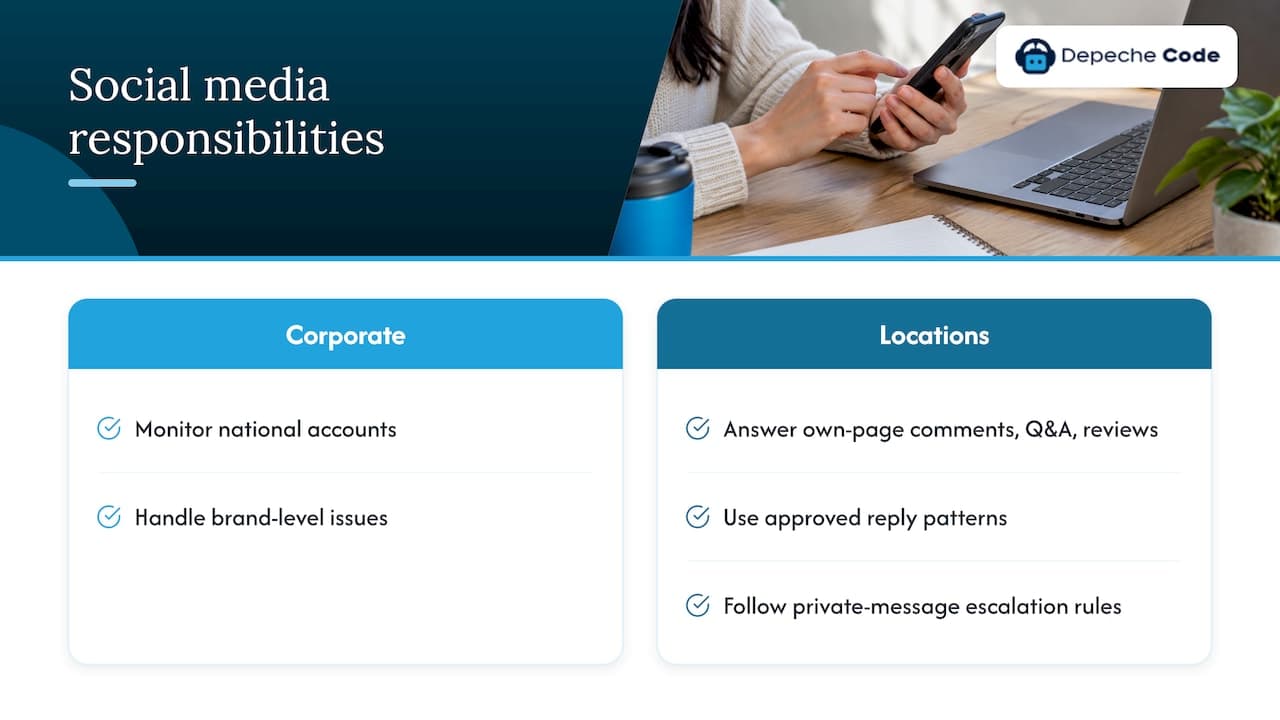
A sensible division: corporate monitors the national accounts and handles brand-level issues. Locations answer comments, questions and review responses for their own pages, using the tone guidelines from strategy 2. Give franchisees a short set of pre-approved reply patterns for common cases such as hours, bookings, and a service problem, and a clear rule on when to move the conversation to a private message.
Automation can help here. An AI chatbot on your website or messaging channels can answer routine questions around the clock and pass complex ones to a person. We build these for businesses, and we cover how they fit into customer support in our overview of chatbots for support efficiency.
7. Measure business results, not applause
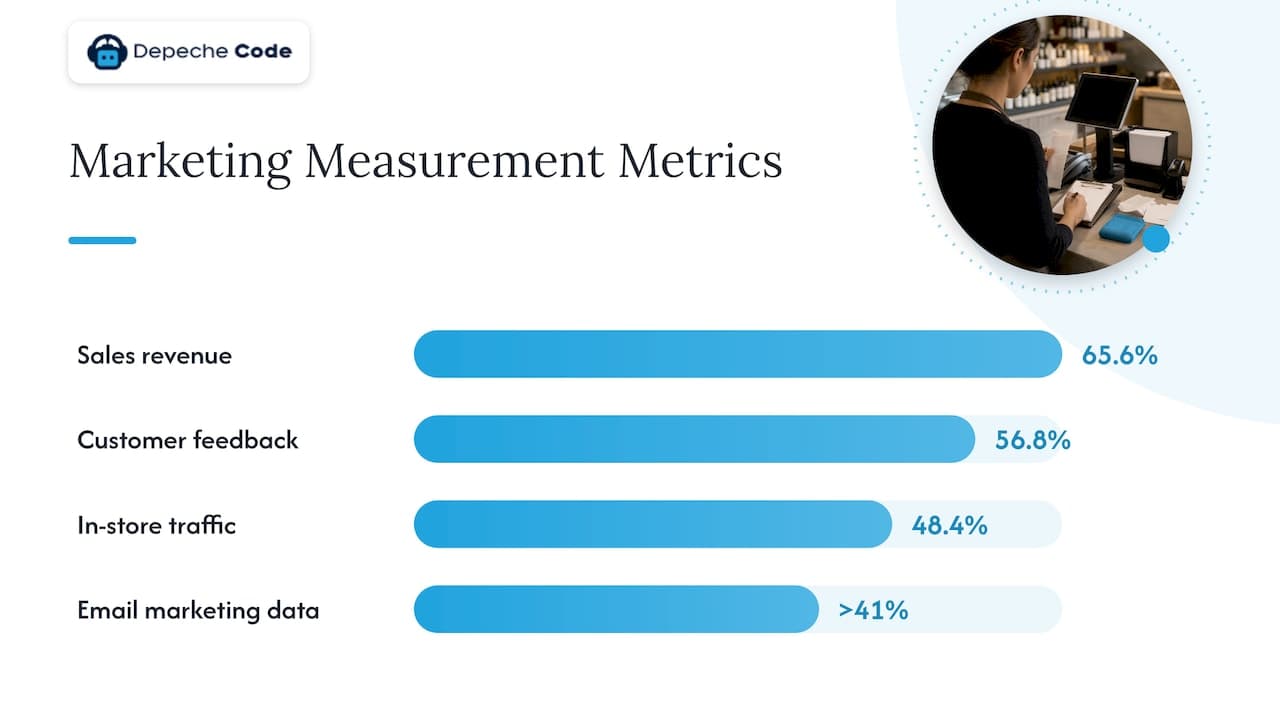
Likes are pleasant, but franchisees pay royalties on sales. The ACHQ Research Report found that 65.6% of franchise marketers look to sales revenue to evaluate marketing effectiveness, 56.8% use customer feedback, 48.4% use in-store traffic, and just over 41% use email marketing data. The same report found that marketers who measure customer feedback report 10% greater satisfaction in their marketing programs.
A workable scorecard for a franchise network:
- Per location: follower growth, engagement rate, review count and rating, messages answered, and, where you can capture it, bookings or redemptions tied to posts.
- Network level: the share of locations that actually publish the content headquarters creates, plus reach and engagement compared across locations.
- Business level: sales, traffic and retention trends, compared against social activity over the same period.
Research also supports the link between local execution and results. A 2019 Local Search Association and SOCi study of 163 franchise brands found a strong correlation between localized social marketing performance and real-world business results. It is a correlation, not proof of cause, but it is a good reason to report by location.
For a step-by-step method, see our guide on how to measure social media ROI.
8. Keep franchise development separate from consumer marketing
Social media can also recruit new franchisees, but it is a different job with a different audience. Consumer posts aim at customers near a location. Franchise development content aims at prospective owners, who need education, proof and a clear path to an inquiry.
The measuring stick changes too. Brent Dowling of a franchise development consultancy said in a 2020 interview that only 34% of brands advertising on social measure their ROI. For franchise development, he named cost per deal as the number one metric, which on Facebook, Instagram and LinkedIn he said can range from $3,000 to $15,000 depending on the franchise’s initial investment. He recommends a 90-day evaluation for digital channels, or 30 days for brands with a higher monthly spend. Treat those as figures from one 2020 interview rather than a benchmark for your brand.
In practice:
- Keep a separate page or campaign for franchise opportunity content, so it does not confuse your customers.
- Choose channels by candidate fit. LinkedIn and Facebook often suit prospective owners better than a youth-oriented video app.
- Educate before asking for a lead, and send traffic to a page built for franchise inquiries.
- Record the lead source correctly, so you know which posts bring real candidates.
9. Tie social to local search and your website
Social posts do not work alone. A customer who sees a location’s post often searches for the location next, so the page they land on matters. Location pages, consistent business listings and reviews all feed the same local visibility that your social presence builds.
If you run a multi-location brand, read our guide to franchise SEO strategies and align the two programs. Use the same location names and details across profiles and your website, and point each location’s social bio to its own landing page rather than a generic homepage.
Perspective: why franchises need a system, not more posting
Franchise social media rarely fails because owners are lazy or headquarters is controlling. It fails because nobody drew the lines. When a location does not know what it may post, it either posts nothing or posts anything.
We start with a short, written split of responsibilities and a one-page guideline card. Then we build a calendar where national moments are fixed and local space is defined. Our in-house, directed AI approach is designed to speed up drafting and adaptation, so locations get ready-to-customize content in less time, and every deliverable stays transparently owned by the client.
We also believe in reporting by location, because a network average hides both your best and weakest performers. Good social media management should let you see exactly which locations are using the system and which need help.
Donovan Wells - Founder and CEO
How we help franchise brands
If you would rather not run this machine yourself, Depeche Code is an Orlando-based agency that handles social media management, SEO, websites and AI chatbots for businesses of all sizes. We can help you set up guidelines, a shared calendar and reporting, and keep the work running month after month.
Tell us how many locations you run and which channels matter to your customers, and we will outline a plan. Start at depechecode.io.
FAQ
How much of a franchise’s social content should come from corporate?
There is no legal or universal number. A common starting point is about 80% headquarters content and 20% local, with some networks using a three-layer model of locked, customizable and local posts. Adjust the ratio based on how mature your franchisees are and how much local flavor your customers expect.
Should every franchise location have its own social media account?
Usually yes for the channels where customers look for local information, most often Facebook and Instagram, provided each page has an owner, a posting plan and a clear admin setup. A location that cannot post regularly is better served by corporate-managed content on a shared account until it can.
Which social media platforms do franchises use most?
Franchise Update Media’s 2024 report found that Facebook (88%) and Instagram (85%) lead for consumer marketing, followed by LinkedIn (75%), YouTube (56%) and TikTok (44%). Choose based on where your own customers spend time rather than copying the average.
What should a franchise measure on social media?
Start with business outcomes such as sales, customer feedback and traffic, since those are what most franchise marketers use to judge effectiveness. Add per-location engagement, review ratings and the share of locations that publish the shared content. Franchise development campaigns should be judged separately, with cost per qualified deal as the main number.
Sources
- How to Master Franchise Social Media Marketing
- ACHQ Research Report, The New Formula for Franchise Marketing
- 2024 Guide to Franchise Social Media Marketing
- Marketing Byte: How Franchises Use Social Media for Consumer Advertising
- The Complete Guide to Franchise Marketing
- How Localized Social Marketing Impacts Multi-Location Brands
- Q&A with Raintree CEO Brent Dowling on franchise development social media
- AI Brand Guidelines