
// Creative Agency
Generative Engine Optimization: 7 Steps That Work in 2026

Generative engine optimization (GEO) is the work of making your business easy for AI systems to find, understand and cite, so that you show up inside the answers ChatGPT, Gemini, Perplexity and Google’s AI Overviews write. For most businesses the winning approach is not a new bag of tricks. It is a strong SEO foundation, a website built to be read by machines and people, and clear facts about your company published in places AI trusts. That is the combined work our SEO and AI search team does for clients, and the steps below show you what it involves.
TL;DR
- GEO aims to get your brand cited or recommended inside AI-written answers, not just ranked in a list of links.
- Google says its AI features are rooted in core Search systems, so sound SEO fundamentals still apply. GEO builds on them.
- Clear structure, original content, crawlable pages and accurate business profiles are the levers you control.
- Measure visibility as a rate across many prompts, not as a ranking position.
- Evidence for any single GEO tactic is still thin, so invest in fundamentals that pay off in both channels.
Table of Contents
- What generative engine optimization means for a business
- GEO vs. SEO: what overlaps and what is different
- 7 steps to improve your AI search visibility
- How to measure visibility in AI answers
- Set realistic expectations
- Where Depeche Code fits
- Our perspective
- FAQ
- Sources
What generative engine optimization means for a business
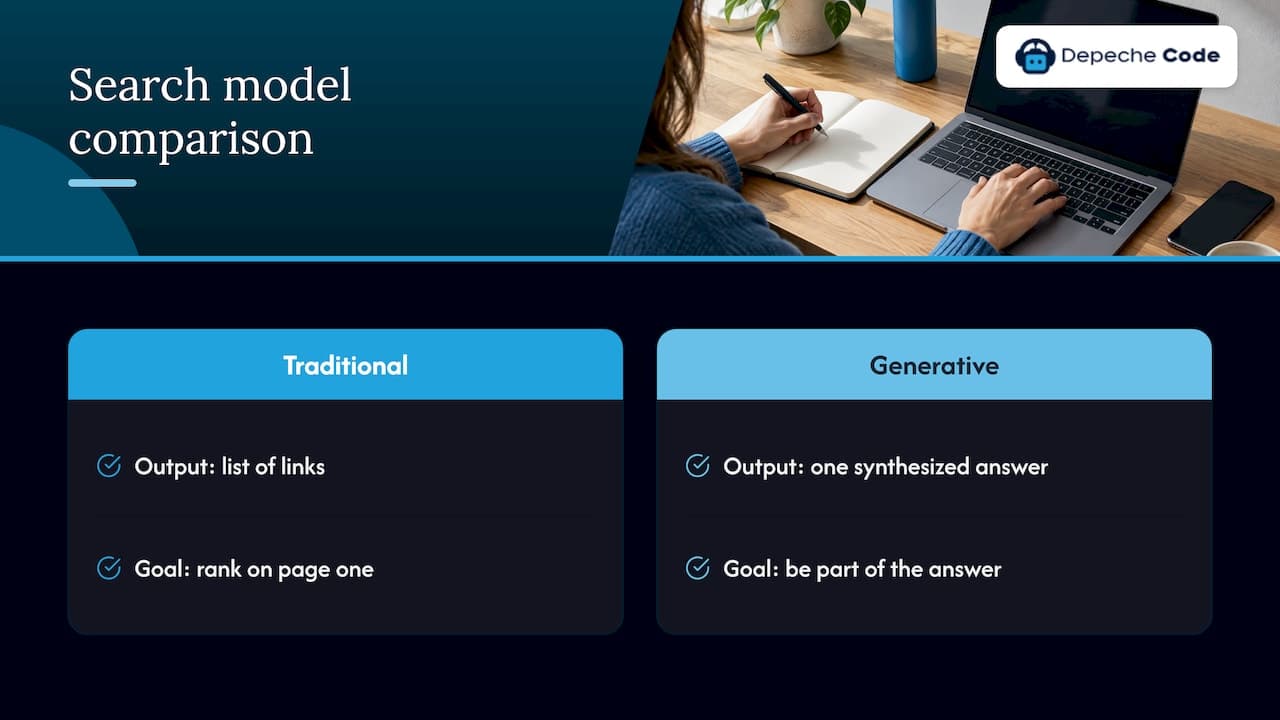
A traditional search engine returns a list of links. A generative engine reads many sources and writes a single answer. Your goal changes from “rank on page one” to “be part of the answer.”
The platforms covered include Google’s AI Overviews and AI Mode, Gemini, ChatGPT, Perplexity, Claude and Bing Copilot. You may also see the practice called AI search optimization, answer engine optimization or genAI search optimization. They describe the same job: improving your AI search visibility, meaning how often and how accurately AI answers mention your company.
Why it matters now: a Pew Research Center analysis of March 2025 browsing found that people clicked a traditional result in 8% of visits when an AI summary appeared, versus 15% when it did not. Customers still research you. Some of that research now happens inside the answer, before anyone visits a website.
GEO vs. SEO: what overlaps and what is different
The two disciplines share more than vendors suggest. Search Engine Land’s comparison notes that the real differences are smaller than marketing implies: where you are cited across the web matters more than backlinks, quotable direct answers matter more than keyword-stuffed long-form, and measurement needs newer tools.
| Classic SEO | GEO | |
|---|---|---|
| Output | A ranked list of links | A written answer with citations or mentions |
| Success looks like | Position and clicks | Mentions, citations and accurate description |
| Content style | Comprehensive pages for keywords | Clear, quotable answers in structured pages |
| Off-site signals | Backlinks | Third-party mentions that shape how AI describes you |
| Measurement | Rankings, traffic | Visibility rate across many prompts |
Both reward helpful, trustworthy content and a technically clean site. That is why we treat them as one program rather than two separate budgets.
7 steps to improve your AI search visibility
1. Fix the technical foundation first
Google’s guide says a page must be indexed and eligible to show in Search with a snippet to appear in its generative features. That means crawlable pages, clean internal links, fast loading and semantic HTML where possible. Broken redirects, blocked sections and slow templates quietly keep you out of AI answers just as they keep you out of search results.
This is where an outdated site hurts most. A redesign that fixes structure and speed often does more for AI visibility than any content tweak. Our website design and redesign work is measured against Google PageSpeed and SEO scores.
2. Publish original, people-first content
Google recommends unique, helpful, reliable content with a distinctive point of view. AI systems summarize; they have little reason to cite a page that repeats what ten others say. Put your own data, pricing logic, project examples and customer questions on the page.
Google also warns against creating separate pages for every query variation just to manipulate AI responses. One strong page per real topic beats a dozen thin ones.
3. Answer questions directly, in a clear structure
Open each section with the answer in one or two sentences, then explain. Use descriptive headings, short lists and tables where they fit. Chris Long of Go Fish Digital reported after six months of testing that AI search tends to pull highly structured content such as bulleted lists and listicle-style articles. Treat that as an observation from one tester, but it matches common sense: a clear page is easier to quote.
4. Keep structured data, skip the gimmicks
Google states that structured data is not required for generative AI search and that no special markup is needed, though it still supports rich results eligibility. Google also says llms.txt files and content chunking are unnecessary. Keep standard schema accurate for your business, products and FAQs, and do not spend budget on AI-specific markup.
5. Make your business facts consistent everywhere
AI answers about local services lean on business data. Google points to Google Business Profiles and Merchant Center feeds as ways to help services and products appear in AI responses. Keep your name, address, hours, services and descriptions identical across your site, profiles and directories.
It also helps to publish a plain, quotable page of verified company facts. A dedicated facts page for AI and press gives answer engines one clean source for your claims instead of leaving them to guess from scattered mentions.
6. Earn mentions off your own site
Search Engine Land points out that third-party citations shape how AI describes a brand. Reviews, industry directories, trade publications, partner pages and local news coverage all feed that picture. Google is clear that seeking inauthentic mentions is not helpful, because its systems are built to filter spam. Earn mentions by being genuinely worth citing.
7. Add a conversational layer on your own site
Google’s guide notes that businesses may consider Business Agent, a conversational experience that lets customers chat with a brand on Google Search. On your own website, an AI chatbot serves the same instinct: visitors increasingly expect to ask a question and get an answer. We integrate AI chatbots, with plans from $49 per month and a one-off setup and integration fee of $299.
How to measure visibility in AI answers
Rankings do not translate. An AI answer has no position seven, and responses vary by model, prompt, location and freshness. A January 2026 study by SparkToro and Gumshoe.ai found it very unlikely that ChatGPT or Google’s AI returns the same list of brands twice, which is why visibility as a percentage across many repeated prompts is the sensible metric.
A practical measurement routine:
- Build a prompt list. Search Engine Land suggests 200 to 500 prompts covering the whole buying journey, mixing real questions from sales calls and support with synthetic ones.
- Track mentions and citations. Count how often answers name your brand, link to your site, and describe you accurately.
- Watch referral traffic. Look at visits from AI assistants in your analytics, and at assisted conversions, as outlined in Search Engine Land’s AI visibility dashboard guide.
- Use Search Console. Google’s Search Console reporting on generative AI features shows how often your pages appear in AI Overviews and AI Mode, though it does not replace tracking other assistants.
- Look for patterns. Because answers vary, the aim is a trend, not a perfect number.
Accuracy matters as much as presence. A brand described wrongly in an AI answer is worse off than one not mentioned, so review what the answers actually say about you.
Set realistic expectations
Research on GEO is young. A July 2026 survey of 45 GEO studies, Optimizing Visibility in Generative Engines, found topical relevance and where information sits in the content to be the most reproducible levers. No single technique has shown a stable, cross-platform effect over time.
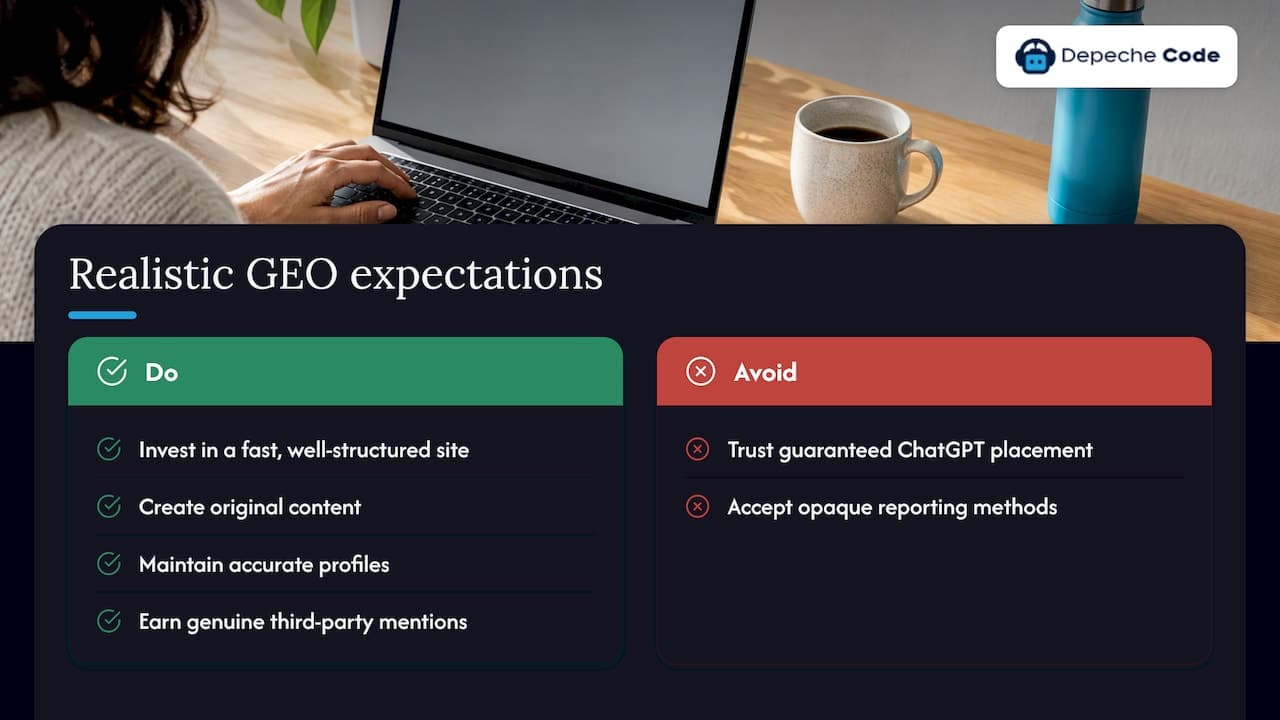
The sensible reading for a business owner: put your money into the things that help in every channel. A fast, well-structured site, original content, accurate profiles and genuine third-party mentions support classic search, AI Overviews and chat assistants at once. Treat anyone promising a guaranteed spot in ChatGPT with caution, and judge any reporting by how transparent its method is.
Where Depeche Code fits
We are a full-service digital agency in Orlando, and the pieces of GEO map onto what we already build and run: website development and redesign, SEO with Organic, Local and Combo SEO/AEO plans, WordPress hosting and maintenance (hosting from $39 per month, maintenance from $99 per month), AI chatbot integration and social media management. We use in-house directed AI to deliver faster, and every deliverable is yours.
If you want a plan that covers site structure, content and AI search visibility together, start with our SEO services.
Want to go deeper first? Our guides on AI Overviews optimization and AI search optimization walk through the tactics in more detail.
Our perspective
Business owners ask us whether GEO replaces SEO. In our experience of building and optimizing sites, it does not. It raises the bar on the same fundamentals.
An AI system can only cite what it can crawl, understand and trust. So we start with the site: speed, structure, clean code and clear answers on every page. Then we layer content and local signals, and that is exactly how our Organic, Local and Combo SEO/AEO plans are designed to work.
We also believe the answer layer should not stop at Google. A chatbot on your own site lets customers ask questions the moment they land, and we build those alongside the website and SEO work so everything is consistent.
Our advice: do the foundations well, publish things only your business can say, and measure visibility as a trend. That approach holds up whichever AI platform wins next year.
Donovan Wells - Founder and CEO
FAQ
Is generative engine optimization the same as SEO?
No, but they overlap heavily. SEO aims to rank pages and earn clicks, while GEO aims to get your brand cited or recommended in AI-written answers. Both rely on helpful content, trustworthy signals and a crawlable site, so a good SEO program is the best starting point for GEO.
Do I need special markup or an llms.txt file?
Google’s official guidance says no. Structured data is not required for its generative AI features, no special AI markup is needed, and llms.txt files are unnecessary. Keep your standard structured data accurate and focus on content and technical health.
How long does it take to show up in AI answers?
There is no reliable timeline, because answers change by model, prompt and location. Improvements to your site and content can be picked up as pages are recrawled, and third-party mentions build over time. Track visibility monthly as a trend rather than expecting a fixed date.
Can a small local business benefit from GEO?
Yes. Local services appear in AI answers when business information is consistent and well described. Google recommends keeping Business Profiles current, and a clear services page with real details gives AI systems something specific to quote.
Sources
- Google’s guide to optimizing for generative AI features on Search
- Pew Research Center: Google users are less likely to click links when an AI summary appears
- Search Engine Land: SEO vs. GEO, AIO, LLMO
- Search Engine Land: How to measure prompt-level visibility in AI search
- Search Engine Land: How to build an AI search visibility dashboard
- Optimizing Visibility in Generative Engines: a critical survey
- HubSpot: Generative engine optimization, what we know so far