
// Creative Agency
SEO for Small Business: 7 Steps That Work in 2026

SEO for small business comes down to three things: a fast website with one clear page for every service you sell, a complete and accurate Google Business Profile, and steady work for at least six months. Do those well and customers who are already searching for what you sell find you instead of your competitor. We build and run this kind of work for businesses from our base in Orlando, so this guide covers the steps in the order we would tackle them, what each one takes, and where owners usually lose months.
TL;DR
- Small business SEO means making your site and local listings easy for Google to understand, so people searching for your services find you without paid ads.
- The seven steps that matter most in 2026: a fast, well-structured site, one page per service, search intent, a Google Business Profile, consistent citations, reviews, and measurement.
- Expect first signals in about 3 to 6 months and a return in 6 to 12, according to a 2026 industry statistics report.
- Most small businesses that hire out SEO spend roughly $500 to $5,000 a month, depending on competition and scope.
- A local SEO checklist at the end gives you the audit order for your own market.
Table of Contents
- What SEO does for a small business
- The 7 steps of small business SEO in 2026
- A local SEO checklist for one location
- What small business SEO costs
- How long it takes
- Where we fit in
- Our perspective
- FAQ
- Sources
What SEO does for a small business
Search engine optimization is the work of helping search engines understand your content and helping people find your site, as Google’s own SEO Starter Guide puts it. For a small business that means one practical outcome: when someone types “emergency plumber near me” or “family dentist in Orlando”, your name is on the first screen.
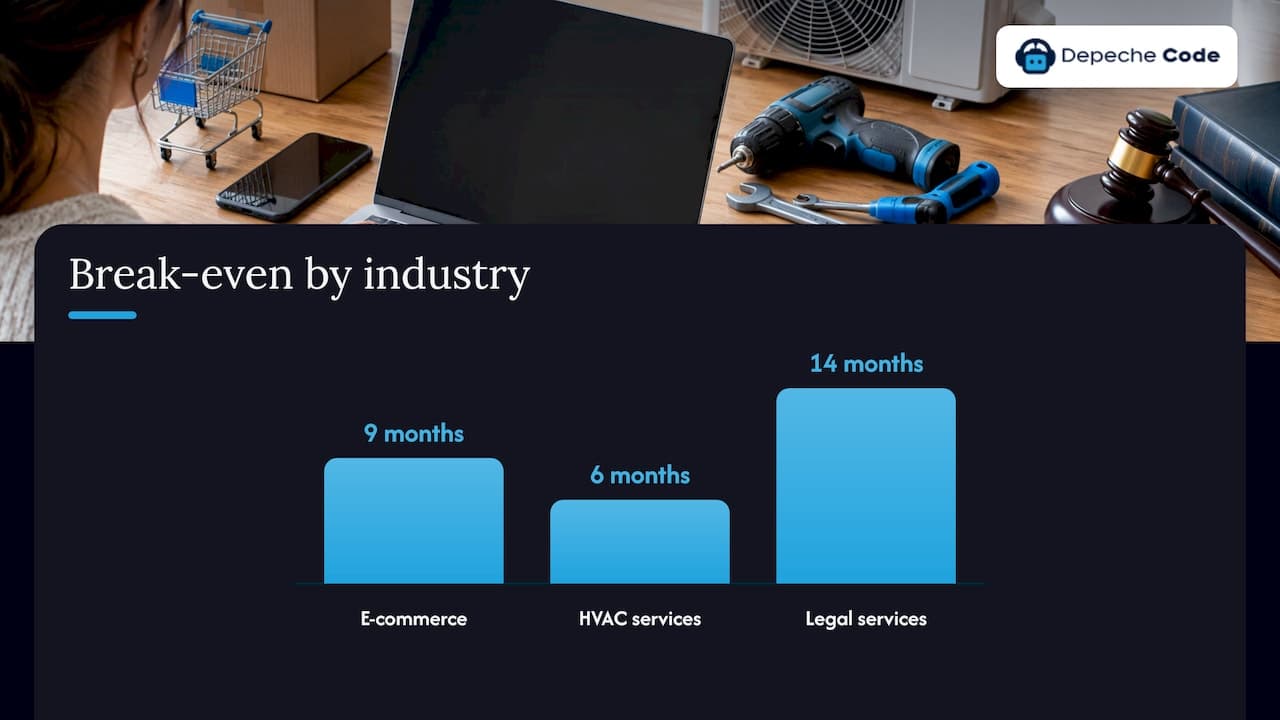
The case for it is the return. Search Engine Land’s SEO services statistics report cites an average ROI of about 22:1 and says 34% of qualified leads come directly from SEO. Those are averages across many campaigns. Industry matters: the same report shows e-commerce breaking even in about nine months and HVAC services in about six, while legal services take around fourteen.
If you want the fundamentals in plain terms first, our business guide to search engine optimization covers them. The rest of this article is the working plan.
The 7 steps of small business SEO in 2026
These are ranked by how much they usually move the needle for a business with one to a few locations and a modest budget.
1. Start with a fast, clean website
Everything else sits on top of your site. If pages load slowly, break on phones or hide your phone number, you pay for every visitor and convert few of them. Google’s guide stresses that your site should be easy for people and crawlers to use, and that it is built around the people visiting, not around tricks.
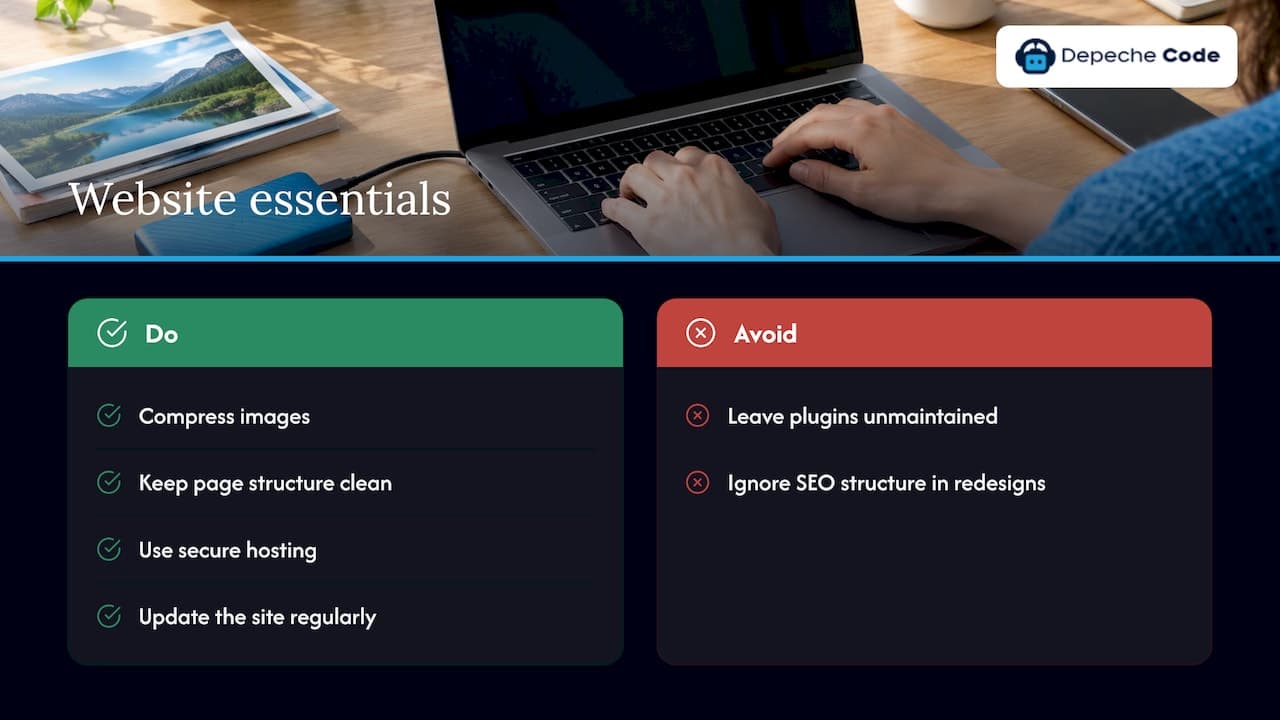
What it takes: a modern theme or custom build, compressed images, a clean page structure, secure hosting and regular updates. Where it goes wrong: an aging site loaded with plugins, left without maintenance for two years. Speed problems and outdated software build up quietly, and owners only notice when rankings slip.
This is why we measure our own builds against Google PageSpeed and SEO scores, and why we pair website design and redesign with hosting and maintenance. A redesign that ignores SEO structure often loses traffic the old site had earned.
2. Give every service its own page
Search Engine Land’s local SEO guide says a local business site should explain what the business does, where it is and how to reach it. Its key pages are the home page, contact, about, a unique page for every major product or service, and a reviews or testimonials page.
The common mistake is one “Services” page that lists everything in a paragraph. Google cannot rank one page for six different searches. A roofer who wants to be found for “roof repair”, “roof replacement” and “storm damage” needs three pages, each with real detail: what the job involves, typical timelines, photos, the areas served, and a clear way to call or book.
3. Match each page to search intent
Search intent is the reason behind a query. Someone typing “how to fix a leaking faucet” wants instructions. Someone typing “plumber Orlando” wants to hire. A page that answers the wrong intent will not rank, however well it is written.
Shopify’s senior SEO lead Kyle Risley makes the same point in a 2026 small business SEO guide: search the keyword yourself, and if Google shows mostly product or service pages, build that kind of page. He also suggests going after specific, longer phrases that bigger competitors skip. For a small business, “commercial HVAC maintenance contract Winter Park” is a better target than “HVAC”.
We explain how to read intent in what search intent is and why it decides rankings.
4. Build out your Google Business Profile
Your Google Business Profile is the free listing that appears in Google Maps and the local results box. For “near me” searches it often matters more than your website.
Search Engine Land’s local SEO coverage describes the core of it: the right primary and secondary categories, accurate name, address and phone, hours, services, photos and reviews. Shopify’s guide adds that Google ranks local results on relevance, distance and prominence. You cannot change distance, but you control the other two.
Practical points:
- Claim one profile per physical location, and never create a second profile for the same address.
- Pick the most specific primary category you can. “Personal injury attorney” beats “lawyer”.
- Keep hours current, including holidays. Wrong hours cost you customers and reviews.
- Add real photos of your work, team and premises, not stock images.
5. Keep your citations consistent
A citation is any mention of your business name, address and phone number on another site: directories, chambers of commerce, industry listings and maps. When those details disagree, Google has less confidence in which is right. A suite number written three ways across fifteen sites is a typical source of trouble.
The fix is an inventory, then cleanup, then new listings only where they add value. Our guide to building local citations the right way walks through it.
6. Earn reviews and respond to them
Reviews count toward prominence in local results, and they also decide whether a searcher picks you once they see you. Search Engine Land’s local SEO audit guide tracks average star rating and review count as audit items for exactly this reason.
Ask every satisfied customer at the moment the job is done, with a direct link to your review form. Reply to every review, positive or negative, politely and specifically. Do not offer rewards for reviews, which breaks platform rules.
7. Measure, then adjust
Google Search Console reports how your site performs in Google Search: which queries bring impressions, which pages get clicks and which have problems. Google’s Search Console help page says learning the basics takes under half an hour. The U.S. Chamber of Commerce’s SEO guide recommends starting with Search Console, Google Analytics 4 and Google Keyword Planner, all free Google tools.
What you want to see monthly: impressions and clicks for your service pages, calls and direction requests from your profile, and form submissions. Rankings alone mislead. Search Engine Land’s audit guide warns there is no single universal ranking position, because Google personalizes local results by where the searcher is standing.
A local SEO checklist for one location
Use this order when you audit your own market. It follows the audit logic in Search Engine Land’s local SEO audit guide, recorded in a simple spreadsheet.
- Profile: categories, name, address, phone, hours, services and photos are complete and match your website.
- Website basics: one page per service and per major service area, each with a clear call to action, your address and a phone number you can tap on mobile.
- Location terms: city, neighborhood and zip code appear naturally in titles, headings and body text, which is how local terms combine with service terms, per Search Engine Land.
- Citations: the same business details appear on every major directory, with duplicates removed.
- Reviews: current star rating, number of reviews, recency, and whether you reply.
- Links: local sites, suppliers, associations and press that point to you, and any broken links on your site.
- Tracking: Search Console and analytics are installed, and calls and form leads are counted.
Work through the list once, fix the gaps in the order above, then repeat each quarter. Our SEO best practices checklist goes deeper on the on-page side.
What small business SEO costs
There is no single price, because scope and competition vary so much. These figures give you the shape of the market:
| Figure | What it tells you | Source |
|---|---|---|
| Retainers rarely above $5,000 a month | The ceiling for most agency work | U.S. Chamber of Commerce |
| $497.16 a month, average small business spend (2019 research) | An older baseline, now low for most markets | Search Engine Land |
| Clients spending over $500 a month were 53.3% more likely to be extremely satisfied | Very small budgets tend to disappoint | Search Engine Land |
What drives price: how many locations you have, how crowded your market is, how much content must be written, the condition of your current site and how fast you want results. A single-location dental practice in a mid-size city needs a different plan from a multi-branch home services company competing in Orlando, Tampa and Miami.
Our Local SEO/AEO plans are scoped to match, and AEO (answer engine optimization) means preparing your content so AI answer tools can also pick it up.
How long it takes
Google’s SEO Starter Guide says changes can take anywhere from a few hours to several months to show in results, and suggests waiting a few weeks before judging an individual change. Search Engine Land’s statistics report puts the realistic window at 3 to 6 months for first signals and 6 to 12 months for a return on investment.
Plan your budget around that. The businesses that get the most from SEO commit to at least a year, because the early months are spent fixing the site, building pages and cleaning up listings, work that produces few visible wins at first and pays off over time. Stopping at month four throws away the groundwork.
For a closer look at how returns build over time, see our piece on SEO for business and lasting growth.
Where we fit in
Depeche Code is a full-service digital agency in Orlando. SEO rests on a site that is fast, well structured and maintained, so we handle the pieces together: website design and redesign, SEO plans (organic, local and combined), and WordPress hosting from $39 per month and maintenance from $99 per month. Our positioning is faster delivery through in-house directed AI, ownership of everything we deliver, and performance we measure with Google PageSpeed and SEO scores.
If you run a business that wants a provider to handle the site, the search work and the upkeep, see our services and tell us your market.

Our perspective
Most small business owners we talk to have already tried one tactic: a few blog posts, a directory listing, a profile they set up and forgot. SEO rarely fails because of one missing tactic. It fails because the parts are handled by different people who never compare notes: one builds the site, another writes content, nobody watches the listings.
We think the site, the local presence and the ongoing maintenance belong together. A fast site that is kept up to date gives every page you publish a better chance to be found. Clear pages for each service give your profile and listings something solid to point to. When we deliver work, you own it, and we measure the technical side with Google PageSpeed and SEO scores so progress is something you can see.
Our advice is to commit to a year, pick the services that make you the money, and build those pages first. Done in that order, SEO compounds.
Donovan Wells - Founder and CEO
FAQ
Is SEO worth it for a small business?
For most businesses with customers who search online, yes. Search Engine Land’s report cites an average return of about 22:1 and says 34% of qualified leads come from SEO. Results build over 6 to 12 months, so it works best as a long-term channel.
How much should a small business pay for SEO?
The U.S. Chamber of Commerce says most agency retainers do not go above $5,000 a month. Many small businesses land between $500 and a few thousand dollars monthly, depending on competition, number of locations and the work needed on the website.
How long does local SEO take to work?
Google says changes can take from hours to several months to appear. Industry data suggests first signals in 3 to 6 months. Local rankings can move faster when your Business Profile and citations were inconsistent at the start, because those fixes are quick.
What is the most important local SEO step?
A complete, accurate Google Business Profile with the right categories, matched by a website that has a dedicated page for each service and area. Those two together tell Google what you do and where, which is the basis for local rankings.
Sources
- SEO Starter Guide, Google Search Central
- Get started with Search Console, Google Search Console Help
- SEO services statistics, Search Engine Land
- What Is Local SEO?, Search Engine Land
- Local SEO Audit Guide, Search Engine Land
- SEO for Beginners, U.S. Chamber of Commerce
- Best SEO Strategies for Small Businesses in 2026, Shopify