

TL;DR:
- A website is the most valuable digital asset for businesses in 2026, building trust and generating leads.
- Those without websites risk losing credibility, visibility, and market reach as online research becomes essential.
A business website is the single most important digital asset a company owns in 2026, serving as the primary touchpoint between your brand and every potential customer searching online. Understanding why businesses need websites in 2026 goes beyond basic visibility. A website drives trust, generates leads, and compounds in value over time through search engine optimization (SEO) and conversion design. 63% of small businesses with websites rate them as extremely or very important to growth. That number tells you where the competitive floor is set.
Why businesses need websites in 2026 to build credibility
Customers expect a website before they trust a business. This expectation has hardened into a standard. A business without a website signals to buyers that it may not be legitimate, established, or worth their time. Websites build trust as the first digital touchpoint, especially as consumers rely on online research before making purchasing decisions.

Professional website design directly influences conversion rates. A cluttered layout, slow load time, or missing contact information tells a visitor to leave. The reverse is equally true: a clean, fast, and clearly branded site earns confidence before a single word is read.
The elements that build credibility online are specific and measurable:
- Mobile performance: Your site must load in under three seconds on a smartphone. Slow mobile sites lose visitors before the page finishes loading.
- Clear branding: Consistent logo, color palette, and tone signal that a real business operates behind the site.
- User experience (UX): Intuitive navigation reduces friction and keeps visitors moving toward a purchase or inquiry.
- Social proof: Customer reviews, case studies, and trust badges convert skeptical visitors into buyers.
- Contact accessibility: A visible phone number, address, and contact form remove the final barrier to engagement.
Pro Tip: Run your site through Google PageSpeed Insights monthly. A score below 70 on mobile is costing you customers and search rankings simultaneously.
Digital footprints built through websites improve business reputation, discoverability, and income generation. Every page you publish adds to that footprint and compounds your authority over time.
How websites drive business growth and lead generation
A website is not a brochure. It is a 24-hour sales system that works while you sleep, travel, and serve existing clients. Website traffic importance has increased for 61% of small businesses over the last couple of years. That shift reflects a fundamental change in how customers find and evaluate businesses before buying.
The growth mechanics of a well-built website operate across three layers:
- Search engine optimization (SEO): SEO positions your pages in front of people actively searching for what you sell. Organic search traffic compounds over months and years, unlike paid ads that stop the moment you cut the budget. Pairing your site with a solid SEO plan accelerates this compounding effect.
- Lead capture systems: Contact forms, quote request pages, email opt-ins, and AI chatbots convert anonymous visitors into named prospects. Without these systems, traffic arrives and leaves without a trace.
- Conversion-focused design: Strategic placement of calls to action, testimonials, and service descriptions guides visitors toward a specific next step. Design that ignores conversion leaves money on the table.
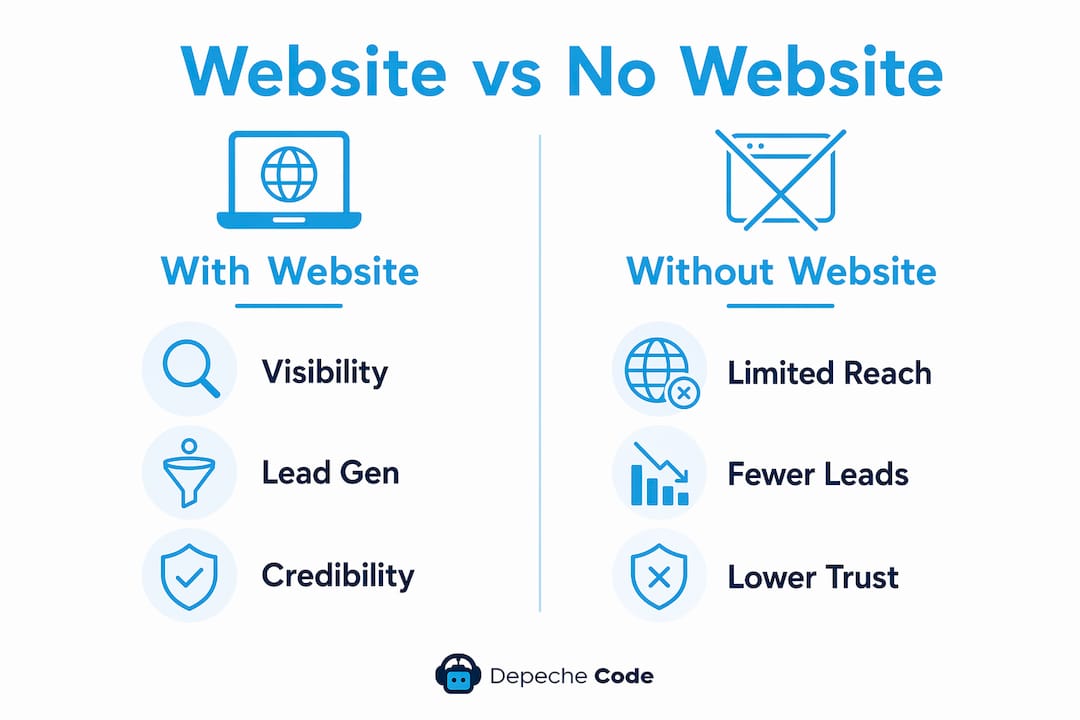
The gap between businesses with and without websites is widening. A business without a site competes only within its physical radius. A business with an optimized site competes regionally, nationally, or globally depending on its goals.
| Growth Factor | With a Website | Without a Website |
|---|---|---|
| Search visibility | High, grows with SEO | None |
| Lead capture | Automated, 24/7 | Manual, limited hours |
| Market reach | Regional to global | Local only |
| Customer trust signals | Immediate and measurable | Absent or weak |
| Long-term ROI | Compounds over time | No digital asset built |
Pro Tip: Add a lead magnet to your homepage, such as a free consultation, downloadable guide, or instant quote tool. Visitors who exchange their email address are far more likely to become paying customers than those who browse anonymously.
Treating a website as an ongoing growth lever rather than a static branding artifact produces significantly better business outcomes. The businesses winning online in 2026 update their content, test their conversion paths, and track their analytics every month.
What happens when businesses have no website?
Nearly one-third of SMBs still lack websites, and the cost of that gap is accelerating. The risks are no longer theoretical. They show up in lost revenue, missed leads, and shrinking market share.
The specific disadvantages of operating without a website in 2026 include:
- Invisible to AI search: Generative engine optimization (GEO) is the emerging discipline of getting your business cited by AI platforms like ChatGPT and Perplexity. AI search platforms increasingly cite web pages, meaning businesses without indexed content simply do not exist in AI-generated answers.
- Social media dependency: Relying solely on social platforms means your business presence lives on rented land. Algorithm changes, account restrictions, or platform shutdowns can erase your audience overnight.
- Directory limitations: Listings on Google Business Profile or Yelp provide basic information but cannot tell your brand story, capture leads, or rank for specific service keywords.
- Credibility deficit: Buyers who cannot find your website often assume your business is too small, too new, or not worth the risk.
The barriers business owners cite for not having a website, including cost, time, and technical complexity, are real but solvable. Entry-level website development options now exist at price points that fit nearly any budget. The cost of not having a site consistently outweighs the cost of building one.
Pro Tip: If you are concerned about budget, look for agencies that offer free or low-cost website development as a starting point. Depechecode, for example, offers a free website development option designed specifically for businesses that need to establish their online presence without a large upfront investment.
Key features of effective business websites in 2026
Not all websites deliver equal results. A site that looks good but loads slowly, ignores SEO, or lacks conversion elements will underperform regardless of how much was spent building it. Mobile performance, user experience, and conversion-focused design are now baseline requirements for any business site that expects to generate results.
Mobile-first performance
More than half of all web traffic arrives from mobile devices. A site that is not built for mobile first will lose those visitors before they read a single line of your copy. Mobile optimization means fast load times, touch-friendly navigation, and readable text without zooming.
SEO and content strategy
A website without SEO is a billboard in the middle of a forest. Search engine optimization connects your pages to the specific queries your customers type into Google. Consistent content publishing, proper keyword targeting, and technical SEO hygiene keep your site climbing in rankings over time. Understanding what SEO delivers for your business is the first step toward making it work.
Conversion architecture
Every page on your site should have a purpose and a next step. Service pages should lead to contact forms. Blog posts should lead to related services. Homepages should immediately communicate what you do, who you serve, and how to get started. Quality web design directly improves conversion rates and business results.
Analytics and ongoing improvement
Operationalizing a website means using tools like Google Analytics 4 and Google Search Console to track what is working and what is not. Businesses that review their website data monthly make better decisions about content, design, and marketing spend. A website that never gets updated is a website that slowly loses ground to competitors who do.
Key takeaways
A business website in 2026 is the foundation of every other digital marketing effort, and businesses that treat it as a living growth system consistently outperform those that do not.
| Point | Details |
|---|---|
| Websites build credibility | Customers expect a professional site before trusting or contacting a business. |
| Traffic importance is rising | 61% of SMBs report that website traffic has grown more important in recent years. |
| No website means no AI visibility | AI search platforms cite web pages, so businesses without sites are invisible to AI-driven results. |
| Growth requires active management | Websites that get regular SEO updates and conversion testing outperform static sites. |
| Mobile performance is non-negotiable | A slow or poorly designed mobile experience loses customers before they engage. |
The website mindset shift that changes everything
Most business owners I talk to think of their website as something they built once and can leave alone. That mindset is the single biggest reason websites fail to generate leads. A website is not a finished product. It is a system that requires the same attention you give your sales process or your customer service.
The businesses I have seen grow fastest online share one habit: they treat their website as a measurable asset with a clear return on investment. They know their monthly traffic numbers. They know which pages convert and which ones do not. They test new calls to action, update their service descriptions, and publish content that answers the questions their customers are actually asking.
The mistake I see most often is neglecting SEO after launch. A new website without SEO is like opening a store with no sign outside. You might get walk-in traffic occasionally, but you are leaving the majority of your potential customers to find your competitors instead. The second most common mistake is ignoring mobile performance. A site that scores poorly on mobile is penalized by Google and abandoned by visitors.
The good news is that fixing these problems is not complicated. It requires consistency, the right tools, and a willingness to look at data honestly. Business owners who make that shift stop asking whether they need a website and start asking how to make it work harder for them.
— Donovan
How Depechecode helps you build a website that works
Depechecode is a full-service digital agency based in Orlando that builds and optimizes websites specifically for business growth. Whether you are starting from scratch or need a complete redesign, Depechecode’s website design and development services are built around conversion, SEO, and long-term performance.
Every Depechecode website includes mobile optimization, clear conversion architecture, and technical SEO foundations from day one. For businesses ready to go further, Depechecode’s SEO plans drive ongoing organic traffic growth month after month. The agency also offers AI chatbot integration and social media management to complete your digital presence. If you are ready to turn your website into a real growth asset, Depechecode has the team and the track record to make it happen.
FAQ
Why do businesses need websites in 2026?
A website is the primary digital touchpoint for customer trust, lead generation, and search visibility. Without one, businesses are invisible to AI search platforms and lose credibility with buyers who research online before purchasing.
How does a website help a small business grow?
A website generates leads through SEO, contact forms, and conversion-focused design around the clock. Businesses with optimized sites reach regional or national markets instead of competing only within their local area.
What happens if a business relies only on social media?
Social media presence lives on platforms you do not own or control. Algorithm changes or account restrictions can eliminate your audience instantly, while a website is a permanent, owned digital asset.
What are the most important features of a business website in 2026?
Mobile performance, SEO, clear calls to action, and analytics tracking are the four features that separate high-performing websites from ones that generate little to no business value.
How do I know if my website is actually working?
Track monthly traffic, lead form submissions, and conversion rates using Google Analytics 4 and Google Search Console. If those numbers are flat or declining, your site needs SEO attention or a conversion design review.