

TL;DR:
- SEO combines technical, content, and off-site strategies to improve website rankings and attract targeted, unpaid traffic. It relies on a well-optimized technical foundation, search intent-aligned content, and external authority signals to achieve long-term growth. Most businesses hinder their SEO success by neglecting technical issues and focusing on shortcuts instead of genuine value.
Search engine optimization (SEO) is the practice of improving your website so search engines like Google can find, understand, and rank your pages higher in organic results, connecting you with customers who are actively searching for what you sell. SEO includes technical SEO, content SEO, and off-site SEO like link building and brand mentions, all working together to drive targeted, unpaid traffic. For business owners and marketers, that means more qualified visitors without paying for every click. A well-executed SEO strategy supports lead generation, sales, and long-term revenue growth in ways that paid advertising alone cannot sustain.
What is search engine optimization and why does it matter?
SEO is not a single tactic. It is a system of three interconnected disciplines: technical SEO, content SEO, and off-site SEO. Each one plays a distinct role, and weakness in any one area limits the performance of the others.

Technical SEO covers everything that helps search engines access and process your site. Site speed, mobile usability, crawlability, and clean URL structures all fall here. If Googlebot cannot reach your pages, your content will never appear in results regardless of how well it is written.
Content SEO focuses on creating pages that match what users are actually searching for. This means researching keywords, structuring content clearly, writing descriptive page titles, and using meta descriptions that accurately summarize each page. Keyword stuffing harms rankings; the goal is natural language that genuinely answers the searcher’s question.
Off-site SEO builds your site’s authority through external signals. Backlinks from credible websites, brand mentions, and social proof tell Google that other sources trust your content. A page with strong off-site authority ranks above a competitor with similar content but fewer external endorsements.
Here is how the three components interact in practice:
- A fast, mobile-friendly site (technical) allows Google to crawl and index your content pages.
- Well-structured content aligned to search intent earns clicks and time-on-page signals.
- Quality backlinks amplify that content’s authority, pushing it higher in results.
- Internal linking connects your pages so Google discovers your full site and distributes ranking strength across it.
Pro Tip: Start every SEO audit by checking whether Google can actually crawl your key pages. Use Google Search Console’s URL Inspection tool before spending time on content or link building.
How does search engine crawling, indexing, and ranking work?
Understanding the three-step process Google uses to evaluate your site removes a lot of guesswork from SEO decisions.
-
Crawling. Googlebot, Google’s web crawler, discovers pages by following links across the internet. It visits your site, reads your HTML, and queues pages for further processing. Your crawl budget, the number of pages Google will crawl in a given period, is finite. Sites with thousands of low-value pages waste that budget on content that will never rank.
-
Rendering and indexing. After crawling, Google renders the page, meaning it processes JavaScript and CSS to see the page as a user would. It then indexes the content, storing it in a massive database that search results are drawn from. Googlebot fetches up to 2MB per HTML resource, so content beyond that limit is simply ignored. This is why placing critical SEO elements, including title tags, meta descriptions, and primary keywords, near the top of your HTML document is not optional. It is a technical requirement.
-
Ranking. Once indexed, pages compete for positions based on relevance and quality signals. Google’s ranking depends on content, user experience, and backlinks, evaluated against the specific query a user types. A page about “commercial plumbing services in Orlando” ranks for that phrase when it clearly addresses the topic, loads quickly, and has earned links from relevant sources.
Two common pitfalls derail this process before it starts. First, a misconfigured robots.txt file can accidentally block Googlebot from entire sections of your site. Second, burying important content deep in JavaScript means Google may never render it at all. How content is delivered in HTML affects whether Google can properly index it, so server-side rendering or static HTML is always more reliable than client-side JavaScript for SEO-critical content.
Key stat: Google’s 2MB HTML fetch limit means a page bloated with inline scripts or base64-encoded images may have its most important content cut off entirely during crawling. Moving heavy CSS and JavaScript to external files is one of the highest-impact technical fixes available.
Why is SEO important for business owners and marketers?
SEO connects businesses with users actively searching for products or solutions, which makes it fundamentally different from display advertising or social media. A Facebook ad interrupts someone scrolling. An organic search result answers a question the user already asked. That distinction drives higher conversion rates and lower cost per acquisition over time.
The business case for SEO breaks down into four clear benefits:
- Cost efficiency. Organic traffic does not carry a cost-per-click. Once a page ranks, it generates visitors without ongoing ad spend. Paid search stops the moment you stop paying; SEO compounds over time.
- Brand authority. Appearing consistently at the top of results for your industry’s key terms builds credibility. Users trust Google’s judgment, and ranking well transfers some of that trust to your brand.
- High-intent traffic. Someone searching “best accounting software for small business” is closer to a purchase decision than someone who sees a banner ad. SEO captures that intent at the right moment.
- Marketing intelligence. Search data reveals exactly what your customers want, in their own words. Google Search Console and Google Analytics show which queries drive traffic, which pages convert, and where users drop off.
“SEO acts as a marketing channel that supports leads, sales, and revenue growth over time.” This is not a long-term gamble. It is a compounding asset that pays dividends the longer you invest in it.
The mistakes that undermine these benefits are predictable. Keyword stuffing, duplicating content across multiple pages, ignoring page speed, and neglecting mobile usability are the four most common ways businesses sabotage their own rankings. Each one signals low quality to Google and pushes pages down, not up. Explore organic SEO strategies that avoid these traps and build durable visibility instead.
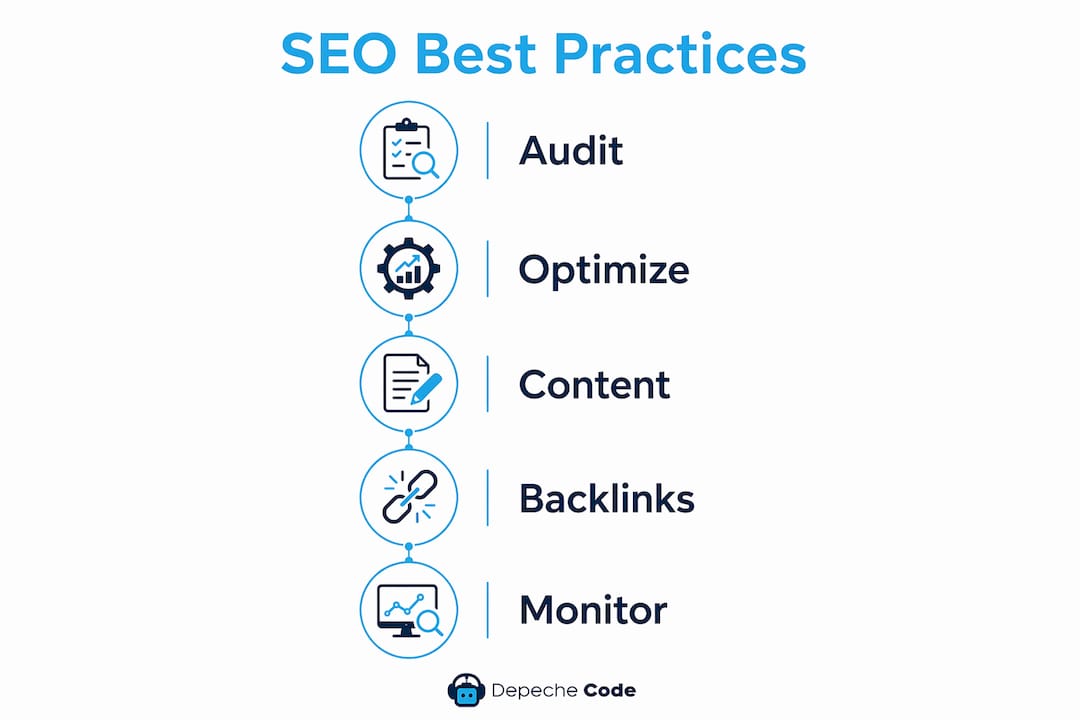
What are current SEO best practices to improve rankings?
SEO best practices in 2026 reflect both Google’s evolving algorithm and the rise of AI-powered search features like AI Overviews. The fundamentals have not changed, but the stakes for getting them right are higher.
| Practice | What it does | Priority |
|---|---|---|
| Descriptive, unique page titles | Tells Google and users exactly what the page covers | High |
| Concise meta descriptions | Improves click-through rate from search results | High |
| Internal linking | Helps Google discover pages and distributes ranking strength | High |
| Structured data markup | Enables rich results like star ratings and FAQs in search | Medium |
| Robots.txt and meta robots management | Controls which pages are crawled and indexed | High |
| Page speed and Core Web Vitals | Affects both ranking and user experience directly | High |
| Snippet eligibility controls | Determines how content appears in AI Overviews | Medium |
Use descriptive unique page titles, natural keywords, and internal links to give Google clear signals about your content’s topic and relevance. Each page on your site should target a specific search intent, not a broad topic. A page titled “Website Design Services for Small Businesses in Orlando” outperforms one titled “Our Services” in every measurable way.
Meta robots tags and X-Robots-Tag HTTP headers give you page-level control over crawling and indexing. Robots.txt blocks crawlers broadly, but meta tags let you control snippet display and indexing separately. Misusing these directives, for example adding a noindex tag to a page you want ranked, is a silent ranking killer that many business owners never catch.
For AI search specifically, page-level snippet controls affect how content appears in AI Overviews. Tags like nosnippet or max-snippet determine whether your content feeds into Google’s AI-generated answers. If you want visibility in AI Mode, your pages must meet technical requirements first. Google prioritizes technical accessibility before judging content eligibility for any search format, traditional or AI-driven.
Pro Tip: Review your robots.txt and meta robots settings quarterly. A single misplaced directive can remove an entire category of pages from Google’s index without triggering any obvious error in your analytics.
For a detailed checklist of what to audit and fix, the SEO best practices checklist from Depeche Code covers both technical and content elements in a format you can hand directly to your web team.
Key takeaways
SEO works because technical accessibility, relevant content, and external authority must all function together to produce consistent organic rankings and business growth.
| Point | Details |
|---|---|
| Three-part system | Technical SEO, content SEO, and off-site SEO each contribute to rankings and must work together. |
| Crawl limits matter | Google fetches only 2MB of HTML per page, so critical elements must appear early in the document. |
| Intent drives rankings | Pages aligned to specific search intent outperform broad, generic content in both rankings and conversions. |
| AI search changes the rules | Snippet eligibility controls now determine whether your content appears in Google’s AI Overviews. |
| SEO compounds over time | Unlike paid ads, organic rankings build authority and traffic that persist without ongoing spend. |
Why I think most businesses get SEO backwards
After working with dozens of business owners on their digital presence, I see the same pattern repeatedly. They invest in content before fixing their technical foundation, then wonder why their articles never rank. The reality is that matching SEO efforts to search intent only matters if Google can find and index your pages in the first place. A beautifully written blog post sitting behind a misconfigured robots.txt file is invisible.
The second mistake is chasing algorithm tricks instead of building genuine usefulness. Google’s ranking signals have grown sophisticated enough that shortcuts tend to backfire within a few algorithm updates. The businesses I have seen sustain top rankings over years are the ones that answered real questions better than anyone else in their space, not the ones that gamed anchor text ratios.
The third shift worth paying attention to is AI search. Google’s AI Overviews pull from pages that meet technical requirements and have clear snippet eligibility. If you are not managing your noindex, nosnippet, and max-snippet tags deliberately, you are leaving AI visibility to chance. The content strategy for 2026 has to account for both traditional rankings and AI-driven answers simultaneously.
My honest advice: fix your technical foundation first, then create content that genuinely serves your customers, then build authority through real relationships and earned links. In that order. Every time.
— Donovan
Ready to put SEO to work for your business?
Understanding SEO is the first step. Executing it consistently is where most businesses need support.
Depeche Code is a full-service digital agency based in Orlando that builds SEO-ready websites and manages search visibility for businesses across industries. From website design and development built on clean, crawlable architecture to SEO plans that cover technical audits, content strategy, and off-site authority building, every service is designed to produce measurable growth. If your site is not ranking where it should, the team at Depeche Code can identify exactly why and fix it. Reach out to explore which plan fits your goals.
FAQ
What does SEO mean in simple terms?
SEO stands for search engine optimization. It is the process of improving your website so search engines like Google rank it higher in results, driving more organic (unpaid) traffic to your pages.
How long does SEO take to show results?
Most businesses see meaningful ranking improvements within three to six months of consistent SEO work, though competitive industries can take longer. Technical fixes often produce faster results than content or link building.
What is the difference between technical SEO and content SEO?
Technical SEO ensures search engines can crawl and index your site, covering speed, mobile usability, and site structure. Content SEO focuses on creating pages that match what users search for, using relevant keywords and clear structure.
Does SEO still work with AI search in 2026?
Yes. Google’s AI Overviews and AI Mode still pull from indexed web pages, so foundational SEO remains critical. Pages must meet technical requirements and have appropriate snippet eligibility controls to appear in AI-generated answers.
What is the biggest SEO mistake business owners make?
The most damaging mistake is blocking search engines from crawling or indexing key pages through misconfigured robots.txt files or accidental noindex tags. High-quality content that Google cannot access will never rank, regardless of how well it is written.