

TL;DR:
- Web hosting quality significantly impacts website speed, uptime, security, and scalability.
- Different hosting types suit various business sizes and growth plans; choose wisely.
- Prioritize support and performance metrics over price for long-term digital success.
Most business owners set up their websites and never think about hosting again. That’s a mistake. Two businesses can run identical websites, yet one loads in under a second while the other takes four seconds to respond. The difference often comes down to hosting. Web hosting benchmarks show premium and cloud hosts hitting 89ms time to first byte with 99.99% uptime, while shared hosts average 150 to 200ms with lower reliability. For a business chasing every conversion, that gap is not trivial. This guide walks you through every major hosting type, what performance numbers actually mean, and exactly how to match a hosting plan to your business goals.
Table of Contents
- What is web hosting? The foundation of your online presence
- Types of web hosting explained: Shared, VPS, Dedicated, and Cloud
- Performance metrics that matter: Speed, uptime, and scalability
- How to choose the right web hosting for your business
- Why most businesses get web hosting wrong (and what actually matters)
- Elevate your business with expert hosting and digital solutions
- Frequently asked questions
Key Takeaways
| Point | Details |
|---|---|
| Web hosting defined simply | Web hosting is the service that keeps your website online and accessible to visitors. |
| Major hosting types | Businesses can choose from shared, VPS, dedicated, and cloud hosting depending on needs and budget. |
| Performance impacts business | Hosting choice affects website speed, uptime, and even SEO rankings. |
| Choose based on growth | It’s best to start with shared or VPS hosting and upgrade as your website and traffic expand. |
What is web hosting? The foundation of your online presence
Think of web hosting as renting space inside a building where your website lives. That building is a server, a powerful computer connected to the internet at all times, ready to send your website’s files to anyone who requests them. When someone types your web address into a browser, your host retrieves those files and delivers them in real time.
A common point of confusion is the difference between hosting and a domain name. Your domain is the address, like your street number, while hosting is the actual physical space where your content sits. You need both, but they are entirely separate services.
For businesses, understanding website hosting basics goes beyond simply getting a site live. Hosting directly affects:
- Availability: Whether your site is online 24/7 or prone to outages
- Speed: How fast pages load for visitors anywhere in the world
- Scalability: Whether your site can handle sudden traffic spikes without crashing
- Security: The baseline protection against hacks, malware, and data breaches
One myth worth addressing: many business owners think cheap hosting is fine because “it’s just file storage.” It is not. Your hosting environment shapes your security posture, your SEO performance, and your customer’s first impression.
Web hosting is not a commodity you buy once and forget. It is infrastructure that either supports your growth or quietly holds it back.
The main types of hosting are shared, VPS, dedicated, and cloud, and each carries very different implications for your business.
Types of web hosting explained: Shared, VPS, Dedicated, and Cloud
With a clear definition in mind, let’s break down the main categories of web hosting and how they compare.
Shared hosting puts your website on a server alongside hundreds or thousands of other sites. Resources like RAM and CPU are split across all of them. It is the most affordable entry point, making it popular with startups and bloggers. The catch? A traffic spike on someone else’s site can slow yours down. This is the infamous “noisy neighbor” problem. You can explore shared hosting plans if you are just starting out or running a low-traffic site.
VPS (Virtual Private Server) hosting partitions a physical server into isolated virtual environments. Your resources are dedicated to you, even though you share the hardware. Performance is more predictable, but some technical knowledge is required to manage a VPS environment effectively.

Dedicated hosting gives your business an entire server. No sharing, no neighbors, full control. It is the most powerful and expensive option, ideal for large ecommerce platforms or enterprises with strict compliance needs. Learn more about dedicated hosting for business if your site demands maximum reliability.
Cloud hosting spreads your site across a network of servers, so if one goes down, another picks up the load. It scales automatically and charges based on usage, which sounds ideal until billing complexity catches businesses off guard.
| Hosting type | Best for | Performance | Avg. monthly cost | Key risk |
|---|---|---|---|---|
| Shared | New/low-traffic sites | Moderate | $3 to $15 | Noisy neighbors |
| VPS | Growing businesses | Good | $20 to $80 | Needs sysadmin skills |
| Dedicated | Large enterprises | Excellent | $100 to $400+ | High cost |
| Cloud | Variable traffic sites | Excellent | Pay as you go | Complex billing |
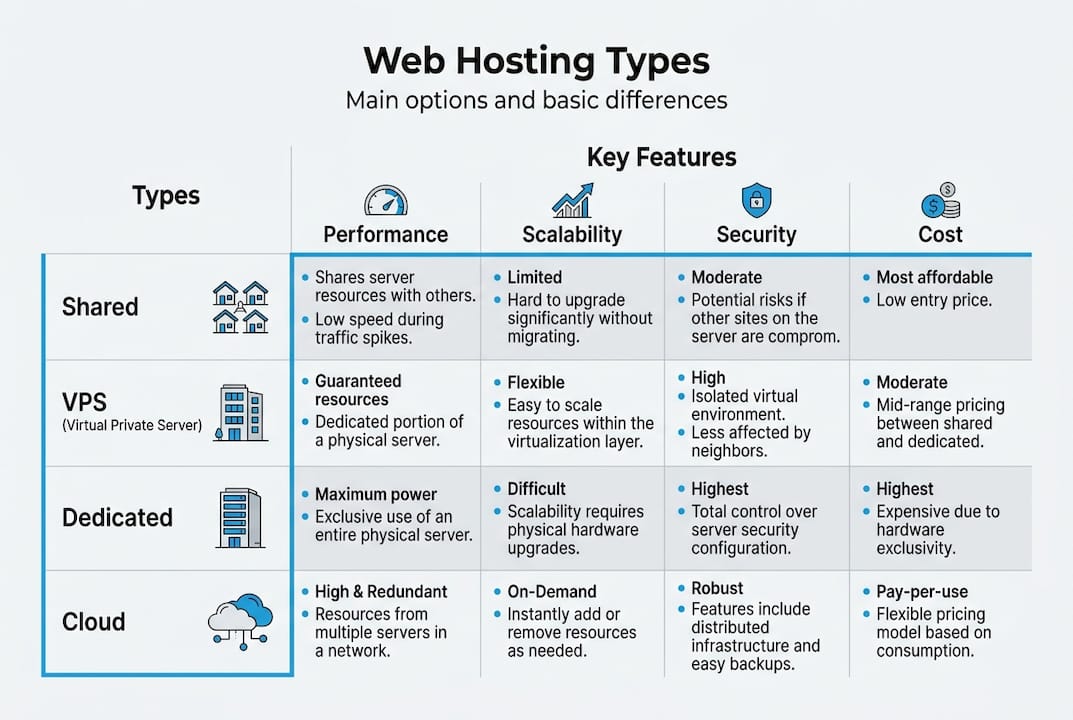
As noted in types of web hosting explained, each option carries edge case risks: shared hosting’s performance can be unpredictable, VPS demands server management skills, and cloud billing can escalate fast without proper monitoring. Before choosing, compare hosting options carefully against your actual traffic and technical capacity.
Performance metrics that matter: Speed, uptime, and scalability
Having explored types of hosting, let’s reveal how each stacks up for the metrics that shape your business’s digital reputation.
Time to First Byte (TTFB) is the time between a browser request and the first byte of data returning from the server. It is a direct measure of server responsiveness. A lower number means a faster-feeling site. Google uses it as a ranking signal.
Uptime percentage tells you how reliably your site stays online. 99.9% sounds impressive until you do the math: that still allows over 8 hours of downtime per year. For a business running online sales, even a few hours offline during peak season can mean thousands in lost revenue.
Scalability measures whether your hosting can absorb sudden traffic without degrading performance. A product going viral or a press mention can send traffic surging in minutes.
| Hosting type | Avg. TTFB | Typical uptime | Handles traffic spikes? |
|---|---|---|---|
| Shared | 150 to 200ms | 99.95% | Poorly |
| VPS | 100 to 150ms | 99.97% | Moderately |
| Cloud/Premium | ~89ms | 99.99% | Excellent |
Premium and cloud hosts consistently achieve 89ms TTFB with 99.99% uptime, compared to shared hosting’s 150 to 200ms average. Faster hosting reduces bounce rates and supports stronger SEO, two outcomes that directly affect revenue.
Pro Tip: When reviewing a host’s SLA (service level agreement), look for how they calculate uptime. Some providers exclude scheduled maintenance from downtime calculations, which inflates their published numbers. Always ask for third-party monitoring data.
It is also worth pairing strong hosting with solid website security practices, since your host sets the foundation but does not cover everything. Understanding the importance of web hosting decisions early prevents expensive fixes later.
How to choose the right web hosting for your business
Understanding performance is crucial, but making the right business decision means matching those facts with your specific goals.
Here is a practical step-by-step framework:
- Assess your current traffic. If you receive fewer than 50,000 visits per month, shared hosting is often sufficient and far more affordable. At 50,000 and above, VPS or cloud becomes worth the investment for consistent performance.
- Project your growth. If you expect significant traffic growth within 12 months, starting on a scalable plan saves you a painful migration later.
- Evaluate your security and compliance needs. Healthcare, finance, and ecommerce sites may require specific certifications or data handling practices that limit which hosting environments qualify.
- Measure your technical capacity. Can your team manage a VPS, or do you need a managed hosting service? Be honest here. Unmanaged servers left poorly configured are a security risk.
- Review support quality. Fast, knowledgeable support is not a luxury. At 2am when your site goes down before a product launch, response time matters enormously.
Pro Tip: Do not just match your current size to a hosting plan. Match your growth plan instead. If you are building toward 100,000 monthly visitors, start on a platform that can scale there without requiring a full migration.
Budget versus performance is a real tradeoff. Premium hosting can cost 5 to 10 times more than shared plans, but the return in uptime, speed, and SEO lift often justifies it for businesses with active marketing campaigns. Look at choosing the best hosting as an investment in your entire digital strategy, not just a technical line item. You can also explore hosting options tailored to different business sizes and stages. For businesses working with an agency, website hosting for agencies offers bundled support that reduces friction across your whole digital setup.
Why most businesses get web hosting wrong (and what actually matters)
Here is what we see repeatedly working with businesses across industries: they choose hosting based on price alone, and they pay for it later in ways that are hard to trace back to that original decision.
A site that loads slowly during a paid ad campaign quietly destroys its own ROI. A site that goes down during a seasonal rush loses customers who never come back. These losses rarely show up labeled as “hosting failure” in an analytics report, but that is exactly what caused them.
The “noisy neighbor” problem is real and underreported. On shared hosting, your performance is partially in the hands of whoever else is on that server that day. You have zero control over it.
We have also watched businesses skip support quality as a factor, only to find that cheap hosting providers take 48 hours to respond to urgent tickets. When your business-ready hosting decision also comes with responsive, technical support, you are not just buying server space. You are buying peace of mind and lost revenue prevention.
The smarter framing is this: hosting is not a cost center. It is infrastructure for growth. Businesses that treat it that way consistently outperform those that do not.
Elevate your business with expert hosting and digital solutions
At Depeche Code, we work with businesses every day that are frustrated by slow sites, unexpected downtime, or hosting plans they have outgrown. We offer professional web hosting built for real business performance, not just the minimum viable setup.

Beyond hosting, our team delivers full website design and development and proven SEO solutions that work together to drive traffic and convert visitors. Whether you are launching a new site or upgrading infrastructure that is holding you back, we can map out the right solution for your goals. Reach out to our Orlando-based team and let us build a digital presence that performs when it counts.
Frequently asked questions
How is web hosting different from a domain name?
Web hosting stores your website’s files and makes them accessible online, while a domain name is the web address people type to find your site. You need both, but they serve completely different functions.
Which type of web hosting is best for small business?
Shared hosting is cost-effective for most small businesses handling fewer than 50,000 monthly visits, but VPS or cloud hosting becomes the smarter choice as traffic and performance demands increase.
How do I know if my business needs to upgrade hosting plans?
You will need to upgrade if your traffic regularly spikes, your site slows down, or you need stronger security and custom features. Cloud hosting handles traffic fluctuations well, though billing complexity is worth planning for.
Does web hosting affect my website’s Google ranking?
Yes, hosting quality directly influences SEO. Hosts delivering 89ms TTFB and 99.99% uptime outperform shared hosts on speed metrics that Google uses as ranking signals, which also reduces bounce rates.