

TL;DR:
- Website optimization boosts search rankings, organic traffic, and conversions.
- Core Web Vitals and technical strategies are essential for ongoing performance improvement.
- Continuous, steady optimization outperforms one-time efforts and sustains long-term growth.
Most businesses treat their website like a digital brochure: build it, launch it, and wait. The problem is that waiting rarely works. Search engines rank sites based on performance signals, content quality, and user experience factors that a basic setup simply can’t satisfy. Skipping optimization means competitors with comparable products but better-tuned websites will consistently outrank you, capturing the leads and revenue you could have earned. This article breaks down what website optimization actually delivers in measurable terms, the methods that move the needle, the mistakes that undermine your efforts, and how to build a process that compounds results over time.
Table of Contents
- The real-world impact of website optimization
- Key optimization methods that drive success
- Risks and pitfalls: Getting optimization wrong
- Ongoing optimization: Auditing and continuous improvement
- Our perspective: What most guides miss about website optimization
- Take the next step in optimizing your website
- Frequently asked questions
Key Takeaways
| Point | Details |
|---|---|
| Optimization boosts visibility | Well-optimized sites achieve higher Google rankings and receive more organic traffic. |
| Technical and content strategies matter | Both technical improvements and relevant content are essential for real growth. |
| Avoid common pitfalls | Over-optimization or technical errors can harm performance and lead to penalties. |
| Treat optimization as ongoing | Routine audits and continuous adjustments are necessary to sustain results. |
The real-world impact of website optimization
Most websites underperform not because of weak products or poor writing, but because of invisible technical and content gaps that prevent search engines from surfacing them. Slow load times, unoptimized images, and shallow page content all work against you quietly. Website optimization improves search visibility, organic traffic, and rankings by enhancing Core Web Vitals and SEO factors, making these fixes far from optional.
The data makes the business case clearly. 62% of top-10 Google results pass all Core Web Vitals, and sites that pass see 18% higher organic traffic on average. That gap between passing and failing sites directly translates to how many potential customers actually find your pages.
“Optimization isn’t a one-time project. It’s the ongoing decision to make your site easier to find, faster to load, and more valuable to visit than your competitors’.”
Real business outcomes back this up. A jewelry retailer that improved page load speed by 65% recorded a 29% increase in conversions, a gain that would have been impossible through ad spend alone at the same cost. That’s the core advantage: organic visibility built through optimization generates leads at a fraction of the cost per acquisition compared to paid channels.
Here’s what businesses gain when they invest in optimization:
- Higher search rankings for target keywords, driving consistent organic traffic
- Lower bounce rates because fast, well-structured pages keep visitors engaged
- Better conversion rates because user experience improvements reduce friction
- Compounding ROI as rankings and traffic build over months rather than resetting with every ad budget cycle
- Reduced acquisition costs compared to pay-per-click campaigns for the same volume of leads
Understanding SEO for business ROI helps frame optimization not as a cost but as a revenue investment. For businesses looking at the broader picture of what optimization involves, website optimization tips from credible sources provide a solid starting framework.
Key optimization methods that drive success
Knowing the payoff is motivating. Knowing exactly how to achieve it is what separates businesses that grow organically from those that stay stuck. Optimization methods fall into two broad categories: technical performance and content strategy, and both must work together.
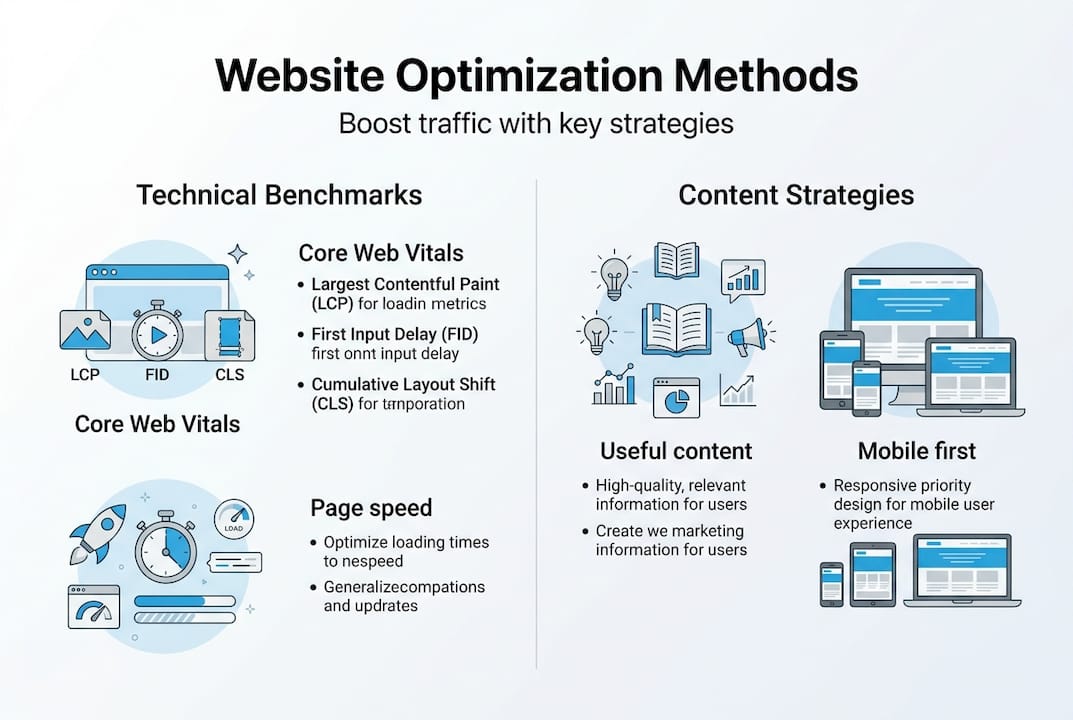
Core Web Vitals are the clearest technical benchmark. They measure three things: Largest Contentful Paint (LCP, how fast the main content loads), Interaction to Next Paint (INP, how responsive the page feels), and Cumulative Layout Shift (CLS, how visually stable the page is). Each has a measurable threshold, and Google uses them as ranking signals.

Here’s a quick reference for what each metric means and its target threshold:
| Metric | What it measures | Target threshold |
|---|---|---|
| LCP | Main content load speed | Under 2.5 seconds |
| INP | Page interactivity/responsiveness | Under 200 milliseconds |
| CLS | Visual stability during load | Under 0.1 |
Beyond Core Web Vitals, a handful of technical tactics deliver the biggest gains. Image optimization with WebP/AVIF formats and lazy loading alone can improve LCP by 30 to 50%, while a CDN (content delivery network) reduces load time by up to 52%. Currently, 51% of sites pass all Core Web Vitals, meaning nearly half your competitors may be handing you a ranking advantage if you act.
Here are the core optimization steps to prioritize:
- Convert images to WebP or AVIF and enable lazy loading to defer off-screen images
- Minify JavaScript and CSS to reduce file sizes that slow initial page rendering
- Implement a CDN to serve assets from servers closer to your users geographically
- Audit mobile performance separately, since mobile-first design directly affects how Google indexes your site
- Run monthly scans with Google PageSpeed Insights to catch regressions before they affect rankings
For deeper technical implementation, performance best practices from MDN provide reliable, up-to-date guidance. Additional context on integrating these into your build is covered in our web development tips for 2026.
Pro Tip: Don’t chase perfect scores on every minor metric. The biggest gains come from fixing the fundamentals: image formats, lazy loading, and server response time. Everything else is incremental.
Risks and pitfalls: Getting optimization wrong
Optimization provides outsized benefits, but some approaches can backfire, sometimes severely. The most common mistake is treating optimization as an aggressive intervention rather than a careful calibration.
Keyword stuffing is still practiced, and it still triggers algorithmic penalties. Repeating target keywords unnaturally across a page doesn’t signal relevance to Google. It signals manipulation, and rankings suffer for it. The same logic applies to building thin content pages purely to target long-tail variations.
Over-optimization risks include triggering penalties, and technical inconsistencies like trailing slash and canonical mismatches split your SEO signals across duplicate URLs. This means Google may be crediting ranking power to a version of your page you didn’t intend, diluting the authority of your primary URL.
Here’s a comparison of common optimization approaches and their actual outcomes:
| Approach | Intended effect | Actual risk |
|---|---|---|
| Keyword stuffing | Higher keyword rankings | Algorithmic penalty, ranking drop |
| Excessive redirects | Clean URL consolidation | Slower load time, crawl budget waste |
| Noindex URLs in sitemaps | Prevent indexing of weak pages | Confuses crawlers, wastes crawl budget |
| Chasing every CWV point | Better performance scores | Diminishing returns past thresholds |
Other pitfalls worth flagging:
- Session or preview URLs accidentally getting indexed create duplicate content problems
- Inconsistent trailing slashes across internal links signal different URLs to search engines
- Structural changes without a proper redirect strategy cause ranking loss
Before any significant site restructure, working through a website redesign checklist protects the rankings you’ve already built. More on how to handle SEO signals during a redesign is covered in our guide on enhancing redesign with SEO. For a broader view of what to avoid, the optimization pitfalls resource is worth reviewing before you start.
Pro Tip: After any structural change to your site, monitor Google Search Console for new crawl errors and duplicate URL reports within the first two weeks. Catching these early prevents long-term ranking damage.
Ongoing optimization: Auditing and continuous improvement
Avoiding pitfalls is part of the job. The other part is recognizing that optimization isn’t a project you complete and archive. User behavior shifts, Google updates its ranking systems, and your competition keeps improving. Static websites lose ground slowly, then suddenly.
Regular audits using PageSpeed Insights and Google Search Console give you the actionable feedback loop needed to catch regressions, find new opportunities, and track whether your changes are actually working. A/B testing page elements like headlines, form layouts, and call-to-action placement creates iterative improvements that stack up over time.
“Businesses that treat optimization as an ongoing discipline consistently outperform those that treat it as a one-time launch task, often doubling their organic visibility within 12 months.”
Here’s a practical monthly optimization cycle:
- Run a PageSpeed Insights audit on your top 10 landing pages and note any metric regressions
- Check Search Console for crawl errors, manual actions, index coverage issues, and new keyword opportunities
- Review top-exit pages using analytics to find where users are dropping off and why
- Update at least two pieces of content to improve depth, relevance, and alignment with current search intent
- Test one page element (headline, CTA, form length) with an A/B experiment tied to a conversion goal
Understanding conversion rate benchmarks helps you measure whether your optimization work is producing results relative to industry standards. Our website development guide walks through how to structure both initial builds and ongoing optimization cycles for maximum compounding effect.
The businesses that see the biggest long-term gains aren’t the ones who ran one aggressive optimization sprint. They’re the ones who built a repeatable monthly process and stuck to it.
Our perspective: What most guides miss about website optimization
Most optimization content focuses on chasing scores: hit a 90+ on PageSpeed, pass every Core Web Vital, fix every crawl error. We’ve worked with enough businesses to know that score chasing is a distraction when your content doesn’t actually answer what your audience is searching for.
Core Web Vitals are a minor signal, not a ranking engine. The sites consistently pulling organic traffic lead with genuine content value, clear site structure, and strong topical authority. Technical health removes barriers. Content creates the pull.
The smarter approach is to treat your website like a product, not a project. Your custom web solutions should reflect your audience’s real questions and needs, not just keyword targets. Every technical fix you make is amplified when the content it serves is actually worth reading.
Consistency beats intensity here. Small, steady improvements in page speed, content depth, and accessibility compound over 12 to 24 months into rankings that are hard for competitors to dislodge. The businesses that panic-optimize after every algorithm update never build that compounding foundation. The ones that stay consistent do.
Take the next step in optimizing your website
Reading about optimization is one thing. Implementing it in a way that moves your actual business metrics is another, and that’s exactly where having the right partner makes the difference.
At Depeche Code, we specialize in helping businesses across industries turn underperforming websites into lead-generating assets. From technical audits and website design and development to tailored SEO options and plans that fit your budget and growth stage, our team builds and optimizes with measurable outcomes in mind. When you’re ready to turn these insights into real visibility and revenue, we’re here to make it happen.
Frequently asked questions
What are the most important website optimization metrics?
The most important metrics are Core Web Vitals (LCP, INP, CLS) alongside mobile performance, organic traffic volume, and conversion rates. Key methodologies like image optimization, minification, and CDN implementation directly influence these scores.
How often should I optimize my website?
You should audit and optimize your website at least quarterly, adjusting for new technologies, content gaps, and search trends. Ongoing audits and A/B tests provide the continuous feedback needed to sustain gains.
Can website optimization really affect sales or lead generation?
Yes. Load improvements of 29 to 65% in documented case studies produced 18 to 34% gains in organic traffic and conversions, demonstrating a direct link between performance and revenue.
Are there risks to over-optimizing a website?
Yes. Over-optimization can trigger penalties and canonical inconsistencies split SEO signals across duplicate URLs, both of which reduce visibility. Balance technical fixes with content relevance and real user experience.