

TL;DR:
- Most businesses fail to see significant SEO improvements because they lack a repeatable, structured process rather than effort alone. Implementing a clear workflow across discovery, on-page optimization, technical health, and local SEO ensures measurable progress and avoids reactive fixes. Focusing on process, regular audits, and adapting content for AI search positions websites for sustained growth and higher rankings.
Most businesses publish content, tweak their pages, and wait. Months pass. Rankings barely move. The problem usually isn’t effort — it’s the absence of a repeatable, structured process. Random SEO tactics produce random results. When you replace guesswork with a clear workflow, every action compounds on the last, and measurable progress becomes the norm rather than the exception. This guide walks you through each stage of a proven SEO process, from initial setup and research through on-page optimization, technical health, local visibility, and AI-ready content.
Table of Contents
- What you need before you start: prerequisites and tools
- The step-by-step SEO process: the big-picture workflow
- Discovery and research: laying the groundwork
- On-page SEO: optimizing pages for maximum impact
- Technical SEO, authority, and ongoing debugging
- Local SEO: special considerations for local and multi-location businesses
- Content optimization for AI search: preparing for the future
- Why most SEO processes fail — and what actually works
- Take your SEO process further with expert support
- Frequently asked questions
Key Takeaways
| Point | Details |
|---|---|
| SEO is a process | Treat SEO as a structured, repeatable workflow, not a series of scattered tasks. |
| Audit and research first | Start each project with a website and competitor audit to guide efforts for the best ROI. |
| Optimize on-page elements | Every web page should follow a checklist covering URLs, metadata, intent, and usability. |
| Keep technical health | Regularly debug and maintain your site’s crawlability, speed, and authority signals. |
| Plan for AI search | Future-proof your content for AI search by focusing on clarity, structure, and entity usage. |
What you need before you start: prerequisites and tools
Before you roll up your sleeves, it’s critical to have the right foundation and resources set up. Jumping straight into keyword research without analytics access or a functioning website is like building a house without blueprints.
Essential prerequisites checklist:
- Admin access to your website’s CMS (content management system)
- Google Search Console and Google Analytics installed and verified
- A baseline SEO tool for keyword and rank tracking
- A clear understanding of your target audience and business goals
- Access to your site’s hosting and DNS settings for technical fixes
Core SEO execution is structured into three pillars: keyword discovery and content creation, on-page optimization, and technical health plus authority building. Your toolset should support all three.
Must-have vs. nice-to-have tools:
| Tool category | Must-have | Nice-to-have |
|---|---|---|
| Analytics | Google Analytics 4 | Hotjar, Microsoft Clarity |
| Search performance | Google Search Console | Bing Webmaster Tools |
| Keyword research | Ubersuggest or free tier tools | Ahrefs, Semrush paid plans |
| Technical auditing | Screaming Frog (free version) | DeepCrawl, Botify |
| Rank tracking | Google Search Console | AccuRanker, SERPWatcher |
| Content optimization | Surfer SEO or Clearscope | MarketMuse |
Most small businesses can start with free tools and upgrade as results justify the cost. If you’re using a website template for marketers, make sure it supports clean URL structures and fast load times before adding any SEO layer.
Common setup mistakes to avoid:
- Installing analytics after publishing content (you lose historical data)
- Skipping Google Search Console verification (you’ll have no crawl visibility)
- Assigning SEO solely to a marketer without developer access for technical fixes
- Using a tool without understanding what it measures
Pro Tip: Assign clear ownership before you start. Someone needs to own keyword research, someone needs to handle technical fixes, and someone needs to publish and update content. Blurring these roles creates bottlenecks.
The step-by-step SEO process: the big-picture workflow
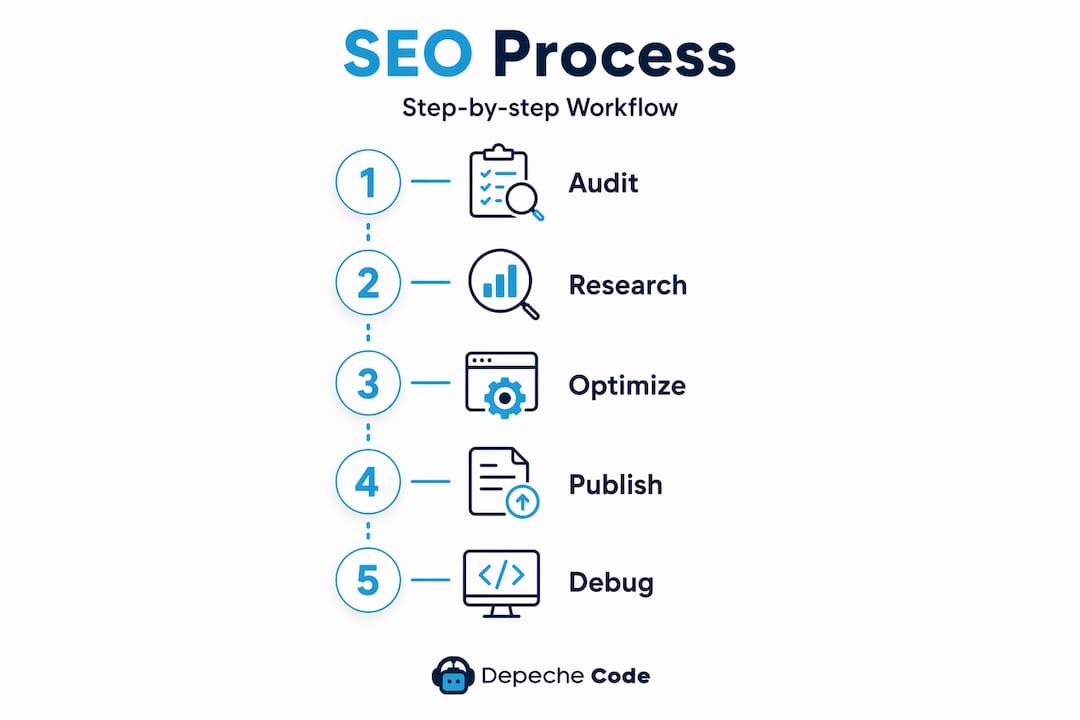
With your tools and access in place, it’s time to map out the process from start to finish. Think of SEO in three repeating phases, not a one-time project.
The three core phases:
- Discovery and research — Audit current performance, identify keywords, analyze competitors
- On-page optimization — Optimize URLs, metadata, headings, content, and internal links
- Technical and authority building — Fix crawl issues, improve speed, earn backlinks
Before touching a single page, audit what you already have. Many businesses skip this and waste weeks optimizing pages that are already ranking or fixing issues that don’t exist.
Phase overview table:
| Phase | Primary objective | Key output |
|---|---|---|
| Discovery | Understand current state and opportunities | Keyword map, competitor gaps |
| On-page | Align pages with search intent | Optimized page list |
| Technical | Ensure search engines can find and rank you | Technical audit report |
| Authority | Build credibility and trust signals | Backlink targets, E-E-A-T plan |
When rankings drop or plateau, a structured SEO debugging workflow helps you diagnose the real cause rather than applying random fixes.
“The biggest SEO mistake is treating it as a one-time project. Search engines evolve, competitors update their content, and your site’s technical health drifts. Process beats tactics every time.”
Discovery and research: laying the groundwork
To drive results, you must begin with research and a clear understanding of the competition and keyword landscape. Skipping this step is the single biggest reason SEO campaigns stall.

Start with a visibility audit. Pull your top pages from Google Search Console, sorted by impressions and clicks. Identify which pages are close to ranking on page one (positions 8 to 15) — these are your fastest wins. Then look for pages with high impressions but low click-through rates, which signals a metadata problem.
Keyword research priorities:
- Focus on keywords with clear business value, not just high search volume
- Separate informational keywords (blog content) from transactional ones (service pages)
- Use keyword gap analysis to find terms your competitors rank for that you don’t
- Analyze search intent for every target keyword before writing a single word
Competitor analysis is a distinct step that improves prioritization by benchmarking SERP intent, competitor content, keywords, and backlinks. Do this before creating new content, not after.
The top two positions in Google capture a dramatically higher share of clicks than positions three through ten combined. That gap in click-through rate is why ranking on page two is essentially invisible to most searchers.
Pro Tip: Build a simple competitor matrix. List your top three to five competitors, then note their top five ranking pages, their domain authority, and their content format. This takes under an hour and shapes your entire content strategy.
Your AI-driven SEO content strategy should be anchored in this research phase, not built on assumptions about what your audience wants.
On-page SEO: optimizing pages for maximum impact
Once you know what to target, it’s time to fine-tune your site’s pages for both users and search engines. On-page SEO is where research becomes action.
Repeatable on-page checklist:
- URL structure — Keep URLs short, descriptive, and keyword-rich. Avoid dates and random strings.
- Title tags — Include the primary keyword near the front. Keep it under 60 characters.
- Meta descriptions — Write a compelling 150-character summary that matches search intent.
- Heading structure — Use one H1 per page. Use H2s and H3s to organize subtopics logically.
- Content and intent alignment — Match the page’s content format to what ranks (list, guide, product page).
- Internal links — Link to related pages using descriptive anchor text.
- Schema markup — Add structured data for articles, products, FAQs, and local businesses.
- Image optimization — Compress images, add descriptive alt text, and use modern formats like WebP.
- Core Web Vitals — Check page speed, interactivity, and visual stability scores.
On-page SEO should be implemented as a repeatable checklist covering URLs, title tags, meta descriptions, heading structure, intent alignment, internal links, schema, images, and Core Web Vitals. Treat it like a quality control process, not a one-time task.
What most businesses miss:
- Duplicate title tags across multiple pages
- Thin content on service pages (under 400 words with no supporting detail)
- Missing alt text on product or portfolio images
- No internal linking strategy, leaving new pages isolated
Pro Tip: Add FAQ schema to any page that answers common questions. This increases your chances of appearing in rich results and AI-generated answer boxes, which are becoming a larger share of search real estate.
Your SEO content optimization process should revisit every key page at least once per quarter to keep content fresh and aligned with current search intent.
Technical SEO, authority, and ongoing debugging
On-page isn’t enough. You’ll also need a plan for technical health and ongoing troubleshooting.
Key technical areas to maintain:
- Crawlability — Ensure your robots.txt file isn’t blocking important pages
- Indexation — Check for noindex tags applied to pages that should rank
- Site speed — Target a Largest Contentful Paint (LCP) under 2.5 seconds
- Mobile-friendliness — Use Google’s mobile usability report in Search Console
- Security — Maintain HTTPS across all pages, including redirects
When visibility drops or stalls, use a structured debugging workflow rather than applying random fixes. The sequence is: crawl, render, index, rank, click. Work through each layer before jumping to conclusions.
Systematic debugging steps:
- Confirm Googlebot can crawl the page (check crawl errors in Search Console)
- Verify the page renders correctly (use Google’s URL Inspection tool)
- Confirm the page is indexed (run a site: search for the specific URL)
- Check ranking position for the target keyword
- Analyze click-through rate from Search Console data
Common technical mistakes:
- Redirect chains longer than two hops
- Slow server response times caused by unoptimized hosting
- Broken internal links that create dead ends for crawlers
- Missing XML sitemap or outdated sitemap entries
Pro Tip: Keep your “debug and fix” workstream completely separate from your “build and grow” workstream. Mixing them causes both to suffer. Schedule dedicated time each month for technical audits.
For ongoing SEO technical troubleshooting, a structured plan beats ad-hoc fixes every single time.
Local SEO: special considerations for local and multi-location businesses
If you rely on local customers, add these dedicated steps to your SEO process. Local SEO operates on a different track from national or global SEO, and mixing the two creates confusion and wasted effort.
Local SEO adds a separate execution track: manage your Google Business Profile, reviews, citations, on-page and local structured data, and local technical checks.
Local SEO checklist:
- Claim and fully optimize your Google Business Profile (categories, photos, hours, services)
- Build consistent NAP (name, address, phone) citations across directories
- Actively request and respond to customer reviews
- Add LocalBusiness schema markup to your website
- Create location-specific landing pages if you serve multiple areas
- Embed a Google Map on your contact page
Key differences from standard SEO:
- Local pack rankings depend heavily on proximity, relevance, and prominence
- Review velocity (how frequently you get new reviews) directly affects local rankings
- Citation consistency matters more for local than for national campaigns
Pro Tip: For multi-location businesses, create a separate Google Business Profile for each location and a dedicated landing page for each. Never combine locations into one profile — it confuses both Google and your customers.
Your local SEO starter tasks should be treated as a parallel workflow, not an afterthought added to your standard SEO checklist.
Content optimization for AI search: preparing for the future
With fundamentals in place, you can stay ahead by adapting your content for where search is headed. AI-powered search features are reshaping how results are displayed and how users find answers.
Modern content optimization must align with AI search considerations, not just classic web ranking signals. This means writing for entities and context, not just keywords.
Steps to optimize for AI search:
- Use clear entity language (specific people, places, products, and concepts)
- Build E-E-A-T signals: demonstrate Experience, Expertise, Authoritativeness, and Trustworthiness
- Add multimedia (images, video, infographics) to improve engagement signals
- Structure content with clear headings, short paragraphs, and direct answers
- Make content accessible: proper alt text, readable fonts, logical page structure
AI-generated answers in search results are pulling from pages that are well-structured, authoritative, and directly answer specific questions. Pages that bury the answer in long introductions get passed over.
Pro Tip: Test your top pages in AI search tools like Google’s AI Overviews and note whether your content appears. If it doesn’t, look at how the featured content is structured and reformat your page to match.
Your AI-ready SEO starter plan should include a quarterly review of how AI search features are displaying your content and which pages need structural updates.
Why most SEO processes fail — and what actually works
After covering the tactical details, it’s worth stepping back to understand why process matters more than any single trick. We’ve worked with businesses that had excellent content and still saw flat results. The common thread was always the same: they were executing tactics without a system.
The tactics-first approach feels productive. You write a blog post, optimize a page, fix a few broken links. But without a repeatable workflow, these actions don’t compound. You end up redoing work, missing obvious gaps, and reacting to ranking drops instead of preventing them.
The hardest lesson is that debugging and content creation must be kept separate. When you mix them, content quality drops because writers are distracted by technical issues, and technical fixes get deprioritized because content deadlines feel more urgent.
Another common failure: mixing local and national SEO activities into one undifferentiated checklist. Local signals (reviews, citations, proximity) have almost no impact on national rankings, and vice versa. Keeping them separate saves time and produces cleaner results.
Our practical recommendations for business owners:
- Build an internal dashboard that tracks rankings, traffic, and conversions weekly
- Review competitor data monthly — their strategy shifts are signals for yours
- Revisit your keyword map every quarter to account for new search trends
- Schedule a dedicated technical audit every 60 days
When you’re diagnosing SEO stalls, the answer is almost always a process gap, not a missing tactic.
Take your SEO process further with expert support
Knowing the process is one thing. Executing it consistently across research, on-page work, technical audits, and local optimization is another challenge entirely — especially when you’re running a business at the same time.

At Depeche Code, we’ve built our SEO plans specifically around this structured, phase-based workflow. Whether you’re starting from scratch with our AI Organic SEO Starter or need to dominate your local market with our Local SEO Starter, we handle the execution so you can focus on your business. Every plan includes a customized audit, keyword mapping, on-page optimization, and ongoing performance monitoring. Reach out today to find out which plan fits your goals.
Frequently asked questions
What are the critical first steps in an SEO process?
Begin by auditing your current website, analyzing competitors, and building a keyword map. An SEO content process starts with auditing existing pages, mapping keywords by business value, then optimizing on-page elements and building internal links after publishing.
When should competitor analysis be done in the SEO workflow?
Do it early — right after your initial audit and before creating or updating any content. Competitor analysis improves prioritization by benchmarking SERP intent, competitor content, keywords, and backlinks.
How do I know if technical SEO issues are hurting my rankings?
Run a structured crawl-to-click debugging workflow to isolate the problem. When rankings stall, a systematic debugging approach finds the root cause faster than random fixes.
What makes local SEO different from regular SEO?
Local SEO requires managing your Google Business Profile, building citations, and ensuring NAP consistency — steps that don’t apply to national campaigns. Local SEO runs as a separate execution track with its own ranking signals and priorities.
How do I optimize my content for AI-powered search?
Focus on entity-rich language, clear structure, E-E-A-T signals, and direct answers. Aligning content with AI search considerations — not just classic ranking factors — improves your visibility in AI-generated results.