TL;DR:
- A managed website service provides ongoing technical support, including hosting, security, and content updates, under a single plan. It differs from managed hosting by offering comprehensive site management, support, design, and SEO assistance, not just server maintenance. Small and mid-sized businesses benefit from protected, fast, and well-maintained websites that support growth and reduce risks.
A managed website service is a comprehensive, ongoing support arrangement where a professional team handles every technical aspect of your website, including hosting, security, updates, and maintenance, so you can focus on running your business. Unlike a one-time website build, this model treats your site as a living asset that requires constant attention. Business owners who adopt managed website solutions report fewer technical emergencies, stronger site performance, and more predictable costs. This guide explains exactly what these services include, how they differ from a basic managed web hosting service, and what to look for when choosing a provider.
What does a managed website service include?
A managed website service covers far more than keeping a server running. It wraps hosting, security, content updates, and technical support into a single ongoing package delivered by a dedicated team.
The core components typically include:
- Hosting and infrastructure management. Your site lives on maintained servers with proactive monitoring to catch issues before visitors notice them.
- Security monitoring and malware scanning. Proactive patching and security updates prevent vulnerabilities before attackers can exploit them. This goes well beyond a basic firewall.
- CMS, plugin, and theme updates. Routine platform updates keep your site compatible and reduce the risk of crashes or exploits.
- Performance tuning and uptime monitoring. Continuous performance maintenance keeps your site fast and available for customers at all times.
- Backups and disaster recovery. Automated backups run on a schedule, so a hacked or broken site can be restored quickly.
- Content updates and design tweaks. Many full-service packages include minor copy changes, image swaps, and layout adjustments on request.
- Technical support. A dedicated team responds when something breaks, rather than leaving you to search forums at midnight.
Pro Tip: Ask any provider to define exactly what “managed” covers in writing. Some packages include only server management, while others cover content, design, and SEO support. The word “managed” alone does not guarantee the full scope.
How does a managed website service differ from managed web hosting?

This distinction trips up more business owners than any other in the digital services space. Managed web hosting focuses exclusively on server infrastructure. The provider handles the backend technical environment, including server configuration, software patches, and uptime. What it does not cover is your actual website content, design, or user experience.
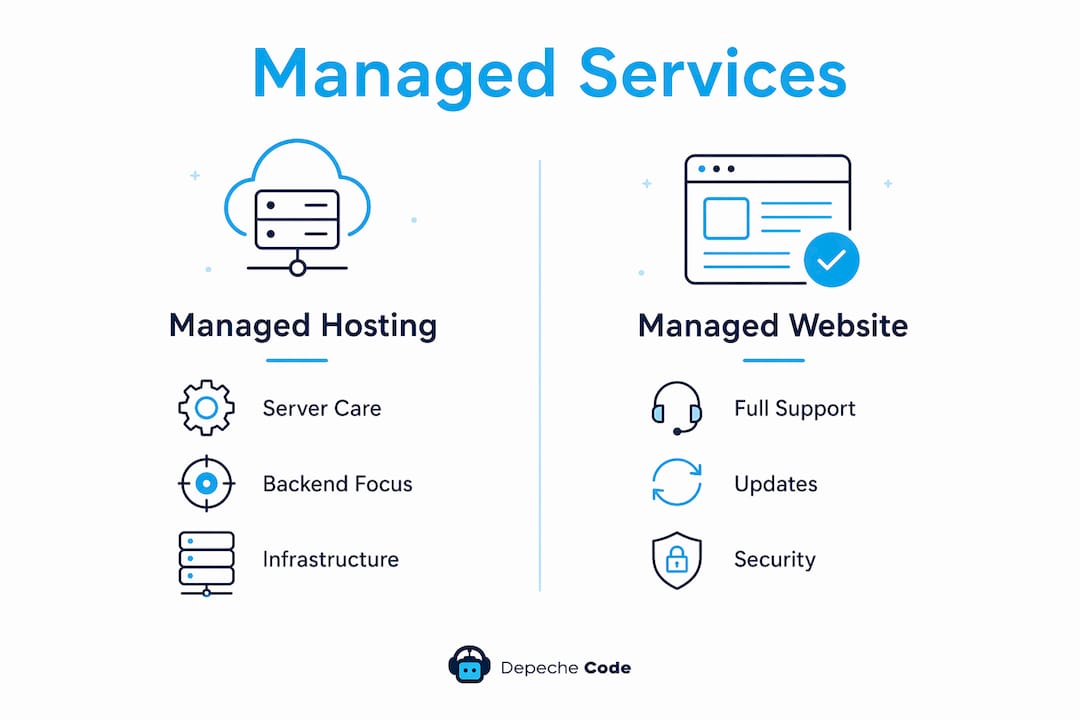
A fully managed website service goes several layers deeper. Confusion about what managed hosting includes leads to buyer frustration when business owners discover content updates are not part of the deal. You can have a perfectly maintained server running a website with outdated copy, broken links, and an obsolete design.
The table below shows where the two services diverge:
| Feature | Managed web hosting | Fully managed website service |
|---|---|---|
| Server and infrastructure management | Included | Included |
| CMS and plugin updates | Included | Included |
| Security patching | Included | Included |
| Content updates | Not included | Included |
| Design changes | Not included | Included |
| Technical support for site issues | Limited | Full coverage |
| SEO and performance guidance | Not included | Often included |
Managed web hosting applies to shared, dedicated, or cloud servers, but “managed” in that context always means backend technical support only. A fully managed website service is the right choice when you want a single team responsible for everything your site needs to perform well.
What are the key benefits of managed website services for business owners?
The benefits of managed websites go beyond convenience. They represent a real shift in how your business manages risk, time, and money.
Risk mitigation and brand protection. Businesses adopt managed services primarily to protect brand credibility by keeping their site reliable and updated. A single hour of downtime during a busy sales period can cost you customers who never come back. 24/7 monitoring and instant threat mitigation detect and handle security threats before they affect your business operations. For a deeper look at how website security choices affect your brand, the connection is direct and measurable.
Time savings and focus. Offloading website management tasks frees business owners from technical distractions and lets them focus on growth. Every hour spent troubleshooting a plugin conflict or chasing a hosting ticket is an hour not spent on sales, operations, or customers.
Predictable costs. Managed packages use all-in-one pricing that covers hosting, updates, design support, and security, eliminating surprise expenses from emergencies or out-of-scope work. The hidden costs of self-managing websites add up fast when you factor in lost productivity and emergency repair bills.
Fast, professional support. Industry-leading providers maintain average technical support response times under 4 minutes for critical issues. That speed matters when your checkout page goes down on a Friday afternoon.
Staying current with web standards. Web technology changes constantly. A managed team keeps your site aligned with current SEO best practices, accessibility standards, and browser compatibility requirements without you needing to track any of it.
How to choose the right managed website service for your business
Choosing the right provider starts with an honest assessment of what your website actually needs.
-
Define your website’s complexity. A five-page brochure site has very different needs than an e-commerce store with hundreds of product pages. More complexity means you need a provider with deeper technical capacity and faster response times.
-
Clarify the service scope. Ask every provider to list exactly what is and is not included. Confirm whether content updates, design changes, and SEO support are part of the package or billed separately.
-
Evaluate support quality and response time. Request the provider’s Service Level Agreement (SLA) benchmarks. An SLA is a written commitment to specific response and resolution times. Any reputable provider will share this document without hesitation.
-
Check security features in detail. Look for multi-layered security approaches that include malware scanning, automated patches, and continuous monitoring, not just a firewall. Small businesses face daily automated cyberattacks, and a single breach can cause lasting damage to customer trust.
-
Assess update and maintenance policies. Ask how often CMS updates are applied, who approves them, and what the rollback process is if an update breaks something.
-
Compare total cost, not just monthly price. A lower monthly fee that excludes content updates or charges per support ticket often costs more over a year than an all-inclusive package.
Pro Tip: Calculate what your time is worth per hour, then estimate how many hours per month you currently spend on website tasks. That number, multiplied by your hourly rate, is your true DIY cost. Most business owners are shocked by the result.
The technical support structure a provider offers tells you a great deal about how they will treat you when something goes wrong. Prioritize providers who assign a named contact rather than routing every issue through an anonymous ticket queue.
Key Takeaways
A fully managed website service is the most effective way for business owners to protect their online presence, control costs, and free up time for growth.
| Point | Details |
|---|---|
| Definition matters | A managed website service covers hosting, security, updates, content, and support under one agreement. |
| Hosting vs. full management | Managed hosting covers only the server. Full management includes content, design, and technical support. |
| Security is non-negotiable | Multi-layered security with 24/7 monitoring protects your brand from daily automated threats. |
| Predictable pricing saves money | All-in-one monthly pricing eliminates surprise costs from emergencies and DIY troubleshooting. |
| Response time signals quality | Providers with SLA-backed response times under 4 minutes deliver measurably better business protection. |
Why managed website services are the smartest investment SMBs can make in 2026
I have worked with hundreds of business owners over the years, and the pattern is always the same. They build a website, feel good about it for six months, and then quietly let it decay while they focus on running their business. By the time they notice the problem, the site is slow, the plugins are two years out of date, and a competitor with a faster, cleaner site is eating their lunch.
The conventional wisdom says managed website services are a luxury for larger companies. I think that is exactly backwards. Small and mid-sized businesses have the most to lose from a compromised or outdated website because they have fewer resources to recover from the damage. A data breach or a week of downtime can permanently alter customer perception for a small brand in a way a large corporation can absorb.
What I find most interesting about 2026 is how managed services have started integrating AI tools for continuous compliance monitoring and automated content auditing. This is not a future trend. It is happening now, and providers who offer it are giving clients a meaningful edge. The businesses I see winning online treat their website as a revenue-generating asset, not a sunk cost. A managed service is the operational structure that makes that mindset possible.
— Donovan
Depechecode’s managed website design and development services
Depechecode is a full-service digital agency based in Orlando that handles website management, maintenance, security, and design for businesses that want results without the technical headaches.

Their website design and development packages include ongoing expert support, security monitoring, and design services built for businesses that need a reliable online presence. Depechecode works with both small businesses and larger organizations, offering service plans that cover everything from initial build to long-term maintenance. If you want a professional team managing your site so you can focus on growth, their team is worth a direct conversation.
FAQ
What is a managed website service in simple terms?
A managed website service is an ongoing arrangement where a professional team handles all technical aspects of your website, including hosting, security, updates, and content maintenance, under a single monthly agreement.
How does managed hosting differ from a fully managed website service?
Managed hosting covers only server infrastructure and backend technical management. A fully managed website service also includes content updates, design changes, and broader technical support for the site itself.
What does a managed website service typically cost?
Pricing varies by provider and scope, but most packages use flat monthly fees that bundle hosting, security, updates, and support to avoid unexpected charges. Exact pricing is best confirmed directly with each provider.
Is a managed website service worth it for small businesses?
Small businesses face the same security threats and performance standards as large companies, but with fewer internal resources to manage them. A managed service provides enterprise-grade protection and support at a predictable monthly cost.
How do I know if my current provider is truly managing my website?
Ask for your provider’s SLA document, a log of recent updates applied to your site, and a summary of security scans run in the past 30 days. A genuine managed service provider will supply all three without hesitation.
Recommended
Related Articles

Depeche Code
April 16, 2026

Depeche Code
March 27, 2026