
Scalable websites save money by eliminating the two biggest budget drains in web ownership: emergency rebuilds and wasted infrastructure. When your site can grow with your business, adding capacity during a traffic spike and pulling back during slow periods, you stop paying for resources you don’t need and stop scrambling to fix a site that can’t keep up. The financial case is straightforward.
Here’s what drives the savings:
- No costly rebuilds. A non-scalable site becomes a bottleneck as traffic and features grow, eventually forcing a full overhaul that costs far more than building right the first time.
- No over-provisioning. Paying for maximum server capacity year-round, even during slow months, wastes money. Scalable architecture adjusts dynamically.
- Fewer crashes, less lost revenue. Downtime at large enterprises can cost $9,000 per minute. A site built to handle surges avoids that exposure.
- Lower maintenance overhead. Modular, well-planned architecture is easier and cheaper to update than a patched-together legacy site.
- Better user experience. Faster load times reduce bounce rates, and 70% of consumers say page load speed affects their willingness to buy.
Why scalable websites save money starts with understanding what scalability actually means
Website scalability is the ability to handle more visitors, more content, and more features without crashing or requiring a ground-up rebuild. Think of it less as a technical specification and more as a business insurance policy. A site that serves you well at 500 visitors a month can become a liability at 50,000 if it was never built to grow.

The cost impact runs in two directions. First, a site that can’t scale forces expensive emergency fixes or full redevelopments at exactly the wrong moment, when your business is growing and needs every dollar working. Second, a site that’s over-built from day one wastes money on infrastructure you won’t use for years.
Two types of scaling define how this works in practice:
- Vertical scaling (scaling up): Adding more power to existing servers, more CPU, more RAM. Fast to implement but has a ceiling and can get expensive quickly.
- Horizontal scaling (scaling out): Adding more servers to distribute the workload. More flexible and cost-effective at high traffic volumes because you only add what you need, when you need it.
The business decision here isn’t purely technical. Choosing a scalable architecture from the start is a financial strategy. It determines whether your site is an asset that grows with you or a cost center that holds you back.
Technical strategies that make cost-effective website design possible
The savings from scalability don’t happen automatically. They come from specific architectural decisions made during development. Here’s what actually moves the needle:
- Cloud infrastructure. Cloud-based hosting gives your site on-demand access to computing resources, storage, and networking without requiring upfront investment in physical hardware. You pay for what you use, not what you might someday need. This single shift eliminates the over-provisioning problem entirely for most businesses.
- Load balancing. A load balancer distributes incoming traffic across multiple servers, preventing any single server from becoming a bottleneck. It also monitors server health and reroutes requests when something goes wrong, which is why load balancing is one of the most direct tools for reducing downtime risk.
- Content Delivery Networks (CDNs). A CDN stores copies of your site’s content on servers around the world and delivers each page from the location closest to the visitor. The result is faster load times globally and less strain on your origin server. For businesses with customers across multiple regions, CDNs are practically non-negotiable.
- Caching. Storing frequently requested data so the server doesn’t have to regenerate it for every visitor. This reduces server load dramatically during traffic spikes and cuts hosting costs.
- Microservices architecture. Breaking your site’s functions into independent components that can be scaled separately. Your checkout system can handle ten times the load without scaling your entire site.
Pro Tip: Most businesses focus on scaling their front-end traffic handling but overlook their database layer. A database that can’t scale becomes the bottleneck even when everything else is optimized. Implement read replicas or database caching early, before you need them.
Long-term benefits of scalable websites for business cost efficiency
The financial case for scalable design gets stronger the longer you look at it. Short-term, the savings are real but modest. Over three to five years, the gap between a scalable site and a non-scalable one becomes dramatic.
- Revenue protection during traffic spikes. A flash sale, a viral post, or a product launch can send traffic through the roof in minutes. A scalable site handles that surge and captures the revenue. A non-scalable site crashes and loses it. For e-commerce businesses especially, a single crashed sale event can wipe out months of marketing spend.
- Reduced redevelopment costs. Scalable architecture means tomorrow’s growth doesn’t force a costly rebuild. You add features and capacity gradually, on your schedule, not in a panic.
- Downtime protection. Downtime costs large enterprises thousands of dollars per minute. Even for smaller businesses, an hour of downtime during a peak period can mean thousands in lost sales and damaged customer trust.
- Geographic expansion without disruption. Adding a new market or region to your business is far cheaper when your site is already built to scale. CDNs and cloud infrastructure handle the geographic distribution without requiring a new build.
- Lower long-term hosting costs. Dynamic resource adjustment means you’re not paying for peak capacity during slow months. That savings compounds over time.
Understanding your long-term website costs before you build is one of the most underrated financial decisions a business owner can make.
How scalability reduces costs: insights from industry experience
The core financial logic of scalability comes down to resource optimization. Paying for maximum server capacity year-round, regardless of actual traffic, is the web equivalent of renting a warehouse for your busiest week and paying that rate every week of the year. Dynamic resource adjustment eliminates that waste.
Key insight: Cost efficiency in scalable architecture stems primarily from paying for what you actually use, not what you might need at peak. Businesses that shift from fixed infrastructure to dynamic cloud-based resources consistently reduce their infrastructure spend during off-peak periods while maintaining full capacity when demand spikes.
The operational savings extend beyond hosting bills. A well-architected site requires less developer time to maintain and update. Modular components can be changed independently without touching the rest of the site, which means smaller, cheaper maintenance tasks instead of large, risky overhauls. For businesses that rely on staff leasing or nearshore teams to manage technical operations, a cleaner architecture also reduces the onboarding time and coordination overhead for those teams.
Monitoring matters as much as architecture. Poorly planned scalability can still generate unnecessary costs if bottlenecks or single points of failure go unaddressed. The savings are real only when the architecture is paired with active performance monitoring.

How a scalable site future-proofs your business against expensive changes
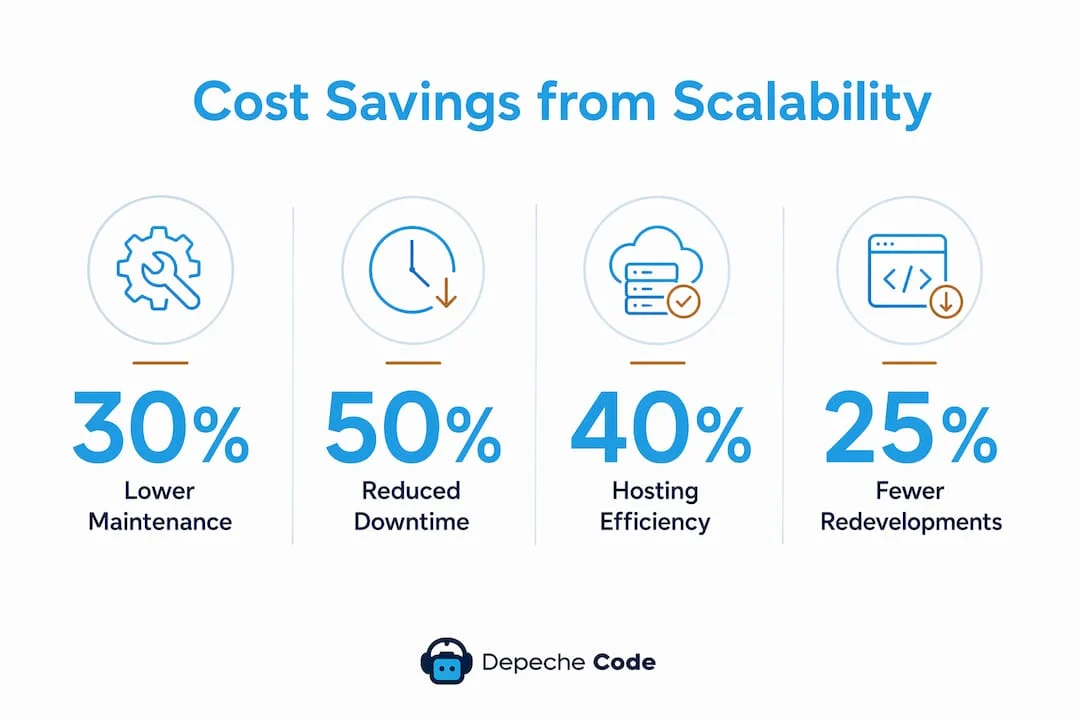
Technology changes fast. The site you build today needs to accommodate features, integrations, and traffic patterns that don’t exist yet. A scalable architecture handles that evolution without requiring a full rebuild every two to three years.
The practical value here is in what you avoid paying for. Businesses that build rigid, monolithic sites often find themselves facing a complete redevelopment cycle every few years as their needs outgrow the original design. Each rebuild carries not just development costs but also the opportunity cost of downtime, redirected staff attention, and disrupted marketing campaigns.
A modular, scalable design lets you add a new payment gateway, integrate an AI chatbot, or expand to a new product category without touching the core architecture. You’re buying optionality. The site grows in the direction your business grows, not in the direction the original developer anticipated.
Scalability also protects you against technology shifts. When a new framework or hosting standard becomes the industry norm, a well-structured site is far easier to migrate than a tightly coupled legacy build. That migration cost difference can run into tens of thousands of dollars for mid-sized businesses.
Initial investment vs. long-term savings: what the numbers actually look like
Scalable architecture costs more upfront. That’s the honest answer, and any agency that tells you otherwise is selling you something. The question isn’t whether the initial investment is higher. It’s whether that investment pays off, and by how much.
A non-scalable site built on the cheap might cost $3,000–$5,000 to launch. A properly architected, scalable site for the same business might run $8,000–$15,000. The gap looks significant at signing. It looks very different three years later.
| Cost Category | Non-scalable site | Scalable site |
|---|---|---|
| Initial build | Lower | Higher |
| — | Often full rebuild | Incremental updates |
| Downtime losses | Higher risk | Substantially lower |
| Hosting (off-peak periods) | Fixed, over-provisioned | Dynamic, usage-based |
| Developer maintenance hours | Higher per update | Lower per update |
The math favors scalability for any business that expects to grow, run promotions, or add features over time. For businesses that plan to stay static, the calculus is different, but those businesses are rare.
Proper hosting management is where much of the ongoing cost difference shows up. Businesses that actively manage their hosting infrastructure spend less and get more reliable performance.
Real-world scenarios where scalable design delivered clear cost savings
Abstract arguments for scalability become concrete when you look at the situations where the architecture either holds or breaks.
E-commerce during peak season. An online retailer running a Black Friday promotion drives ten times normal traffic to their site over 48 hours. A site built on cloud infrastructure with load balancing handles the surge automatically. The alternative, a fixed-server site, either crashes under the load or requires expensive emergency capacity upgrades purchased at the worst possible time.
Media and content sites after viral traffic. A blog post or video gets picked up by a major publication and sends a wave of new visitors. A CDN-backed, horizontally scalable site serves those visitors without a hiccup. The traffic converts to subscribers and revenue. A non-scalable site goes down, the moment passes, and the opportunity is gone.
SaaS and membership platforms. Businesses running subscription platforms need to add users, features, and data storage continuously. A scalable backend handles that growth incrementally. A non-scalable one forces a painful, expensive migration at exactly the moment the business is trying to grow fastest.
Geographic expansion. A U.S.-based business expanding to European or Latin American markets needs fast load times for those new users. A CDN solves that problem without a new server build in each region. For businesses using tailored nearshore workforce solutions to support international operations, a globally distributed site architecture complements that operational model directly.
Common mistakes that undermine scalability and drive costs back up
Scalability doesn’t guarantee savings. Several common mistakes can erode the financial benefits even when the architecture looks right on paper.
Ignoring the database layer. Most scalability planning focuses on web servers and front-end performance. The database is often the real bottleneck. A site that scales its servers but not its database will still crash under load, just at a different point in the stack.
No performance monitoring. A scalable architecture without active monitoring is a car without a dashboard. You won’t know a bottleneck is developing until it becomes a crisis. Monitoring tools like New Relic or Datadog catch performance degradation before it becomes downtime.
Over-engineering from day one. The opposite mistake is building for a scale you won’t reach for years, paying for complexity and infrastructure you don’t need yet. The right approach is building a foundation that can scale, not building the full scale upfront.
Single points of failure. A load balancer helps, but if your entire site depends on one database server or one third-party API with no fallback, you still have a fragility problem. Redundancy at critical points is part of what scalability actually means.
Neglecting security at scale. Larger, more distributed architectures have a wider attack surface. Businesses that scale their infrastructure without scaling their security practices often face breaches that cost far more than any infrastructure savings.
Choosing the wrong hosting model. Shared hosting is cheap but has hard limits. Dedicated servers are powerful but expensive and inflexible. Cloud hosting sits in the middle and is usually the right answer for growing businesses. Understanding how hosting affects your web costs is foundational to getting scalability right.
Depechecode builds websites that grow with your business
Most businesses don’t need to choose between a cheap site that breaks and an expensive enterprise build that’s overkill. Depechecode offers a third option: custom website design and development built on scalable architecture from day one, priced for small and mid-sized businesses.

The difference with Depechecode is that scalability isn’t an add-on. It’s baked into the development process, which means you’re not paying to retrofit it later when your traffic grows or your feature list expands. The agency’s Orlando-based team handles the full stack, from architecture planning through ongoing maintenance, so you’re not managing multiple vendors or absorbing surprise costs when something needs updating. For businesses that want to start lean, Depechecode also offers a free website development option that gives you a scalable foundation without the upfront investment. Get in touch with the Depechecode team to see which build path fits your growth plan.
FAQ
What does it mean when a website is scalable?
A scalable website can handle increasing traffic, content, and features without crashing or requiring a full rebuild. It adjusts resources dynamically to match demand, so growth doesn’t force expensive overhauls.
What is the main financial advantage of website scalability?
The biggest financial advantage is avoiding repeated costly redevelopments and paying only for the infrastructure you actually use. Downtime costs large enterprises as much as $9,000 per minute, making reliability a direct revenue issue.
Is it cheaper to build a scalable website upfront or rebuild later?
Building for scalability upfront costs more initially but saves money over time by eliminating full rebuilds, reducing maintenance hours, and lowering hosting costs through dynamic resource adjustment.
What are the five golden rules of a good website?
Definitions vary, but the most widely cited principles are fast load speed, mobile responsiveness, clear navigation, secure infrastructure, and the ability to grow without a rebuild. Scalability underpins the last two directly.
Key Takeaways
Scalable websites save money by eliminating costly rebuilds, reducing wasted infrastructure spend, and protecting revenue during traffic surges through dynamic resource management.
| Point | Details |
|---|---|
| Avoid costly rebuilds | Scalable architecture lets you add features incrementally, preventing full redevelopments as your business grows. |
| Downtime is expensive | Large enterprises can lose as much as $9,000 per minute during outages, making reliability a direct financial priority. |
| Pay for what you use | Cloud-based, dynamic resource adjustment eliminates the waste of paying for peak capacity year-round. |
| Load speed drives revenue | 70% of consumers say page load time affects their willingness to buy, linking performance directly to sales. |
| Depechecode builds scalable sites | Depechecode designs custom websites with scalable architecture built in from day one, suited for growing businesses. |
Recommended
Related Articles

Depeche Code
April 25, 2026