

TL;DR:
- Long-term website costs include expenses for design, hosting, maintenance, and digital marketing, and are typically higher than initial fees. Complex sites like eCommerce stores require significantly more ongoing investment than simple blogs or business pages. Businesses should allocate 10 to 15 percent of their initial development cost annually and proactively manage renewals to avoid costly issues.
Long-term website cost is the total of all expenses required to launch, maintain, and grow a website over time, covering development, hosting, domain registration, ongoing maintenance, and digital marketing. Business owners who treat this as a one-time purchase routinely face budget surprises that stall growth. A realistic budget accounts for every recurring line item, not just the initial build. Platforms like Wix and providers like GoDaddy publish cost ranges that confirm how quickly annual website expenses add up beyond the launch invoice.
What is long-term website cost and what drives it?

Long-term website cost is the industry term for total cost of website ownership, which spans every dollar spent from initial design through years of ongoing operation. The number is almost always larger than business owners expect, because the launch fee is only the first payment in a multi-year commitment.
The core cost drivers fall into five categories:
- Design and development: Custom builds range from a few thousand dollars for a small business site to six figures for enterprise platforms. This is the largest single upfront expense.
- Domain registration: Annual fees typically run $10–$20 per year for common extensions, though premium domains cost significantly more.
- Hosting: Hosting fees range from $3 to $250 per month depending on traffic volume and service tier. That spread reflects the difference between a shared hosting plan and a dedicated server with managed support.
- Maintenance: Security patches, plugin updates, backups, and performance monitoring are non-negotiable recurring costs.
- Digital marketing: SEO, content creation, and social media management are ongoing investments that directly affect how much traffic the site generates.
The table below shows typical annual cost ranges across each component for a small to mid-size business website.
| Cost component | Low estimate | High estimate |
|---|---|---|
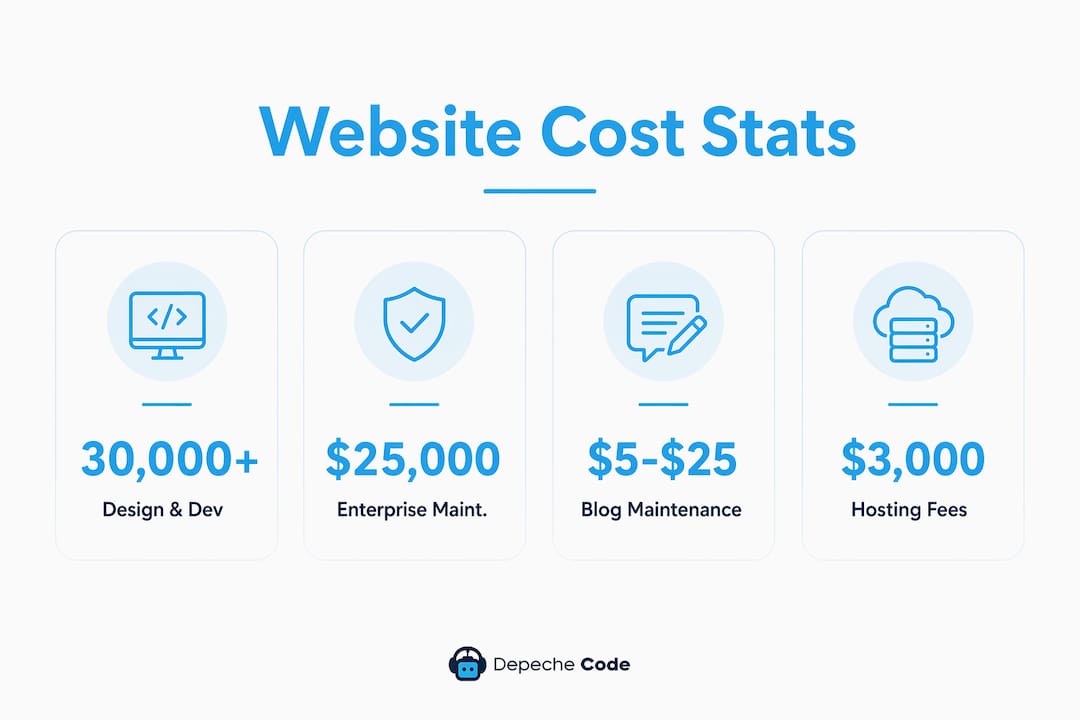
| Design and development | $3,000 | $30,000+ |
| Domain registration | $10/year | $50/year |
| Hosting | $36/year | $3,000/year |
| Maintenance | $600/year | $6,000/year |
| Digital marketing | $1,200/year | $24,000/year |
Pro Tip: Build a 12-month cost spreadsheet before signing any vendor contract. List every renewal date and fee so you see the true annual total, not just the launch invoice.
How do website size and complexity affect long-term costs?
Website type is the single biggest variable in long-term website expenses. A personal blog and an eCommerce store both need hosting and maintenance, but the dollar amounts are not remotely comparable.
Maintenance for a personal blog costs as little as $5–$25 per month. An eCommerce store with payment gateways, inventory systems, and customer accounts typically runs $300–$1,000 per month in maintenance alone. That gap exists because complex features require more frequent updates, more security oversight, and more developer time when something breaks.
| Website type | Monthly maintenance cost | Key cost drivers |
|---|---|---|
| Personal blog | $5–$25 | Hosting, basic updates |
| Small business site | $50–$500 | Security, plugins, backups |
| eCommerce store | $300–$1,000 | Payment systems, inventory, uptime |
| Enterprise platform | $2,000–$25,000+ | Custom dev, 24/7 support, compliance |
Enterprise website maintenance costs range from $2,000 to $25,000 or more per month. That figure includes custom development, round-the-clock support, and the kind of performance monitoring that a shared hosting plan cannot provide.
Traffic volume also pushes costs up. A site that handles 10,000 visitors per month needs a different hosting tier than one handling 500,000. When traffic spikes unexpectedly, underpowered hosting causes slowdowns or outages, both of which cost revenue.
Pro Tip: Map every feature your site uses before requesting a maintenance quote. Payment processing, membership portals, and third-party API integrations each add to the monthly bill. Knowing your feature list upfront prevents scope surprises.
You can also use a website maintenance checklist to audit your current site’s complexity before comparing service plans.
What budget strategies help manage long-term website expenses effectively?
The most reliable budgeting rule for website upkeep is straightforward: allocate 10–15% of your initial development cost annually for maintenance. If your site cost $20,000 to build, budget $2,000–$3,000 per year for hosting renewals, plugin updates, and minor developer fixes. This rule keeps you from treating maintenance as an afterthought.
Here is a practical four-step approach to managing website cost over time:
- Audit your renewal calendar. List every subscription tied to your site: hosting, domain, SSL certificate, premium plugins, and third-party tools. Note the renewal date and cost for each.
- Separate maintenance from marketing. These are two distinct budget lines. Conflating them leads to underfunding one or both.
- Price proactive maintenance against reactive repair. Cleaning up a hacked website costs $5,000–$50,000. Regular monthly maintenance fees are a fraction of that figure.
- Evaluate service plans annually. Hosting providers and maintenance agencies update their plans. Reviewing them each year prevents you from overpaying for a tier you have outgrown or underpaying for one that no longer covers your needs.
“Website maintenance should be treated as critical sales infrastructure rather than a miscellaneous overhead cost, as downtime directly impacts revenue.” — 1Byte Blog
Many businesses underestimate ongoing hosting, security, and update costs until a breach or outage forces the issue. Proactive budgeting is not caution. It is the cheaper path.
A detailed 2026 website cost breakdown can help you build a more accurate annual budget before committing to a vendor or plan.
How do digital marketing and ongoing content affect long-term website cost?
Digital marketing is the cost category that most business owners underestimate or exclude entirely from their website budget. Hosting and maintenance keep the site alive. Marketing determines whether anyone finds it.
Marketing investments can rival or exceed maintenance costs depending on business goals. A local service business might spend $500–$1,500 per month on SEO and content. A national eCommerce brand might spend $5,000–$20,000 per month across SEO, paid search, and social media. Both figures are legitimate depending on the competitive environment and revenue targets.
Common marketing activities that belong in your annual website budget include:
- SEO: Keyword research, on-page optimization, link building, and technical audits. These are ongoing, not one-time tasks.
- Content creation: Blog posts, landing pages, case studies, and video scripts. Fresh content drives organic traffic and supports SEO rankings.
- Social media management: Posting, community engagement, and paid promotion tied to website traffic goals.
- Email marketing: Campaigns that drive repeat visits and conversions from existing contacts.
- Video production: B2B brands increasingly use video production as part of their content mix, and production costs vary widely by format and length.
The key insight is that marketing spend compounds over time. A business that invests consistently in SEO and content for two years builds organic traffic that reduces its dependence on paid advertising. Skipping marketing to cut costs is a short-term saving that produces a long-term traffic deficit.
Key Takeaways
Long-term website cost covers every dollar spent on development, hosting, maintenance, and marketing over the life of the site, and the total is almost always higher than the initial build fee.
| Point | Details |
|---|---|
| Total cost of ownership | Budget for development, hosting, domain, maintenance, and marketing as separate annual line items. |
| Maintenance rule of thumb | Allocate 10–15% of your initial development cost each year for ongoing upkeep and updates. |
| Complexity drives cost | eCommerce and enterprise sites cost significantly more to maintain than simple business or blog sites. |
| Proactive beats reactive | A hacked site cleanup costs $5,000–$50,000; regular maintenance costs a fraction of that annually. |
| Marketing is not optional | SEO and content investment drives traffic growth and reduces long-term dependence on paid advertising. |
Why I stopped treating website costs as a one-time line item
The business owners who get burned by website costs are not careless. They are working from an incomplete mental model. They think of a website the way they think of a piece of equipment: pay once, use indefinitely. A website does not work that way. It is closer to a retail location. You pay rent every month, you maintain the space, and you invest in attracting foot traffic.
I have seen businesses spend $15,000 on a well-designed site and then allocate zero budget for the following year. By month eight, plugins are outdated, the SSL certificate has lapsed, and the site is flagged as insecure by Google Chrome. The fix costs more than a year of proper maintenance would have. That pattern is not an edge case. It is common.
The other mistake I see is treating SEO as a launch task rather than an ongoing investment. A business will pay for keyword research and on-page optimization at launch, then stop. Six months later, competitors who kept investing in content have outranked them. The site is technically sound but invisible.
The security risks of skipping maintenance are real and quantifiable. A well-maintained website builds customer trust and reduces the risk of costly hacks and downtime. That is not a soft benefit. It is a direct line to revenue protection.
My honest advice: build your website budget the same way you build a staffing budget. Identify every recurring cost, assign a dollar amount, and review it quarterly. The businesses that do this never face a surprise $20,000 cleanup bill.
— Donovan
How Depechecode handles your website’s long-term needs
Running a website well over time requires more than a good launch. It requires consistent maintenance, reliable hosting, and marketing that keeps pace with your growth goals.

Depechecode is a full-service digital agency based in Orlando that covers every layer of long-term website cost. From website design and development built for business growth to WordPress maintenance plans that handle security, updates, and backups, Depechecode structures its services around what business owners actually need year over year. The agency also offers SEO options and plans that treat search visibility as the ongoing investment it is. If you want a partner who understands the full cost picture, not just the launch fee, Depechecode is worth a conversation.
FAQ
What is included in long-term website cost?
Long-term website cost includes initial design and development fees, recurring hosting and domain registration, ongoing maintenance such as security updates and backups, and digital marketing expenses like SEO and content creation.
How much should I budget annually for website maintenance?
Budget 10–15% of your initial development cost each year for maintenance. A site that cost $20,000 to build should carry a $2,000–$3,000 annual maintenance budget.
How much do annual website hosting fees typically cost?
Annual website hosting fees range from roughly $36 to $3,000 per year, depending on traffic volume, server type, and the level of managed support included in the plan.
What happens if I skip website maintenance?
Skipping maintenance exposes your site to security breaches and performance failures. Cleaning up a hacked website costs $5,000–$50,000, which far exceeds the cost of consistent monthly maintenance.
Does digital marketing count as a long-term website expense?
Yes. SEO, content creation, and social media management are recurring costs that directly affect how much traffic and revenue your website generates. They belong in your annual website budget alongside hosting and maintenance.