TL;DR:
- A website cost breakdown details every expense involved in creating and maintaining a business website, with total costs often exceeding initial estimates. Business owners should account for ongoing fees such as hosting, security, content updates, and maintenance, which can multiply the initial investment by two to three times over three years. Choosing between freelancers and agencies depends on project complexity, timeline, and support needs, while realistic budgeting requires itemizing each expense category and including contingency funds.
A website cost breakdown is a detailed accounting of every expense involved in designing, building, launching, and maintaining a business website. Most business owners focus on the upfront development fee and miss the full picture. The real number, once you factor in hosting, content, security, and ongoing maintenance, is typically 2–3 times what you paid to launch. This guide uses real 2026 pricing data to walk you through every cost category, compare your build options, and help you allocate your budget with confidence.
What is a website cost breakdown for business owners?
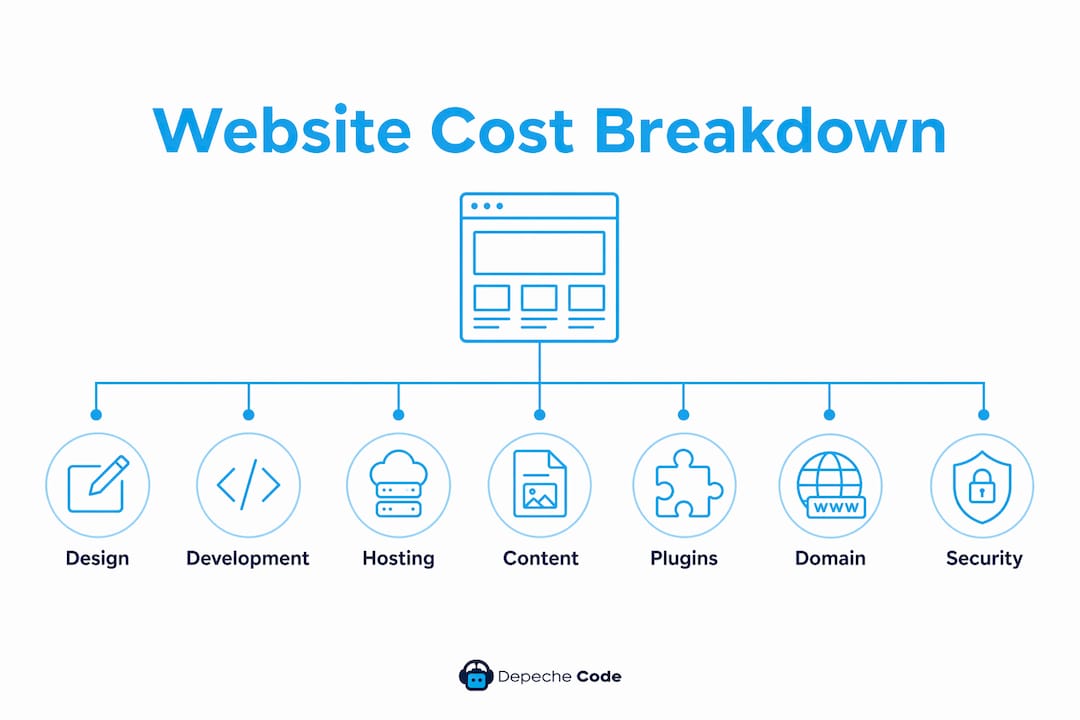
A website cost breakdown divides your total investment into specific line items, so you know exactly where every dollar goes. The main categories are domain registration, web hosting, design and development, content creation, plugins and third-party tools, security, and ongoing maintenance.
Domain registration runs $10–$25 per year on average, according to 2026 hosting data. That is a minor line item, but renewing it late can take your site offline instantly.
Web hosting costs $5–$50 per month depending on your plan and platform. Shared hosting sits at the low end. Managed WordPress hosting or VPS plans push toward the top of that range. The gap matters because faster, more reliable hosting directly affects your Google rankings and user experience.
Design and development is the largest single cost for most projects. Here is where your choices create the biggest spread in price. Template-based builds using platforms like WordPress, Squarespace, or Webflow cost far less than fully custom-coded sites. 80% of businesses do not need a fully custom build and can use premium templates to save significant startup costs. That statistic should reframe how you approach your first conversation with any developer.

Content creation ranges from $0 to over $5,000 depending on scope and how much you outsource. Writing your own copy saves money but costs time. Professional copywriting and photography add up fast, especially for product-heavy or service-heavy sites.
Plugins, third-party apps, and licensing fees are easy to underestimate. A contact form, booking system, live chat tool, or payment gateway each carries its own monthly or annual fee. These small subscriptions stack quickly.
SSL certificates are now standard and often included with hosting plans, but premium SSL options for e-commerce or enterprise sites can cost $50–$300 per year. Google flags sites without SSL as “not secure,” making this non-negotiable.
Pro Tip: Before signing any contract, ask your developer to itemize every third-party tool or plugin the project requires and confirm which fees are one-time versus recurring. This single question prevents the most common budget surprises.
How do freelancer and agency website development costs compare?
The choice between a freelancer and a full-service agency is the single biggest variable in your website development costs. The price difference is significant, and so are the tradeoffs.
| Factor | Freelancer | Agency |
|---|---|---|
| Typical cost range | $2,000–$8,000 | $5,000–$18,500+ |
| Standard 5–10 page site | ~$8,500 average | ~$18,500 average |
| Timeline (standard site) | 3–6 weeks | 4–8 weeks |
| Support and accountability | Single point of contact | Dedicated team |
| Best for | Smaller budgets, simpler projects | Complex builds, ongoing partnerships |
Freelancer vs. agency pricing data from 600+ real projects in 2026 shows the global average cost sits at $8,500 for freelancer-built sites versus $18,500 for agency-built sites. That $10,000 gap reflects more than just labor. Agencies bring project managers, designers, developers, and QA testers under one roof.
Development timelines also affect total cost. Landing pages take 1–2 weeks, standard business sites take 3–6 weeks, and custom e-commerce or SaaS platforms require 8–24 weeks. Longer timelines mean more billable hours, more revision cycles, and more opportunities for scope creep to inflate your budget.
Freelancers make sense when your project is well-defined, your budget is tight, and you have the time to manage the relationship yourself. Agencies make sense when you need a full team, want a single contract covering design through launch, or plan to build a long-term digital partnership.
Pro Tip: Ask any freelancer or agency for three references from projects similar in size and industry to yours. The quality of those references tells you more than any portfolio screenshot.
What hidden and ongoing costs should business owners expect?
Total cost of ownership over three years is typically 2.0x to 3.4x the initial build cost. That multiplier surprises most business owners because they budget for launch and forget about everything that comes after. Here are the ongoing expenses you need to plan for:
-
Annual maintenance and security updates. Maintenance costs range from $500 to $2,000 per year for freelancer-built sites, with higher costs for complex builds. This covers plugin updates, security patches, and performance checks. Skipping maintenance is how sites get hacked or break after a platform update.
-
Hosting and domain renewals. These are predictable but easy to forget. Budget $60–$600 per year for hosting depending on your plan, plus $10–$25 for your domain. Set calendar reminders for renewal dates.
-
Content updates and SEO refinements. A static website loses search rankings over time. Regular blog posts, updated service pages, and technical SEO work require either your time or a paid professional. See the website maintenance checklist from Depechecode for a clear breakdown of what this involves month to month.
-
Third-party tool subscriptions. CRM integrations, email marketing platforms, booking tools, and analytics software each carry monthly fees. A mid-size business site commonly runs $100–$400 per month in tool subscriptions alone.
-
Scalability and feature additions. As your business grows, you will want new landing pages, e-commerce functionality, or integrations with new software. Budget a contingency of 15–20% of your initial build cost annually for these additions.
-
Unexpected downtime and emergency fixes. Servers go down. Plugins conflict. Payment gateways break. Without a maintenance retainer in place, emergency developer time is billed at premium rates, often $100–$200 per hour.
Understanding total cost of ownership from day one changes how you evaluate proposals. A $3,000 freelancer quote and a $7,000 agency quote look very different once you add three years of maintenance, hosting, and content costs to both.
How to budget effectively for a website project
Effective website budgeting starts with a needs assessment, not a price comparison. Define what your site must do before you ask anyone for a quote. Here is a practical framework:
-
Define your scope first. List every page, feature, and integration your site needs. A 5-page brochure site, a 20-page service site, and an e-commerce store with 500 products are three completely different projects. Use the step-by-step web development guide from Depechecode to structure this process.
-
Prioritize features by business impact. Separate must-haves from nice-to-haves. A contact form and mobile-responsive design are must-haves. An animated homepage header is not. Cutting nice-to-haves in the first build reduces cost and speeds up launch.
-
Allocate specific budget line items. Use real 2026 ranges: $10–$25 for domain, $60–$600 per year for hosting, $2,000–$18,500 for design and development, $0–$5,000 for content, $500–$2,000 per year for maintenance. Build your budget from the bottom up, not from a single round number.
-
Run a cost-benefit analysis on template versus custom. Choosing between template and custom should be based on an audit of your actual business needs. A premium WordPress or Webflow template can deliver 90% of the functionality of a custom build at 30% of the cost.
-
Use website builders for low-budget launches. Platforms like Webflow, Squarespace, and Wix offer plans starting as low as $3.50 per month including hosting and basic maintenance. This is a legitimate starting point for businesses with tight budgets and fast timelines.
-
Set aside a contingency budget. Reserve 15–20% of your total project budget for scope changes, unexpected integrations, or post-launch fixes. Projects that go over budget almost always do so because contingency was not planned.
Key takeaways
A website’s true cost is 2–3 times the initial build price once hosting, maintenance, content, and tools are included over three years.
| Point | Details |
|---|---|
| Cost breakdown covers seven areas | Domain, hosting, design, content, plugins, security, and maintenance all require separate budget lines. |
| Freelancers vs. agencies | Freelancers average $8,500 per project; agencies average $18,500, with added team support and accountability. |
| Ongoing costs multiply your investment | Total cost of ownership over three years runs 2.0x to 3.4x the initial build cost. |
| Template builds suit most businesses | 80% of businesses do not need custom development and can save significantly with premium templates. |
| Budget from the bottom up | Itemize every cost category with real price ranges before requesting any developer quotes. |
What I have learned about website budgets after years in the field
The most expensive mistake I see business owners make is treating the website launch as the finish line. They spend months negotiating the build cost down by $500, then get blindsided by $2,000 in annual maintenance fees they never planned for. The launch is the starting line.
The second mistake is confusing “custom” with “better.” I have seen $20,000 custom builds that underperformed $4,000 premium template sites in every measurable way, including speed, conversion rate, and SEO performance. The right question is not “custom or template?” The right question is “what does my business actually need this site to do?”
When I work with business owners evaluating proposals, I always push them to ask for a three-year total cost estimate, not just a build quote. That single number changes every conversation. A $6,000 agency build with a $1,200 annual maintenance retainer costs $9,600 over three years. A $3,000 freelancer build with no support plan and $150 per hour emergency rates can easily cost more.
My honest advice: pick the build option that fits your three-year budget, not your launch-day budget. And always, always get the maintenance plan in writing before you sign anything.
— Donovan
How Depechecode helps you plan and build within budget

Depechecode is a full-service digital agency based in Orlando that builds websites for businesses of every size, with transparent pricing and no hidden fees. Whether you need a clean five-page business site or a full custom build with SEO integration, the team provides detailed cost estimates before any work begins. Explore the website design and development packages to see exactly what is included at each tier. For businesses watching their budget closely, Depechecode also offers a free website development option worth reviewing before you commit to a paid build. Every project includes guidance on ongoing costs so you budget for the full picture, not just day one.
FAQ
What is the average cost to build a business website in 2026?
The average cost ranges from $2,000 to $8,000 for freelancer-built sites and $5,000 to $18,500 for agency-built sites, based on analysis of 600+ real projects. The global average sits at $8,500 for freelancers and $18,500 for agencies.
What is included in a website cost breakdown?
A full website cost breakdown covers domain registration, web hosting, design and development, content creation, plugins and third-party tools, SSL security, and ongoing maintenance fees.
How much should I budget for website maintenance each year?
Annual maintenance costs run $500 to $2,000 for most freelancer-built business sites. Complex or agency-built sites can cost significantly more depending on the number of integrations and update frequency.
Do I need a custom website or will a template work?
80% of businesses do not need a fully custom build. Premium templates on platforms like WordPress or Webflow deliver comparable functionality at a fraction of the cost for most standard business sites.
What is total cost of ownership for a website?
Total cost of ownership is the full three-year expense of running a website, including build, hosting, maintenance, content, and tools. It typically runs 2.0x to 3.4x the initial build cost.