

TL;DR:
- Most businesses lack a structured content process, causing flat traffic and low engagement despite quality efforts. Establishing clear workflows, defining goals, and implementing governance with modular components improve efficiency, visibility, and search rankings. Incorporating structured data, continuous measurement, and scalable systems ensures content consistently fulfills user needs and grows business performance.
Most business owners pour time and money into content without a clear system, then wonder why their traffic flatlines and their engagement numbers barely move. The problem usually isn’t the quality of a single article or video. It’s the absence of a repeatable, structured process that connects every piece of content to a measurable business outcome. People-first content that genuinely addresses user needs is now essential for visibility in both classic and AI-powered search, which means the bar for casual, scattered content efforts keeps rising.
Table of Contents
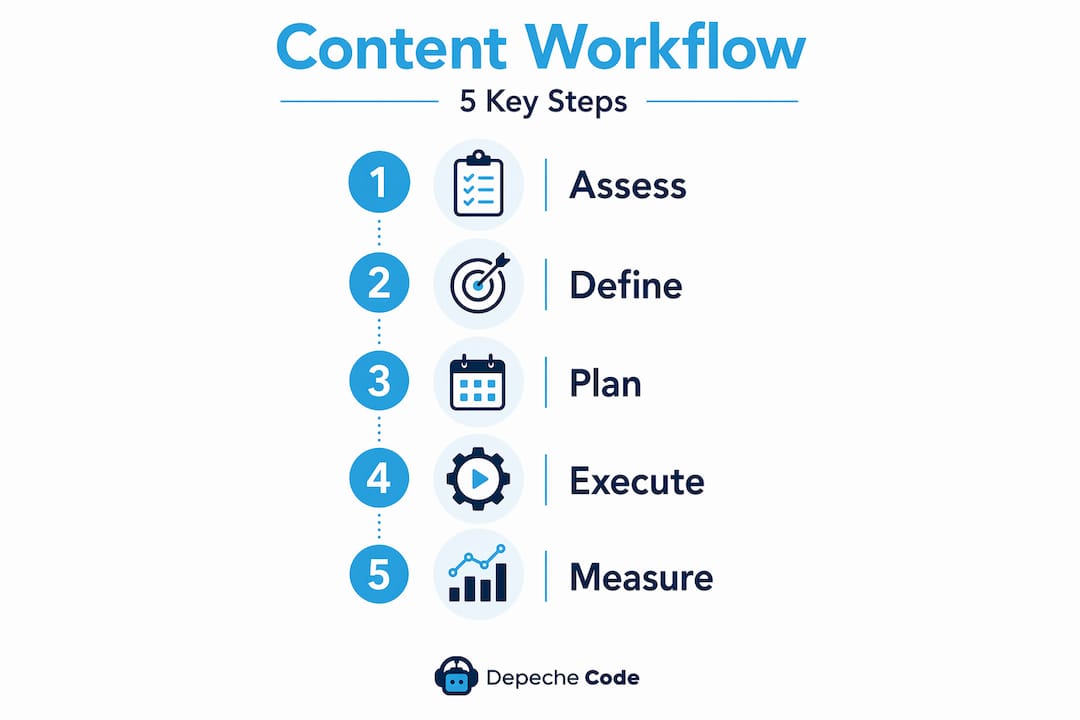
- Assess your current content workflow
- Define content goals, audience, and core topics
- Plan your content creation workflow and tools
- Execute, review, and measure content impact
- What most guides miss about scaling the content creation process
- Supercharge your visibility with proven solutions
- Frequently asked questions
Key Takeaways
| Point | Details |
|---|---|
| People-first content wins | Unique, helpful content designed with user needs in mind improves online visibility in AI and classic search. |
| Explicit QA gates | Structured review criteria and checkpoints prevent fragmented stakeholder feedback and ensure quality. |
| Modular workflows scale | Enterprises achieve sustainable content scaling by combining governance and modular components. |
| Strategy drives ROI | Relevant, measurable goals and quality execution are the strongest drivers of content effectiveness and return. |
| Tools support process | The right collaboration and orchestration tools help businesses boost efficiency without sacrificing standards. |
Assess your current content workflow
Understanding your starting point is essential before restructuring your process. Many marketing teams discover that what they’ve been calling a “workflow” is actually a loose collection of habits. Some work, most don’t, and nobody’s sure which is which.
Start by mapping every step your content goes through from idea to publication. Who generates topics? Who writes, edits, approves, and publishes? Where do pieces get stuck? How long does each stage actually take? Even a rough diagram of this process reveals patterns you can’t see when you’re in the middle of it.
When you audit your workflow, look for these common strengths and weaknesses:
- Strengths to preserve: A reliable subject matter expert, a consistent publishing cadence, a channel that drives measurable traffic
- Weaknesses to fix: No documented brief template, approval bottlenecks with a single gatekeeper, no performance review cycle
- Red flags: Content created without a defined audience in mind, publishing driven by calendar pressure rather than strategy, zero use of structured data
Google recommends using structured data and ensuring main content is easily distinguishable, which directly affects how your pages perform in AI-enhanced results. If your current process doesn’t include a structured data review step, you’re leaving visibility on the table.
The numbers reinforce this urgency. Nearly half of marketers rate their content efforts as only somewhat effective or worse, according to B2B Content Marketing Institute benchmarks. That statistic means most companies are investing in content creation without getting the return they expect, and the root cause is usually process failure, not talent failure.
A useful benchmarking exercise is to compare your current output against what a well-run content operation produces. Review your content creation guide for baseline standards. Then check your SEO ROI benchmarks to understand what realistic performance targets look like for your industry.
| Workflow element | Weak process | Strong process |
|---|---|---|
| Topic sourcing | Random ideas, no data | Keyword research + audience questions |
| Brief quality | Vague or nonexistent | Template with audience, goal, and SEO inputs |
| Review cycle | Ad hoc, multiple rounds | Defined stages, one revision round |
| Performance tracking | Pageviews only | Engagement, rankings, and conversions |
| Structured data | Not considered | Built into publishing checklist |
Define content goals, audience, and core topics
With workflow gaps identified, you’ll need to clarify what your content aims to accomplish and who it serves. This step sounds obvious, but the majority of businesses skip it or treat it as a one-time setup rather than an ongoing strategic anchor.
Measurable content objectives give your entire team a shared definition of success. Instead of “publish more blogs,” define goals like “increase organic traffic to service pages by 25% in six months” or “generate 50 qualified leads per month from content channels.” These specific targets shape every decision downstream, from topic selection to content format to distribution channel.
Defining your ideal audience profile goes deeper than demographics. You want to understand the specific questions your buyers ask at each stage of the decision process. A small business owner researching website redesign is in a different mindset than a marketing director evaluating long-term SEO partners, even if they’re in the same industry. Build distinct profiles for each and map topics to those profiles.
Here’s a practical framework for selecting core topics:
- Identify your highest-revenue services or products. These are your anchor topics. Every cluster of content should connect back to them in some way.
- Research the questions your audience actually asks. Use search data, sales team feedback, and customer support logs to find real language.
- Assess keyword competition and search volume. Prioritize terms where you have a realistic chance to rank within 90 days.
- Map topics to funnel stages. Awareness content attracts new visitors; consideration content builds trust; decision content converts. You need all three layers working together.
- Evaluate content longevity. Evergreen topics build compounding traffic over time. Trending topics drive short-term spikes. Your mix should reflect your goals.
“Unique, non-commodity, people-first content is vital for fulfilling user needs and gaining search visibility.” — Google Search Central
This means generic “tips and tricks” articles that could have been written by anyone, for any industry, are increasingly invisible. Your content has to reflect real expertise, specific use cases, and genuine answers that your competitors can’t easily replicate.
Pro Tip: Before writing a single piece, run a quick search for your top five target topics and read the top three ranking results carefully. Note what they cover well and what they miss entirely. Your content should address the gaps, not duplicate what already ranks.
Aligning your content topics with your overall website architecture also pays dividends. A well-structured website design process guide shows how content organization on your site directly affects both user experience and search performance.
Plan your content creation workflow and tools
With clear goals and topics defined, structuring your workflow ensures smooth, consistent execution. This is where most small and mid-size businesses lose momentum. They plan the strategy but never build the repeatable operational system that keeps production on track week after week.

Enterprises that succeed at scale prioritize workflow orchestration and modular components to maintain consistent quality. The principle applies equally to a five-person marketing team or a solo content manager. Modular means building reusable parts: standard brief templates, approved visual asset libraries, brand voice guidelines, and topic research frameworks that can be applied to any new piece without starting from scratch.
Here’s an example of a modular workflow structure:
| Stage | Key task | Tool type | Owner |
|---|---|---|---|
| Ideation | Keyword research + audience mapping | SEO research tool | Marketing lead |
| Brief creation | Fill standard brief template | Document management | Content strategist |
| Creation | Draft and develop content | Writing + media tools | Writer/designer |
| Internal review | Edit for accuracy and brand voice | Collaboration platform | Editor |
| QA checkpoint | SEO check, structured data, links | Checklist tool | SEO manager |
| Approval | Final sign-off | Workflow management | Decision maker |
| Publishing | Schedule and distribute | CMS + social scheduler | Publisher |
| Performance review | Track against goals | Analytics dashboard | Marketing lead |
Explicit QA and review checkpoints are essential to avoid the fragmented, ad hoc feedback loops that slow most teams down. When everyone knows that feedback happens at stage three, not at any random point before or after publication, the process becomes predictable and stress drops noticeably.
Key tools to evaluate for each stage of your workflow:
- Brief and ideation: Shared document templates, keyword research platforms
- Creation: Writing tools with collaborative editing and comment capabilities
- Visual content: For teams producing videos, investing in professional video editing and creation capabilities raises the overall content quality floor
- Publishing and scheduling: CMS platforms with built-in SEO fields and social distribution integrations
- Analytics: Dashboards that combine organic traffic, engagement metrics, and goal conversions in one view
Governance is the part most plans overlook. Who has authority to approve final content? What happens when the subject matter expert and the SEO manager disagree on a topic angle? Documenting decision rights in advance prevents delays and protects brand consistency. Reference a clear website development workflow model to see how structured decision-making at each stage reduces rework and improves final output quality.
Pro Tip: Build a simple content calendar that shows not just publish dates but also the due dates for briefs, first drafts, and final approvals. Working backwards from the publish date with hard intermediate deadlines is one of the single most effective ways to prevent last-minute rushes.
Execute, review, and measure content impact
Planning enables efficient execution. Now, clear checkpoints and measurement bring your process full circle. This final operational stage is where strategies either prove their worth or fade quietly into the archives.
Follow these execution steps to keep production on track:
- Brief every piece before anyone writes a word. The brief is your contract with the creator. It defines the audience, the goal, the primary keyword, the target word count, the call to action, and any mandatory sources to include.
- Set a realistic first-draft timeline and hold to it. Missed draft deadlines compound across the calendar and push publish dates back by weeks.
- Run the QA checklist before every piece leaves your team. Check reading level, factual accuracy, structured data markup, internal links, image alt text, and page title format.
- Publish with full distribution intent. A piece that publishes with no promotion is a piece that underperforms. Share across email, social channels, and relevant internal pages immediately.
- Schedule a 30-day and 90-day performance review for every significant piece. Rankings, traffic, engagement time, and conversion rates tell you whether the piece is working or needs refinement.
Key metrics to track for each published piece:
- Organic impressions and click-through rate from Google Search Console
- Average engagement time and scroll depth from your analytics platform
- Backlinks and referring domains accumulated over time
- Conversions or goal completions attributed to content traffic
Improved content effectiveness is consistently driven by better strategy, stronger content relevance, and improved measurement capabilities. The businesses that outperform their peers aren’t necessarily creating more content. They’re measuring more precisely and adjusting faster based on what they learn.
Content that fulfills users’ specific needs, including follow-up questions and deeper inquiry, consistently wins in both classic and AI-powered search. This means your review cycle should include a question: does this piece answer what a reader would ask next? If the answer is no, build a follow-up piece and link the two together.
Review your website launch steps to confirm that your content publishing process aligns with broader site performance standards, including page speed, mobile rendering, and crawlability.
What most guides miss about scaling the content creation process
Most content process articles tell you to build a calendar, pick some tools, and establish a review cycle. That advice isn’t wrong. But it leaves out the part that actually determines whether a content operation scales successfully or collapses under its own weight: governance and modularity.
We’ve seen businesses with excellent strategies and talented writers still produce inconsistent, off-brand content at any meaningful volume. The reason is almost always the same. There’s no documented source of truth for brand voice, no clear authority structure for approvals, and no modular components that writers can pull from without reinventing the wheel for every new piece.
Governance and modular content sourcing matter more than raw production speed when you need to scale. Speed without governance creates noise. Governance without modularity creates bottlenecks. You need both working together before you try to increase your content volume.
The practical implication is uncomfortable for many teams: before you publish more, you should probably publish less and more carefully. Establish your templates. Document your brand voice with real examples, not abstract adjectives. Build a reusable asset library for visuals, data points, and approved quotes. Run three or four pieces through your fully documented process before scaling output.
Another insight that rarely surfaces in generic guides: your best-performing content will often reveal your process failures. If a piece massively outperforms expectations, ask why. Was the brief unusually detailed? Was the review process more thorough than usual? Did it hit a topic the audience genuinely cared about because someone took extra time on research? The answer usually points to a process element worth standardizing.
Scaling also means building redundancy into your team. A process that only works when one specific person is available isn’t a process. It’s a single point of failure. Your advanced content creation infrastructure should be transferable, so new team members can onboard into a working system rather than learning a collection of unwritten rules.
Supercharge your visibility with proven solutions
Once your content process is structured and your goals are clear, the right specialized support can accelerate results significantly.

At Depeche Code, we work with businesses at every stage of their digital presence, from building the technical foundation to executing content strategies that drive measurable traffic. Our SEO solutions are built to align with your content calendar and amplify every piece you publish. If your website itself needs a structural upgrade to support your content ambitions, our professional website design services ensure your platform is fast, mobile-optimized, and search-ready. And if you need hands-on support developing content that ranks and converts, our content creation expertise can fill the gaps your internal team faces. Let’s build a system that grows with your business.
Frequently asked questions
What makes content rank in both classic and AI-powered Google Search?
Unique, people-first content that fulfills user needs, uses structured data, and delivers a clear user experience ranks best in both AI and classic search.
How can I avoid fragmented stakeholder feedback during content creation?
Use explicit QA gates and version control to ensure feedback is structured and time-bound, preventing ad hoc review cycles that delay publishing and degrade content quality.
What measurement capability should I focus on for better content ROI?
Prioritize content relevance, quality, and user engagement measurement, since strategy and relevance are the primary drivers of improved content effectiveness and ROI.
What tools help scale content without losing quality?
Modular workflows, strong governance, and orchestration tools enable scalability while maintaining quality and brand consistency across every piece you produce.