

TL;DR:
- Choosing the right online marketing channels requires clear goals and understanding each channel’s purpose in the customer journey.
- Most SMBs benefit from a deliberate mix of three to five channels, starting with foundational SEO and email marketing.
Choosing how to spend your marketing budget feels like standing in front of a wall of switches with no diagram. There are seven major types of online marketing that most SMBs work with, including SEO, content marketing, social media, pay-per-click (PPC) advertising, email, affiliate, and influencer marketing. Each one serves a different purpose in the customer journey, and picking the wrong combination means either burning budget on channels that won’t convert or missing the audiences that would. This guide maps out every major option, breaks down what each one actually costs and delivers, and helps you build a marketing mix that fits where your business is right now.
Table of Contents
- How to select the right types of online marketing for your business
- Search engine optimization (SEO) and content marketing
- Pay-per-click (PPC) and social media marketing
- Email marketing: The high-ROI powerhouse
- Affiliate and influencer marketing: Leveraging partnerships for growth
- Comparing types of online marketing: Choosing the right mix for SMB success
- Why a multi-channel mindset beats chasing every new trend
- How Depeche Code can help you master online marketing
- Frequently asked questions
Key Takeaways
| Point | Details |
|---|---|
| Start with clear goals | Choosing online marketing types requires matching channels to business goals like brand awareness or sales. |
| Use multiple channels | Most successful small businesses deploy 3–5 complementary marketing types across the customer journey. |
| Balance short and long term | PPC offers immediate traffic while SEO and content build sustainable organic presence. |
| Leverage email marketing | Email delivers top ROI when automated, segmented, and personalized for nurturing leads. |
| Focus and optimize | Mastering a few well-chosen channels outperforms spreading resources too thin across all options. |
How to select the right types of online marketing for your business
Before you commit budget to any channel, you need a clear answer to one question: what does success look like in the next 90 days versus the next 12 months? The answer shapes everything. Paid channels build visibility fast, SEO compounds authority over time, and email gives you direct access to people who already want to hear from you. Trying to do all three simultaneously without a plan spreads your team thin and your results thin along with it.
Here is a practical framework for evaluating your options:
Define your goal first
- Brand awareness: social media marketing, PPC, influencer campaigns
- Lead generation: SEO, PPC, content marketing, landing page optimization
- Customer retention: email marketing, loyalty programs, personalized content
- Sales conversion: email automation, retargeting ads, affiliate offers
Evaluate your budget and time horizon
- Immediate results needed: PPC advertising, paid social
- 6 to 12 month runway: SEO strategies and content marketing
- Ongoing relationship building: social media marketing and email
Balance owned versus paid media
Paid media gets you visibility on demand. Owned media, like your email list and organic search rankings, costs nothing per impression once built. Most SMBs thrive on a 60/40 split, leaning toward owned channels as they mature.
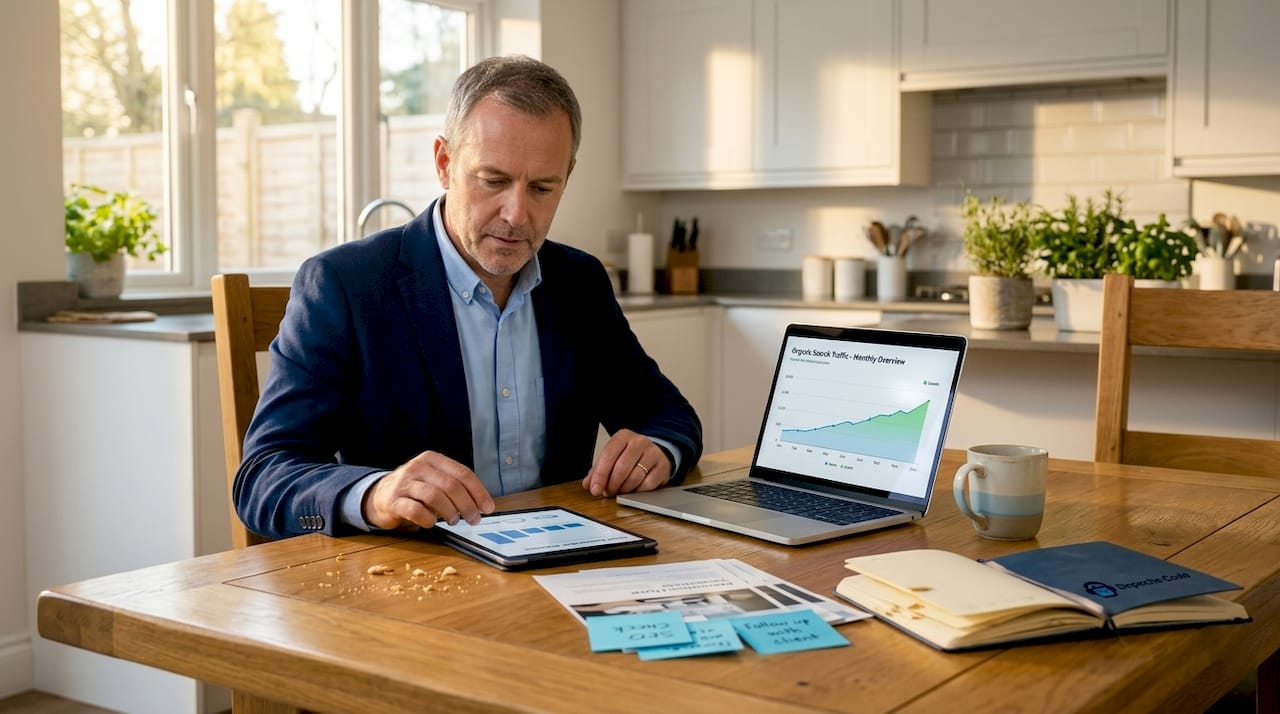
Pro Tip: Start with three channels maximum. One for awareness, one for conversion, one for retention. Add more only after you can measure each one cleanly.
Most businesses do best with a mix of three to five types, matching each channel to a specific stage of the customer journey. A restaurant launching a new location needs PPC and social ads now, while a B2B software company with a long sales cycle needs SEO and email nurturing more than flash ads.
Search engine optimization (SEO) and content marketing
SEO is the practice of improving your website so it ranks higher in search engine results for terms your potential customers are searching. Content marketing is the fuel that powers it. Together, they form the most durable foundation you can build your online presence on. SEO generates 53% of trackable website traffic globally, and that traffic compounds over time rather than stopping the moment you pause spending.
Here is what these two channels actually involve in practice:
- On-page SEO: Optimizing page titles, headers, meta descriptions, and content structure for target keywords
- Technical SEO: Site speed, mobile usability, crawlability, and structured data markup
- Link building: Earning backlinks from authoritative websites to increase domain authority
- Content marketing: Blog posts, guides, case studies, videos, and tools designed to answer your audience’s questions
The financial case is hard to argue with. SEO ROI reaches 748% in SaaS businesses, and content marketing ROI ranges between 317% and 1,389% depending on the industry and execution quality. These are not short-term gains; they build over 12 to 24 months, then continue paying out indefinitely.
The real trap SMBs fall into is expecting SEO results in 30 days. That is not how it works. SEO is a 6 to 12 month investment that accelerates over time. If you need traffic tomorrow, pair SEO with PPC while your organic rankings build. You can explore proven SEO techniques that prioritize durable results over quick fixes.
Pro Tip: Use your best-performing blog content to identify which topics generate the most search interest, then build supporting pages around those topics. Google rewards topic depth, not isolated articles.
When building your content strategy, treat your SEO options and plans as a long-term infrastructure investment, not a monthly expense to minimize.
Pay-per-click (PPC) and social media marketing
PPC advertising means you bid for placement in search results or on social platforms, and you pay only when someone clicks your ad. No clicks, no cost. That model makes PPC uniquely measurable compared to traditional advertising, and it delivers visibility immediately once a campaign goes live. This makes it the go-to channel for product launches, seasonal promotions, and any situation where you need traffic now.
Social media marketing operates differently. Rather than bidding for placement on search intent, you build a community on platforms like Facebook, Instagram, LinkedIn, or TikTok and engage that audience through content, stories, and conversation. With over 5 billion users worldwide active on social platforms in 2026, ignoring social media means ignoring where a significant portion of your customers spend their attention.
Here is how the two compare for SMB use cases:
| Factor | PPC advertising | Social media marketing |
|---|---|---|
| Speed to results | Immediate (same day) | Weeks to months |
| Cost model | Pay per click | Organic free; paid ads available |
| Best for | High-intent conversions | Awareness and community building |
| Targeting | Keyword, location, device | Demographics, interests, behavior |
| Required resources | Ad budget plus campaign management | Content creation and consistent posting |
| ROI timeline | Short term | Long term |
The smartest SMB approach combines both: run PPC for conversion campaigns with tight margins and use social media services to build the brand equity that lowers your cost-per-click over time. A customer who recognizes your brand from Instagram is far more likely to click your Google ad than a cold prospect.
Pro Tip: For PPC, start with remarketing campaigns targeting people who already visited your website. They convert at two to five times the rate of cold traffic at a fraction of the cost.
You can also see how coordinated social media growth strategies build the kind of audience that makes your paid ads more effective over time.
Email marketing: The high-ROI powerhouse
Email is not a legacy channel. It is consistently the highest-returning digital marketing type available, and it is especially powerful for SMBs because the cost scales almost independently from list size. Email returns $36 to $42 for every $1 spent, making it more efficient per dollar than any other major channel.
What drives those returns is not the channel itself. It is how you use it:
- Welcome series: The first 3 to 5 emails a new subscriber receives shape their entire relationship with your brand. High-open, high-click territory.
- Abandoned cart sequences: Recover 10 to 15% of lost purchases with a well-timed, personalized reminder series.
- Post-purchase flows: Turn one-time buyers into repeat customers through education and relevant offers.
- Re-engagement campaigns: Win back lapsed subscribers before removing them to protect your sender reputation.
The ROI data on automation is striking. Automated emails drive 37% of email revenue despite accounting for only 2% of sends. Segmentation, meaning sending the right message to the right subset of your list, can increase email revenue by 760%. These are not marginal improvements; they are transformational when applied consistently.
Your email list is also the only marketing asset you fully own. An algorithm change can tank your search rankings overnight. A platform policy shift can cut your social reach in half. Your email list belongs to you regardless of what any third-party platform decides.
Pro Tip: Clean your email list every 90 days by removing subscribers who haven’t opened in six months. Smaller, engaged lists outperform large, unresponsive ones on every metric including deliverability and conversions.
Pairing email marketing with broader SEO and content strategies creates a full-funnel system where SEO captures new audiences and email converts them over time.
Affiliate and influencer marketing: Leveraging partnerships for growth
Both affiliate and influencer marketing expand your reach through other people’s audiences, but they operate on different incentive structures. Understanding the difference helps you pick the right one for your goals.
Affiliate marketing works on a commission model. You recruit partners, typically bloggers, review sites, or other businesses, who promote your product and earn a percentage of each sale they generate. You pay for results, not exposure. That makes it a low-risk way to extend your marketing reach without upfront ad spend.
Key elements of a successful affiliate program:
- Offer commissions that are genuinely attractive to partners (typically 10 to 30% for digital products, 5 to 15% for physical goods)
- Provide partners with ready-made creative assets, banners, and copy
- Use reliable tracking software so every referral is credited correctly
- Actively recruit partners whose audiences match your ideal customer profile
- Review partner performance monthly and reinvest in top performers
Influencer marketing is relationship-driven rather than performance-driven. You partner with content creators who have established trust with niche audiences and pay them to authentically feature your brand. The key value is trust: a recommendation from a creator with 50,000 engaged followers often outperforms a paid ad reaching 500,000 cold users.
Influencer campaigns work best when:
- The creator’s audience closely overlaps with your target customer
- The content format fits your product naturally (a cooking influencer demonstrating kitchen equipment, not just holding a product label)
- You allow creative freedom rather than scripting every detail
- You track performance through unique discount codes or UTM links
Both channels are most effective as amplifiers built on top of a solid owned-media foundation, not replacements for SEO or email.
Comparing types of online marketing: Choosing the right mix for SMB success
Here is the full picture side by side. Use this as your starting point when building or revising your channel mix:
| Type | Avg cost | ROI potential | Time to results | Best use case |
|---|---|---|---|---|
| SEO | Low to medium | Very high (748%+) | 6 to 12 months | Long-term organic traffic |
| Content marketing | Low to medium | High (317–1,389%) | 3 to 12 months | Brand authority, SEO fuel |
| PPC | Medium to high | Moderate to high | Immediate | Promotions, lead gen |
| Social media | Low (organic) to high (paid) | Moderate | Weeks to months | Brand awareness, community |
| Email marketing | Low | Highest ($36–$42 per $1) | Immediate to short | Conversion, retention |
| Affiliate marketing | Performance-based | High | 1 to 3 months | Sales expansion |
| Influencer marketing | Varies widely | Moderate to high | Weeks | Awareness, trust building |
Most successful SMBs combine five to seven channels across awareness, engagement, and conversion stages to get the best outcome rather than betting on one. That does not mean running all seven from day one. It means building deliberately:
- Start with SEO and email as your always-on foundation
- Add PPC for immediate visibility when launching products or entering new markets
- Layer in social media for community and trust building
- Test affiliate and influencer campaigns once your conversion infrastructure is solid
Track your SEO and marketing ROI across channels to see clearly where your best-performing traffic originates, then double down there.
Why a multi-channel mindset beats chasing every new trend
Here is an honest perspective after working with hundreds of SMBs: the businesses that struggle most are not the ones with small budgets. They are the ones with fragmented attention.
They read about short-form video going viral and drop their email strategy. They see a competitor running LinkedIn ads and immediately shift budget away from SEO. They end up mediocre on every channel instead of excellent on three. Successful SMBs focus on three to five core channel types and build real competence in each one before expanding.
Think of each type as a funnel capability. SEO handles discovery. PPC handles urgency. Email handles conversion and retention. Social media handles trust and community. When you assign each channel a specific job in the customer lifecycle, you stop measuring all of them by the same metric and start seeing each one clearly.
The other trap is chasing vanity metrics. Follower counts, impressions, and raw traffic numbers feel like progress but tell you almost nothing about business health. Conversion rate, cost per acquisition, email open rate, and organic ranking for revenue-generating keywords — those are the numbers worth optimizing. Build your measurement around the customer lifecycle, not platform-specific dashboards.
Deep optimization of fewer channels consistently produces better measurable returns than thin coverage across many. That is not a popular message in an industry that profits from selling you more services. But it is the truth behind the businesses we see growing sustainably year over year. Pair this mindset with a solid SEO strategy and you have the foundation for real, compounding growth.
How Depeche Code can help you master online marketing
Knowing which types of online marketing to prioritize is one thing. Building and running them effectively is another challenge entirely, especially when you are also managing a business.
At Depeche Code, we specialize in helping small and medium-sized businesses in Orlando and beyond develop marketing systems that actually produce results. From custom website design and development that gives your marketing a strong foundation to SEO plans built for long-term organic growth, we bring all the key pieces together. Our team also handles social media marketing and integrates email and content strategies into a coordinated multi-channel approach. You get a team that understands your goals, not a one-size-fits-all package.
Frequently asked questions
What are the main types of online marketing for small businesses?
The seven most commonly used types are SEO, content marketing, social media marketing, PPC advertising, email marketing, affiliate marketing, and influencer marketing, each serving a different role in the customer journey.
How does pay-per-click (PPC) advertising work?
PPC means you pay only when someone clicks your ad, giving you immediate placement in search results or social feeds with a budget you control and can stop at any time.
Why is email marketing considered high ROI?
Email reaches people who already opted in to hear from you, and automated, segmented campaigns return an average of $36 to $42 for every dollar spent, consistently outperforming other digital channels.
Should small businesses use multiple online marketing types at once?
Yes. Most successful SMBs combine five to seven types across the customer journey, but starting with three well-chosen channels is more effective than spreading thin across all of them at once.
How long does it take to see results from SEO compared to PPC?
PPC delivers clicks and traffic immediately once campaigns launch, while SEO builds organic rankings gradually over months and continues growing without ongoing ad spend once established.