
TL;DR:
- Digital branding involves strategically managing a business’s identity and experience across all digital channels to build trust and loyalty. It is a continuous system that impacts revenue, requiring clear guidelines, governance, and regular reviews to ensure consistency and adaptability. Proper digital branding practices enable small businesses to create a professional online presence that drives engagement and long-term growth.
Digital branding is the strategic process of creating and managing your brand’s identity, reputation, and perception across every digital platform your customers touch. It goes far beyond a logo or a color palette. According to industry analysis, consistent brand presentation can increase revenue by up to 23% on average. That number reflects what most business owners underestimate: digital branding is not a design project. It is an ongoing operational system that shapes how customers feel about your business every time they encounter it online. This guide breaks down the definition, core elements, best practices, and practical steps you need to build a brand that earns trust and drives growth.
What is digital branding and why does it matter?
Digital branding is defined as the deliberate, strategic management of how your business looks, sounds, and behaves across all digital channels, including your website, social media, email, mobile apps, and search results. The standard industry term for this discipline is digital brand management, and it covers everything from visual identity to tone of voice to user experience design.
Digital branding goes beyond logos and taglines. It defines how a brand is expressed, delivered, and governed across every digital channel and internal content workflow. That distinction matters because most businesses treat branding as a one-time creative exercise rather than a continuous management function.
The importance of digital branding becomes clear when you consider the customer journey. A prospect might discover your business through a Google search, visit your website, follow you on Instagram, and read your email newsletter before making a purchase decision. If your visual identity, messaging, and tone feel inconsistent across those touchpoints, trust erodes. If they feel cohesive and intentional, trust builds. That trust is the foundation of every sale, referral, and long-term customer relationship you will ever generate.
What are the core elements of digital branding?
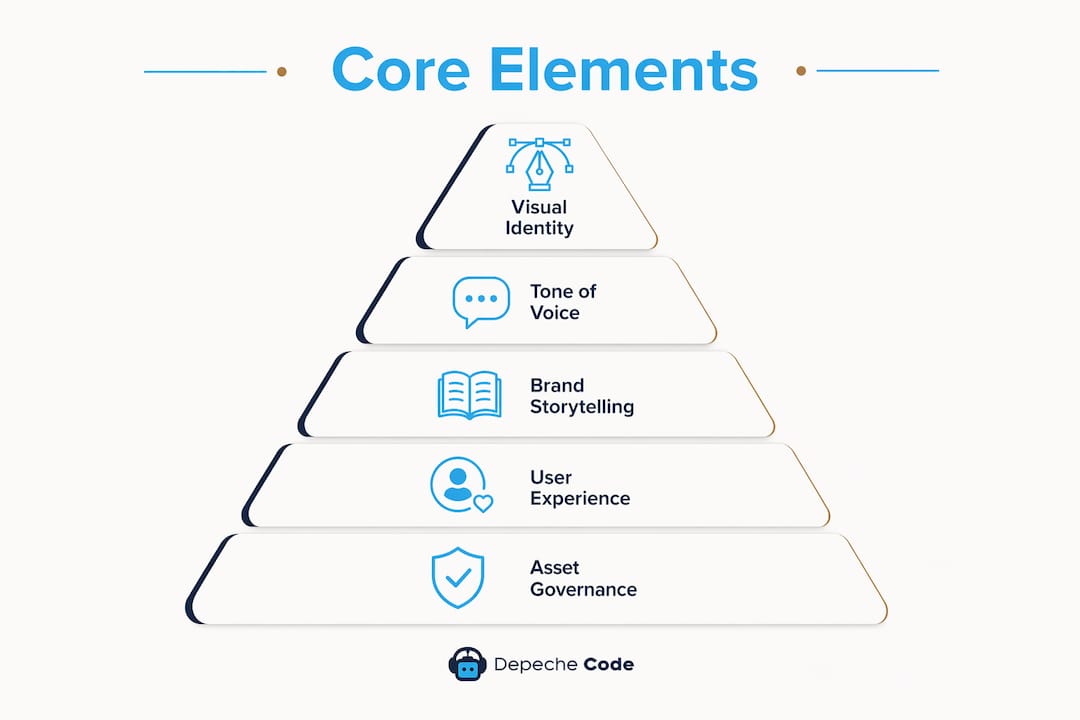
Strong digital brand identity is built from several interlocking components. Understanding each one helps you identify where your brand is strong and where it needs work.
Visual identity is the most visible layer. It includes your logo, color palette, typography, and imagery style. These elements must work together to create immediate recognition. A customer scrolling through Instagram should recognize your content before they even read your handle.

Messaging and tone of voice define how your brand communicates. Are you authoritative and precise, or warm and conversational? Your tone should stay consistent whether you are writing a product description, a customer service reply, or a social media caption.
Brand storytelling creates emotional connection. Customers do not buy products. They buy the story of who made it, why it exists, and what it means for their lives. Your digital content should consistently reinforce that narrative.
User experience across digital platforms is where branding meets functionality. Your website, mobile app, and social profiles should all feel like they belong to the same brand. Navigation, layout, and interaction design all communicate brand values, whether you intend them to or not.
Digital asset management and governance is the operational backbone. Without a system for storing, organizing, and distributing brand assets, teams produce inconsistent content. Governance distributed across teams improves brand consistency without creating bottlenecks.
| Element | What it controls |
|---|---|
| Visual identity | Logo, color, typography, imagery |
| Tone of voice | Language style, personality, communication register |
| Brand storytelling | Narrative, values, emotional connection |
| User experience | Website, app, and platform design consistency |
| Asset governance | Storage, access, approval, and distribution of brand materials |
Pro Tip: Build a simple brand style guide in a shared tool like Figma or Notion before you create any new digital content. Even a two-page document covering your logo usage, color codes, and tone rules will prevent the inconsistency that quietly erodes brand trust.
How does digital branding differ from digital marketing?
Digital branding and digital marketing are not the same thing, though they depend on each other. Confusing the two leads to campaigns that generate clicks but build no lasting loyalty.
Digital branding is about who you are. It defines your identity, values, and the emotional experience customers have with your business. It operates on a long time horizon and builds brand equity that compounds over years.
Digital marketing is about what you do right now. It uses channels like paid search, email campaigns, and social ads to promote specific products or offers and drive measurable short-term results.
“Without intentionality and strategic alignment, digital branding can become a series of disconnected design choices rather than a cohesive system.” — madegooddesigns.com
The practical implication is this: your marketing campaigns will perform better when they are built on a strong brand foundation. A Google ad with a clear brand voice converts better than a generic one. A retargeting campaign works harder when the audience already recognizes and trusts your visual identity.
Here is how the two disciplines compare across key dimensions:
- Goal: Branding builds long-term recognition and trust. Marketing drives short-term conversions and revenue.
- Timeline: Branding is continuous and cumulative. Marketing runs in defined campaigns with start and end dates.
- Measurement: Branding is measured through sentiment, recognition, and loyalty. Marketing is measured through clicks, leads, and sales.
- Output: Branding produces identity systems and guidelines. Marketing produces ads, content, and promotions.
- Dependency: Marketing borrows from branding. Branding does not depend on marketing to exist.
Businesses that invest in digital branding strategies first and marketing second consistently outperform those that do the reverse. Your brand is the reason customers choose you over a competitor with a lower price.
What are best practices for creating a strong digital brand identity?
Building a strong digital brand identity requires more than good design. It requires systems, governance, and a commitment to consistency that most businesses underestimate.
1. Audit your current digital brand presence.
Before building anything new, document what exists. Collect every logo version, color code, font file, and content template your team currently uses. You will almost certainly find inconsistencies. That audit is your baseline.
2. Create living brand guidelines.
Static PDF brand guides fail because teams cannot search them, update them, or integrate them into daily workflows. Successful brand systems are searchable, modular, and integrated into tools like Slack and Figma. A minimum viable brand guideline structure includes brand foundations, identity rules, tone principles, reusable components, template libraries, and defined approval workflows.
3. Adopt responsive logo systems.
Standard horizontal logos often fail to read well on mobile devices. A responsive logo system includes multiple variants: a full lockup for desktop, a simplified mark for mobile, and an icon-only version for app icons and favicons. This is not optional in 2026. Mobile accounts for the majority of web traffic, and your logo must work at every size. Learn more about responsive design principles and how they apply to brand assets.
4. Review your brand guidelines at least twice per year.
Industry experts recommend reviewing digital brand guidelines at least twice per year, with quarterly audits for high-change content like social media templates and annual reviews for stable assets like logo usage rules. Markets shift, products evolve, and your brand guidelines must keep pace.
5. Implement governance at the point of creation.
Locked-field templates and approval workflows prevent off-brand content from being published in the first place. This approach balances creative flexibility with brand control and eliminates the need for constant manual review.
6. Track brand sentiment before investing in expensive tools.
Experts advise starting with simple qualitative feedback before enterprise analytics platforms. A weekly review of customer comments, Google reviews, and social mentions costs nothing and reveals more than most dashboards. Once you know what customers actually say about your brand, you can invest in tools that measure it at scale.
| Best practice | Why it works |
|---|---|
| Living brand guidelines | Teams can find and use current assets without asking for help |
| Responsive logo system | Brand recognition holds across all screen sizes and devices |
| Twice-yearly guideline reviews | Guidelines stay accurate as products and markets evolve |
| Creation-point governance | Off-brand content is prevented before it is published |
| Qualitative feedback first | Reveals real customer perception before investing in analytics tools |
Pro Tip: Use RACI governance models to assign clear ownership for each brand asset. RACI stands for Responsible, Accountable, Consulted, and Informed. Assigning these roles prevents the ownership drift that causes brand guidelines to become outdated and ignored.
How can businesses apply digital branding to drive engagement and growth?
Translating digital branding concepts into daily operations is where most businesses stall. The gap between a brand strategy document and consistent brand execution is wider than most marketing teams expect.
Start by identifying your three most important digital touchpoints. For most businesses, these are the website, one or two social media platforms, and email. Prioritize getting those three channels to feel completely consistent before expanding to others. Trying to maintain brand consistency across eight platforms simultaneously with a small team is a reliable path to inconsistency everywhere.
Embedding brand standards into daily creation tools and workflows is the most effective way to scale consistency. When your social media templates, email headers, and presentation decks are pre-built to brand specifications, every team member produces on-brand content without needing to consult a style guide every time.
Cross-team collaboration is non-negotiable. Sales teams send emails. Customer service teams write responses. Operations teams create internal documents that sometimes go external. Every person who creates content that a customer might see is a brand ambassador, whether they know it or not. A short brand orientation for all new hires, combined with accessible templates, closes most of the gap. Understanding what digital agencies do can also help you identify which brand functions to keep in-house and which to delegate.
Use analytics to monitor brand consistency over time. Track metrics like brand mention sentiment, website bounce rate by traffic source, and social media engagement rate by content type. These numbers tell you whether your brand is resonating or creating friction. When you redesign your website, use a website redesign checklist to protect brand consistency and SEO simultaneously.
Key takeaways
Digital branding is a continuous management system, not a one-time design project, and businesses that treat it as an operational function consistently outperform those that treat it as a creative exercise.
| Point | Details |
|---|---|
| Digital branding definition | The strategic management of brand identity, reputation, and experience across all digital channels. |
| Revenue impact | Consistent brand presentation can increase revenue by up to 23% on average. |
| Branding vs. marketing | Branding builds long-term equity; marketing drives short-term conversions. Both require each other. |
| Living guidelines | Brand guidelines must be searchable, modular, and integrated into daily tools to be effective. |
| Governance at creation | Locked-field templates and approval workflows prevent off-brand content before it is published. |
Where most digital branding advice gets it wrong
I have worked with enough businesses to say this plainly: the biggest mistake is treating digital branding as a deliverable rather than a discipline. A business hires a designer, gets a logo and a color palette, and considers the job done. Six months later, the sales team is using a different font in their proposals, the social media manager is posting with a completely different tone, and the website looks like it belongs to a different company entirely.
The brands that actually build recognition and loyalty treat their brand guidelines the way a software team treats a codebase. It is a living system that gets updated, version-controlled, and integrated into every tool the team uses. When I see a business that has embedded its brand standards into Figma components, Canva templates, and email builders, I know that brand will compound in value over time.
The other thing most articles will not tell you: flexibility matters as much as consistency. A brand that is so rigid it cannot adapt its tone for a crisis response or its visuals for a platform-specific format will feel robotic and out of touch. The goal is a brand system with clear rules and deliberate exceptions, not a brand prison. Build the system. Then teach your team when and how to flex it.
— Donovan
How Depeche Code helps you build a brand-consistent digital presence
Your website is the single most important digital branding asset your business owns. Every other channel points back to it.
Depeche Code, based in Orlando, specializes in website design and development that translates your brand identity into a professional, consistent online presence. From custom layouts and typography to mobile-optimized design and ongoing technical support, the team builds websites that look and perform like your brand at its best. If you are starting from scratch, explore the free website development option to get your digital brand foundation in place without the upfront cost. Depeche Code also offers social media management to keep your brand voice consistent across every channel that matters.
FAQ
What is the digital branding definition?
Digital branding is the strategic process of managing how a business looks, communicates, and behaves across all digital platforms to build recognition, trust, and customer loyalty over time.
How does digital branding differ from traditional branding?
Traditional branding focuses on physical touchpoints like print, packaging, and broadcast media. Digital branding operates across websites, social media, apps, and search results, and it requires ongoing governance because digital channels change faster than physical ones.
What are the core elements of digital brand identity?
The core elements are visual identity (logo, color, typography), tone of voice, brand storytelling, user experience design, and digital asset governance. All five must work together to create a consistent customer experience.
How often should you update your digital brand guidelines?
Industry experts recommend reviewing brand guidelines at least twice per year, with quarterly reviews for high-change assets like social media templates and annual reviews for stable assets like logo usage rules.
Why is digital branding important for small businesses?
Consistent digital branding builds the trust that converts first-time visitors into customers and customers into repeat buyers. For small businesses competing against larger brands, a cohesive and professional digital presence is one of the most cost-effective competitive advantages available.