

TL;DR:
- Digital agencies vary greatly in scope, specialization, and ROI delivery methods.
- Successful partnerships rely on clear processes, transparent metrics, and aligned strategic goals.
- Choosing an agency based on fit and transparency ensures better long-term growth results.
Most business owners assume all digital agencies are interchangeable. Pick one, pay the retainer, and wait for results. That assumption costs companies serious money. The reality is that digital agencies integrate creativity, technology, and marketing expertise in ways that are wildly different from one provider to the next. The scope of services, the methodologies, the level of specialization, and the actual return on investment vary enormously. This article breaks down exactly what digital agencies do, how they deliver results, what agency models exist, and what separates a partnership that drives real growth from one that quietly drains your budget.
Table of Contents
- What is a digital agency? Core functions and offerings
- How digital agencies deliver results: Methodologies and innovation
- Agency types: Specialist, full-service, and hybrid
- Critical success factors and pitfalls in digital agency relationships
- What most business owners miss: Our take on digital agency selection
- Take your digital presence further with expert solutions
- Frequently asked questions
Key Takeaways
| Point | Details |
|---|---|
| Clear agency definition | Digital agencies merge creative, technical, and marketing skills to deliver online growth solutions. |
| Structured workflows matter | Methodologies like SOPs and agile hybrids ensure consistent high-quality results. |
| Specialist vs full-service | Specialists offer depth, full-service agencies deliver breadth; hybrids balance both. |
| Avoid common pitfalls | Success depends on relationship quality, data transparency, and avoiding siloed strategies. |
| ROI proves value | Benchmarks like 300% content ROI and 214% organic growth show genuine agency impact. |
What is a digital agency? Core functions and offerings
A digital agency is, at its core, a specialized service provider that combines creativity, technology, and marketing expertise to deliver comprehensive digital solutions. But that definition alone doesn’t capture how broad the territory actually is. A digital agency can mean anything from a two-person team running Facebook ads to a 200-person firm managing global SEO campaigns, custom software builds, and AI-powered customer experiences simultaneously.
The major service areas that define most digital agencies fall into six categories:
- Search engine optimization (SEO): Improving a website’s visibility in Google and other search engines through technical optimization, content strategy, and link building.
- Website development and redesign: Building or overhauling websites to improve performance, user experience, and conversion rates.
- Social media management: Creating and distributing content across platforms like Instagram, LinkedIn, and Facebook, while managing community engagement and paid social campaigns.
- Pay-per-click (PPC) advertising: Running paid search and display ad campaigns on Google Ads, Meta Ads, and similar platforms to generate immediate traffic and leads.
- Content marketing: Developing blog posts, videos, case studies, and other content assets that attract and convert your target audience.
- Data analytics: Tracking campaign performance, website behavior, and conversion data to inform decisions and optimize spend.
These services rarely operate in isolation. The agencies that generate the best results for clients are the ones that connect these channels into a unified strategy. For example, an agency running SEO and content marketing together can amplify results because each blog post supports keyword rankings while also feeding social media and email campaigns.
Here’s a quick look at what ROI benchmarks tell us across core digital agency services:
| Service | Average ROI benchmark | Key metric |
|---|---|---|
| Content marketing | Up to 300% | Traffic and leads over 12 months |
| Email marketing | $36 returned per $1 spent | Revenue per campaign |
| SEO | 14.6% lead close rate | vs. 1.7% for outbound |
| Paid social | 200-400% ROAS for optimized accounts | Return on ad spend |
| Website redesign | 200%+ conversion lift | Before vs. after optimization |
The businesses that benefit most from digital agency services are those that treat agencies as strategic partners rather than vendors. When your agency understands your revenue goals, your customer acquisition costs, and your competitive landscape, they can allocate effort where it actually moves the needle. When they’re just executing tasks, you’re paying for activity without direction.
How digital agencies deliver results: Methodologies and innovation
Understanding what agencies offer is just the beginning. The real differentiator is how they work. The process structure inside an agency determines whether projects launch on time, campaigns get optimized continuously, and clients feel informed or confused.
Most high-performing agencies follow a structured workflow that looks something like this:
- Onboarding and discovery: The agency learns your business, audits existing assets (website, social profiles, analytics), and identifies gaps and opportunities.
- Strategy and planning: Goals are defined, resources are allocated, timelines are set, and the team responsible for each deliverable is identified.
- Creative execution: Content gets written, designs get built, ad copy gets tested, and technical work gets implemented.
- Review and approval: A structured feedback loop ensures quality control before anything goes live.
- Launch: Campaigns go live, websites deploy, and tracking is confirmed to be working correctly.
- Monitoring and optimization: Performance data is reviewed regularly, and adjustments are made based on what the numbers show.
- Continuous improvement: Insights from each campaign cycle inform the next one, compounding results over time.
This kind of structured agency workflow relies on SOPs (standard operating procedures), RACI matrices (which clarify who is Responsible, Accountable, Consulted, and Informed), and hybrid agile/waterfall project management. Agencies that skip these structures tend to produce inconsistent results because quality depends on individual effort rather than repeatable systems.

The other major shift happening inside agencies right now is AI integration. Agencies using AI tools for content production report cutting content creation time by 58% and boosting overall team productivity by up to 60%. This isn’t about replacing strategists. It’s about automating the repetitive parts of the workflow so that humans can focus on creative thinking, relationship management, and strategic decisions.
For example, AI chatbots in agencies are now handling initial client inquiries, scheduling, reporting summaries, and even first-draft content outlines. On the SEO side, AI tools are accelerating keyword research, technical audits, and competitor analysis. Agencies that integrate these tools thoughtfully report significantly faster turnaround times without sacrificing output quality.
Pro Tip: When evaluating an agency’s process, ask them to walk you through a recent campaign from kickoff to reporting. If they can’t describe it step by step, their process likely isn’t documented, and undocumented processes produce unpredictable results.
The agencies that are growing client accounts fastest right now are combining SEO ROI-driven strategies with AI-assisted content pipelines. Case studies from 2024 and 2025 show organic session growth of up to 214% and lead increases of 89% in accounts where both methodologies were applied consistently over 12 months.
Agency types: Specialist, full-service, and hybrid
Not every agency is built the same way. Before you sign a contract, you need to understand the three primary agency models and what each one actually means for your business outcomes.
Specialist agencies focus on one or two service areas and go extremely deep. An SEO-only agency, for example, has teams dedicated entirely to technical audits, link acquisition, content optimization, and search analytics. Their depth of expertise in that one area is usually unmatched. The trade-off is integration. If you also need social media management or a website rebuild, you’re coordinating multiple vendors, which creates communication gaps and siloed results.
Full-service agencies offer everything under one roof. One team, one point of contact, one strategy. This integration means your SEO, paid ads, social content, and website are all aligned and working from the same data. The risk with some full-service agencies is that they spread expertise too thin. They claim to do everything but may not do any one thing exceptionally well.
Hybrid agencies attempt to capture the advantages of both. Specialists vs. full-service research consistently shows that hybrid models, which are agencies with deep expertise in two to three core areas while offering complementary services through vetted partners, tend to deliver the best balance of depth and integration for growing businesses.
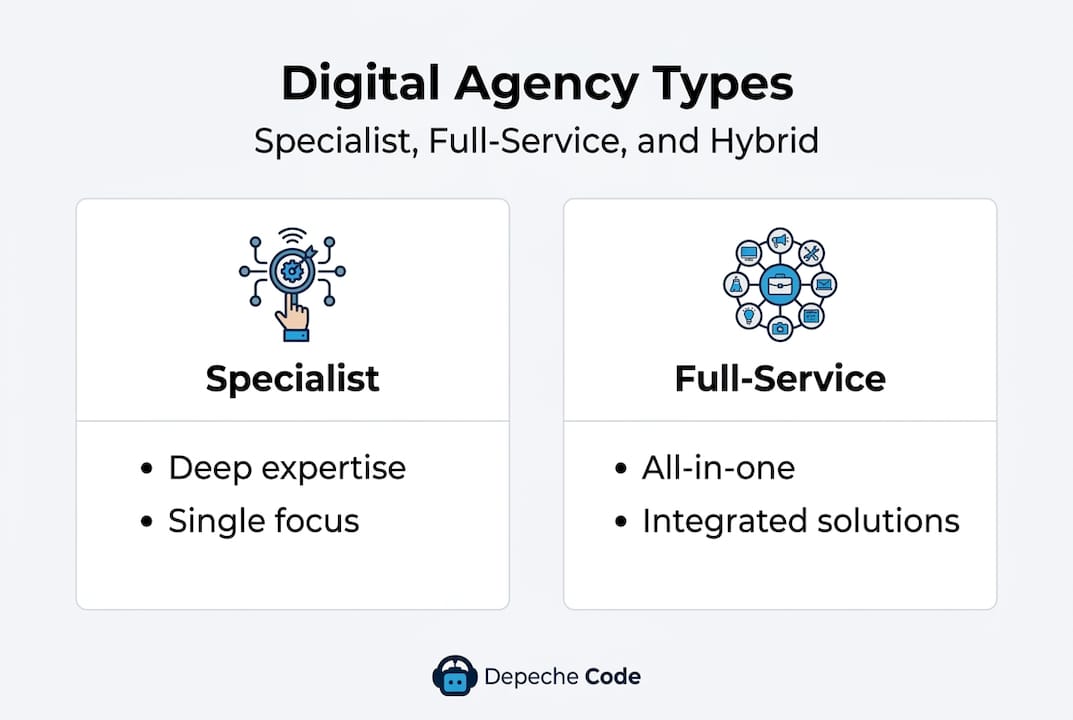
Here’s a direct comparison to help you decide:
| Agency type | Best for | Core strength | Main risk |
|---|---|---|---|
| Specialist | One specific channel priority | Deep expertise | Siloed, hard to integrate |
| Full-service | Unified strategy and single contact | Channel integration | Potentially shallow expertise |
| Hybrid | Balanced depth with coordination | Best of both models | Requires strong agency partnerships |
Some additional points worth considering when choosing your agency model:
- Budget size matters. If your monthly digital budget is under $5,000, a full-service agency may give you better value than splitting spend across multiple specialists.
- Internal team capacity matters too. If you have an in-house marketing coordinator, a specialist agency is easier to manage. If you don’t, full-service or hybrid saves you coordination overhead.
- Growth stage influences the decision. Early-stage businesses often benefit from specialist SEO or web development agencies to build their foundation. Established businesses scaling across multiple channels often benefit more from hybrid or full-service models.
Industry benchmarks show that businesses working with hybrid agency models report 30% higher lead growth rates compared to those using single-channel specialists. Client retention rates at full-service agencies average around 65 to 70%, while specialist agencies that deliver measurable results in their core service see retention rates above 75%.
Critical success factors and pitfalls in digital agency relationships
Choosing the right agency type is only the beginning. What happens after you sign the contract matters just as much. Many business owners don’t realize that poor agency relationships are more often caused by process failures and misaligned expectations than by a lack of talent.
Here are the most common reasons agency relationships fail:
- Chasing vanity metrics. Tracking page views and follower counts without connecting them to revenue leads to campaigns that look good on paper but don’t pay the bills.
- Poor client alignment. When the agency doesn’t fully understand your customer, your margins, or your competitive position, their strategies won’t reflect your actual business reality.
- Siloed channels. Running SEO with one agency and paid ads with another, without shared data and strategy, leads to wasted spend and missed opportunities for synergy.
- Weak communication cadence. Monthly check-ins are not enough. High-performing partnerships involve weekly or biweekly touchpoints where data is reviewed and decisions are made.
Agency partnership success requires what’s called E-E-A-T content (Experience, Expertise, Authoritativeness, and Trustworthiness), strong technical SEO foundations, and intent-matching across all content and ad copy. These aren’t buzzwords. They’re the functional criteria that determine whether your content ranks and converts, or gets ignored entirely.
“81% of clients stay with agencies because of relationship quality, not performance metrics alone. The agency that communicates proactively, explains its decisions, and admits mistakes builds partnerships that outlast algorithm changes and market shifts.” (AgencyAnalytics, 2025)
AI integration inside agency workflows is a growing asset, but it comes with a warning. AI-generated content and AI-driven optimization still require human oversight. Agencies that automate their content strategy entirely without human editorial review produce output that lacks the nuance and originality that both search engines and real readers reward.
Pro Tip: Ask your agency to show you their reporting dashboard before you commit. If they can’t show you clear data linking their work to business outcomes like leads, revenue, or cost per acquisition, they likely don’t have the measurement infrastructure to prove their value.
Here’s what successful digital growth partnerships actually look like in practice: a defined onboarding process, a shared KPI (key performance indicator) framework, weekly communication, documented SOPs, and a quarterly strategy review where results are evaluated against goals and the next 90 days are planned accordingly.
What most business owners miss: Our take on digital agency selection
After working with businesses across dozens of industries, we’ve noticed a consistent pattern. The clients who regret their agency choices almost always made the same mistake: they optimized for the lowest price or the biggest promise. The ones who get outstanding results focused on something less obvious: fit and transparency.
Fit means the agency actually understands your industry, your customer journey, and your growth constraints. It doesn’t mean they’ve worked in your vertical before, but it does mean they ask the right questions during discovery and demonstrate that they’ve done their homework.
Transparency means they show their work. They share documented processes, real SEO ROI case studies, named benchmarks, and honest timelines. Agencies that make bold guarantees without showing the methodology behind those guarantees are selling hope, not a strategy.
We’d also caution against treating the relationship as transactional. The agencies that move fastest for their clients are the ones where communication is open, feedback is direct, and both sides feel accountable. That dynamic doesn’t happen because of a contract. It happens because both parties invest in the relationship from day one.
The question to ask during any agency pitch isn’t “what have you done for clients?” It’s “show me the data, walk me through your process, and tell me what happens when a campaign underperforms.” The answer to that last question tells you everything.
Take your digital presence further with expert solutions
At Depeche Code, we’ve built our agency around exactly the principles this article covers: transparent processes, measurable results, and real relationships with the businesses we serve.
Based in Orlando, we work with small and large businesses to design and develop high-performing websites, run SEO campaigns that compound over time, and manage social media strategies that actually build audiences worth having. Whether you’re starting from scratch or looking to outpace competitors who’ve had a head start, our team brings the structure, tools, and expertise to get you there. Explore what a tailored digital strategy looks like for your business at depechecode.io.
Frequently asked questions
How do digital agencies differ from traditional marketing agencies?
Digital agencies focus on online channels like SEO, website development, and social media, while traditional agencies specialize in offline tactics such as print and TV advertising. A specialized digital provider combines creativity, technology, and marketing expertise for online results specifically.
What services should I expect from a full-service digital agency?
You can expect SEO, web development, social media management, PPC, content marketing, and analytics all under one roof. A full-service agency coordinates these channels into a single, integrated strategy so your data and messaging stay aligned.
What benchmarks prove digital agency ROI?
Content marketing ROI averages 300%, SEO leads have a 14.6% close rate versus 1.7% for outbound, and agencies report up to 214% organic session growth. AI tools are also cutting content production time by 58%, making agency output faster and more cost-effective.
How should I choose the best digital agency for my business?
Focus on agencies with documented processes, proven ROI through real case studies, and a communication style that matches how you work. Proven agency selection criteria include data transparency, client retention track records, and hybrid methodologies that balance depth with channel integration.