

TL;DR:
- Off-page SEO involves external actions like backlinks, mentions, and citations that enhance a website’s authority and trustworthiness. These signals influence search rankings and Google’s E-E-A-T framework, especially in AI-driven search results. Success requires consistent reputation-building strategies that focus on quality over quantity and building credibility over time.
Off-page SEO is defined as every action taken outside your own website to build its authority, credibility, and visibility in search engine results. SEMrush describes off-page SEO as activities that build credibility from external sources for better rankings, covering link building, social media engagement, citations, and public relations. While on-page SEO controls what your site says about itself, off-page SEO determines what the rest of the internet says about you. That external validation is what Google, Bing, and AI-powered search systems use to decide which sites deserve top positions. For digital marketers, business owners, and website administrators, understanding off-page SEO methods is the difference between a site that ranks and one that stagnates.
What is off-page SEO and why does it matter?
Off-page SEO is the collection of signals from outside your website that tell search engines your content is worth ranking. Search Engine Land defines it as every action outside your site that boosts authority through inbound links, citations, and brand mentions. These signals matter because search engines cannot fully trust a website’s self-assessment. A site can claim expertise on any topic, but external recognition from authoritative sources is independent proof.
The importance of off-page SEO becomes clear when you look at competitive search results. Two sites with nearly identical on-page optimization will be separated almost entirely by their off-page profiles. The site with more credible backlinks, consistent brand mentions, and strong PR coverage will outrank the one without. Google’s algorithm has always weighted external signals heavily, and that weighting has only grown more sophisticated in 2026.
Off-page SEO also builds compounding authority over time. Each new backlink from a reputable domain, each brand mention in an industry publication, and each citation in a local directory adds to a site’s cumulative trust score. That trust score is not reset by algorithm updates the way keyword rankings can be. Sites with genuine off-page authority tend to recover faster from algorithm changes than those relying purely on on-page tactics.
What are the key off-page SEO techniques and why do they matter?
The core off-page SEO techniques fall into several distinct categories, each contributing to authority and trust in different ways.

Link building remains the most powerful off-page signal. A backlink from a respected domain like Forbes, a university site, or an industry trade publication tells Google that a credible source vouches for your content. The quality of referring domains matters far more than raw link count. One link from a domain with strong authority outweighs dozens of links from low-quality directories.
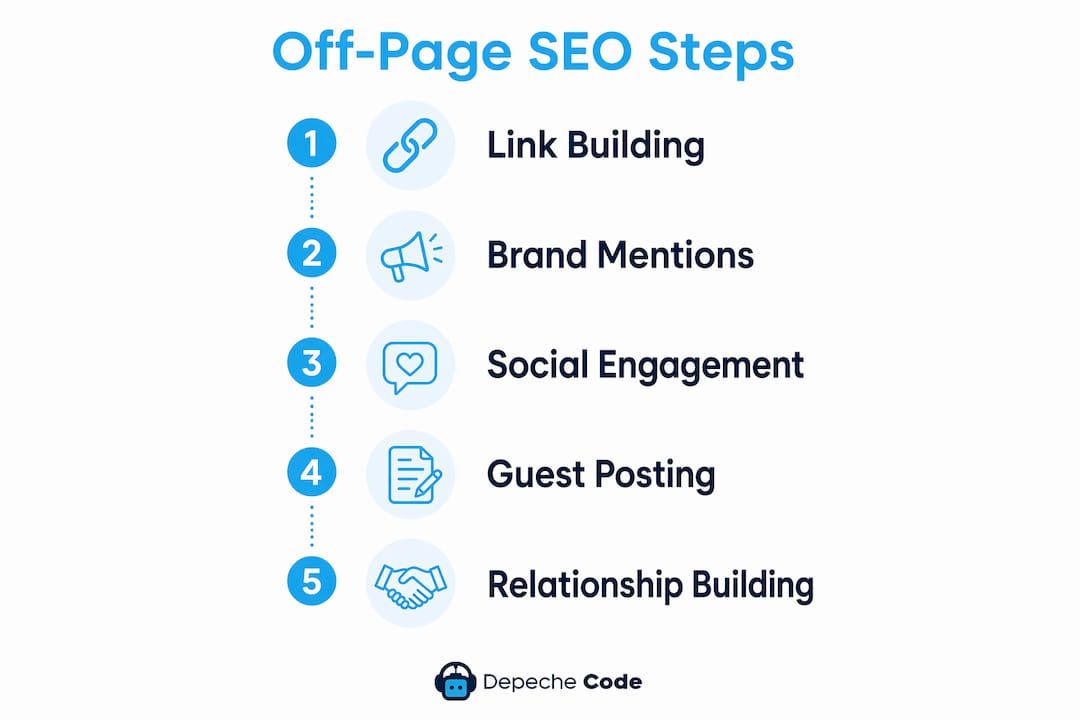
Brand mentions and unlinked citations are a modern off-page signal that many practitioners underestimate. Unlinked brand mentions from authoritative sites still contribute to off-page credibility metrics, even without a hyperlink. When a major news outlet names your company in an article without linking to you, Google’s systems register that mention as a trust signal. SEO teams now track both linked and unlinked mentions as part of their off-page reporting.
Social media engagement amplifies content reach and generates the kind of visibility that leads to organic links and mentions. A post that earns significant shares on LinkedIn or X (formerly Twitter) gets seen by journalists, bloggers, and industry professionals who may cite it in their own content. Social signals are not direct ranking factors, but they accelerate the distribution that produces real off-page signals.
Public relations and digital PR generate high-authority backlinks at scale. A well-placed press release, a data-driven study, or a contributed article in an industry publication can earn dozens of links from a single campaign. This approach treats off-page SEO as earned media rather than a link acquisition exercise.
Local citations matter specifically for businesses targeting regional audiences. Consistent name, address, and phone number (NAP) data across directories like Google Business Profile, Yelp, and industry-specific listings builds local authority. Depeche Code’s work with local citation strategies shows how this consistency directly lifts regional search visibility.
- Build backlinks from relevant, authoritative domains in your industry
- Track both linked and unlinked brand mentions using tools like Google Alerts or Ahrefs
- Run digital PR campaigns around original data, studies, or expert commentary
- Maintain consistent NAP data across all local directories
- Engage on social platforms to distribute content to audiences who may cite it
Pro Tip: When pitching guest articles or press coverage, lead with a data point or original finding your audience has not seen before. Editors and journalists cite sources that give them something new to report.
How does off-page SEO differ from on-page SEO?
On-page SEO and off-page SEO address completely different dimensions of search optimization, and both are required for competitive rankings.
On-page SEO covers everything you control directly on your website. That includes title tags, meta descriptions, header structure, content quality, internal linking, page speed, and schema markup. On-page work tells search engines what your site is about and how it is organized. It is the foundation without which off-page efforts have nothing to amplify.
Off-page SEO covers everything that happens on other websites, platforms, and publications. You do not control these signals directly. You earn them by producing content worth citing, building relationships with publishers, and maintaining a credible public presence. The SEO best practices that produce results in 2026 treat both disciplines as equally necessary, not as alternatives.
| Aspect | On-page SEO | Off-page SEO |
|---|---|---|
| Location | Your own website | External websites and platforms |
| Control | Full control | Indirect, earned through reputation |
| Key elements | Content, meta tags, site structure | Backlinks, mentions, citations, PR |
| Time to impact | Faster, often within weeks | Slower, typically months |
| Primary signal | Relevance and content quality | Authority and trustworthiness |
The practical implication is that on-page SEO makes you eligible to rank, while off-page SEO determines where you actually land. A technically perfect website with no external recognition will not outrank a well-cited competitor in a competitive niche. The two disciplines work together, and neglecting either one creates a ceiling on your rankings.
What role does off-page SEO play in Google’s E-E-A-T and website authority in 2026?
Google’s E-E-A-T framework, which stands for Experience, Expertise, Authoritativeness, and Trustworthiness, is the evaluative lens through which Google’s quality raters and algorithms assess content. Off-page SEO signals like citations and authoritative mentions are directly linked to the Authoritativeness and Trustworthiness dimensions of E-E-A-T.
The logic is straightforward. A website can write anything about itself. But when third-party sources consistently reference, cite, and link to that website, it provides ecosystem-level evidence of credibility that no amount of on-site content can replicate. E-E-A-T frameworks link off-page recognition to search engines needing external evidence, not just website self-claims.
“Off-page SEO is not about getting links. It is about demonstrating that your site is trusted by the broader web ecosystem through shares, mentions, and earned media.” — SEMrush
In 2026, AI-driven search features like Google’s AI Overviews pull from sources that demonstrate consistent external validation. Sites that appear in multiple credible publications, earn citations from authoritative domains, and maintain a visible brand presence are far more likely to be sourced in AI-generated answers. This makes off-page SEO a direct input to AI search visibility, not just traditional blue-link rankings.
The connection between off-page SEO and E-E-A-T also means that the quality of your external recognition matters more than ever. A single mention in a respected industry journal carries more E-E-A-T weight than fifty mentions in low-authority blogs. Search Engine Land recommends treating off-page SEO as consistent reputation and credibility building aligned with Google’s broader authority evaluation, not as a volume exercise.
How can you effectively improve your off-page SEO in 2026?
Improving off-page SEO requires a structured approach that treats reputation building as a long-term system, not a series of one-off tasks. Off-page SEO ranking improvements often take months due to dependency on outside relationships and mentions. Setting realistic timelines is the first step toward a sustainable strategy.
- Audit your current backlink profile. Use a tool like Ahrefs or Google Search Console to identify your existing referring domains, spot toxic links worth disavowing, and find gaps compared to top-ranking competitors.
- Create link-worthy assets. Original research, detailed guides, free tools, and data studies earn citations naturally. Efficient link acquisition follows publishing credible content valuable enough to earn citations without aggressive outreach.
- Pursue digital PR campaigns. Pitch data-driven stories to journalists in your industry. A single placement in a major publication can generate multiple high-authority backlinks and dozens of brand mentions.
- Write guest articles for authoritative publications. Target publications your customers actually read. A guest post on an industry trade site builds both a backlink and direct referral traffic from a relevant audience.
- Monitor and convert unlinked mentions. Set up Google Alerts or use a tool like Mention to track every time your brand appears online without a link. Reach out to those publishers and request a link addition. This is one of the highest-conversion link-building tactics available.
- Build local citations consistently. For businesses serving specific regions, local SEO growth depends on consistent NAP data across Google Business Profile, Yelp, and niche directories.
- Diversify your earned channels. Balancing link building with PR and citation activities reduces risk as Google evaluates trust across multiple signal types, not just backlinks.
Pro Tip: Relationship building with journalists, bloggers, and industry editors produces compounding returns. One strong contact who covers your industry regularly is worth more than a hundred cold outreach emails to strangers.
The SEO ROI data consistently shows that businesses investing in off-page strategies alongside on-page work see significantly stronger long-term ranking stability than those focusing on technical SEO alone.
Key takeaways
Off-page SEO builds the external authority and trust that search engines require to rank your site above well-optimized competitors.
| Point | Details |
|---|---|
| Off-page SEO definition | Activities outside your website that build authority through links, mentions, and citations. |
| Link quality over quantity | One backlink from a high-authority domain outweighs dozens from low-quality sources. |
| E-E-A-T connection | External citations and mentions directly support Google’s Authoritativeness and Trustworthiness signals. |
| Unlinked mentions count | Brand mentions without hyperlinks still contribute to off-page credibility and should be tracked. |
| Long-term investment | Off-page results take months to materialize and require consistent, diversified effort across channels. |
Why off-page SEO is the part most businesses get wrong
Most businesses I work with understand that they need backlinks. What they miss is that link building is a byproduct of a credibility strategy, not a strategy in itself. The sites that dominate competitive search results in 2026 are not the ones that sent the most outreach emails. They are the ones that built something worth citing and then made sure the right people knew it existed.
The biggest mistake I see is treating off-page SEO as a checklist item. A business will run a guest posting campaign for three months, see modest results, and then abandon it. Off-page authority compounds over time. A site that earns ten high-quality links per month for two years will have a profile that is nearly impossible for a competitor to replicate quickly. The businesses that win are the ones that treat off-page SEO as infrastructure, not a campaign.
I also think the obsession with link count is a distraction. I have seen sites with 200 referring domains outrank sites with 2,000, purely because the 200 came from genuinely authoritative, relevant sources. Relevance is the filter that most link-building advice skips over. A backlink from a site in your exact industry niche carries more weight than a generic link from a high-authority site with no topical connection to your content.
The practical advice I give every client is this: build one genuinely useful asset per quarter, whether that is original research, a free tool, or a definitive guide. Then distribute it through PR, social media, and direct outreach to relevant publishers. That system, repeated consistently, produces the kind of off-page profile that sustains rankings through algorithm changes.
— Donovan
How Depeche Code helps you build real off-page authority
Off-page SEO success starts with a website that earns trust before anyone links to it. Depeche Code, a full-service digital agency based in Orlando, builds the technical and content foundation that makes off-page efforts pay off. From professional website design that signals credibility to visitors and publishers alike, to structured SEO plans that include link building, citation management, and reputation monitoring, Depeche Code covers the full picture.
If your site is not earning the external recognition it deserves, the issue is often the foundation, not the outreach. Depeche Code’s SEO team works with small and large businesses to build authority that compounds over time. Explore the SEO options and plans to find the right fit for your goals.
FAQ
What is off-page SEO in simple terms?
Off-page SEO is everything you do outside your own website to improve its authority and search rankings, including earning backlinks, brand mentions, and citations from other sites.
How long does off-page SEO take to show results?
Off-page SEO improvements typically take several months to appear in rankings because they depend on external sites and audiences building links and mentions over time.
What is the most important off-page SEO technique?
Link building from high-authority, relevant domains is the most impactful off-page technique, though brand mentions, digital PR, and local citations all contribute to a complete authority profile.
Do social media links count as off-page SEO?
Social media links are generally nofollow and do not pass direct ranking authority, but social engagement drives content distribution that leads to organic backlinks and brand mentions from other publishers.
How does off-page SEO relate to Google’s E-E-A-T?
Off-page signals like authoritative backlinks and consistent brand citations directly support the Authoritativeness and Trustworthiness dimensions of Google’s E-E-A-T framework, which influences how quality raters and algorithms evaluate your site.