

TL;DR:
- Technical SEO forms the foundation of search rankings by ensuring search engines can crawl, index, and understand your site effectively. In 2026, optimizing for AI crawlers and structured data is crucial, making technical signals essential for visibility across emerging platforms. Ignoring technical SEO risks losing organic traffic despite having quality content and backlinks.
Most marketers pour time into writing content and chasing backlinks, then wonder why rankings never move. The answer is usually sitting underneath everything else. Technical SEO is the infrastructure that tells search engines whether your site is worth crawling, indexing, and ranking. Without it, even the best content gets ignored. Organic search drives 53% of all web traffic, yet a single misconfiguration in your site’s crawl settings can make that traffic disappear. This guide explains what technical SEO is, why it matters more than ever in 2026, and exactly how to put it to work.
Table of Contents
- Key Takeaways
- What technical SEO actually means
- The evolving technical SEO landscape in 2026
- Core components and how to optimize them
- Common technical SEO mistakes to stop making
- How to do technical SEO: a practical starting point
- My honest take on technical SEO in 2026
- Ready to build a technically sound website?
- FAQ
Key Takeaways
| Point | Details |
|---|---|
| Technical SEO is foundational | It controls crawlability, indexability, and site speed before content or links can have any effect. |
| Speed directly affects revenue | A 1-second page load delay reduces conversions by 7% and page views by 11%. |
| Fixing issues multiplies ROI | Resolving technical SEO errors makes other SEO investments 2x to 5x more effective. |
| Beginners can start today | Basic tasks like configuring sitemaps, robots.txt, and HTTPS are manageable in an afternoon for any business owner. |
| AI search changes the rules | Structured data and semantic HTML now determine whether AI systems cite your content. |
What technical SEO actually means
Technical SEO is the practice of optimizing your website’s infrastructure so that search engines and AI crawlers can access, understand, and index your content without obstacles. It has nothing to do with what your pages say and everything to do with how your site is built.
Think of it this way. If your content is the menu at a restaurant, technical SEO is the building itself. A five-star menu means nothing if the front door is locked, the address is wrong on Google Maps, or the kitchen is invisible from the street. Content without technical SEO is exactly that situation.
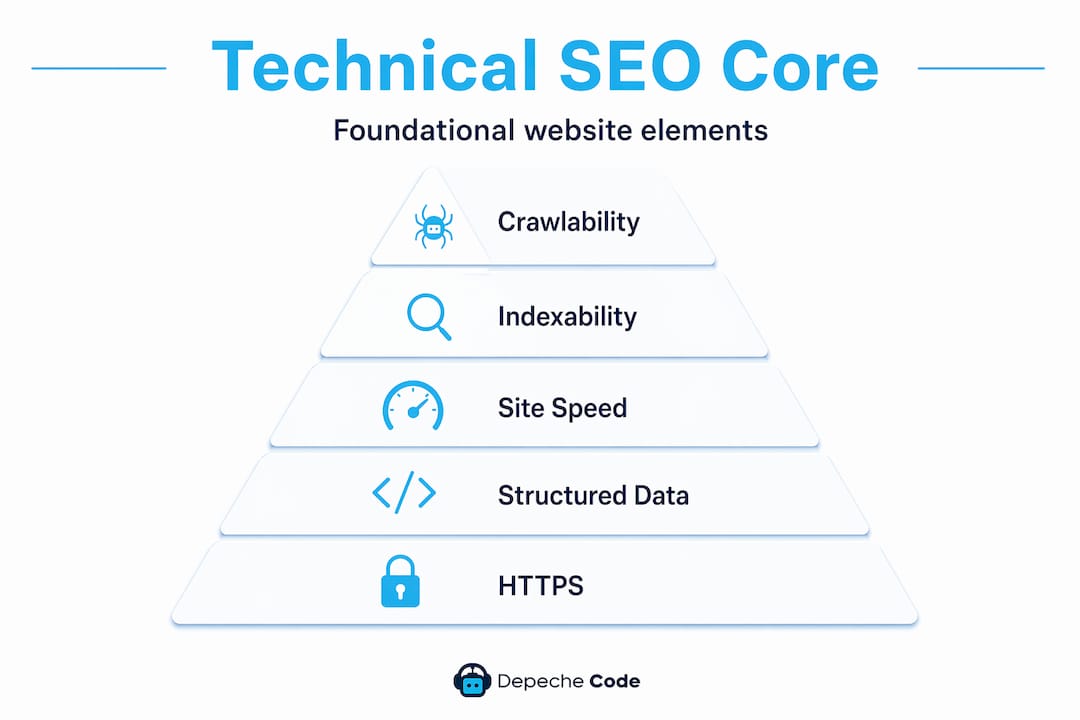
The core elements of technical SEO include:
- Crawlability: Can search engines reach and follow your pages?
- Indexability: Are your pages eligible to appear in search results?
- Site speed: Does your site load fast enough to meet user and algorithm standards?
- Structured data: Have you labeled your content so machines understand what it means?
- HTTPS: Is your connection secure?
- Mobile-friendliness: Does your site perform on phones, where most users now browse?
Understanding what technical SEO is also means knowing what it is not. Here is a clear comparison:
| SEO Type | Primary Focus | Examples |
|---|---|---|
| Technical SEO | Site infrastructure and machine access | Page speed, crawl settings, schema markup |
| On-page SEO | Content quality and keyword relevance | Title tags, headings, internal links |
| Off-page SEO | External authority and reputation | Backlinks, brand mentions, reviews |
What is on-page SEO without technical SEO? Basically useless. Google cannot rank a page it cannot crawl. Technical SEO is the prerequisite that makes on-page and off-page work actually pay off.
Pro Tip: Run a quick crawl simulation using Google Search Console’s URL Inspection tool on your homepage. If it returns errors or shows “Discovered but not indexed,” your technical foundation needs attention before anything else.
The evolving technical SEO landscape in 2026
Technical SEO basics have changed significantly over the past two years. In 2026, you are not just optimizing for Google and Bing. Your site is being accessed by a growing ecosystem of AI crawlers from ChatGPT, Perplexity, Claude, and others. Each one has different capabilities, different rules, and different reasons for visiting your site.
Here is what has shifted in the current environment:
- Selective indexing is now the norm. Google indexes fewer crawled URLs than it did a decade ago. Crawl budget management, which means directing bots to your most valuable pages, is no longer optional for large or complex sites.
- JavaScript rendering has improved but is uneven. Google renders most JavaScript within hours of first crawl, but other AI crawlers struggle with client-side rendering. Server-side rendering gives you coverage across all crawlers, not just Google.
- robots.txt has become an editorial governance document. Managing AI bot access through robots.txt is now a strategic decision about which systems can train on your content versus retrieve it in real time. That is a business decision, not just a technical one.
- INP has replaced FID as a Core Web Vital. Interaction to Next Paint measures how quickly your page responds after a user action. INP scores under 200 ms are considered good; anything above 500 ms actively hurts your rankings.
- Generative Engine Optimization is emerging. Technical SEO is shifting toward what researchers call GEO, where structured data feeds and semantic markup determine whether AI systems cite you in their answers. This is a major strategic development, not a minor update.
For anyone learning technical SEO for beginners in 2026, these changes mean the fundamentals still apply, but the stakes are higher and the audience for your technical signals is wider than ever before.
Core components and how to optimize them
Technical SEO strategies break down into several interconnected areas. Mastering each one builds the foundation that your entire search presence depends on.
Crawlability and indexability
Start with your XML sitemap. It should list every page you want indexed and stay updated automatically if your CMS supports it. Your robots.txt file should block only what you genuinely want hidden, such as staging pages, internal search results, or admin areas. Never accidentally block CSS or JavaScript files, since that prevents proper rendering.

URL structure matters more than most people realize. Short, descriptive, keyword-relevant URLs outperform long strings of parameters. A URL like "/services/seo-audit` tells both users and crawlers what the page is about instantly.
Site speed and Core Web Vitals
Page speed is a direct ranking signal and a conversion factor. Beyond reducing load time, you need to focus on three Core Web Vitals: Largest Contentful Paint (LCP), Cumulative Layout Shift (CLS), and the newer INP metric. Compress images, use lazy loading, minimize render-blocking scripts, and invest in a fast hosting environment.
| Metric | Good Score | Poor Score | Impact |
|---|---|---|---|
| LCP | Under 2.5 sec | Over 4 sec | Page load perception |
| CLS | Under 0.1 | Over 0.25 | Visual stability |
| INP | Under 200 ms | Over 500 ms | Interaction responsiveness |
Structured data and HTTPS
Schema markup does two jobs now. It helps Google generate rich snippets in search results, and it helps AI systems understand what your content is about so they can cite you. Semantic HTML elements like definition lists, article tags, and FAQ schema increase the chances of being featured in AI-generated answers by 30% to 40%.
HTTPS is non-negotiable. Any site still running HTTP in 2026 is actively harming its own visibility. Pair a valid SSL certificate with proper canonical tags and clean 301 redirects to avoid duplicate content penalties and diluted link equity.
Pro Tip: Use Google’s Rich Results Test to check whether your schema markup is eligible for enhanced search features. Many sites implement schema incorrectly and miss out on significant click-through rate improvements.
For those working through a technical SEO checklist, prioritize HTTPS, canonicalization, and structured data early. These fixes deliver the fastest measurable results.
Common technical SEO mistakes to stop making
The biggest misconception in the field is that technical SEO is only for developers. It is not. Fundamental tasks like sitemaps and HTTPS configuration are approachable for any business owner willing to spend a focused afternoon. Thinking you need a developer before you start is what keeps sites broken for months.
Here are the mistakes that show up most often, and the fixes that move the needle fastest:
- Noindex tags left on production pages. This happens when a site launches without removing the development-era noindex setting. Check your robots meta tags and HTTP headers immediately after any site migration or redesign.
- Broken HTTPS certificates or mixed content warnings. Even one HTTP element on an HTTPS page triggers browser warnings and undermines trust signals.
- Crawl blocks on key resources. Blocking CSS or JavaScript in robots.txt prevents proper rendering, making your pages look broken to search engines.
- Index bloat from low-quality pages. Pruning thin or duplicate pages improved index quality and domain-wide quality scores for multiple e-commerce sites, leading to measurable organic visibility gains.
- Auditing without fixing. A technical audit is worthless without implementation. Audits without action produce reports, not rankings.
Pro Tip: Do not wait for a perfect audit to start fixing things. Resolve the most critical errors first, particularly noindex tags, crawl blocks, and HTTPS issues, since these have the fastest impact. Most critical fixes show results within days.
Understanding the importance of technical SEO means accepting that perfection is the enemy of progress. Fix what breaks first, then refine from there.
How to do technical SEO: a practical starting point
Knowing what technical SEO is matters. Knowing how to do it is what actually changes your rankings. Here is a practical framework to get started without getting overwhelmed:
- Run a site audit. Use tools like Google Search Console, Screaming Frog, or Ahrefs to identify crawl errors, broken links, duplicate content, and indexing issues. Free tools get you surprisingly far.
- Fix critical errors first. Prioritize anything that blocks crawling or indexing. Noindex on live pages, disallowed URLs, and missing sitemaps should be resolved before anything else.
- Measure Core Web Vitals. Pull your LCP, CLS, and INP scores from PageSpeed Insights. Address the worst-performing pages, especially high-traffic ones.
- Implement schema markup. Add at least basic Organization, Article, and FAQ schema to relevant pages. This directly supports both traditional rich results and AI citation potential.
- Audit your robots.txt and sitemap. Confirm your sitemap is submitted in Search Console and that robots.txt is not accidentally blocking pages you want indexed.
- Monitor continuously. Technical SEO is not a one-time project. Schedule monthly crawls and keep a close eye on Core Web Vitals trends in Search Console.
For those looking at the broader picture, understanding how SEO drives long-term ROI helps frame technical work as a strategic investment rather than a maintenance task.
Pro Tip: Google Search Console is free and often surfaces the most business-critical technical issues faster than paid tools. Start there before spending money on anything else.
My honest take on technical SEO in 2026
I have worked on dozens of sites where content was excellent and backlinks were solid, but organic traffic was flat. In every single case, a technical audit revealed something fundamental that was quietly blocking progress. Fixing those issues, sometimes in a week, doubled the ROI of the entire SEO investment.
What I have learned is that most people treat technical SEO as a one-time checkbox. They run an audit, fix the obvious errors, and move on. But in 2026, the game is different. You are now optimizing for a dozen AI crawlers alongside Google, each with different rendering capabilities and access rules. The sites that win are the ones that have made their data structures transparent and machine-readable across all of these systems.
The part I find most underappreciated is robots.txt. Business owners almost never think about it strategically, but right now it controls whether AI companies can use your content to train their models or only retrieve it in real time. That is a legal and commercial decision dressed up as a technical setting.
My advice: do not separate technical SEO from your broader content and marketing strategy. They are not parallel tracks. Technical SEO is the road. Everything else is the vehicle. Without the road, it does not matter how fast your car is.
The future belongs to sites that make themselves easy for machines to understand and cite. That means investing in structured data, fast load times, and clean crawl configurations consistently, not just when something breaks.
— Donovan
Ready to build a technically sound website?
If you have made it this far, you understand that technical SEO is the foundation everything else depends on. Depechecode helps businesses in Orlando and across the country build websites that are designed to perform from the ground up.

From professional website design and development built on SEO-friendly architecture to comprehensive SEO plans that include technical audits and ongoing fixes, Depechecode covers the full picture. Small businesses can also explore a free website development option to get started without the upfront cost. For businesses focused on 2026 AI-driven search visibility, the AI Organic SEO Starter package aligns technical SEO with modern generative search practices. Contact Depechecode today to find out what is holding your site back.
FAQ
What is technical SEO in simple terms?
Technical SEO is the process of optimizing your website’s backend infrastructure so search engines can crawl, index, and rank your pages. It covers speed, security, site structure, and structured data.
How is technical SEO different from on-page SEO?
On-page SEO focuses on content quality and keyword use, while technical SEO focuses on how your site is built and whether search engines can access it. Both are necessary, but technical SEO comes first.
How long does it take to see results from technical SEO fixes?
Most technical fixes show measurable impact within 4 to 8 weeks, with critical errors like crawl blocks or noindex tags often resolving in a matter of days once corrected.
Do I need a developer to do technical SEO?
Not always. Basic tasks like submitting a sitemap, configuring robots.txt, and enabling HTTPS are manageable for non-developers. Complex issues like JavaScript rendering or site architecture changes typically benefit from developer support.
Why does technical SEO matter for AI search in 2026?
AI search systems like ChatGPT and Perplexity use structured data and semantic HTML to identify citable content. Sites with proper schema markup and clean technical foundations are significantly more likely to appear in AI-generated answers.