

You’ve updated your website, published a few blog posts, and waited. Nothing happened. No spike in traffic, no new inquiries, no sign that anyone noticed. This is one of the most common frustrations for small and medium business owners, and it almost always comes down to one thing: content without a strategy. Content marketing generates 3x more leads than paid ads at 62% less cost, yet most businesses still publish randomly and wonder why results are flat. This guide walks you through a proven, step-by-step website content creation process designed to turn your site into a real lead generation engine.
Table of Contents
- Why content quality matters more than quantity
- Essential preparations: Goals, audience, and keyword strategy
- Step-by-step website content creation process
- Common mistakes and verification: How to ensure content works
- Level up your website content with expert help
- Frequently asked questions
Key Takeaways
| Point | Details |
|---|---|
| Quality beats quantity | Publishing fewer, high-quality posts gives better website results than frequent low-value updates. |
| Preparation drives success | Set clear goals, know your audience, and do keyword research before writing any content. |
| Follow a repeatable process | Effective content creation uses structured steps, blending AI and human review for best results. |
| Track and improve | Regularly measure traffic and engagement to refine your content strategy over time. |
Why content quality matters more than quantity
Posting more often feels productive. It rarely is. The businesses that see consistent growth from their websites are not the ones publishing every day. They are the ones publishing with purpose. Before you write another word, it helps to understand what quality actually means in this context.
Quality content is accurate, complete, well-structured, original, and written in a human voice. It answers a real question your audience is asking, and it does so better than anything else on the first page of Google. That is a high bar, but it is the bar that matters.
The numbers back this up. 83% of marketers say publishing higher-quality content less frequently is more effective than churning out volume, yet only 47% of businesses have a documented content strategy. That gap is your opportunity.

Common pitfalls of chasing volume include thin posts that cover topics too broadly, duplicate content that confuses search engines, and articles that attract clicks but fail to convert visitors into leads. If your content is not tied to a business goal, it is just noise.
Here are five elements every effective piece of website content must have:
- Clear purpose: Every page or post should serve one specific goal, whether that is ranking for a keyword, capturing an email, or explaining a service.
- Audience alignment: The content speaks directly to the person most likely to buy from you, not a general internet audience.
- Actionable value: Readers leave with something useful, a tip, a framework, or a decision they can make.
- On-page SEO: Proper headings, meta descriptions, internal links, and keyword placement are non-negotiable.
- Strong call to action: Every piece of content should tell the reader what to do next.
If you are also thinking about how your site looks and functions alongside your content, enhancing website redesign with SEO techniques is a smart parallel investment.
Essential preparations: Goals, audience, and keyword strategy
Great content does not start with writing. It starts with planning. Skipping this phase is the single biggest reason SMB content fails to deliver results.
Start with clear goals, audience personas, and keyword research, then build a content calendar that balances awareness, consideration, and decision-stage topics. That structure gives every piece of content a job to do.
Setting goals means being specific. “Get more traffic” is not a goal. “Rank on page one for ‘Orlando web design for restaurants’ within 90 days” is a goal. Specificity shapes every decision you make about what to write and how to write it.
Audience personas are simple profiles of your ideal customers. You do not need a marketing degree to build one. Answer these questions: What does this person do for work? What problem are they trying to solve? What objections do they have before buying? What language do they use when they search online? A one-page persona built from these answers will sharpen every piece of content you create.
Here is a simple numbered process for building your first persona:
- Interview two or three of your best current customers.
- Identify the problem they had before finding you.
- Note the exact words they used to describe that problem.
- List the other solutions they considered.
- Write a one-paragraph profile combining all of the above.
For keyword research, you do not need expensive tools to get started. Here is a quick comparison of free options:
| Tool | Best for | Cost |
|---|---|---|
| Google Search Console | Tracking what you already rank for | Free |
| Google Keyword Planner | Finding search volume estimates | Free |
| Ubersuggest | Competitor keyword gaps | Free tier available |
| AnswerThePublic | Question-based keyword ideas | Free tier available |
Pro Tip: Your customers are handing you keywords every day. The questions they ask in emails, calls, and reviews are low-competition, high-intent search terms. Start a running document and log every question you receive. Those become your next ten blog topics.
If you are working with a design partner or considering a site overhaul, reviewing website redesign tips can help you align your content strategy with a stronger site structure from the start.
Step-by-step website content creation process
Once your goals, personas, and keywords are in place, the actual creation process becomes much faster and more focused. Here is a repeatable workflow you can use for every piece of content.
- Brainstorm with intent: Pull topic ideas from your keyword list, customer questions, and competitor gaps. Every idea should map to a persona and a goal.
- Build an outline first: Before writing a single sentence, map out your headings and the key point each section will make. This prevents rambling and keeps word count tight.
- Write a rough draft fast: Do not edit while you write. Get the ideas down, then refine. Speed in the draft phase protects your creative momentum.
- Optimize for on-page SEO: Add your target keyword to the title, first paragraph, at least one subheading, and the meta description. Add internal links to related pages.
- Edit for readability: Read it out loud. If you stumble, rewrite. Aim for short paragraphs, plain language, and a clear call to action at the end.
- Publish and promote: Post it, share it on social media, and link to it from relevant existing pages on your site.
50% of bloggers who publish two to six times per week report strong results, and content remains the most effective channel for demand generation at 83%. Consistency matters, but only when the content itself is worth reading.
Here is a comparison of manual versus AI-assisted content workflows:
| Step | Manual workflow | AI-assisted workflow |
|---|---|---|
| Topic research | 2-3 hours | 30-45 minutes |
| Outline creation | 45 minutes | 10-15 minutes |
| First draft | 3-4 hours | 45-60 minutes |
| Editing and fact-checking | 1-2 hours | 1-2 hours (same) |
| Total time saved | Baseline | Up to 60% faster |
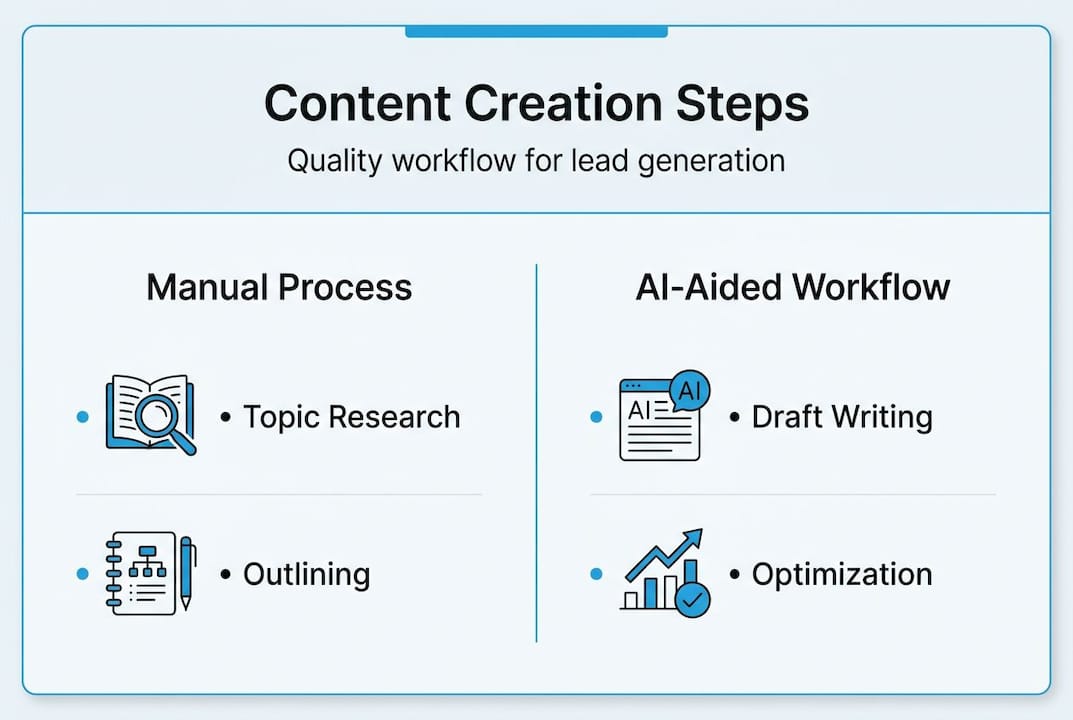
Pro Tip: AI tools are excellent for generating outlines, suggesting headlines, and speeding up first drafts. But human oversight is essential for E-E-A-T, which stands for Expertise, Experience, Authoritativeness, and Trustworthiness. Google rewards content that demonstrates real-world knowledge. Always add your own examples, data, and perspective before publishing.
If your site itself is holding back your content’s performance, check out website redesign signs to see whether a structural update might be overdue.
Common mistakes and verification: How to ensure content works
Creating content is only half the job. Knowing whether it is working, and fixing it when it is not, is what separates businesses that grow from those that plateau.
Here are the five most common content mistakes SMBs make:
- Writing for everyone: Content that tries to appeal to all audiences connects with none. Narrow your focus to your persona.
- Ignoring search intent: A post optimized for a keyword but written for the wrong stage of the buyer journey will rank and still fail to convert.
- No internal linking: Every new page you publish should link to and from at least two other pages on your site. This builds authority and keeps visitors engaged.
- Publishing and forgetting: Content needs to be reviewed and updated regularly. A post from two years ago with outdated information actively hurts your credibility.
- Skipping the call to action: If you do not tell readers what to do next, most of them will leave without taking any action.
To verify your content is working, track these four metrics monthly:
Traffic: Are more people finding this page over time? Use Google Search Console or Google Analytics.
Time on page: Are visitors actually reading? Under 30 seconds usually means the content missed the mark.
Conversions: Are readers clicking your call to action, filling out a form, or calling your business?
Backlinks: Are other sites linking to your content? This is a strong signal of quality.
“Quality content is accurate, complete, structured, original, and human-voiced. Evaluate it via traffic, engagement, conversions, and backlinks.” — HubSpot
When a page is underperforming, you have two options: update it with better information and stronger optimization, or consolidate it with a related page that is performing better. Both strategies work. Doing nothing does not.
If you are also evaluating the broader digital support your business needs, choosing a web design service that understands content strategy alongside design can make a significant difference in your results.
Level up your website content with expert help
Applying everything in this guide takes time, skill, and consistency. Most business owners have the motivation but not always the bandwidth to execute a full content strategy while running their operations. That is exactly where a dedicated digital partner makes the difference.

At Depeche Code, we work with small and medium businesses to build content strategies that are backed by real SEO data and tied directly to business goals. Our team handles everything from website design and redesign to SEO solutions and social media management, so your content works across every channel. If you want to stop guessing and start seeing measurable results, reach out for a free consultation. We will review what you have, identify the gaps, and build a plan that actually moves the needle for your business.
Frequently asked questions
What is the best starting point for website content creation?
Set clear website goals and define your target audience persona before creating any content. Without those two anchors, even well-written content tends to miss the mark.
How often should I publish new website content?
Focus on quality and regularity rather than daily output. Publishing two to six targeted, well-researched posts per month can significantly outperform a high-volume, low-quality approach.
How do I know if my website content is working?
Track traffic, time on page, conversions, and backlinks on a monthly basis. These four metrics give you a clear picture of whether your content is reaching and engaging the right audience.
Should I use AI tools for website content creation?
AI tools speed up research, outlining, and drafting, but human oversight is necessary to maintain quality, accuracy, and the kind of real-world authority that search engines reward.
Recommended
- How To Leverage AI Chat Bots For Lead Generation • Depeche Code
- How To Optimize Your WordPress Website For SEO With AI Chat Bot Integration • Depeche Code
- Expert Tips On Redesigning Your Website For Better User Experience • Depeche Code
- The Dos And Don’ts Of Redesigning Your Website For Better User Experience • Depeche Code