

TL;DR:
- Prioritize web trends that deliver measurable ROI, adaptability, and future-proofing for sustainable growth.
- AI boosts productivity but requires human review for complex or security-sensitive code to maintain quality.
- Server-first architecture and Core Web Vitals are essential for fast, secure, and SEO-friendly websites in 2026.
Your website is either working for your business or quietly working against it. In 2026, the gap between high-performing sites and outdated ones is wider than ever, and the technology driving that gap moves fast. Business owners and marketing managers face a real challenge: which trends deserve your time and budget, and which are just noise? This article cuts through the clutter by giving you a practical framework for evaluating what matters, then walking you through the five most impactful website development trends this year. Think of it as your decision toolkit for staying competitive without chasing every shiny new thing.
Table of Contents
- How to evaluate the best website development trends for 2026
- AI integration: Productivity booster or double-edged sword?
- Server-first and edge technologies: Redefining speed and scale
- The performance imperative: Core Web Vitals, UX, and business outcomes
- Design, type safety, and sustainability: Building for the future user
- A smarter roadmap: What most experts miss about adopting new trends
- Transform your website with the latest 2026 solutions
- Frequently asked questions
Key Takeaways
| Point | Details |
|---|---|
| AI boosts productivity | AI tools now save developers 5-8 hours per week and accelerate routine coding. |
| Server-first is standard | Server-first rendering improves speed and security for modern business websites. |
| Core Web Vitals impact ROI | Sites passing all Web Vitals see 24 percent lower bounce rates and better user engagement. |
| Design must balance trends | Innovative design should enhance user experience while ensuring accessibility and sustainability. |
How to evaluate the best website development trends for 2026
Not every trend deserves your attention. The ones worth pursuing share four qualities: they deliver measurable ROI, they adapt to different business contexts, they don’t require a complete team overhaul to implement, and they position you well for the next three to five years. If a trend fails two or more of those tests, it’s probably hype.
Here’s how to apply that filter in practice:
- ROI impact: Can you tie this trend to lower bounce rates, higher conversions, or reduced development costs? If the data isn’t there, wait.
- Adaptability: Does it work for your industry, your audience, and your current tech stack? A trend that works for a SaaS company may not suit a local service business.
- Skill requirements: Will your team need six months of retraining, or can they adopt it incrementally? Steep learning curves eat into the gains.
- Future-proofing: Is this trend gaining traction in the broader ecosystem, or is it a niche experiment? Look for adoption curves, not just press coverage.
The difference between hype and lasting value usually comes down to evidence. Trends with strong case studies, growing developer adoption, and measurable business outcomes are the ones worth prioritizing. You’ll find solid web development tips for 2026 that align with these criteria throughout the rest of this article.
Pro Tip: Before committing budget to any new technology, ask your development team to score it on all four criteria above. A simple 1-5 scale per category gives you a fast, defensible ranking.
AI integration: Productivity booster or double-edged sword?
Artificial intelligence has moved from novelty to necessity in web development. The numbers are striking: over 70% of developers now use AI tools daily, reporting 55% faster task completion and saving heavy users five to eight hours every week. That’s not a marginal improvement. That’s a structural shift in how development teams operate.
The most common AI use cases in web development right now include:
- Code generation: Autocomplete tools like GitHub Copilot handle repetitive boilerplate at roughly three times the speed of manual coding.
- Testing automation: AI generates test cases and identifies edge cases faster than manual QA processes.
- Content structuring: AI assists with metadata, alt text, and structured data markup at scale.
- Design prototyping: Tools like Figma’s AI features speed up wireframing and layout iteration.
But here’s the part most vendors won’t tell you. AI slows complex logic and introduces subtle errors that aren’t immediately obvious. When AI writes business-critical workflows, payment logic, or security-sensitive code, the review burden actually increases. You save time on the easy stuff and spend it on scrutiny of the hard stuff.
For business owners, the practical takeaway is this: AI-enhanced development can lower your project costs and speed up delivery timelines. But the quality of the output depends entirely on the expertise of the humans reviewing it. A team that uses business success with AI-enhanced development as a strategy, not a shortcut, will outperform one that just turns on the tools and walks away.
Pro Tip: Start with AI-assisted code generation for repeatable tasks like form handling and API calls. Implement a mandatory human review step for any logic touching user data, payments, or security.
Server-first and edge technologies: Redefining speed and scale
Following AI’s emergence, the next wave centers on foundational architecture upgrades. Specifically, the shift from client-side rendering to server-first models is reshaping how websites are built and how fast they load.
In a traditional client-side setup, your browser downloads a large JavaScript bundle and then builds the page. Server-first rendering flips that: the server does the heavy lifting and sends a ready-to-display page to the browser. The result is a smaller JS bundle, faster initial load, and fewer attack surfaces for security vulnerabilities.
Next.js holds 35% of new projects and is growing year over year, making it the dominant meta-framework for server-first development. Pair that with edge computing, where your content is served from nodes closest to your user geographically, and you get dramatically lower latency and new options for real-time personalization.
Here’s a quick comparison to help you choose the right model:
| Approach | Best for | Key advantage | Watch out for |
|---|---|---|---|
| Server-first | Content-heavy, SEO-critical sites | Fast initial load, security | Higher server costs |
| Client-side | Highly interactive apps | Rich UX, dynamic updates | Slower first load, SEO gaps |
| Edge computing | Global audiences, personalization | Low latency, geo-targeted content | Complexity, debugging |
For most business websites, a server-first approach with edge delivery is the strongest foundation. It supports SEO, reduces security risk, and scales cleanly. Explore future-proof development approaches if you’re planning a rebuild or major upgrade this year. You can also check framework market share data to see how these trends play out across the broader developer ecosystem.
The performance imperative: Core Web Vitals, UX, and business outcomes
With foundational choices set, performance becomes the difference-maker for capturing users and driving conversions. Google’s Core Web Vitals are the standard measurement framework, and they directly influence both search rankings and user behavior.
The three metrics you need to know:
- LCP (Largest Contentful Paint): How fast your main content loads. Target: 2.5 seconds or less.
- INP (Interaction to Next Paint): How quickly your page responds to user input. Target: 200 milliseconds or less.
- CLS (Cumulative Layout Shift): How much your layout jumps around during load. Target: 0.1 or less.
Only 48 to 57% of sites pass all three on mobile, and sites that fail see 24% higher bounce rates. That’s a direct revenue leak.
Here’s how to improve each metric systematically:
- Improve LCP: Optimize and compress hero images, use a CDN, and preload critical resources.
- Improve INP: Minimize JavaScript execution time, defer non-essential scripts, and break up long tasks.
- Improve CLS: Set explicit width and height on images and embeds, avoid inserting content above existing elements.
- Test regularly: Use Google Search Console and PageSpeed Insights to track your scores over time.
- Prioritize mobile: With most traffic now on phones, mobile scores matter more than desktop.
If you want a step-by-step approach, optimize for Web Vitals with a focus on the metrics that affect your specific industry. The connection between performance and profit is not theoretical. Faster sites convert better, rank higher, and retain users longer.
Design, type safety, and sustainability: Building for the future user
Beyond speed, today’s leaders also prioritize user experience, reliability, and long-term responsibility. Three converging forces are shaping how modern sites are built and presented.
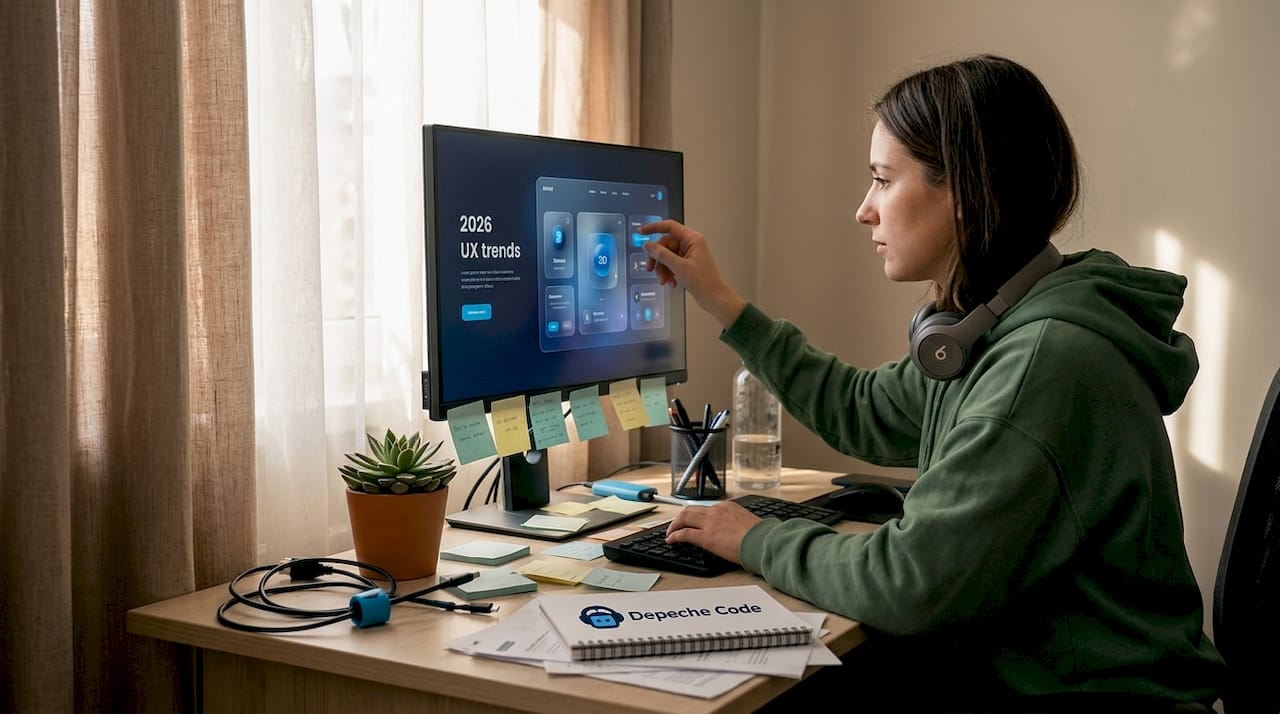
Visual design in 2026 leans into immersive experiences. 3D elements, glassmorphism (frosted-glass UI effects), and bold typography are popular, but the smartest teams balance these with accessibility and load speed. A stunning visual effect that slows your LCP or fails contrast ratio standards is a net negative. Check web design trends research for a current overview of what’s resonating with users.
TypeScript has become the baseline for serious front-end work. TypeScript now drives 45 to 60% of front-end projects, and its end-to-end type safety catches errors before they reach production. For business owners, this means fewer bugs, more predictable behavior, and lower long-term maintenance costs. React remains the dominant library within that ecosystem.
Sustainability is no longer a niche concern. Digital use accounts for 3.7% of global CO2, and green hosting options are growing fast. Lightweight code, efficient media delivery, and eco-conscious hosting choices reduce your carbon footprint and often improve performance at the same time.
Key considerations for 2026:
- Use responsive design for business as your baseline before layering in visual effects
- Adopt TypeScript for new projects to reduce technical debt
- Choose green hosting providers where possible
- Test every design choice against WCAG accessibility guidelines
- Reference modern design trends to stay current without sacrificing usability
Businesses can’t ignore eco-impact and accessibility alongside aesthetics. The sites that win in 2026 are the ones that look great, load fast, and work for everyone.
A smarter roadmap: What most experts miss about adopting new trends
Here’s what we’ve seen repeatedly working with businesses across industries: the companies that struggle most with their websites aren’t the ones ignoring trends. They’re the ones chasing all of them at once.
FOMO-driven pivots are expensive. A team that rebuilds its stack around every new framework, or redesigns its UI every time a new aesthetic goes viral, burns budget without building compounding value. The businesses that win are the ones that sequence their investments deliberately.
Our recommendation is to treat trends in tiers. Start with foundational upgrades that have the broadest impact: AI-assisted development workflows, server-first architecture, and Core Web Vitals performance. These improvements lift every other part of your site. Once those are solid, layer in design innovation and sustainability practices where they fit your brand and audience naturally.
The web success tips for 2026 that actually move the needle share one quality: they’re chosen with intention, not impulse. Score every trend against your specific business goals before committing. A trend that’s transformative for an e-commerce brand may be irrelevant for a B2B service firm. Context is everything, and thoughtful adoption will always outperform reactive pivoting.
Transform your website with the latest 2026 solutions
Ready to put these insights into practice? At Depeche Code, we help business owners and marketing managers implement exactly the trends covered in this article, without the guesswork or wasted budget.

From website design and development built on server-first architecture to AI chatbot solutions that enhance customer engagement, our team brings the technical depth and strategic clarity your site needs in 2026. Not sure where to start? We offer a free website development consultation to audit your current setup and identify the highest-impact improvements. Let’s build something that performs.
Frequently asked questions
Are AI tools reliable for all aspects of website development in 2026?
AI excels at repetitive tasks and code generation, but complex logic and security-sensitive workflows still require experienced human oversight for reliable results.
What are Core Web Vitals and why do they matter?
Core Web Vitals are Google’s performance metrics covering load speed, interactivity, and visual stability. Sites that pass all three see 24% lower bounce rates, which directly affects conversions and search rankings.
How do I balance modern design trends with accessibility needs?
Adopt fresh visuals like 3D or glassmorphism thoughtfully, but always test for color contrast, screen reader compatibility, and keyboard navigation to serve every user effectively.
Why is server-first rendering getting so much attention?
Server-first reduces JS bundle size and security exposure compared to client-side rendering, making it faster, safer, and more SEO-friendly for most business websites.
Does sustainable web hosting make a real difference?
Absolutely. With digital use at 3.7% of global CO2, choosing green hosting and optimizing code efficiency directly reduces your environmental impact while often improving site performance.