

TL;DR:
- A business website is a goal-driven online hub that builds credibility and generates leads.
- Essential features include a custom domain, clear descriptions, contact forms, and mobile responsiveness.
- Success depends on clarity, regular updates, and measuring key metrics like visitors and inquiries.
A business website is not a digital brochure collecting dust in some corner of the internet. It is the most active, hardest-working member of your team, operating 24 hours a day, 7 days a week, without a single coffee break. Many small and mid-sized business owners still treat their website as an afterthought, something to check off a list rather than a tool that generates real revenue. This guide breaks down what a business website truly is, the core features that make one effective, the different types available, and exactly how to get started building or improving yours.
Table of Contents
- What defines a business website?
- Essential features and benefits for businesses
- Types of business websites and choosing the right fit
- How business websites drive tangible results
- Getting started: Steps to launch or improve your business website
- Why most business websites fail (and how to get it right)
- Build your business website with expert support
- Frequently asked questions
Key Takeaways
| Point | Details |
|---|---|
| Business website definition | A business website is a professional digital hub for showcasing services, products, and building customer trust. |
| Essential features | Key elements like mobile responsiveness, contact forms, and strong branding set the foundation for success. |
| Website types | Choosing the right website type—informational, e-commerce, or portfolio—aligns with business goals. |
| Measurable impact | Track leads, sales, and credibility improvements to gauge your website’s true value. |
| Professional support | Expert help in design and strategy accelerates results and avoids common pitfalls. |
What defines a business website?
A business website is a professionally designed, goal-driven digital hub that represents your company online, communicates your value to potential customers, and actively supports your sales and marketing efforts. It is not a hobby page or a personal blog. It exists to do specific work for your company every single day.
The distinction matters more than most people realize. A personal site might share someone’s travel photos or opinions. A portfolio site showcases creative work. A business website, by contrast, is built around credibility, conversion, and customer interaction. It needs to answer visitor questions instantly, guide them toward a clear action, and make your company look trustworthy before a single conversation happens.
Here is a quick comparison to make the differences concrete:
| Feature | Business website | Personal site | Portfolio site |
|---|---|---|---|
| Primary goal | Generate leads and sales | Share personal content | Showcase creative work |
| Target audience | Customers and clients | Friends and followers | Potential employers or clients |
| Key elements | Services, contact forms, CTAs | Blog posts, personal info | Project galleries, bio |
| Ongoing maintenance | High priority | Low priority | Moderate priority |
As professional website design continues to evolve, businesses that invest in purposeful online presence consistently outperform those that do not. A professional online presence sets businesses apart from competitors in ways that no social media profile or directory listing can fully replace.
“Every business, regardless of size, needs a dedicated website in 2026. It is your only fully owned digital real estate where you control the message, the experience, and the outcome.”
Exploring the different types of website design available will help you understand which approach fits your specific goals before you invest a single dollar.
Essential features and benefits for businesses
With a solid definition in mind, we can now explore the crucial features and benefits that make a business website effective. Not all websites are created equal, and the gap between a site that converts visitors into customers and one that simply exists is usually a handful of very specific features.
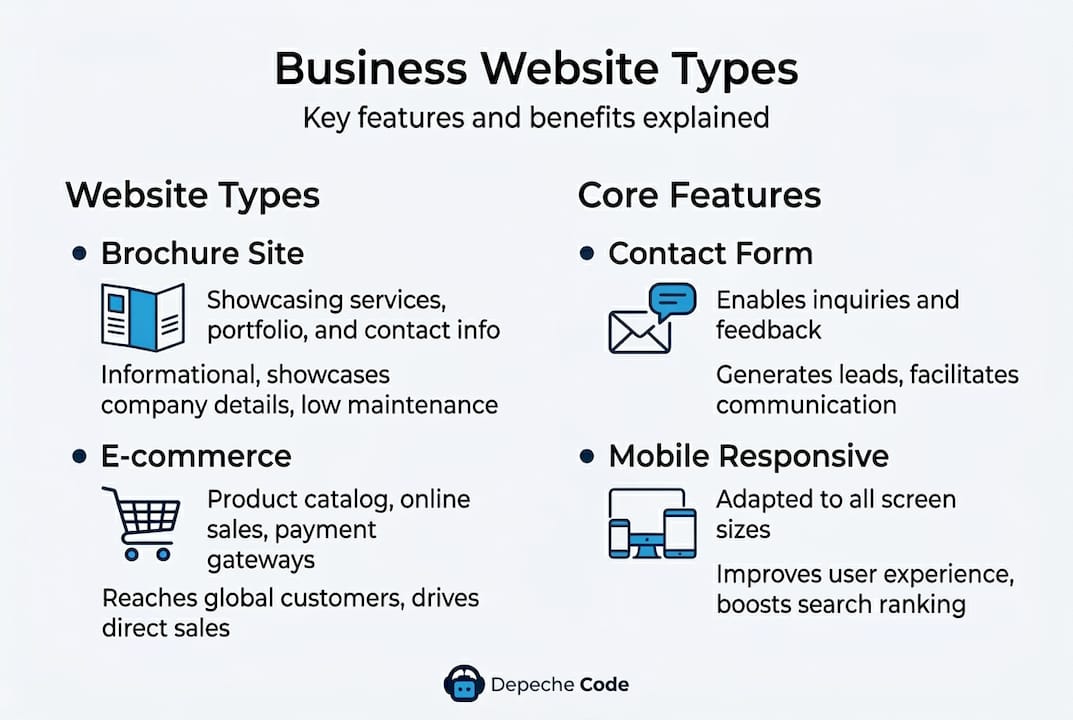
Core features every business website needs:
- Custom domain name: A branded domain (yourbusiness.com) builds immediate trust and makes your company easier to find
- Branded visual design: Colors, fonts, and imagery that reflect your brand identity consistently
- Clear service or product descriptions: Visitors should understand what you offer within seconds of landing on your page
- Contact and lead capture forms: The primary bridge between an interested visitor and a paying customer
- Responsive web design: Your site must look and work perfectly on phones, tablets, and desktops
- Customer testimonials and social proof: Reviews and case studies that eliminate doubt and build confidence
- Fast page load speed: A slow website loses visitors before they even read your headline
The benefits these features deliver go far beyond aesthetics. A well-designed website can increase business credibility and lead generation simultaneously, making your marketing dollars stretch further. Custom web solutions tailored to your industry and audience will outperform generic templates every time.
Top business benefits at a glance:
- Enhanced trust and professional credibility with new prospects
- 24/7 access to your information, even when your team is offline
- Steady lead generation through search engines and referrals
- Scalable marketing through SEO, content, and paid advertising
- Reduced reliance on expensive traditional advertising channels
Pro Tip: Even a simple contact form placed prominently on your homepage can double the number of inquiries you receive in a month. Most visitors will not pick up the phone, but they will fill out a quick form if it is easy to find and easy to complete.
Types of business websites and choosing the right fit
Understanding features is just the start. The next step is matching your business with the right website type. Different business models require tailored website approaches, and choosing the wrong type can waste both time and budget.
The four main types of business websites:
- Informational: Explains who you are, what you do, and how to reach you. Best for service businesses, local companies, and professional practices
- E-commerce: Enables direct online sales with product pages, shopping carts, and payment gateways. Best for retail and product-based businesses
- Portfolio: Displays past work to attract new clients. Best for agencies, designers, photographers, and consultants
- Lead generation: Focused entirely on capturing visitor contact information through forms, offers, and landing pages. Best for B2B companies, real estate, and service providers with longer sales cycles
| Website type | Core feature | Best for |
|---|---|---|
| Informational | Pages, blog, contact form | Local services, professional firms |
| E-commerce | Product catalog, checkout | Retail, product businesses |
| Portfolio | Project galleries, bio | Creatives, agencies |
| Lead generation | Forms, landing pages, offers | B2B, high-ticket services |
How to choose the right website type for your business:
- Define your primary goal: Are you selling directly, capturing leads, or building brand awareness?
- Identify your customer’s buying journey: Do they research first, or buy impulsively?
- Audit your competitors: What type of site are the leaders in your industry using?
- Consider your content capacity: Can you maintain a blog, a product catalog, or a portfolio regularly?
- Consult with digital agency services to get a professional recommendation based on your specific goals and budget
How business websites drive tangible results
Once you select a website type, it is time to focus on tangible business value and ongoing results. A website is only as valuable as the outcomes it produces, and the good news is that those outcomes are very measurable.
Measurable outcomes a strong business website delivers:
- More qualified leads arriving through organic search and referrals
- Higher sales conversion rates through clear calls to action and trust signals
- Reduced manual workload because your site answers common questions automatically
- Lower customer acquisition costs compared to paid advertising alone
- Stronger brand recognition and recall among your target audience
Consider a real scenario. A local HVAC company had only a Facebook page and relied on word of mouth. After launching a properly built website with service pages, customer reviews, and a contact form, they saw a 40% increase in monthly service requests within three months, without increasing their advertising budget. The website worked while the owner slept.

Responsive design significantly improves conversion rates from mobile users, which now account for the majority of web traffic in most industries. If your site is not mobile-friendly, you are losing real customers right now.
Pro Tip: Track three core metrics from day one: total website visitors, form submissions or inquiries, and direct revenue attributed to online leads. These three numbers tell you almost everything you need to know about whether your site is working.
“A website that is not regularly updated sends a signal to visitors that your business may not be active or trustworthy. Fresh content and current information are signals of reliability.”
This is why keeping websites updated is not optional. It directly affects how both search engines and real visitors perceive your business. Review your website development steps to make sure your launch plan includes a content update schedule.
Getting started: Steps to launch or improve your business website
Whether starting from scratch or upgrading your site, here is how to move forward efficiently. Many business owners feel overwhelmed by the process, but breaking it into clear steps removes the confusion fast.
Step-by-step roadmap:
- Define your goals: Write down exactly what you want your website to do. Generate leads? Sell products? Build brand awareness? Be specific
- Choose your domain name: Pick something short, memorable, and directly related to your business name
- Select a website type: Based on your goals, choose from informational, e-commerce, portfolio, or lead generation
- Find the right development partner: Compare website design and development options to find an agency or platform that matches your budget and timeline
- Plan your content: Write clear headlines, service descriptions, an about section, and gather customer testimonials before design begins
- Design for your user, not yourself: Your brand colors matter, but your visitor’s experience matters more
- Test before launch: Check every form, link, page, and image on both desktop and mobile
- Set a maintenance schedule: Plan monthly reviews of content, performance, and security updates
Pro Tip: Set a realistic budget before you shop for help. A good professional website from a qualified agency typically costs far less than most business owners expect, especially compared to the leads it generates. Start simple and build from there rather than trying to launch a perfect site on day one.
Professional design and regular updates are key to long-term website success, which is why knowing when to bring in experts versus doing it yourself is one of the most important early decisions you will make.
Why most business websites fail (and how to get it right)
Here is something most web agencies will not tell you. The majority of business website failures have nothing to do with technology. They fail because the owner spent too much energy on how the site looks and not nearly enough on what it says and where it sends people.
We have seen beautifully designed websites that generate zero leads. The photos were stunning. The fonts were elegant. But the headline said nothing useful, the services page was vague, and there was no clear next step for the visitor. A confused visitor always leaves.
The real question is not “Does my site look professional?” It is “Does my site make it completely obvious what I offer, who I serve, and what someone should do next?” Those three elements outperform any visual upgrade every single time.
Updating and refining your website based on real visitor behavior, not just personal taste, is what separates sites that grow businesses from sites that simply exist. Look at your site through your customer’s eyes. If they land on your homepage and cannot answer those three questions within five seconds, you have found the real problem.
Focus your resources on clarity first. Then build beautiful on top of clear.
Build your business website with expert support
You now have a clear picture of what a business website is, what it needs, and how to measure its success. Taking the next step does not have to be complicated or expensive.
At Depeche Code, we work with small and mid-sized businesses across every industry to build websites that actually perform. From professional website design services tailored to your brand, to our free website development program for qualifying businesses, and affordable SEO options that help customers find you online. Our team handles the technical details so you can focus on running your business. Let us build something that works as hard as you do.
Frequently asked questions
What makes a business website different from a personal site?
A business website is built to promote a company, generate leads, and build customer trust, while a personal site centers on individual content or interests. A professional online presence gives your company a credibility advantage that social profiles simply cannot match.
Does every small business need a website in 2026?
Yes, because most buyers research businesses online before making contact or a purchase. A well-designed website increases both credibility and lead generation, making it one of the highest-return investments a small business can make.
Which features are most important for a new business website?
Start with a custom domain, clear service or product descriptions, a contact form, and a mobile-friendly layout. Responsive design significantly improves conversion rates from mobile users and is now a baseline requirement, not a bonus feature.
How can I measure if my business website is working?
Monitor total visitors, form submissions, and leads or sales that originate from your website each month. Keeping websites updated and reviewing these metrics regularly lets you identify what is working and where to improve.
Recommended
- Explore The Main Types Of Website Design For Business
- Step-by-step Web Development: Build A Winning Business Website
- Unlock Business Growth With Custom Web Solutions Explained
- Website Accessibility Guide: What Business Owners Must Know
- How to Start a Business Ontario: Step-by-Step Guide – The Online Notary
- Understanding How to Start a Small Business Successfully – My Mobile Notary