
TL;DR:
- Incremental website updates are faster, less risky, and provide ongoing business benefits.
- Regular small improvements boost SEO, trust, conversions, and prevent costly full redesigns.
- Most businesses succeed by continuous optimization rather than waiting for extensive overhauls.
Most business owners assume that improving their website means a full redesign with a big price tag and months of disruption. That assumption costs them real money. The truth is that incremental updates are often faster and lower risk compared to complete redesigns, and they deliver compounding benefits over time. Whether your site is two years old or five, strategic, smaller improvements can dramatically lift your search rankings, build visitor trust, and drive more conversions. This guide walks you through the when, why, and how of keeping your business website sharp, competitive, and working hard for your growth goals.
Table of Contents
- The real impact of website updates on business success
- Incremental updates vs. full redesign: Which is better for SMEs?
- How regular website improvements boost SEO and visibility
- Key steps: Keeping your business website current and effective
- Our perspective: What most business owners miss about website updates
- Ready to future-proof your website?
- Frequently asked questions
Key Takeaways
| Point | Details |
|---|---|
| Incremental wins | Frequent small updates yield better SEO and lower risk than big redesigns. |
| Visibility boost | Search engines reward updated websites with higher rankings and traffic. |
| Cost-effective approach | Incremental improvements are more budget-friendly for SMEs. |
| Customer trust | Regular website refreshes build trust and signal credibility to visitors. |
| Stay relevant | Ongoing updates help your business adapt to changing markets and technology. |
The real impact of website updates on business success
Your website is not a brochure you print once and forget. It is a living sales tool, and how well it performs directly affects your revenue. When your site is current, fast, and relevant, search engines reward you with better rankings. That means more qualified visitors finding you instead of your competitors.
Updated websites also signal professionalism. A visitor who lands on a site with outdated content, broken links, or a design that looks like it was built in 2015 will question whether your business is still active or trustworthy. First impressions happen in milliseconds, and a neglected site loses that moment every single time.
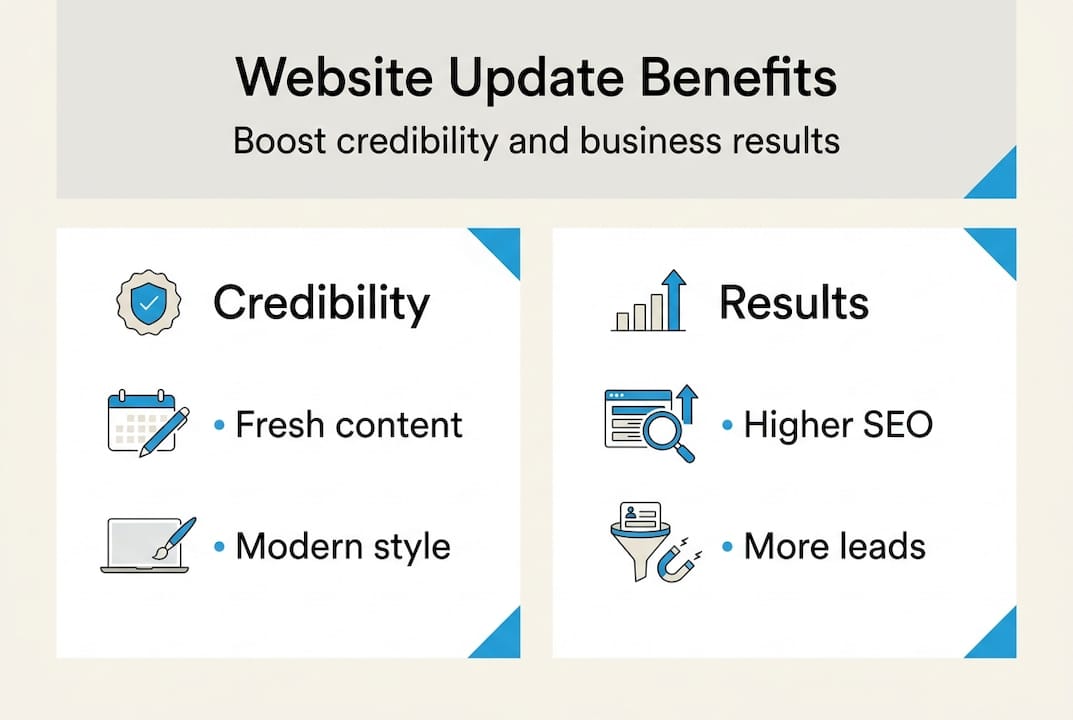
The website impact on business outcomes is measurable. Consider these core benefits that regular updates deliver:
- Higher search rankings from fresh content and technical improvements
- Lower bounce rates because visitors find what they need quickly
- More conversions from clearer calls to action and faster load times
- Stronger brand trust from a polished, consistent online presence
- Reduced security vulnerabilities through regular software and plugin updates
“Incremental updates preserve SEO and reduce risk compared to complete redesigns, making them the smarter choice for most growing businesses.”
Think of your website like a retail storefront. If the windows are dirty, the signage is faded, and the layout is confusing, customers walk past. Regular upkeep, not a full renovation every few years, is what keeps foot traffic steady. The same logic applies online. Investing in ongoing website maintenance is not a luxury. For businesses that depend on digital leads, it is a core operating expense that pays for itself.
Incremental updates vs. full redesign: Which is better for SMEs?
Understanding the business case for updates, let’s compare the main approaches for improving your site. Both paths have their place, but most small and medium-sized businesses benefit far more from a steady stream of targeted improvements than from waiting years for a big overhaul.
Incremental updates include things like refreshing page copy, improving site speed, updating images, fixing broken links, adding new service pages, or tweaking your calls to action. These changes are fast, affordable, and low risk. Full redesigns involve rebuilding the site structure, visual identity, and often the underlying platform. They are appropriate when the foundation is broken, but they take months and carry real SEO risk if not managed carefully.
| Factor | Incremental updates | Full redesign |
|---|---|---|
| Cost | Low to moderate | High |
| Timeline | Weeks | Months |
| SEO risk | Minimal | High if mismanaged |
| Business disruption | Very low | Moderate to high |
| Long-term value | Compounding | One-time reset |
According to incremental updates are faster (weeks versus months), affordable, and lower risk, while redesigns can disrupt SEO if not managed carefully. So when does a full redesign actually make sense? Here are the situations that justify it:
- Your site’s core architecture makes it impossible to optimize for mobile or speed
- Your brand identity has fundamentally changed and the site no longer reflects it
- Your platform is outdated and no longer supported by developers
- Conversion rates have remained critically low despite multiple optimization attempts
- You are entering a new market or launching a significantly different service line
For every other scenario, targeted improvements win. Before committing to a full overhaul, review our redesign SEO checklist to understand what is at stake and whether you actually need it. If you do move forward with a redesign, explore what redesign value looks like when it is done strategically.
Pro Tip: Always back up your entire site before making significant changes, and set up rank tracking before and after any major update so you can catch SEO shifts early.
How regular website improvements boost SEO and visibility
Many website updates are motivated by the need for better SEO, and here is how improvements deliver real visibility gains. Search engines like Google use hundreds of signals to decide which sites deserve top spots. One of those signals is freshness. Sites that are regularly updated tell search engines that the content is current and relevant, which matters especially for local and service-based businesses competing in specific geographic markets.
But not all updates move the SEO needle equally. Here is a breakdown of the most impactful types of changes and what they deliver:
| Update type | SEO impact |
|---|---|
| Content refresh (new stats, updated copy) | Improved relevance and keyword rankings |
| Page speed optimization | Lower bounce rate, higher Core Web Vitals scores |
| Mobile usability improvements | Better rankings on mobile search results |
| Metadata updates (titles, descriptions) | Higher click-through rates from search pages |
| Internal linking improvements | Better crawlability and page authority distribution |
Incremental improvements help maintain and enhance SEO without the risks that come with a full redesign. For local businesses especially, this is significant. A plumber in Orlando who updates their service pages monthly, adds new customer FAQs, and keeps their Google Business Profile in sync with their site will consistently outrank a competitor with a prettier but static site.
Here is what visibility gains look like in practice for service businesses:
- A law firm that refreshes practice area pages quarterly sees more local search impressions
- A restaurant that updates its menu and adds seasonal content attracts more foot traffic from search
- A contractor who adds project photos and case studies regularly builds both trust and rankings
Supporting your site updates with a strong local SEO growth strategy amplifies every improvement you make. And if you are unsure whether your site needs attention now, check our guide on website update timing to get clarity fast.
Key steps: Keeping your business website current and effective
Now that you know what matters, here is a practical framework for staying proactive and competitive. The businesses that win online are not the ones with the flashiest sites. They are the ones that treat their website like a product, iterating consistently and measuring results.
Follow these steps to build a sustainable update rhythm:
- Review your current site against your business goals, competitor sites, and user behavior data from tools like Google Analytics
- Plan your updates by listing what needs to change, from content gaps to technical issues to design inconsistencies
- Prioritize by impact and focus first on changes that affect the most visitors or the most revenue-generating pages
- Execute in phases rather than all at once, so you can isolate what is working and avoid disrupting the user experience
- Measure outcomes by tracking rankings, traffic, bounce rates, and conversion rates before and after each round of changes
- Iterate based on data and repeat the cycle every quarter so improvements compound over time
Pro Tip: Block time on your calendar for a quarterly website review and set a dedicated update budget, even a small one. Businesses that plan for this avoid the expensive scramble of emergency fixes and missed opportunities.
Prioritizing incremental updates is affordable, low risk, and sustains improvements over time for SMEs. The key is consistency, not perfection. A site that improves by 5% every quarter is dramatically better after two years than one that had one big redesign and then sat untouched.
For specific tactics, our website improvement tips cover what to focus on at each stage. And when you are ready to invest in more substantial web design upgrades, you will have a clear baseline to measure against.
Our perspective: What most business owners miss about website updates
With those steps in mind, here is our practical conclusion and a piece of advice your competitors may not know.
We have worked with dozens of SMEs across industries, and the pattern is consistent: businesses that wait for the “perfect time” to do a big redesign almost always lag behind those that make small, steady improvements. One client spent 18 months planning a full overhaul while a competitor quietly updated their service pages, improved their mobile speed, and added a chatbot. By the time the redesign launched, the competitor had already captured the market share.
The uncomfortable truth is that most of the ROI from website investment comes from small, planned enhancements, not dramatic overhauls. A redesign is rarely a cure-all. It resets your foundation, but it does not automatically bring traffic or leads. Only consistent effort does that.
Our advice: shift your mindset from “redesign when things break” to “improve continuously before they do.” Treat your site like a long-term website growth engine, not a one-time project. That shift alone puts you ahead of most of your competitors.
Ready to future-proof your website?
If you want results without the risks of a full overhaul, there is a smarter path forward. At Depeche Code, we help growth-focused SMEs make targeted, affordable improvements that move the needle on rankings, leads, and conversions.
Whether you need a strategic refresh of your existing website design solutions, a full-service approach through our redesign services, or a visibility boost through our SEO services, we tailor every solution to your budget and business goals. Reach out today for a free consultation and find out exactly where your site stands and what it will take to make it your strongest sales asset.
Frequently asked questions
How often should I update my business website?
You should review and update your website at least quarterly to keep content fresh, security strong, and SEO rankings high. Sites with consistent updates maintain stronger credibility and search visibility over time.
What are the signs that my website needs an update?
If your site loads slowly, looks outdated, or is not bringing in leads, it is time for an update. Outdated or slow websites consistently see lower traffic and fewer conversions.
Does updating my website hurt my SEO?
Incremental updates protect and often improve your SEO, but major redesigns require careful redirects to avoid ranking drops. Full redesigns risk SEO loss unless redirects and technical elements are managed precisely.
Are website updates expensive for small businesses?
Incremental improvements are much more affordable and manageable for SMEs compared to full site overhauls. Incremental updates are affordable for SMEs, while full redesigns should only be used when foundational issues cannot be resolved otherwise.
What areas should I prioritize in website updates?
Focus on fresh content, site speed, mobile usability, and clear calls to action for the best results. Updating content and performance elements consistently pays the biggest dividends for both SEO and user experience.