

TL;DR:
- Building a strong online presence enhances visibility, trust, and customer engagement, driving sustainable growth.
- Regular management of search rankings, reviews, and social activity ensures consistent brand credibility and lead generation.
Investing in your online presence means deliberately building and maintaining a visible, trustworthy digital footprint that converts strangers into paying customers. For business owners and entrepreneurs, this investment covers four interconnected pillars: discoverability through search engines, credibility through reviews and reputation, engagement through social media and content, and sustained growth through consistent cross-channel strategy. The four benefits working together support long-term business success in ways that traditional marketing simply cannot match. Understanding why online presence matters starts with recognizing that your customers are already online, researching, comparing, and deciding before they ever contact you.
Why invest in online presence to increase visibility and customer discovery?
Visibility is the entry point for every customer relationship. A business that does not appear in search results, on Google Maps, or across social platforms does not exist for the majority of modern buyers. Your website, search engine rankings, social profiles, and marketplace listings each serve as separate discovery channels, and each one compounds the others.

SEO is the most durable visibility tool available to small and mid-sized businesses. A well-optimized website earns organic traffic month after month without paying for each click. Depeche Code’s own analysis of client results shows that SEO delivers lasting growth with a measurable return that outperforms most paid channels over a 12-month horizon. Mobile optimization matters just as much. Google’s mobile-first indexing means a slow or poorly formatted mobile site loses rankings regardless of content quality.
The table below summarizes the primary discovery channels and their practical impact on business visibility.
| Channel | Primary visibility impact |
|---|---|
| Google Search (SEO) | Drives high-intent organic traffic from buyers actively searching |
| Google Business Profile | Captures local searches and maps discovery |
| Social media profiles | Builds brand awareness and repeat exposure |
| Online marketplaces | Reaches buyers already in purchase mode |
| Review platforms | Surfaces your business during competitor comparisons |
Pro Tip: Set up and fully complete your Google Business Profile before spending a dollar on paid ads. It is free, it ranks in local searches, and it is the first thing most local buyers see.
How does online reputation build the trust that drives purchases?
Visibility alone does not close sales. A 2026 Clutch survey found that 96% of consumers check reviews before a first-time purchase, and 47% always check reviews when buying from an unfamiliar brand. That number makes reputation management one of the highest-leverage activities a business owner can prioritize.
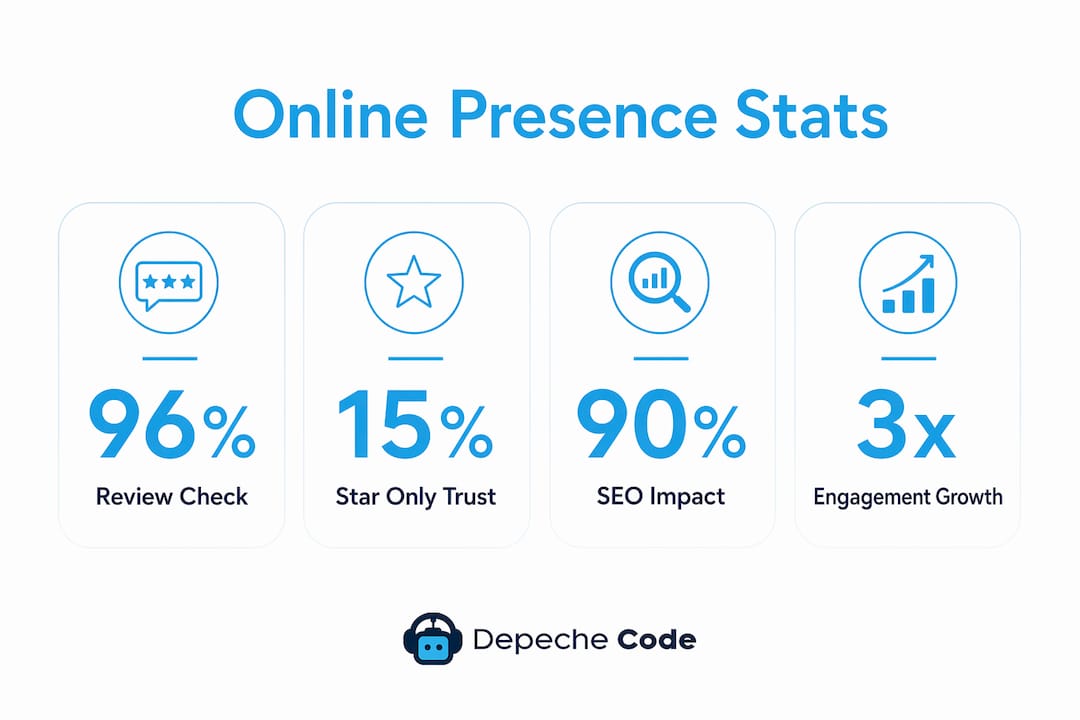
Star ratings alone are no longer enough. Only 15% of consumers trust star ratings without reading the accompanying text. Buyers want specifics: what went wrong, how the business responded, whether the experience feels real or manufactured. This shift has made Online Reputation Management (ORM) a strategic business function rather than a branding afterthought.
A peer-reviewed January 2026 study confirmed that ORM practices improve small business performance across reputation, trust, and competitive advantage. The study frames ORM not as a marketing vanity project but as a quantifiable driver of revenue. Business owners with strong customer orientation and high digital confidence consistently outperform peers by actively collecting reviews, responding professionally to negative feedback, and integrating ORM tools into their operations.
The core behaviors that build review-based trust include:
- Requesting reviews at the right moment, typically within 24 hours of a completed transaction
- Responding to every review, positive and negative, within 48 hours
- Addressing specific complaints publicly to demonstrate accountability
- Syndicating authentic reviews across Google, Yelp, Facebook, and industry-specific platforms
- Avoiding generic responses that signal automated or insincere engagement
“Treating reviews as performance media rather than passive feedback transforms them from a reputation signal into a conversion tool.” — Emplifi, 2026
What are the advantages of community and engagement in an online presence?
Community is what separates businesses that survive from those that grow. Active engagement via blogs, social media, and email sustains customer relationships long after the initial purchase, creating loyalty loops that reduce churn and increase lifetime value. A customer who follows your brand on Instagram, reads your monthly newsletter, and occasionally comments on your posts is far more likely to return and refer others than one who bought once and moved on.
Social media is the most accessible community-building channel for small and mid-sized businesses in 2026. A survey by eMarketer found that 68% of small-business owners say social media posting and paid ads deliver more growth value than any other marketing channel. That consensus reflects a real shift in where buyers spend attention and how they discover new brands.
The table below compares major social platforms by their business value for SMBs.
| Platform | Best for | Primary business value |
|---|---|---|
| Local and community businesses | Targeted ads, events, and local groups | |
| Visual products and lifestyle brands | Brand awareness and product discovery | |
| B2B services and professional firms | Lead generation and thought leadership | |
| YouTube | Education-based and service businesses | Long-form trust-building content |
| TikTok | Consumer brands targeting under-40 buyers | Viral reach and rapid awareness growth |
Depeche Code’s social media management services are built around consistent posting schedules, audience engagement, and platform-specific content strategies that match each business’s customer profile.
Pro Tip: Pick two platforms where your customers already spend time and post consistently for 90 days before adding a third. Scattered presence across six platforms beats none, but focused presence on two builds community faster.
How to strategically enhance your online visibility for growth and lead generation
Enhancing online visibility is not a one-time project. It requires a coordinated system across channels with consistent messaging, visuals, and customer experience at every touchpoint. The Emplifi 2026 survey found that 56% of consumers making purchases over $500 visit three or more websites before deciding, and 79% read three or more reviews. Inconsistencies between your website, social profiles, and review platforms leak trust and lose sales.
Follow these steps to build a measurable, consistent online presence:
- Audit your current footprint. Search your business name on Google, Bing, and Yelp. Note what appears, what is missing, and where your information is inconsistent or outdated.
- Optimize your website for mobile and speed. Use Google PageSpeed Insights to identify load-time issues. A site that loads in under three seconds retains significantly more visitors than one that takes five or more.
- Publish content on a regular schedule. Blog posts, case studies, and FAQs improve SEO rankings and give social media channels something worth sharing. Aim for at least two pieces of content per month at minimum.
- Implement a review collection system. Send automated post-purchase emails or SMS requests using tools like Birdeye, Podium, or your CRM’s built-in review request feature. Consistency matters more than volume.
- Track performance monthly. Monitor website traffic through Google Analytics 4, track keyword rankings through Google Search Console, and measure social engagement through each platform’s native analytics.
- Invest in paid amplification selectively. Once organic channels are producing results, use Google Ads or Meta Ads to amplify your best-performing content and reach new audiences in your target geography.
Regularly updating your website with fresh content and accurate business information signals credibility to both search engines and the buyers who land on your pages. A neglected website communicates neglect across the entire brand.
Key takeaways
A strong online presence requires visibility, trust, engagement, and consistency working together across every platform where your customers search and decide.
| Point | Details |
|---|---|
| Visibility drives discovery | SEO, Google Business Profile, and social media together create multiple entry points for new customers. |
| Reviews determine trust | 96% of consumers check reviews before buying, making ORM a direct revenue function. |
| Community extends loyalty | Active social media and content engagement keeps customers returning and referring others. |
| Cross-channel consistency is non-negotiable | Inconsistent information across platforms loses buyers during high-value purchase research. |
| Measurement turns effort into strategy | Tracking traffic, rankings, and reviews converts online presence from a cost into a measurable asset. |
The uncomfortable truth about online presence investment
Most business owners I work with treat their online presence like a storefront renovation. They invest heavily once, feel satisfied with the result, and then let it sit untouched for two or three years. That approach worked in 2015. It does not work now.
The businesses I have seen grow consistently share one habit: they treat their online presence as an ongoing operation, not a completed project. They post regularly, respond to reviews within a day, update their website when their services change, and check their analytics at least once a month. None of those tasks require a large budget. They require discipline and a clear understanding of what each channel is supposed to do.
The other mistake I see constantly is investing in visibility without investing in trust. A business can rank on page one of Google and still lose the sale if its review profile is thin, its website looks outdated, or its social media has not been touched in six months. Buyers cross-check everything now. The multi-source research behavior documented in 2026 consumer surveys confirms what I have observed firsthand: a single weak link in your digital chain is enough to send a buyer to a competitor.
My honest recommendation is to align your online presence investment with your actual business goals before spending anything. If you need local customers, prioritize Google Business Profile and local SEO. If you sell high-ticket services, prioritize reviews and case studies. If you are building a brand, prioritize social media and content. Strategy beats volume every time.
— Donovan
How Depeche Code helps you build a presence that drives real growth
Depeche Code is a full-service digital agency based in Orlando that builds and manages the online presence systems that small and large businesses need to compete. From professional website design built for speed, mobile performance, and SEO to structured SEO plans that generate organic traffic month after month, every service is designed to produce measurable results. The team also manages social media growth, AI chatbot integration, and reputation-focused content strategies tailored to each client’s industry and goals. If your online presence is not generating the visibility, trust, or leads your business needs, Depeche Code can build the system that changes that.
FAQ
Why is online presence important for small businesses?
Online presence determines whether potential customers can find, trust, and choose your business. With 96% of consumers checking reviews before a first purchase, a weak or absent digital footprint directly costs revenue.
What is the most effective channel for online visibility?
SEO and Google Business Profile deliver the highest-intent traffic for most small businesses because they capture buyers who are already searching for what you offer. Social media builds awareness and community alongside search.
How often should a business update its online presence?
Website content should be updated at minimum monthly, social media should be active at least two to three times per week, and review responses should happen within 48 hours of each new review.
What is Online Reputation Management (ORM)?
ORM is the practice of actively monitoring, collecting, and responding to customer reviews across platforms to build trust and improve business performance. A 2026 peer-reviewed study links strong ORM practices directly to measurable small business growth.
How do I measure the return on my online presence investment?
Track website traffic through Google Analytics 4, keyword rankings through Google Search Console, review volume and rating trends on Google and Yelp, and social media engagement rates monthly to connect effort to outcomes.