

TL;DR:
- Digital marketing enables businesses to reach targeted audiences with real-time performance tracking, offering a superior ROI over traditional advertising. It builds long-term assets like SEO content and email lists that generate sustained growth beyond immediate lead flow. Consistent measurement and strategic channel selection are essential for maximizing digital marketing effectiveness and long-term success.
Digital marketing is the strategic use of online channels to reach targeted audiences, measure performance in real time, and generate returns that traditional advertising simply cannot match. Business owners who ask why invest in digital marketing are asking the right question at the right time. In 2026, digital marketing drives SME agility and competitive advantage far beyond basic communications. Channels like Google Ads, HubSpot, and organic SEO give businesses of every size the tools to reach the right buyer at the right moment, with full accountability for every dollar spent.
Why invest in digital marketing over traditional advertising?
Digital marketing outperforms traditional advertising on three dimensions that matter most to business owners: cost, precision, and measurability. A billboard in Orlando reaches everyone who drives past it. A Google Ads campaign reaches only people searching for exactly what you sell, in the zip codes you choose, at the budget you set. That difference is not marginal. It is structural.
Budget flexibility and targeting allow small businesses to compete against larger competitors without fixed advertising commitments. You can start a paid search campaign with a modest test budget, measure results within days, and scale only what works. Traditional media placements lock you into fixed contracts with no ability to pivot.
The ROI gap is equally significant. SEO leads cost 61% less than outbound marketing leads, and email marketing returns $42 for every dollar spent on average. These numbers reflect the compounding efficiency of channels that improve with data over time, not one-time placements that disappear after the campaign ends.
Pro Tip: Before comparing digital to traditional spend, calculate your current cost per acquired customer across each channel. Most business owners discover they have been paying three to five times more per customer through offline channels than they realized.
Here is a direct comparison of how the two approaches stack up:
| Factor | Digital marketing | Traditional marketing |
|---|---|---|
| Budget flexibility | Start small, scale on performance | Fixed contracts, high minimums |
| Audience targeting | Demographics, behavior, location, intent | Broad geographic or demographic reach |
| Performance tracking | Real-time clicks, conversions, revenue | Estimated reach, delayed feedback |
| ROI measurability | Precise attribution per channel | Difficult to attribute directly |
| Speed to adjust | Same day pivots possible | Weeks or months to change creative |
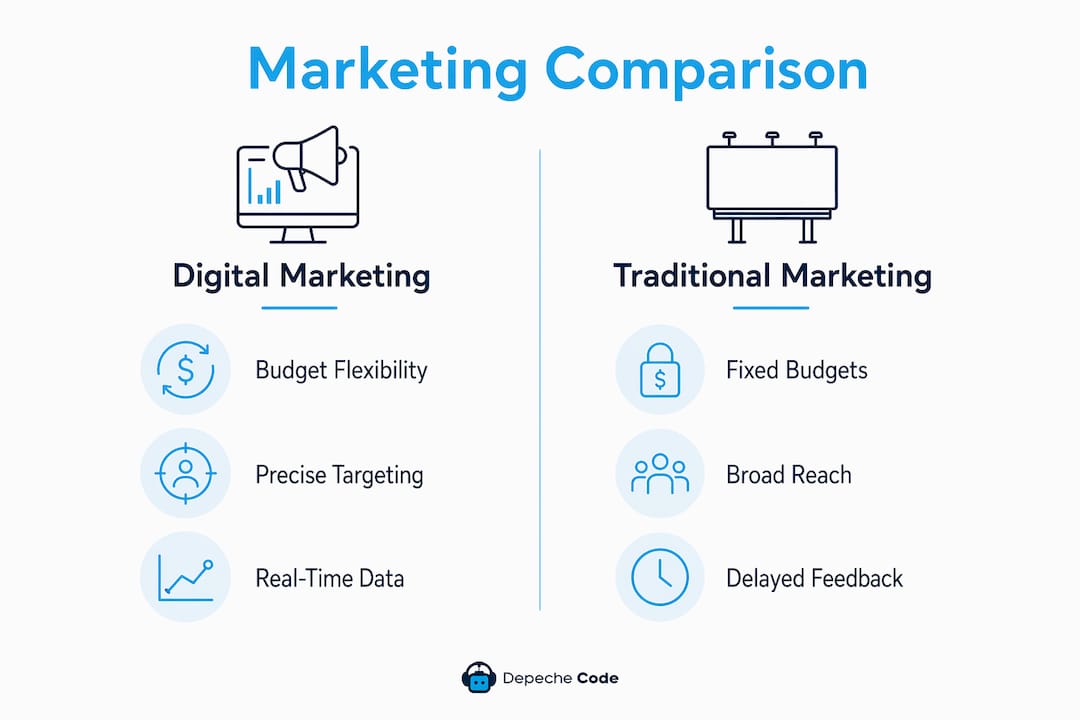
The real-time measurement of impressions, clicks, and conversion rates gives digital marketers a feedback loop that traditional media buyers never had. When a campaign underperforms, you know within 48 hours. When it overperforms, you increase spend immediately. That responsiveness alone justifies the shift in budget allocation.
How digital marketing builds long-term business assets
The most underappreciated reason to invest in digital marketing is not the immediate lead flow. It is the owned assets you accumulate over time. Paid ads stop the moment you stop paying. SEO-optimized content, email lists, and engaged social communities keep generating returns long after the original investment.

Owned digital assets like search-optimized websites and email subscriber lists compound in value and reduce your dependence on rented platforms like Meta or Google over time. A business with 40,000 email subscribers and 200 ranking blog posts has a marketing engine that runs whether or not it is running paid ads that month.
The compounding nature of SEO is particularly powerful. A well-optimized article published today may rank on page one of Google within six months and generate qualified leads for the next five years. Depechecode’s SEO ROI analysis shows how this long-term compounding translates into lasting growth for businesses that commit to the channel consistently.
Building owned assets also creates brand authority. When your website ranks for competitive search terms, earns quality backlinks, and accumulates genuine reviews, you build trust signals that paid ads cannot replicate. Buyers who find you through organic search convert at higher rates because they perceive you as a credible authority, not just an advertiser.
The key owned asset categories worth building include:
- Email lists: Direct access to your audience with no algorithm dependency
- SEO content: Articles, guides, and landing pages that rank and generate leads passively
- Social communities: Engaged followers on platforms like LinkedIn or Instagram who share and advocate
- Customer reviews: Google Business Profile ratings that influence purchase decisions before a buyer ever visits your site
- Video libraries: YouTube content that builds authority and drives search traffic simultaneously
Consistent monthly investment in digital presence builds cumulative brand equity that compounds over time. Businesses that stop and start their digital marketing lose ground to competitors who stay consistent. The asset-building mindset separates businesses that grow sustainably from those that chase short-term spikes.
What makes a digital marketing investment actually effective?
Investing in digital marketing without a measurement framework is the fastest way to waste budget. Marketing strategist Brandon Rollins identifies the core risk clearly: investing in channels you cannot measure or do not understand destroys returns regardless of how much you spend. The solution is building your tracking infrastructure before you scale spend.
Follow this sequence to protect your investment:
- Validate your offer first. Paid ads amplify what already exists. If your offer does not convert organically, scaling paid spend will only amplify the failure faster. Test your offer with a small audience before committing significant budget.
- Install proper tracking from day one. UTM parameters, CRM integrations, and Google Analytics 4 conversion goals are non-negotiable. Without them, you are making decisions based on incomplete data.
- Know your customer lifetime value. A customer worth $5,000 over two years justifies a very different acquisition cost than one worth $200. Your acceptable cost per lead flows directly from this number.
- Understand the payback lag. Digital marketing follows a J-curve. SEO and content marketing require upfront investment with delayed returns. Businesses that quit after 90 days rarely see the compounding phase that makes these channels profitable.
- Ignore vanity metrics. Impressions, follower counts, and page views tell you almost nothing about business performance. Track qualified leads, cost per acquisition, and revenue attributed to each channel instead.
- Balance paid and organic. Paid channels like Google Ads and Meta Ads generate immediate traffic. Organic channels like SEO and email build durable assets. A healthy digital strategy uses both, with organic growing as a percentage of total traffic over time.
Understanding what digital agencies actually do in this process helps business owners set realistic expectations. Depechecode’s breakdown of agency roles and tracking clarifies how professional partners structure campaigns for true business metrics rather than surface-level reporting.
Pro Tip: Ask any agency or hire you evaluate to show you a sample report. If it leads with impressions and follower growth rather than cost per lead and revenue, that is a signal they are optimizing for the wrong outcomes.
Which digital marketing channels deliver the best results?
The right channel depends entirely on your business model, sales cycle, and growth objective. There is no universal answer, but there are clear patterns based on business type and goal.
Short-form video on Instagram Reels and YouTube Shorts drives brand awareness faster than almost any other format, and micro-influencers with niche audiences often convert at a lower cost than major celebrity partnerships. This makes video a high-leverage channel for businesses with strong visual products or services.
Here is how major channels align with common business objectives:
| Channel | Best for | Key advantage |
|---|---|---|
| SEO | Long-term lead generation | Low cost per lead, compounding returns |
| Google Ads (PPC) | Immediate demand capture | High intent audience, fast results |
| Email marketing | Retention and repeat sales | $42 return per dollar, owned channel |
| Social media | Brand awareness and community | Audience building, organic reach |
| Content marketing | Authority and trust building | Supports SEO and all other channels |
| Video (YouTube, Reels) | Awareness and engagement | High reach, authentic connection |
AI and automation are reshaping how these channels perform. Tools like HubSpot’s AI features, Google’s Performance Max campaigns, and AI-powered audience segmentation allow smaller teams to run campaigns that previously required large marketing departments. Depechecode’s social media growth services incorporate these automation layers to maximize reach without inflating labor costs.
For small businesses, the most practical starting point is usually a combination of local SEO, Google Business Profile optimization, and email list building. These three channels require modest budgets, generate measurable results within 90 days, and build owned assets simultaneously. Enterprise businesses typically layer in PPC, content marketing, and paid social to accelerate growth across multiple audience segments. For a full breakdown of which methods fit your business model, Depechecode’s SMB marketing channel guide covers every major option with practical recommendations.
Key takeaways
Digital marketing investment pays off because it combines precise targeting, measurable ROI, and compounding owned assets that traditional advertising cannot replicate.
| Point | Details |
|---|---|
| ROI superiority | SEO leads cost 61% less than outbound leads; email returns $42 per dollar spent. |
| Owned asset value | Email lists, SEO content, and social communities generate returns long after initial investment. |
| Measurement is mandatory | UTM tracking, CRM data, and conversion goals separate profitable campaigns from wasted spend. |
| Offer validation first | Paid ads amplify existing conversion paths. Validate your offer before scaling any channel. |
| Channel fit matters | Match channels to objectives: SEO for long-term leads, PPC for immediate demand, email for retention. |
Why I think most businesses underinvest in digital marketing for the wrong reasons
After working with businesses across industries, the pattern I see most often is not reckless overspending on digital marketing. It is chronic underinvestment driven by impatience and poor measurement. A business owner runs Google Ads for six weeks, sees no immediate profit, and concludes digital marketing does not work. What actually happened is they quit before the J-curve turned positive.
The businesses I have watched grow consistently are not the ones with the biggest budgets. They are the ones that treat digital marketing as a capital investment rather than an expense. They build their email list every month. They publish content that ranks. They track every lead source with discipline. Over 18 to 24 months, that consistency creates a compounding advantage that paid-only competitors cannot buy their way out of.
The other mistake I see regularly is chasing every new tactic without mastering the fundamentals. AI-powered search optimization and short-form video are genuinely worth attention in 2026. But they work best when built on a foundation of a well-structured website, clean tracking, and a validated offer. Tactics without infrastructure are just noise.
My honest recommendation: pick two or three channels, measure them with precision, and stay consistent for at least 12 months before drawing conclusions. The businesses that do this almost always find that digital marketing was worth it. The ones that do not rarely give it a fair test.
— Donovan
Ready to make your digital marketing investment count?
Knowing why to invest in digital marketing is the first step. Executing it with the right infrastructure and expertise is what separates businesses that grow from those that stall.
Depechecode is a full-service digital agency based in Orlando that builds the digital foundation businesses need to compete and win. From website design and development that converts visitors into leads, to SEO plans that generate compounding organic traffic, every service is built around measurable business outcomes. Whether you are starting from scratch or scaling an existing presence, Depechecode delivers tailored strategies with the technical depth and responsiveness that growing businesses require. Reach out to explore a plan built around your goals.
FAQ
Why invest in digital marketing instead of traditional advertising?
Digital marketing delivers measurable ROI, precise audience targeting, and real-time performance data that traditional media cannot provide. Channels like SEO and email marketing generate returns that compound over time rather than ending when the campaign does.
How long does it take to see results from digital marketing?
Paid channels like Google Ads produce results within days. SEO and content marketing follow a J-curve model, with meaningful returns typically appearing between six and twelve months after consistent investment begins.
What is the most cost-effective digital marketing channel?
SEO generates leads that cost 61% less than outbound marketing leads, making it the highest long-term ROI channel for most businesses. Email marketing follows closely, returning $42 for every dollar spent on average.
How do I know if my digital marketing investment is working?
Track cost per qualified lead, customer acquisition cost, and revenue attributed to each channel using UTM parameters and CRM data. Vanity metrics like impressions and follower counts do not reflect true business performance.
Do small businesses really benefit from digital marketing?
Small businesses benefit directly because digital channels allow precise local targeting with modest budgets, enabling them to compete against larger competitors without large fixed advertising costs.