

TL;DR:
- Digital marketing connects businesses with customers through a sophisticated, always-on system that builds brand equity over time. It emphasizes measurement, targeted channels, and owned asset growth to achieve sustainable competitive advantages in 2026. Success relies on strategic integration, disciplined execution, and continuous optimization of digital touchpoints.
Digital marketing is defined as the strategic use of internet-based channels, including search engines, social media platforms, email, and websites, to connect businesses with customers at every stage of the buyer journey. The role of digital marketing has expanded far beyond simple advertising. It now drives brand awareness, lead generation, customer retention, and measurable revenue growth. Platforms like HubSpot and Salesforce have built entire ecosystems around this principle, and businesses that treat digital marketing as an always-on operating system consistently outperform those that rely on campaign bursts alone. Understanding how this works is no longer optional for business owners and marketing professionals. It is the foundation of competitive advantage in 2026.
How digital marketing drives brand presence and customer engagement
Digital marketing connects businesses to customers across the full buyer journey, from first awareness through post-purchase loyalty. This is not a single tactic. It is a system of coordinated touchpoints across owned media (your website, email list), earned media (press mentions, organic social shares), and paid media (Google Ads, Meta campaigns). Each channel reinforces the others, and consistency across all three is what builds a recognizable brand.
The most effective approach is what Smart Insights calls always-on digital marketing, a continuous operating model that maintains visibility year-round rather than going dark between campaigns. Think of it like a retail store that keeps its lights on every day versus one that only opens during the holidays. The always-on model keeps your brand in front of prospects at the exact moment they are ready to buy, regardless of when that moment arrives.
Lifecycle marketing is the practical application of this principle. Rather than sending the same message to everyone, lifecycle management and personalized communication segments audiences by behavior and stage. A new subscriber gets an onboarding sequence. A lapsed customer gets a re-engagement offer. A repeat buyer gets a loyalty reward. Each message is relevant, timely, and far more likely to convert than a generic broadcast.
The core benefits of building brand presence through digital marketing include:
- Measurable reach: Track impressions, clicks, shares, and time-on-page in real time, giving you data no billboard or TV spot can match.
- Audience precision: Serve ads and content to specific demographics, interests, and behaviors rather than broadcasting to everyone.
- Cost efficiency: Allocate budget toward what performs and cut what does not, something traditional media cannot do mid-campaign.
- Compounding owned assets: Build email lists, search rankings, and social communities that grow in value over time without proportional cost increases.
- Customer loyalty: Consistent engagement through relevant content and personalized offers increases retention and purchase frequency.
Pro Tip: Start by auditing your owned assets. Your email list and organic search rankings are the two highest-return assets in digital marketing because you control them and they compound over time. Paid channels amplify reach, but owned channels sustain it.
Which digital marketing strategies and channels are most effective for business growth
Not all digital marketing channels deliver the same results for every business. The right mix depends on your audience, sales cycle, and budget. The table below breaks down the major channels, their primary use cases, and their core strengths.

| Channel | Primary use | Core strength |
|---|---|---|
| SEO (search engine optimization) | Organic discovery and long-term traffic | Compounds over time; high purchase intent traffic |
| Paid search (Google Ads) | Immediate visibility for high-intent queries | Fast results; precise keyword targeting |
| Social media marketing | Brand awareness and community building | Audience reach; visual storytelling |
| Email marketing | Nurture campaigns and retention | Highest ROI per dollar; direct audience access |
| Content marketing | Education, trust, and SEO support | Builds authority; supports every other channel |
| Paid social (Meta, LinkedIn) | Retargeting and new audience acquisition | Granular demographic targeting |
| CRM and marketing automation | Personalization at scale | Reduces manual effort; improves conversion rates |
SEO is the channel most business owners underinvest in early, yet it delivers the most durable returns. A well-optimized page on your website can generate qualified traffic for years without additional spend. Pairing SEO with content marketing, publishing guides, case studies, and comparison pages, creates a self-reinforcing system where each piece of content supports your search rankings and educates prospects simultaneously. Depechecode’s guide on top SEO strategies covers how to build this system for measurable business growth.
Email marketing consistently delivers the highest return on investment of any digital channel. The reason is simple: you own the list. Unlike social media followers, your email subscribers cannot be taken away by an algorithm change. HubSpot’s research confirms that email nurture campaigns are among the most effective tools for moving prospects through the buyer journey, particularly for B2B companies with longer sales cycles.
Social media and influencer marketing serve a different purpose. They build awareness and social proof at the top of the funnel. LinkedIn works for B2B audiences. Instagram and TikTok work for consumer brands. The key is matching the platform to where your audience actually spends time, not where you feel most comfortable posting.
Pro Tip: Do not try to master every channel at once. Pick two or three that align with your audience and business model, execute them well for 90 days, measure the results, and then expand. Spreading budget and attention too thin is the most common reason digital marketing strategies fail to produce results.
How digital marketing supports measurable optimization and ROI tracking
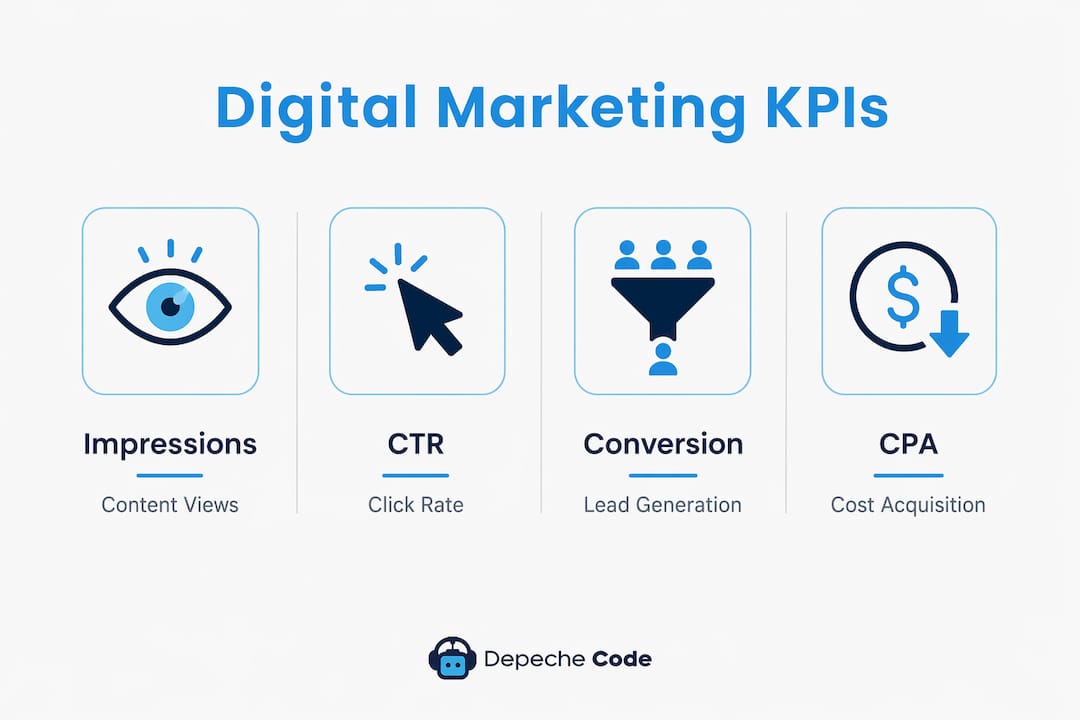
The single biggest advantage digital marketing holds over traditional marketing is measurability. Tracking KPIs like impressions, CTR, and conversions gives marketing teams a real-time feedback loop that print, radio, and TV simply cannot provide. This means you can identify what is working within days, not months.
The table below summarizes the KPIs that matter most and what each one tells you about campaign performance.
| KPI | What it measures | Why it matters |
|---|---|---|
| Impressions | How many times your content was seen | Indicates reach and brand exposure |
| Click-through rate (CTR) | Percentage of viewers who clicked | Measures message relevance and creative effectiveness |
| Conversion rate | Percentage of visitors who completed a goal | Directly links traffic to business outcomes |
| Cost per acquisition (CPA) | Cost to acquire one customer | Determines channel profitability |
| Time on page | How long visitors engage with content | Signals content quality and audience fit |
| Email open rate | Percentage of recipients who opened | Measures subject line effectiveness and list health |
Attribution modeling is where measurement gets genuinely powerful. Rather than crediting the last ad a customer clicked before buying, multi-touch attribution assigns value to every touchpoint in the journey. A prospect might discover your brand through a blog post, follow you on LinkedIn, click a retargeting ad two weeks later, and then convert via email. Without attribution modeling, you would credit only the email and potentially cut the blog and social spend that started the relationship.
Real-time data allows teams to pivot budgets and creative mid-campaign, something no traditional channel permits. If a Facebook ad is outperforming a Google display campaign by a factor of three, you can shift budget within hours. This agility compounds over time, with each optimization cycle producing better results than the last.
Key practices that separate high-performing digital marketing teams from average ones:
- Set KPI benchmarks before launching any campaign so you have a baseline for comparison.
- Review performance weekly, not monthly. Digital channels move fast and delayed reviews mean wasted spend.
- Use Google Analytics 4, HubSpot, or Salesforce Marketing Cloud to centralize your data and reduce reporting blind spots.
- Connect your campaign performance metrics to financial outcomes so marketing spend is justified in terms of revenue, not just traffic.
What is the impact of digital marketing on business competitiveness and innovation
Digital marketing competencies drive SME innovation and organizational performance in ways that go well beyond customer acquisition. Analytics capabilities help businesses sense market opportunities before competitors do. CRM systems enable co-creation of value with customers through personalized experiences. Social media interaction generates real-time feedback that informs product development and service improvements.
A strategic digital marketing roadmap connects channel execution directly to business goals, preventing the common trap of running isolated tactics that generate activity but not revenue. Salesforce research shows that businesses without this roadmap produce marketing that looks busy but fails to move financial metrics. The roadmap approach forces alignment between marketing campaigns and sales targets, customer service improvements, and product launches.
The competencies that matter most for competitive advantage in 2026 are:
- Analytics and data interpretation: The ability to read performance data and translate it into decisions, not just reports.
- CRM and customer segmentation: Using tools like Salesforce or HubSpot to personalize communication at scale across thousands of contacts.
- Social media interaction: Actively engaging with audiences rather than broadcasting at them, which builds community and brand trust.
- Content strategy: Producing material that educates, builds authority, and supports search visibility simultaneously.
- Marketing automation: Removing manual steps from nurture sequences so your team focuses on strategy rather than execution.
For small and mid-sized businesses, these competencies are not just communication tools. They are the infrastructure for entrepreneurial agility. A business that can sense a shift in customer demand through social listening, test a new offer via email, and measure the response within 48 hours has a structural advantage over a competitor that relies on quarterly market research reports.
Prioritizing owned asset growth, specifically your email list, search rankings, and engaged social communities, creates a compounding return that paid advertising alone cannot replicate. Paid channels are a volume dial you can turn up or down. Owned assets are equity that appreciates.
Key takeaways
Digital marketing works when it operates as a connected, always-on system that links channel execution to business goals, measures every touchpoint, and compounds owned assets over time.
| Point | Details |
|---|---|
| Always-on over campaign bursts | Continuous digital presence outperforms seasonal campaigns by maintaining visibility when buyers are ready. |
| Channel selection matters | Match channels to your audience and sales cycle rather than spreading budget across every platform. |
| Measurement drives ROI | Tracking CTR, conversion rate, and CPA in real time allows budget reallocation before spend is wasted. |
| Owned assets compound | Email lists and search rankings grow in value over time and are not subject to algorithm changes. |
| Strategy roadmap is non-negotiable | Tactics without a connected strategy produce activity but rarely produce consistent financial results. |
Why most digital marketing efforts underperform (and what actually fixes it)
After working with businesses across industries, the pattern I see most often is not a lack of effort. It is a lack of connection. Teams are running Google Ads, posting on Instagram, sending emails, and publishing blog content, but none of it is talking to the rest. Each channel operates in its own silo, with its own goals, its own messaging, and its own reporting. The result is a lot of activity and very little compounding.
The fix is not a bigger budget. It is a strategy roadmap that forces every channel to serve the same business objective. When your SEO content feeds your email nurture sequence, and your email sequence supports your retargeting ads, and your retargeting ads bring prospects back to a landing page that was built to convert, you have a system. Without that connection, you have a collection of tactics.
The other mistake I see constantly is treating paid advertising as a substitute for owned asset growth. Paid channels are fast, but they are rented. The moment you stop paying, the traffic stops. Businesses that invest in building search visibility and growing their email lists are building assets that work for them around the clock without ongoing ad spend. That is the difference between renting and owning your audience.
The businesses I have seen grow most consistently are not the ones with the largest budgets. They are the ones that picked two or three channels, executed them with discipline, measured everything, and reinvested in what worked. Digital marketing rewards consistency and data literacy far more than it rewards spending.
— Donovan
How Depeche Code helps you build a digital marketing presence that performs
Depeche Code is a full-service digital agency based in Orlando that builds the infrastructure behind high-performing digital marketing programs. If your business needs a stronger foundation, the team at Depeche Code delivers custom website design built for both user experience and search performance, giving your digital marketing a home base that converts.
For businesses ready to grow organic traffic, Depeche Code’s SEO plans and options are structured to deliver measurable ranking improvements and qualified leads. The agency also manages social media growth and integrates AI chatbot solutions that keep your brand engaging customers around the clock. Whether you are starting from scratch or scaling an existing presence, Depeche Code provides the technical expertise and marketing strategy to make it work.
FAQ
What is the role of digital marketing in business?
The role of digital marketing is to connect businesses with customers across the full buyer journey using channels like search engines, social media, email, and websites. It drives brand awareness, lead generation, and customer retention through targeted, measurable efforts.
How does digital marketing work for small businesses?
Digital marketing works for small businesses by enabling precise audience targeting and real-time performance measurement at a fraction of traditional advertising costs. Channels like SEO, email marketing, and social media allow small teams to compete with larger brands by focusing spend where it produces results.
What are the most effective digital marketing strategies in 2026?
The most effective strategies combine SEO for long-term organic traffic, email marketing for retention and nurture, and paid search or social for immediate reach. Connecting these channels through a unified strategy roadmap produces compounding results that isolated tactics cannot match.
Why does digital marketing matter more than traditional marketing?
Digital marketing provides real-time measurement of KPIs like CTR, conversion rate, and cost per acquisition, allowing teams to optimize campaigns mid-flight. Traditional marketing channels cannot offer this feedback loop, which means digital marketing consistently delivers higher and more accountable ROI.
What digital marketing competencies give businesses a competitive edge?
Analytics, CRM, content strategy, and marketing automation are the competencies that most directly drive competitive advantage. Research shows that digital marketing capabilities in analytics and social media interaction are particularly linked to SME innovation and organizational performance.