

TL;DR:
- A local business SEO workflow is a structured process to improve visibility in local search results. It emphasizes optimizing the Google Business Profile, maintaining NAP consistency, building citations, and generating reviews over a phased 90-day plan. Tracking both Google rankings and AI citations is essential for long-term success.
A local business SEO workflow is a structured, step-by-step process to optimize your online presence so your business appears prominently in local search results across both Google and AI-powered platforms. The standard industry term for this practice is “local search optimization,” and it covers everything from your Google Business Profile to structured data markup on your website. Local SEO success now means appearing on Google Maps, voice assistants, and AI-generated answer boxes, not just the traditional blue links. A well-built workflow gives you a repeatable system to claim that visibility and hold it.
What foundational elements are essential in a local business SEO workflow?
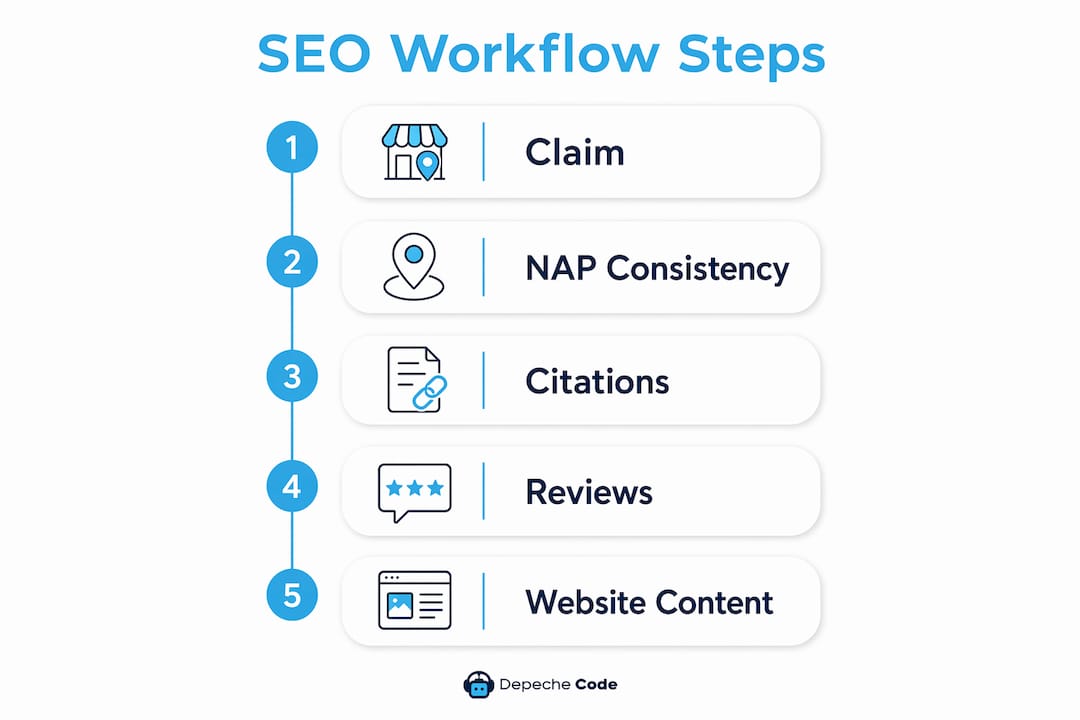
The foundation of any local business SEO workflow rests on four core assets: your Google Business Profile (GBP), NAP consistency, citations, and reviews. Get these right before touching anything else. Skipping this step is the single most common reason local businesses stall in search rankings.
1. Optimize your Google Business Profile
Your GBP is the most visible local ranking asset you control. GBP category selection directly affects ranking eligibility, so choose a primary category that matches your most common search queries exactly, then add relevant secondary categories. Fill every field: business description, hours, service areas, photos, and products. Post weekly updates to signal activity to Google.

2. Lock down NAP consistency
NAP stands for Name, Address, and Phone number. Every directory, social profile, and website listing must show identical information. Even a small variation, like “St.” versus “Street,” confuses search engines and weakens your authority. Audit your existing listings with a tool like Moz Local or BrightLocal before you build new ones.
3. Build and clean citations
Citations are online mentions of your business details on directories like Yelp, Apple Maps, and industry-specific sites. Submit your NAP to the top 50 authoritative local directories first. Then fix or remove duplicate or incorrect listings. Clean citations signal trustworthiness to both Google and AI answer engines.
4. Set up a review generation workflow
Review velocity of 10–15 new reviews per month, sustained over time, correlates with improved local authority. That means you need a system, not a one-time ask. Send a follow-up text or email after every transaction with a direct link to your Google review page. Respond to every review, positive or negative, within 48 hours.
Pro Tip: Set a calendar reminder every Monday to respond to any new reviews from the previous week. Consistent engagement signals to Google that your business is active and customer-focused.
How do you build website content for local SEO success?
Your website is the second pillar of your small business SEO plan. A well-optimized GBP without a strong website leaves ranking potential on the table. The goal is to create pages that satisfy both Google’s crawlers and the AI systems that pull answers from your content.
-
Create dedicated location and service pages. Each page should cover one city or service in depth, targeting 1,500 or more words. Thin pages with 300 words do not rank for competitive local queries. Include the city name, neighborhood references, and specific service details that a local customer would actually search for.
-
Add LocalBusiness schema markup. Structured data schema helps both Google and AI systems understand and rank your content. Use LocalBusiness JSON-LD on every location page, and add Service schema on service pages. This is one of the fastest ways to improve how AI answer engines cite your business.
-
Build FAQ sections into every page. AI answer engines pull directly from FAQ-style content when generating responses. Write questions the way your customers actually ask them, like “Does [your business] serve [city name]?” or “How much does [service] cost in [city]?” Answer each question in two to three clear sentences.
-
Embed Google Maps and strengthen internal links. Embed a Google Maps widget on your contact and location pages. Link from your homepage to each location page using anchor text that includes the city and service name. Internal linking spreads authority and helps search engines map your site’s local relevance.
Pro Tip: Write your location pages as if a new resident just moved to town and knows nothing about your business. That level of specificity wins both Google rankings and AI citations.
What does a phased 90-day local SEO launch plan look like?
A phased 90-day plan grounded in a competitive audit is the right starting point before extending into a full 12-month roadmap. Trying to do everything at once produces inconsistent results. Sequencing your work produces compounding gains.
Pre-launch: competitive audit and baseline
Before day one, run a baseline audit. Document your current Google rankings for 10–20 local keywords. Record your GBP completeness score, citation count, and average review rating. Research the top three local competitors and note what they are doing better. This data becomes your benchmark.
Days 1–30: claim, fix, and submit
- Claim and fully complete your Google Business Profile.
- Submit your NAP to the top 50 local directories.
- Fix any existing duplicate or incorrect citations.
- Publish your first two location or service pages on your website.
- Add LocalBusiness schema to all key pages.
Days 31–60: content and reviews
- Publish two more location or service pages.
- Launch your review generation system and target your first 10 new reviews.
- Add FAQ sections to all published location pages.
- Begin posting weekly GBP updates with photos and offers.
Days 61–90: links and early tracking
- Reach out to three local organizations, chambers of commerce, or community blogs for a mention or link.
- Check your Google rankings against your baseline.
- Verify that your schema markup is indexed correctly using Google Search Console.
- Identify which pages are gaining impressions and double down on those topics.
| Phase | Timeline | Primary focus |
|---|---|---|
| Audit and setup | Pre-launch | Baseline research, GBP claim, NAP audit |
| Foundation | Days 1–30 | Citations, schema, first content pages |
| Growth | Days 31–60 | Reviews, FAQ content, GBP posts |
| Early traction | Days 61–90 | Local links, ranking checks, schema verification |
| Momentum | Months 4–6 | Content expansion, authority building |
| Competitive push | Months 7–9 | Local press outreach, AI visibility checks |
| Establishment | Months 10–12 | Sustained review velocity, advanced link building |
A 12-month local SEO roadmap advances through four phases: launch, momentum building, competitive push, and establishment. Each phase has specific focus areas. Skipping phases shortens your gains.
How do you monitor and optimize your local SEO performance?
Tracking performance across both Google and AI platforms gives you the full picture of your local search visibility. Monitoring only one channel means you are flying partially blind. The modern local SEO workflow requires a dual-system view.
-
Track Google rankings weekly. Monitor your target local keywords in Google Search Console and a rank-tracking tool. Pay specific attention to map pack appearances, since those drive the highest click-through rates for local queries.
-
Monitor AI engine citations. Search your business name and primary services in ChatGPT, Perplexity, and Google’s AI Overviews. Note whether your business appears in AI-generated answers. If it does not, your structured data or content depth likely needs work.
-
Audit GBP and citations monthly. Check your GBP for unanswered questions, suggested edits from users, and photo freshness. Run a citation audit quarterly to catch new duplicates or incorrect listings that appear over time.
-
Measure review velocity. Track how many new reviews you receive each month. A drop in review velocity is an early warning sign that your follow-up system has broken down.
-
Adjust based on data. If a location page gains impressions but not clicks, rewrite the title tag and meta description. If a page ranks but does not convert, improve the call-to-action and add more specific local details. Data tells you exactly where to focus next.
The dual-system approach to local SEO, covering both Google’s traditional surfaces and AI answer engines using the same core inputs, is the defining shift in local search optimization for 2026. Businesses that track both channels consistently outpace those that do not.
Key takeaways
A successful local business SEO workflow requires consistent execution across Google Business Profile, citations, website content, and AI-optimized structured data within a phased timeline.
| Point | Details |
|---|---|
| GBP is your top priority | Complete every GBP field and post weekly updates to signal activity to Google. |
| NAP consistency is non-negotiable | Identical name, address, and phone across all directories builds search authority. |
| Phased execution beats rushing | A 90-day launch plan followed by a 12-month roadmap produces compounding results. |
| Structured data serves two masters | LocalBusiness schema helps both Google and AI answer engines cite your business. |
| Track Google and AI separately | Monitor map pack rankings and AI engine citations as two distinct performance channels. |
Why most local SEO plans fail before month three
Most local businesses abandon their SEO plan too early because they measure the wrong things. They check rankings after two weeks, see no movement, and conclude the work is not working. That is the wrong timeline and the wrong metric.
The first 30 days of a local SEO strategy are almost entirely invisible in rankings. You are building infrastructure: citations, schema, GBP completeness. None of that shows up as a ranking jump overnight. What you should measure in month one is completeness, not position. Did you submit to 50 directories? Did you add schema to every key page? Did you get your first five reviews? Those are the real early KPIs.
The second thing I see go wrong is treating AI search as a separate project. It is not. The same inputs that power your Google local rankings, your GBP, your structured data, your review count, also feed AI answer engines. AI-powered local search is not a new channel requiring a new budget. It is an extension of the same workflow you are already building. The businesses winning AI citations in 2026 are not doing anything exotic. They have thorough location pages, clean citations, and active review profiles.
My honest advice: commit to 90 days of consistent execution before evaluating results. Build the local SEO foundation correctly in the first month, add content and reviews in the second, and check your baseline comparison in the third. That is when the data gets interesting and the adjustments get precise.
— Donovan
How Depechecode supports local businesses with SEO
Depechecode is a full-service digital agency based in Orlando that builds and manages local SEO workflows for small and growing businesses. Their team handles everything from GBP setup and citation audits to location page creation and schema implementation.
If you want a professionally managed local SEO plan built around your specific market and goals, Depechecode offers tiered options from starter packages to advanced growth programs. Their local SEO growth service includes phased launch planning, ongoing content creation, and AI visibility tracking. You can also pair SEO with website design and development to make sure your location pages are built to rank from day one.
FAQ
What is a local business SEO workflow?
A local business SEO workflow is a repeatable, step-by-step process to optimize your online presence for local search results. It covers Google Business Profile setup, citation building, website content, and performance tracking.
How long does local SEO take to show results?
Most businesses see measurable ranking improvements within 60–90 days of consistent execution. A full 12-month roadmap is needed to reach and hold competitive positions in most local markets.
What is the most important local ranking factor?
Google Business Profile optimization is the single most impactful local ranking factor. Accurate categories, consistent NAP, active photo uploads, and steady review generation all contribute directly to map pack visibility.
Do AI answer engines use the same signals as Google for local search?
Yes. AI answer engines use the same core inputs as Google local search, including GBP data, structured data schema, citations, and reviews. Optimizing for Google also improves your AI citation visibility.
How many reviews does a local business need each month?
A review velocity of 10–15 new reviews per month, maintained consistently, correlates with stronger local authority over time. The key is consistency, not a single burst of reviews.