

TL;DR:
- Website engagement depends on technical performance, clear navigation, and engaging content that encourages visitors to stay and return. Data analysis and testing reveal what strategies truly work to improve session duration, reduce bounce rates, and foster loyalty. Personalization, interactivity, and continuous optimization are essential for building deeper user relationships and long-term website success.
Most businesses obsess over traffic numbers, but traffic without engagement is just noise. If visitors land on your site and leave without clicking, scrolling, or converting, you have a pipeline problem — not a marketing one. Knowing how to increase website engagement is what separates sites that generate real business results from those that simply exist. This guide covers concrete strategies for website retention, from technical performance to content design and behavioral analytics, so you can build a site that earns attention and keeps it.
Table of Contents
- Key takeaways
- How to increase website engagement: start with your foundation
- Designing navigation that pulls people deeper
- Creating content that makes visitors stay and come back
- Using data and testing to verify what actually works
- Advanced tactics for deeper engagement and loyalty
- My take on engagement after years in digital
- Let Depechecode build an engaging website for you
- FAQ
Key takeaways
| Point | Details |
|---|---|
| Speed is the first filter | Pages that load in under 3 seconds retain far more visitors than slower alternatives. |
| Navigation shapes session depth | Clear menus, internal links, and logical structure push visitors deeper into your site. |
| Content format drives behavior | Video, interactive tools, and proper formatting significantly increase time on site and return visits. |
| Data reveals what design cannot | Heatmaps and session replays uncover friction that bounce rates alone will never explain. |
| Personalization compounds loyalty | Behavior-based content and smart CTAs convert one-time visitors into repeat users over time. |
How to increase website engagement: start with your foundation
Before any content strategy or personalization tactic can work, your site’s technical performance has to be solid. Users decide to stay or bounce within the first 5 seconds of landing on a page. If those 5 seconds involve waiting for images to load or watching a layout shift around, you have already lost them.
Page speed is the most immediate lever you can pull. Aim for a full load time under 3 seconds, and prioritize the above-the-fold content loading almost instantly. Tools like Google PageSpeed Insights and GTmetrix will show you exactly where time is being lost. Common fixes include using a content delivery network (CDN), switching to modern image formats like WebP, deferring non-critical JavaScript, and inlining critical CSS to reduce render-blocking resources.
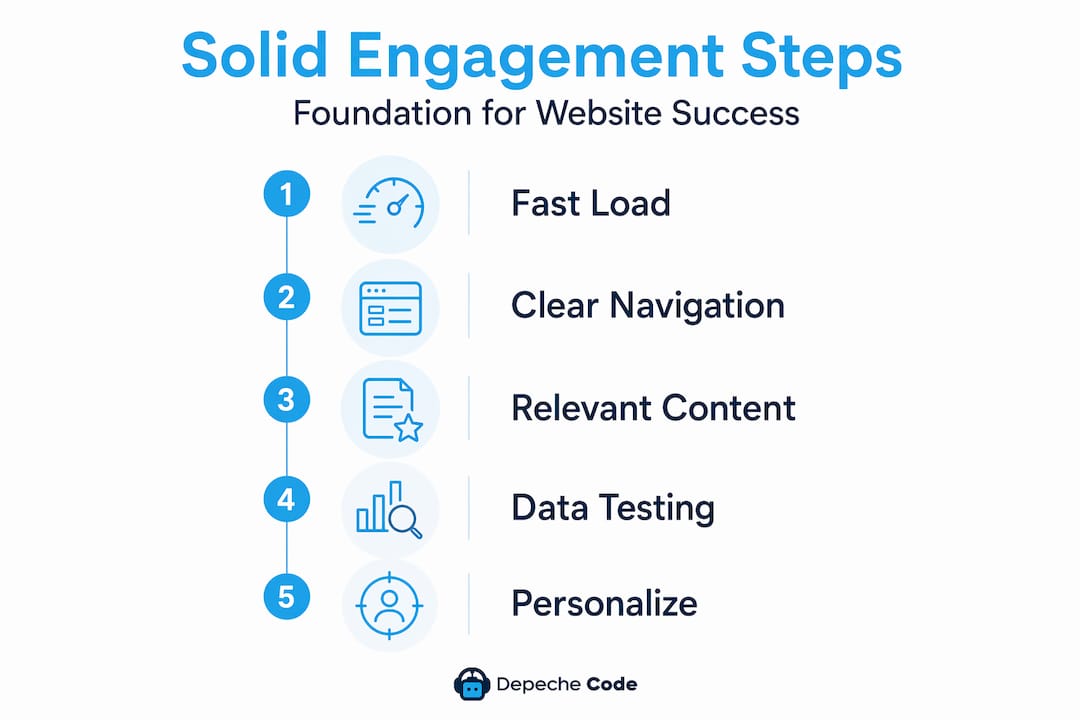
Mobile performance is not optional. Poor mobile UX causes rapid bounce because the majority of web traffic today comes from mobile devices. A 1-second improvement in mobile load time can increase conversions by up to 27% for e-commerce sites. That is not a marginal gain.
Here is where to focus your technical audit:
- Run a Core Web Vitals check through Google Search Console
- Test your site on real mobile devices, not just browser emulators
- Compress and lazy-load all images below the fold
- Minify CSS, HTML, and JavaScript files
- Review third-party scripts (chat widgets, analytics tags) and remove anything unnecessary
Pro Tip: Set up real user monitoring (RUM) through tools like Cloudflare or SpeedCurve so you see actual load times from real visitors in different locations, not just lab results.
Designing navigation that pulls people deeper
Even a fast site fails if visitors cannot figure out where to go next. Navigation is the architecture of your user experience, and most businesses underestimate how much poor navigation kills engagement metrics for websites.

The best navigation menus do one thing well: they make the next logical step obvious. That means limiting your top-level menu to five or six items, using descriptive labels instead of clever ones, and making your search bar easy to find. A visitor who cannot locate what they need within two clicks is a visitor who leaves.
Internal linking is one of the most underused ways to enhance engagement. When you link relevant articles, product pages, or guides together in a logical topic cluster, you are creating a path that keeps users moving through your site. Think of it as a conversation: each page suggests where to go next. If you need a framework for this, user experience and conversions have a well-documented relationship that internal structure directly influences.
Mobile navigation deserves its own attention. Thumb-friendly design means placing key navigation elements within easy reach of the bottom of the screen, keeping buttons large enough to tap without frustration, and avoiding hover-dependent menus that simply do not work on touchscreens.
Watch out for these common UX failures that kill sessions:
- Rage clicks on non-clickable elements that look interactive
- Dropdown menus that disappear before the user can select an option
- CTAs buried below the fold with no directional cues
- Generic button labels like “Click Here” that communicate nothing
Pro Tip: Record five real user sessions using a session replay tool and watch them without fast-forwarding. You will spot navigation problems in minutes that no analytics dashboard would ever show you.
Creating content that makes visitors stay and come back
Content is where engagement either accelerates or collapses. Format matters as much as substance. A well-researched article buried in a wall of text will underperform a moderately useful article that is properly structured, scannable, and visually broken up.
Pages with video content see session durations 2 to 3 times longer than those without video. That is a dramatic difference for a single format change. You do not need a production budget. A clear, well-lit explainer video or a product walkthrough recorded on a decent webcam will do the job.
Beyond video, these content formats consistently boost website interaction:
- Subheadings every 200 to 300 words to break up long reads
- Summary boxes at the top of articles for readers who skim first
- Collapsible FAQs on product and service pages
- Infographics that distill complex data into shareable visuals
For interactive content, the impact is clear. Polls, quizzes, and comment sections foster genuine connection and increase the likelihood of return visits. A quiz that helps someone choose the right product does two things at once: it solves their problem and keeps them on your site for another three minutes.
Here is a simple content update sequence that works for any business:
- Audit your top 10 pages for average time on page using Google Analytics
- Identify the three lowest performers and check their format and structure
- Add one multimedia element (video, infographic, or interactive tool) to each
- Republish with an updated date and monitor the change over 30 days
- Apply the winning format to the next tier of pages
Pro Tip: Returning visitors respond differently than first-time visitors. Use behavior-based personalization to show returning users different content blocks or CTAs than new visitors. This is one of the fastest ways to improve strategies for website retention without adding a single new page.
For a deeper look at structuring content to drive leads, Depechecode has written a content engagement guide worth reading alongside this one.
Using data and testing to verify what actually works
Opinions about what looks good on a website are abundant. Data about what actually works is what matters. This is where most businesses fall short in their engagement efforts. They make design changes based on assumptions and never measure the result.
Start by tracking the right engagement metrics for websites. Session duration and bounce rate are the obvious ones, but scroll depth and micro-conversions tell a more specific story. Tracking micro-conversions like guide downloads, quiz starts, and video plays gives you a precise map of where users are engaging and where they drop off before the main conversion event.
Heatmaps and session replays go even further. Behavior-based analytics reveal exactly where users click, scroll, and get stuck in ways that average metrics cannot capture. Rage clicks, for example, are a more reliable indicator of UX friction than a high bounce rate, because they show you the exact moment a user lost patience.
| Tool type | What it measures | Best for |
|---|---|---|
| Heatmaps | Click and scroll patterns | Finding ignored or over-clicked elements |
| Session replays | Full user journey recordings | Diagnosing drop-off and navigation confusion |
| A/B testing tools | Variant performance comparison | Testing headlines, CTAs, and layouts |
| Event tracking | Micro-conversion actions | Mapping user intent and funnel stages |
A/B testing should be a continuous practice, not a one-time experiment. Test one variable at a time: a headline, a CTA button color, or a page layout. Run each test until you have statistical significance, then apply the winner and move on to the next variable. Small wins compound into major engagement improvements over months.
Pro Tip: Pair exit-intent surveys with session replay data. When a user exits after a rage click, a simple one-question survey asking “What were you looking for?” gives you qualitative context that turns behavioral data into a clear fix.
Advanced tactics for deeper engagement and loyalty
Once your technical foundation is stable and your content is performing, the next level of ways to enhance engagement involves personalization, interactivity, and community signals.
Personalized CTAs aligned with user behavior consistently outperform generic ones. Geo-targeted messages and returning visitor content make users feel like the site was built for them specifically, which increases both time on site and conversion rates. An AI chatbot is one of the most practical tools for delivering this kind of real-time personalized assistance. Platforms like ChatzyBot demonstrate how AI-driven chat can handle visitor questions, guide users to the right pages, and keep sessions active without requiring human staff on standby.
Smart exit popups triggered after 70% scroll depth or on exit intent can increase conversions by up to 3% when they are relevant and not intrusive. The key word is “relevant.” A popup offering a discount on the exact product someone just browsed is effective. A generic newsletter signup that appears on every page after five seconds is noise.
Other advanced engagement tactics worth testing:
- Gamified progress bars on onboarding flows or assessments
- Voting features on blog posts or product pages to surface social proof
- Push notification opt-ins for mobile users who want return-visit prompts
- User-generated content sections that give customers a reason to come back
The goal with all of these is to create reasons for visitors to take one more action. Each additional action deepens the relationship between the user and your site.
My take on engagement after years in digital
I have worked with dozens of businesses on website performance, and the pattern I keep seeing is this: companies invest in redesigns hoping for a visual refresh to fix engagement, and they are disappointed when nothing changes. What I have learned is that most engagement problems are not aesthetic. They are structural and behavioral.
The businesses that see real improvement are the ones willing to watch session replays, read heatmaps, and make unglamorous fixes to navigation labels and button placement. I have seen a CTA copy change on a single page outperform a full redesign in terms of session depth. That sounds counterintuitive, but it makes sense when you realize users do not engage with how a site looks. They engage with how easy it is to get what they came for.
My honest advice: treat your website as an ongoing conversation with your visitors, not a finished product. Happy visitors improve SEO rankings because UX signals influence how search engines assess your content. Engagement and discoverability are connected. When you improve one, you often move the other. The businesses I have seen grow fastest in 2026 are the ones that stopped asking “Does this look good?” and started asking “Does this work?”
— Donovan
Let Depechecode build an engaging website for you
If the strategies in this guide feel like a lot to execute on your own, you are not alone. Most businesses do not have the internal bandwidth to audit their UX, restructure their content, and run A/B tests simultaneously.
Depechecode is a full-service digital agency based in Orlando that handles exactly this kind of work. From custom website design and development built around engagement and conversions, to SEO plans that connect discoverability with site performance, the team builds digital solutions that are grounded in real business results. Depechecode also offers AI chatbot integration and social media growth services to keep users engaged across every channel. If you want a site that works harder for your business, that is what Depechecode does best.
FAQ
What is a good website engagement rate?
A good engagement rate varies by industry, but a session duration above 2 minutes and a bounce rate below 50% are generally solid benchmarks. Tracking micro-conversions and scroll depth gives a more accurate picture than bounce rate alone.
How do I quickly improve my site’s engagement metrics?
Start with page speed and mobile experience, since users decide to stay or leave within the first 5 seconds. Adding video content and improving navigation clarity are the next fastest wins.
What engagement metrics should I track?
Focus on session duration, scroll depth, bounce rate, and micro-conversions like downloads or quiz completions. These engagement metrics for websites give you a full view of how users interact with your content at each stage of their visit.
How does UX affect SEO and engagement?
UX and SEO reinforce each other directly. Better user experience reduces bounce rate and increases time on site, both of which are signals that search engines use to evaluate content quality. Depechecode’s perspective on SEO and business growth covers this relationship in detail.
Does personalization really make a difference in engagement?
Yes, and the impact is measurable. Personalized CTAs and behavior-based content segments improve both engagement and conversion rates by making users feel the site responds to their specific needs rather than serving generic content to everyone.