

TL;DR:
- Choosing the right website pricing model depends on project scope, goals, and flexibility needs. Fixed, hourly, value-based, and retainer options each suit different situations and risk levels. Budgeting for ongoing costs ensures long-term site performance and security.
A website pricing model is the method a service provider uses to calculate and charge for web development work, typically structured as hourly rates, fixed project fees, value-based pricing, or monthly retainers. Choosing the wrong model costs businesses real money. A simple brochure site and a custom web application require completely different cost structures, yet many business owners treat them the same way. Understanding the four main pricing models gives you the clarity to budget accurately, negotiate confidently, and avoid the scope creep that derails projects before they launch.
What is a website pricing model and why does it matter?
A website pricing model defines the financial framework between you and your web development provider. It determines not just the total cost, but also who carries the risk when a project grows beyond its original scope.

Initial development costs in 2026 range from $300 for a simple landing page to over $120,000 for a custom web application. That gap exists because different pricing models apply to different levels of complexity, and matching the model to the project is the single most important budgeting decision you will make.
The industry uses the term “engagement model” interchangeably with pricing model in professional services contexts. Both phrases describe the same thing: the rules governing how work gets billed and how costs get controlled. Knowing both terms helps you communicate clearly with any agency or freelancer you evaluate.
What are the main types of website pricing models?
Four pricing models cover the vast majority of web development engagements: hourly, project-based, value-based, and monthly retainer. Each fits a different situation.
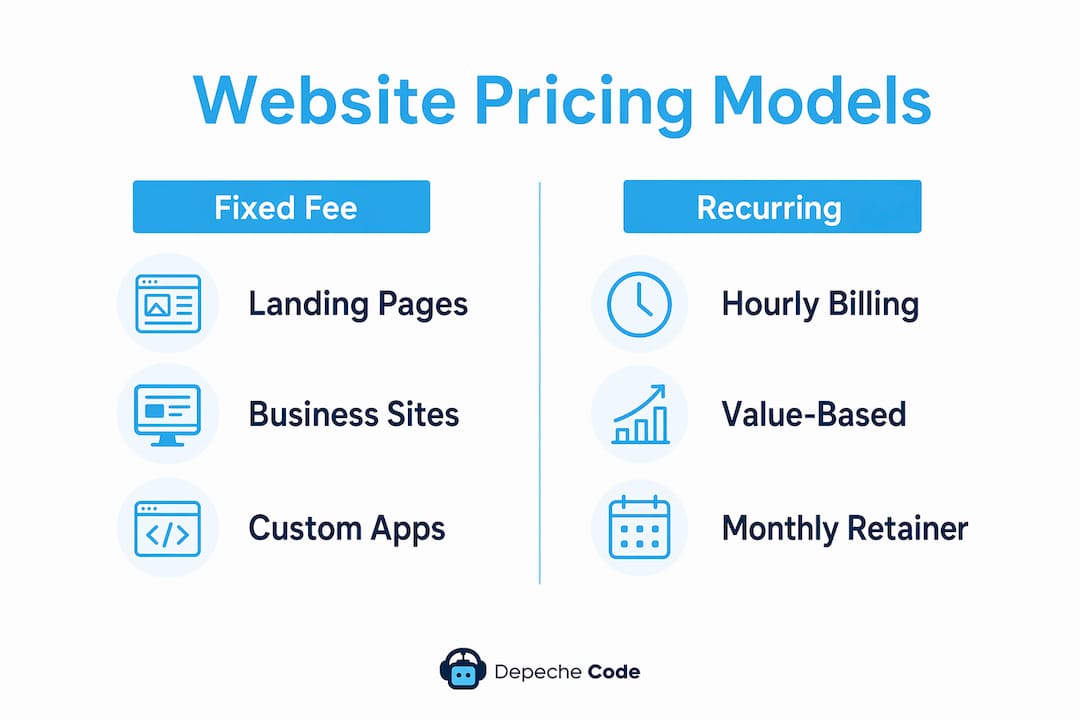
Hourly billing
Hourly billing charges you for every hour of work logged. Rates vary by provider experience and geography, but the model suits projects with undefined or frequently changing requirements. The downside is cost unpredictability. A project estimated at 40 hours can easily run to 70 if requirements shift, and you absorb that difference.
Project-based (fixed) fees
Fixed project fees offer clarity and reward provider efficiency, but they require accurate scope estimation upfront. You agree on a price before work begins, and that price holds regardless of how long the project takes. The risk shifts to the provider if they underestimate the work. For you, the benefit is a predictable budget line.
Value-based pricing
Value-based pricing ties the fee to the business outcome the website is expected to generate, not the hours spent building it. A landing page expected to generate $500,000 in annual leads commands a higher fee than one built for a local service business. Value-based pricing signals partnership and positions the provider as invested in your growth, not just your invoice. The challenge is that it requires transparent, trust-based conversations about expected business outcomes from day one.
Monthly retainer
A retainer locks in a set number of hours or deliverables per month for a fixed fee. This model works well for ongoing SEO, content updates, maintenance, and performance monitoring. Retainers give you predictable costs and guaranteed provider availability.
Pro Tip: Match the model to your certainty level. If you know exactly what you want, use a fixed project fee. If requirements are still evolving, start with hourly or a retainer until the scope firms up.
- Hourly: Best for exploratory projects, small tasks, or when scope is unclear
- Fixed project: Best for defined deliverables with clear requirements
- Value-based: Best for high-ROI projects where outcomes are measurable
- Retainer: Best for ongoing work, maintenance, and continuous improvement
How much does a website cost by pricing model in 2026?
Cost ranges vary significantly by project type, and the pricing model you choose affects how those costs land in your budget.
Landing pages run $300–$3,000, standard business sites fall in the $1,000–$10,000 range, and custom web applications can reach $120,000 or more. These figures reflect project-based pricing. Under hourly billing, the same projects carry similar totals but with less predictability.
| Project Type | Typical Cost Range | Common Pricing Model |
|---|---|---|
| Landing page | $300–$3,000 | Fixed project or hourly |
| Small business site | $1,000–$10,000 | Fixed project |
| E-commerce site | $5,000–$30,000 | Fixed project or value-based |
| Custom web application | $50,000–$120,000+ | Hourly or value-based |
| Ongoing maintenance | $50–$500+/month | Monthly retainer |
Recurring costs add to the total picture. Domain registration runs $0–$30 per year. Hosting ranges from $5 per month for basic SaaS site builders to $800 or more per month for enterprise-grade infrastructure. These costs exist regardless of which pricing model you used to build the site.
Geographic and provider variation also matter. An agency in Orlando charges differently than a solo freelancer in a lower-cost market. The pricing model is the structure; the rate is the variable inside it.
Pro Tip: Always ask for a full cost breakdown that separates the build fee from recurring costs. A $2,000 website with $300/month in platform fees costs more over two years than a $4,000 site with $20/month in hosting.
How to choose the right website pricing model for your business
Choosing a pricing model is a strategic decision, not just a financial one. The model you select signals how you want to work with a provider and how much flexibility you need.
Mismatched pricing models cause budget overruns. High-growth startups with evolving requirements benefit from hourly or retainer models. Established businesses launching a defined product page or rebrand are better served by a fixed project fee. Forcing a startup into a fixed-price contract before requirements are clear is one of the most common and costly mistakes in web development.
Mature agencies often combine flat-rate project fees with monthly retainers for ongoing optimization. This hybrid approach balances upfront cost certainty with long-term performance support. You pay a defined amount to build the site, then a monthly fee to keep it performing. For businesses that treat their website as a revenue channel, this structure makes the most sense.
Consider these factors before committing to a model:
- Project clarity: How well-defined are your requirements? Vague briefs favor hourly billing.
- Budget certainty: Fixed fees protect your budget; hourly billing protects your scope flexibility.
- Growth stage: Startups need flexibility. Established businesses need predictability.
- Long-term relationship: If you plan to work with the same provider for years, a retainer builds a better partnership than repeated one-off projects.
- ROI visibility: If you can measure the revenue impact of your site, value-based pricing may deliver better outcomes for both sides.
Pricing also signals brand positioning. A provider offering value-based pricing is telling you they are invested in your results, not just your hours. That distinction matters when you are choosing between a transactional vendor and a long-term growth partner. For professional services businesses, hybrid pricing structures that blend project fees with ongoing support often deliver the best return on investment.
What hidden costs should you budget for beyond the initial build?
Total cost of ownership is the full amount you will spend on a website over its lifetime, not just the launch price. Ignoring ongoing costs leads to budget shortfalls that put site security and performance at risk.
The most common hidden costs include:
- Domain renewal: $10–$30 per year, often forgotten after the first purchase
- Hosting: $5–$800+ per month depending on traffic, platform, and infrastructure needs
- SSL certificates: Often bundled with hosting, but not always
- Plugin or software licenses: $50–$500+ per year for premium tools, themes, or integrations
- Security monitoring: $10–$100+ per month for malware scanning and firewall protection
- Ongoing maintenance: $50–$500+ per month for updates, backups, and performance checks
A detailed cost breakdown helps you see the full picture before you sign any contract. Skipping this step is how businesses end up with a beautiful website that goes down because the hosting bill lapsed or a plugin update broke the checkout flow.
Website maintenance is not optional for any business that depends on its site for leads or revenue. Budget for it from day one, not as an afterthought. For a deeper look at long-term budgeting, the total cost of ownership guide covers every line item you need to plan for.
Key Takeaways
The most effective approach to website pricing is matching the model to your project’s scope, certainty level, and long-term goals before any contract is signed.
| Point | Details |
|---|---|
| Four core models exist | Hourly, fixed project, value-based, and retainer each serve different project types and risk profiles. |
| Costs vary widely by complexity | Projects range from $300 for a landing page to $120,000+ for custom web applications in 2026. |
| Recurring costs add up fast | Hosting, domains, plugins, and maintenance can add $50–$500+ per month beyond the build fee. |
| Hybrid models offer balance | Combining a fixed build fee with a monthly retainer gives you cost certainty and ongoing performance support. |
| Model choice signals partnership | Value-based pricing positions your provider as a growth partner, not just a vendor. |
What I’ve learned after years of watching businesses pick the wrong model
The most expensive mistake I see business owners make is choosing a pricing model based on the lowest number, not the best fit. A $1,500 fixed-price website sounds great until the scope expands and the provider stops responding because they are losing money on the project.
The second mistake is treating the build cost as the total cost. I have watched businesses launch a $10,000 website and then balk at a $150/month maintenance retainer. Six months later, the site gets hacked, the backup is three months old, and the recovery costs more than two years of maintenance would have.
My honest advice: if you are a business owner evaluating providers, ask them to walk you through their pricing model before you discuss features or design. How they answer tells you more about the partnership than any portfolio. A provider who explains the tradeoffs clearly, who tells you when a fixed fee is risky and when hourly makes more sense, is a provider worth trusting.
Hybrid models are underused by small businesses and overused by agencies trying to lock in recurring revenue. The right hybrid structure serves both sides. You get a defined deliverable and ongoing support. The provider gets fair compensation for both the build and the maintenance. When it works, it is the best arrangement in web development.
One more thing: value-based pricing is not a premium upsell. It is a fundamentally different conversation about what your website is worth to your business. If you cannot answer that question, you are not ready for value-based pricing yet. Start with a fixed project, measure the results, and revisit the model on your next engagement.
— Donovan
Depechecode’s approach to flexible website pricing
Depechecode, based in Orlando, works with business owners and marketing professionals across industries to build websites that fit both their goals and their budgets.

Rather than locking every client into a single pricing structure, Depechecode offers project-based engagements for defined builds and ongoing retainer options for businesses that need continuous support, maintenance, and SEO. Whether you are launching a new site or rebuilding an existing one, the team structures pricing around your actual requirements. Explore website design and development options to see how Depechecode approaches pricing for projects of every size, or check out the free website development offer if you are just getting started.
FAQ
What is a website pricing model?
A website pricing model is the billing structure a web development provider uses to charge for their work, typically hourly, fixed project, value-based, or monthly retainer. The model determines how costs are calculated and who carries the financial risk when scope changes.
Which pricing model is best for a small business?
Fixed project pricing works best for small businesses with clearly defined requirements, while a monthly retainer suits businesses that need ongoing updates and maintenance. Startups with evolving needs benefit most from hourly billing until their scope is firm.
How much should a business website cost in 2026?
Standard business websites cost between $1,000 and $10,000 for most small to mid-sized companies, with custom web applications reaching $50,000 to $120,000 or more. Recurring costs for hosting, domains, and maintenance add $50–$500+ per month beyond the initial build.
What does value-based pricing mean for websites?
Value-based pricing sets the fee based on the business outcome the website is expected to generate, not the hours required to build it. It requires clear upfront agreement on measurable goals and works best when both the client and provider trust each other’s projections.
What ongoing costs should I budget for after my website launches?
Recurring website expenses include domain renewal ($0–$30/year), hosting ($5–$800+/month), plugin licenses, security monitoring, and maintenance. Budgeting for these costs from the start protects your site’s performance and security long after launch.