

TL;DR:
- Depeche Code is a full-service agency offering web development, SEO, mobile apps, and AI chatbots under one roof. It consistently delivers measurable outcomes, fast turnaround times, and transparent pricing for clients across the U.S.
For businesses that need one agency to handle web development, brand design, SEO, mobile apps, and AI chatbots without juggling five vendors, Depeche Code is the strongest full-service pick available. Based in Orlando and serving clients across the U.S., the agency combines technical depth with creative execution in a way most boutique design firms simply cannot match.
Here is why Depeche Code stands out:
- Full-service stack: Website design and development, SEO, social media management, mobile app development, and AI chatbot integration under one roof.
- Measurable outcomes: Client reviews consistently cite professionalism, fast turnaround, and real improvements in online visibility.
- Transparent pricing: Published SEO plans and package options let you compare costs before a single call.
- Regional reach: Serves small and large businesses across multiple U.S. markets, with documented regional coverage.
Ready to get started? Request a quote or consultation and have your goals and budget ready for a faster response.
Pro Tip: Before contacting any agency, write down three specific business outcomes you want (e.g., “rank on page one for [keyword],” “cut bounce rate by 20%,” “launch a mobile app by Q3”). Agencies that respond to those specifics rather than pitching generic services are worth your time.
Table of Contents
- Core services you should expect from a full-service agency
- How do you evaluate and choose the right marketing and design company?
- Why Depeche Code is worth a serious look
- How do you verify an agency’s reputation beyond its portfolio?
- What agency size fits your business?
- Which industries do full-service agencies typically serve?
- How should an agency communicate and manage your project?
- What contract terms should you review before signing?
- What post-launch support should you expect?
- Key Takeaways
- What most buyers get wrong about choosing an agency
- Depechecode: a practical next step for businesses ready to move
- FAQ
Core services you should expect from a full-service agency
Not every agency calling itself “full-service” actually covers the full stack. Here is what a genuinely capable marketing and design firm delivers, and what to look for in each area:
- UX and website design: Wireframes, user flows, and responsive layouts. Ask to see mobile versions of past sites. Responsive design directly affects bounce rate and search rankings.
- SEO strategy and execution: Keyword research, on-page optimization, technical audits, and link building. Agencies should show you published SEO plan options with clear deliverables per tier.
- Social media management: Content creation, scheduling, community management, and growth reporting. Social media services should include a content calendar and monthly performance report.
- Mobile app development: Native or cross-platform builds with post-launch maintenance. Top-rated app development includes hosting and update support, not just the initial build.
- Hosting and maintenance: — Uptime monitoring, security patches, and CMS updates. This is often where agencies differentiate on long-term value.
One distinction worth knowing: boutique creative-first firms excel at brand identity and visual storytelling but may hand off development to contractors. Technical-first full-service agencies build the product and the marketing engine together. For most growing businesses, the second model reduces handoff errors and keeps accountability in one place.
How do you evaluate and choose the right marketing and design company?
Choosing a branding and marketing firm is not a beauty contest. The agency with the most impressive portfolio is not automatically the right fit for your budget, timeline, or industry. Work through this sequence before signing anything.
- Match capabilities to your actual needs. List every service you need in the next 12 months. Cross-reference against each agency’s confirmed service pages, not their homepage headline.
- Demand proof, not promises. Ask for two or three case studies with specific metrics: traffic growth percentages, conversion rate changes, or revenue tied to a campaign. Directory roundups like Built In’s Austin agency list show that specialty tags and recent case studies are the first things buyers look for.
- Test chemistry in discovery. A 30-minute discovery call reveals how an agency listens. Do they ask about your customers, or do they pitch their process immediately?
- Clarify scope in writing. Vague statements like “we’ll handle your marketing” are red flags. Every deliverable should have a name, a format, and a due date.
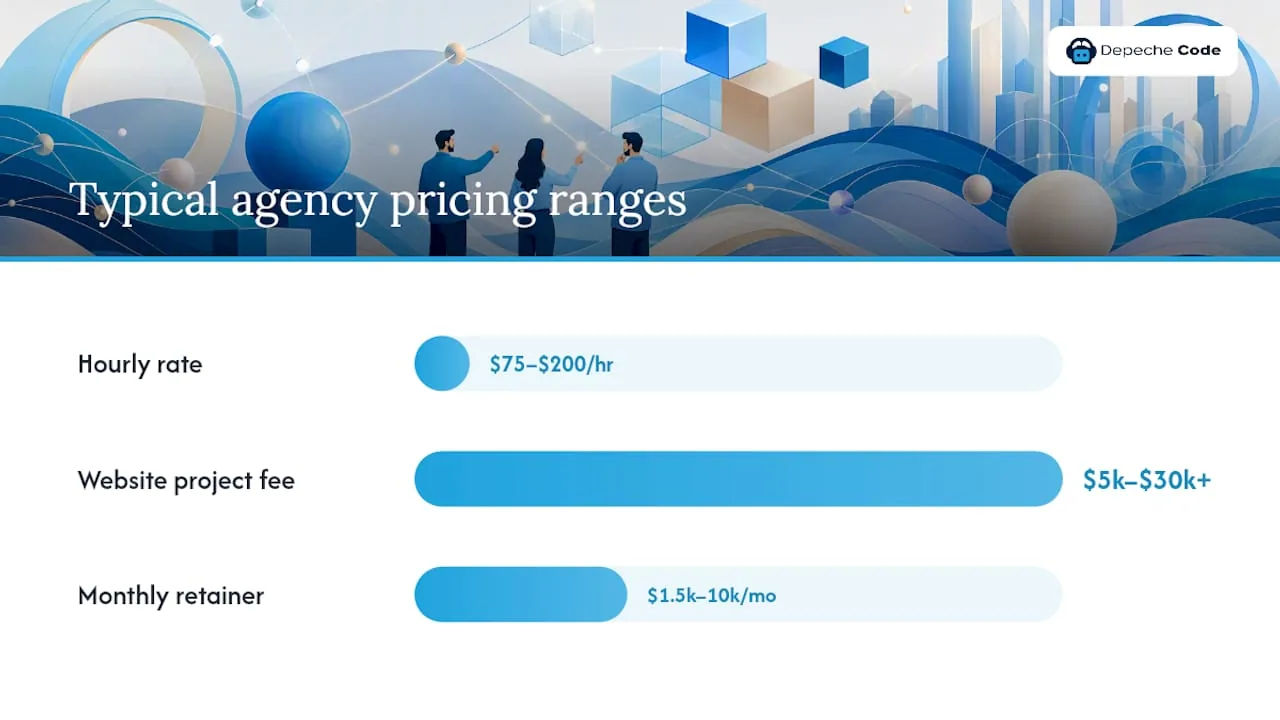
- Compare pricing models honestly. Three structures dominate the market: hourly rates (typically $75–$200/hr for U.S. agencies), fixed-project fees (a website redesign commonly runs $5,000–$30,000+ depending on complexity), and monthly retainers ($1,500–$10,000/month for ongoing marketing). What drives cost upward: custom integrations, e-commerce functionality, multilingual content, and tight timelines.
Questions to ask in every agency interview:
- Who on your team will work on my account day-to-day?
- What does your reporting cadence look like, and what metrics do you track?
- Who owns the designs, code, and content after the project ends?
- What does post-launch support cost, and what does it cover?
- How do you handle scope changes mid-project?
Red flags to watch for:
- No case studies with measurable outcomes, only visual samples.
- Timelines stated as “approximately” with no milestone schedule.
- Unclear IP ownership in the contract draft.
- No written maintenance or support plan after launch.
A typical website plus branding plus SEO engagement runs several weeks from discovery to launch, including phases for discovery and strategy, design, development, QA and revisions, followed by ongoing optimization. What shortens timelines: a client who provides content and feedback fast. What extends them: scope changes after design approval.
Pro Tip: Copy this checklist into your RFP: capability match, two verifiable case studies, written scope, IP ownership clause, post-launch support terms, and a milestone schedule. Any agency that pushes back on providing these in writing is telling you something.
Why Depeche Code is worth a serious look
Depechecode is a full-service digital agency built for businesses that need integrated marketing and technical execution without the overhead of managing multiple vendors. Here is how the service stack maps to business outcomes:
| Service | Business Outcome | Sample Deliverable |
|---|---|---|
| Website design & development | Higher conversion rate, lower bounce rate | Custom responsive site, CMS setup |
| SEO strategy | Organic traffic growth, page-one rankings | Keyword map, on-page optimization, monthly report |
| Social media management | Audience growth, engagement rate | Content calendar, monthly analytics report |
| Mobile app development | New revenue channel, customer retention | Native or cross-platform app with maintenance plan |
| AI chatbot integration | — | Embedded chatbot with custom conversation flows |
| WordPress hosting and maintenance | Uptime reliability, security compliance | Managed hosting, security patches, update schedule |
Client reviews highlight three things consistently: the team responds fast, projects finish on time, and the work actually improves online visibility. That last point is what separates a design firm from a growth partner.
Pricing at Depechecode follows both project and retainer models. Website projects are scoped per engagement; SEO and social media services are available as ongoing monthly plans with published options so you can compare tiers before committing. For businesses that want to start with a specific package, the free website development offer provides a low-friction entry point.
Pro Tip: Ask Depechecode for a scope document before signing. The agency’s published service pages give you a baseline to compare against the proposal, so you can spot gaps or additions before the contract is finalized.
How do you verify an agency’s reputation beyond its portfolio?
A polished portfolio proves creative ability. It does not prove reliability, communication, or whether the agency delivered on time and on budget. Here is how to go deeper.
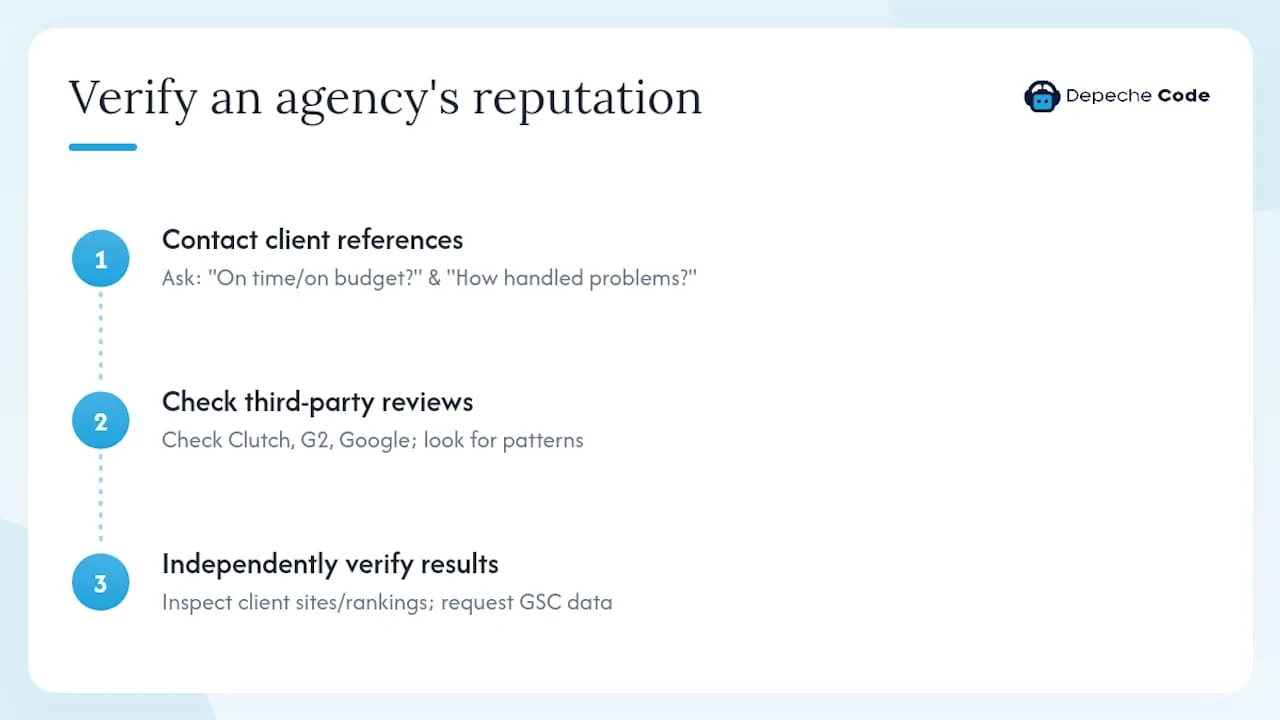
Ask for three client references you can contact directly, not just written testimonials on the agency’s site. When you call, ask specifically: “Did the project finish on time and within budget?” and “How did the agency handle problems when they came up?” Those two questions reveal more than any review.
Check Google Business reviews and third-party directories like Clutch or G2 for patterns. A single five-star review means little. Thirty reviews that consistently mention responsiveness and measurable results mean a lot. Look at how the agency responds to negative reviews too. A professional, non-defensive reply to a complaint is a better trust signal than a perfect score.
Finally, search for the agency’s past clients and look at those businesses’ websites and search rankings independently. If an agency claims SEO success for a client, you can verify organic visibility using free tools like Google Search Console data the client shares, or by simply searching the client’s target keywords.
What agency size fits your business?
Agency headcount shapes your experience more than most buyers realize. A five-person boutique gives you direct access to senior talent on every call, but capacity limits mean they may not handle a full rebrand plus app development simultaneously. A 50-person agency has specialists for every channel but may assign your account to a junior team once the contract is signed.
For small businesses with budgets under $5,000/month, a mid-size agency (10–30 people) with a documented process and a dedicated account manager tends to deliver the best balance of attention and capability. Mid-market companies running larger campaigns benefit from agencies that have in-house developers, designers, and strategists who collaborate daily rather than contractors assembled per project.
The right question is not “how big is the agency?” but “who specifically will work on my account, and what is their experience level?” Get names and LinkedIn profiles before signing.
Which industries do full-service agencies typically serve?
Most established marketing design firms serve a mix of industries, but the best ones have documented outcomes in sectors relevant to your business. Common verticals include retail and e-commerce, healthcare, professional services, real estate, hospitality, and technology startups.
What matters more than industry match is outcome match. An agency that helped a law firm rank on page one for competitive local keywords has demonstrated SEO execution that transfers to any service business. An agency that built a mobile app for a healthcare provider has shown it can handle compliance-sensitive technical work.
When reviewing case studies, look for the business type, the specific challenge, the solution, and the measurable result. “We redesigned their website” is not a case study. “We redesigned their website and reduced bounce rate from 72% to 41% in 90 days” is.
How should an agency communicate and manage your project?
Communication style is where most agency relationships succeed or fail. Before signing, confirm three things: the project management tool they use (Asana, Trello, Basecamp, and ClickUp are common), the reporting cadence (weekly check-ins or bi-weekly calls), and the single point of contact for day-to-day questions.
Feedback loops matter as much as the tool. A good agency sets clear revision rounds per deliverable (typically two to three rounds for design), documents feedback in writing rather than relying on verbal notes, and flags scope changes before doing the work, not after billing for it. If an agency cannot describe its feedback process in a proposal, that is a gap worth probing before you commit.
What contract terms should you review before signing?
Three clauses deserve close attention in any agency contract. First, intellectual property ownership: confirm that all designs, code, and content transfer to you upon final payment, not upon project completion. Second, termination terms: understand the notice period required to exit a retainer and whether you owe fees for work in progress. Third, scope change protocol: the contract should specify how out-of-scope requests are priced and approved, in writing, before work begins.
Non-disclosure agreements are standard for agencies handling sensitive business data. If an agency does not offer one, ask for it. For projects involving user data (apps, chatbots, e-commerce), confirm the agency’s data handling practices align with applicable U.S. privacy regulations.
This article provides general information, not legal advice. Review any agency contract with a qualified attorney before signing.
What post-launch support should you expect?
A website or app launch is not the end of the engagement. It is the beginning of the maintenance phase, and the terms of that phase should be agreed upon before the project starts.
Standard post-launch support from a full-service agency includes security updates, CMS version upgrades, uptime monitoring, bug fixes within a defined response window (typically 24–72 hours for non-critical issues), and periodic performance reviews. Some agencies bundle this into a monthly retainer; others bill hourly for maintenance work.
Ask specifically: “What happens if my site goes down at 2 AM on a Saturday?” The answer tells you whether the agency has a real support infrastructure or is relying on a single developer checking email.
Key Takeaways
Depechecode is the strongest full-service marketing and design company for businesses that need integrated web development, SEO, and growth services under one accountable team.
| Point | Details |
|---|---|
| Recommended agency | Depechecode delivers web design, SEO, mobile apps, AI chatbots, and social media from one team. |
| Top selection criteria | Match capability to your needs, then verify with case studies that show specific measurable outcomes. |
| Pricing models | Agencies generally offer hourly, fixed-project, or monthly retainer structures with variable rates depending on complexity and scope. |
| Timeline expectations | A full website plus branding plus SEO engagement typically runs 12–20 weeks from discovery to launch. |
| Verify reputation | Check third-party reviews, call references directly, and independently confirm claimed SEO results. |
| Next step | Contact Depechecode with your goals and budget ready for a scoped proposal. |
What most buyers get wrong about choosing an agency
The conventional wisdom says to pick the agency with the best-looking portfolio. That advice is not wrong, it is just incomplete. Design quality is table stakes. What actually predicts a successful engagement is whether the agency can articulate why a design decision was made and what business outcome it was meant to drive.
Agencies that lead with aesthetics and follow with strategy tend to produce beautiful work that does not move the needle. Agencies that lead with the business problem and let design serve the solution tend to produce work that looks good and performs. The difference shows up in how they talk during a discovery call, not in the portfolio PDF they email you afterward.
The other thing buyers underestimate is the cost of switching. If you hire a firm that owns your code, your domain, or your ad accounts and the relationship sours, extracting your assets can cost more than the original project. Ownership clauses in contracts are not a formality. They are the single most important legal protection you have.
Depechecode: a practical next step for businesses ready to move
Depechecode gives you a full-service digital team without the overhead of hiring in-house developers, designers, and marketers separately. For businesses comparing agencies, the concrete advantage is this: one point of contact, one contract, and one team accountable for your website, your search rankings, your social presence, and your app.
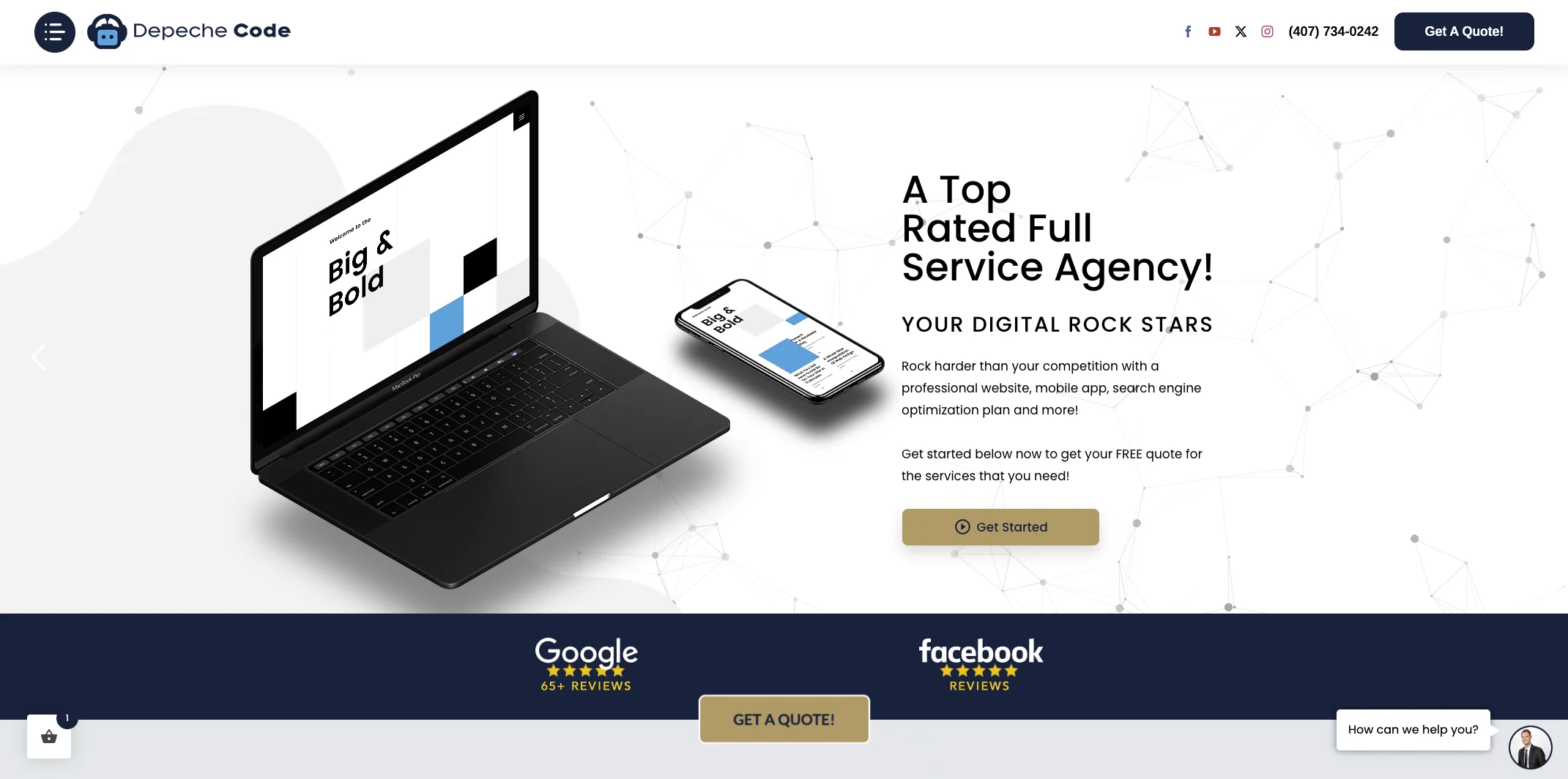
The agency’s published SEO plans and social media packages let you review pricing tiers before a single conversation, which cuts the evaluation time significantly. For businesses starting from scratch, the free website development option is a low-risk entry point to see the team’s process firsthand.
To get a scoped proposal, reach out through the Depechecode website with your business goals, current pain points, and a rough budget range. The team typically responds within one business day. Have your existing site URL, any brand assets you own, and your top three priorities ready. That information lets the team skip the generic pitch and go straight to a plan that fits your situation.
FAQ
What does a full-service marketing and design company do?
A full-service marketing and design firm handles brand identity, website design and development, SEO, content, social media, paid ads, and technical products like mobile apps and AI chatbots. The goal is measurable business growth, not just deliverables.
How much does hiring a marketing and design firm cost?
U.S. agency pricing typically runs $75–$200 per hour for hourly work, $5,000–$30,000+ for fixed website projects, and $1,500–$10,000 per month for ongoing retainers. Scope complexity, custom integrations, and timeline pressure drive costs upward.
How long does a website plus branding plus SEO project take?
Most engagements run 12–20 weeks from discovery to launch. Fast client feedback and pre-prepared content are the two factors that shorten timelines most reliably.
How do you verify an agency’s reputation before hiring?
Call references directly, check third-party review platforms for patterns across multiple reviews, and independently verify claimed SEO results by searching the client’s target keywords. A directory like DesignRush can surface additional agency profiles and ratings for comparison.
Why should I consider Depechecode for my business?
Depechecode offers a documented full-service stack covering web development, SEO, mobile apps, AI chatbots, and social media management, with published pricing options and a track record of positive client reviews citing responsiveness and measurable online visibility improvements.