

Search intent is the reason a person types a query into Google in the first place, and it falls into four buckets: informational, navigational, commercial, investigational, and transactional. Every ranking algorithm update since 2011 has pushed further toward rewarding pages that match that reason, not just pages that repeat the right words. If you’re building content and skipping this step, you’re guessing.
Here’s the quick version of what each type does for the searcher:
- Informational — the searcher wants to learn something (“what is search intent,” “how does compound interest work”).
- Navigational — they already know where they’re going and just need the fastest path (“Ahrefs login,” “Semrush pricing”).
- Commercial investigational — they’re comparing options before they buy (“best CRM for small teams,” “Semrush vs. Ahrefs”).
- Transactional — they’re ready to act now (“buy Yoast premium,” “hire SEO agency near me”).
The BLUF takeaway: before you write a single word of content for a target keyword, run a quick SERP scan to identify keyword intent and match your content format to whatever’s already ranking. Guess wrong here and no amount of on-page polish saves the page.
Key Takeaways
Matching content format to the searcher’s actual goal, not just their keywords, is what determines whether a page ranks, converts, or both.
| Point | Details |
|---|---|
| Four intent types | Classify every keyword as informational, navigational, commercial investigational, or transactional before writing. |
| SERP features reveal intent | Product carousels signal transactional queries; featured snippets signal informational ones. |
| Match the three Cs | Align content type, format, and angle with what’s already ranking for that keyword. |
| Audit before you rewrite | Depechecode’s audit template exports Search Console data, maps SERP features, and scores pages by impact before any rewrite starts. |
Table of Contents
- Why Search Intent Matters for Rankings and Revenue
- What Are the Main Types of Search Intent?
- How Do You Determine Search Intent for a Keyword?
- How to Match Your Content to Search Intent
- Common Search Intent Mistakes to Fix First
- The Depechecode Search Intent Audit Template
- Why Intent Alignment Is the Part Most SEOs Skip
- Get a Search Intent Audit Built by Depechecode
- Sources
- FAQ
Why Search Intent Matters for Rankings and Revenue
Google doesn’t rank pages for keyword matches anymore. It ranks pages for relevance to the reason someone searched, and intent alignment directly affects rankings, click-through rate, and conversion potential. Miss the intent and you can have flawless technical SEO, perfect schema markup, and a 2,000-word article, and still sit on page two because Google’s evaluators decided your format doesn’t serve the query.
The stakes show up in a few concrete places:
- Relevance signals — pages that match the dominant SERP format tend to earn and keep rankings longer.
- Click-through rate — a title that promises the wrong outcome gets skipped, even at position three.
- Time on page and bounce rate — a visitor expecting a buying guide who lands on a bare product page leaves in seconds.
- Conversion rate — intent-matched pages convert better because the visitor was already primed for that exact action.
Picture two pages targeting “best running shoes for flat feet.” One is a straight product listing page. The other is a comparison guide with pros, cons, and a buyer’s checklist. If the SERP is dominated by review-style content and buying guides, the product page is fighting the wrong battle; searchers at that stage want research, not a checkout button. Watch impressions and click-through rate in Search Console first. If impressions climb but clicks and engagement stay flat, that’s usually a sign the format doesn’t match what the searcher expected when they clicked.
What Are the Main Types of Search Intent?
Most SEOs work from a four-bucket model: informational, navigational, commercial, investigational, and transactional. Backlinko’s breakdown of search intent confirms these as the standard categories, and Google’s own Search Quality Evaluator Guidelines group user goals into Know, Do, Website, and Visit-in-person categories that map cleanly onto the same four buckets. Here’s how to recognize and serve each one.
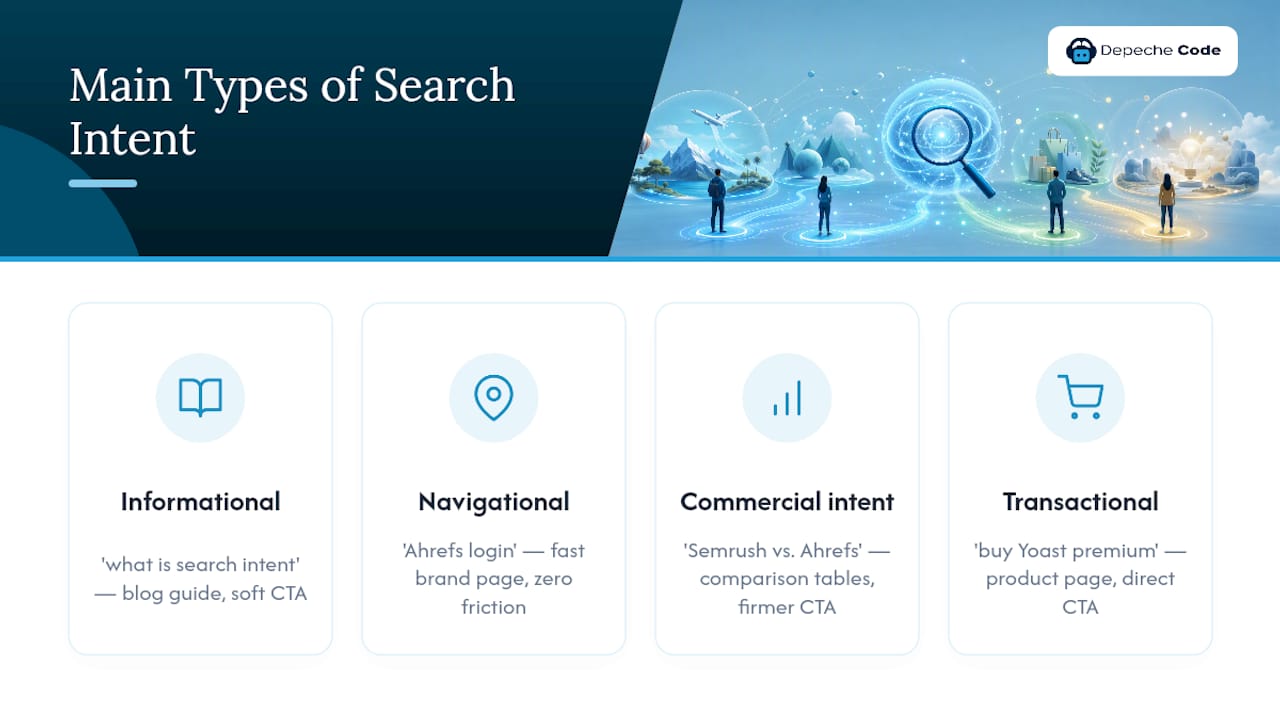
Informational intent shows up in queries like “what is search intent,” “how to train for a 5K,” or “symptoms of dehydration.” The searcher wants an answer, not a sales pitch. Best format: a blog guide or explainer with a clear structure, maybe an FAQ block. The right CTA here is soft. Offer a newsletter signup or a related guide, never a hard purchase ask.
Navigational intent looks like “Ahrefs login,” “Depechecode contact page,” or “Facebook.” The searcher already knows the destination. Your job, if you’re not the brand being searched for, is nearly impossible to win here, and honestly not worth chasing. If it’s your own brand, the best format is a clean, fast-loading page that gets them where they’re going with zero friction.
Commercial investigational intent covers “best website builders for small business,” “Semrush vs. Ahrefs,” or “top-rated SEO agencies.” These searchers are close to a decision but still comparing. Best format: comparison tables, review-style content, or “best of” roundups. The CTA can be a bit firmer, things like “get a quote” or “compare plans,” since they’re warming up to act.
Transactional intent is queries like “buy Yoast premium,” “hire local SEO company,” or “sign up for Google Workspace.” These searchers want to act right now. Best format: a product page or service landing page with pricing, trust signals, and a direct CTA like “Get Started” or “Request a Quote.”
Some keywords resist a clean label. “Best CRM software” could be informational (someone researching the category) or commercial (someone ready to sign a contract next week). When intent looks mixed, scan the SERP for feature variety and group related keywords together before committing to one dominant format. If the top ten results are split between guides and product pages, a hybrid page, educational content with a clear path to a decision, usually performs better than forcing a single lane.
How Do You Determine Search Intent for a Keyword?
Run this checklist on any keyword before you write a page for it:
- Check the modifiers. Words like “how,” “what,” and “guide” usually signal informational intent. “Best,” “vs.,” and “review” signal commercial investigational. “Buy,” “price,” “near me,” and “discount” signal transactional.
- Scan the top ten results. What content type dominates? Blog posts, product pages, comparison articles, or local business listings?
- Note the SERP features. Product carousels and shopping results point to transactional intent, while knowledge panels and featured snippets point to informational intent. A local pack almost always means the searcher wants a nearby business, not a national brand.
- Pull engagement data from Google Search Console. Look at click-through rate and average position for the query. A high impression count with low clicks often means your title or format doesn’t match what searchers expected.
- Cross-check with a keyword research tool to confirm search volume and related query clusters.
On the tool side, here’s what each one actually gives you:
- Google Search Console shows real click and impression data for queries you already rank for, which tells you if your current content is satisfying intent or just showing up.
- Semrush breaks out intent labels (informational, navigational, commercial, transactional) directly in its Keyword Magic Tool, saving you the manual SERP scan.
- Ahrefs shows SERP features and top-ranking content types side by side in Keywords Explorer, so you can see exactly what format is winning.
- Google Trends shows whether interest in a query is seasonal, rising, or flat, which matters for deciding how much investment a page deserves.
Quick worked example: take the keyword “best project management software.” Modifier check: “best” signals commercial investigational. SERP scan: the top results are almost all comparison articles and roundups, not single product pages. SERP features: no shopping carousel, but there’s a featured snippet listing criteria for choosing software. Verdict: build a comparison guide, not a landing page for one product.
How to Match Your Content to Search Intent
Once you know the intent, rework the page around it. Ahrefs calls this the “three Cs”: align content type (what you publish), content format (how it’s structured), and content angle (the specific focus) with what the dominant SERP already rewards.
Before and after, a typical fix looks like this:
- Title and meta description — rewrite to match the actual searcher goal, not just the keyword string.
- H1 alignment — the headline should promise exactly what the SERP shows is working, whether that’s a definition, a comparison, or a purchase path.
- Content format and depth — a 300 word product blurb won’t compete against 2,000 word buying guides; match the depth the SERP already demands.
- CTA placement — soft CTAs (subscribe, read more) for informational content, firm CTAs (get a quote, buy now) for transactional content.
The CTA mismatch is where a lot of pages quietly lose money. An informational title like “How to Choose a CRM” paired with a hard “Buy Now” button feels like a bait and switch, and readers bounce. A transactional title like “CRM Software Pricing” paired with a vague “Learn More” link wastes a visitor who was ready to convert. Match the CTA’s urgency to the title’s promise.
Search engines and AI tools both rely on structured content and clear semantic signals to understand what a page is actually for, so headers, schema, and internal linking all help reinforce the intent match you’re building.
If you’re managing dozens or hundreds of pages, prioritize by traffic potential first, then by how far the current page is from matching intent. A high-traffic page with a total format mismatch (like a product page ranking for an informational query) should jump the queue over a low-traffic page with a minor CTA tweak.
Pro Tip: Group your keywords by intent before you touch a single page. Rewriting one page at a time without that map means you’ll fix the same mismatch three separate times instead of once across a whole cluster.
Common Search Intent Mistakes to Fix First
The most common miss is targeting an informational keyword with a product page, essentially trying to sell someone who just wants an answer. Right behind it: ignoring the SERP format entirely and publishing a listicle when the top results are all in-depth guides, or slapping a transactional CTA on top of educational content.
Fast fixes for a content audit:
- Pull your top twenty pages by impressions with low CTR and check if the format matches the SERP.
- Swap mismatched CTAs first. It’s the cheapest fix with the fastest signal.
- Rebuild content depth where competitors are running longer, more structured guides.
Pro Tip: After a rewrite, give it two to four weeks before judging results. Search Console data needs time to reflect the new click behavior, and rankings often shift gradually rather than overnight.
The Depechecode Search Intent Audit Template
Here’s the workflow Depechecode runs when auditing a client’s existing content library for intent mismatches:
- Export query data from Google Search Console, focusing on pages with high impressions but weak click-through rate or conversion numbers.
- Group keywords by intent using modifier patterns and SERP feature checks, not just search volume.
- Map SERP features for each cluster to confirm what format Google is currently rewarding.
- Score each page on a simple impact-times-effort matrix, prioritizing high-traffic pages with clear format mismatches.
- Assign a rewrite scope for each flagged page, whether that’s a full rebuild or a targeted CTA and structure fix.
A typical mid-priority page might need a new H2 structure, an added comparison table, and a CTA swap, roughly a half-day rewrite rather than a full content rebuild. High-priority pages, the ones bleeding traffic on a total format mismatch, usually justify a complete rewrite from scratch.
This is the same search intent framework Depechecode applies across client accounts, whether the goal is local visibility or broader organic growth.
Why Intent Alignment Is the Part Most SEOs Skip
Most content teams treat search intent as a box to check once, during keyword research, then forget it. At Depechecode, we treat it as an ongoing filter applied to every page before publishing and again during quarterly audits, because SERPs shift and a page that matched intent a year ago can drift out of alignment as competitors rebuild around the same query. One client’s local service page, originally built as a plain contact form, jumped in both rankings and lead volume after we rebuilt it as a comparison-style guide once the SERP shifted toward that format. Intent work isn’t a separate task from technical SEO or link building; it’s the filter that decides whether either of those efforts pays off.
Get a Search Intent Audit Built by Depechecode
Depechecode is the alternative to guessing your way through a content calendar: instead of publishing and hoping, you get a structured audit that tells you exactly which pages are fighting the wrong battle. A typical intent audit pulls your Search Console export, maps every target keyword against current SERP features, and hands back a prioritized rewrite roadmap ranked by traffic impact and effort.
The goal isn’t more content. It’s content that matches what searchers actually want when they type the query, which is what drives traffic quality and conversion rate, not just rankings on a dashboard. If your pages are ranking but not converting, or not ranking at all despite solid writing, a mismatch in intent is often the reason. Explore Depechecode’s SEO services and request an audit to see where your content is losing searchers before they ever reach your CTA.
Sources
- What is search intent in SEO? Using different types of keyword intent
- Search Intent in SEO: What It Is & How to Optimize for It
- What Is Search Intent? How to Identify It & Optimize for It
- Search Intent and SEO: How to Optimize for User Goals
FAQ
What Is an Example of Search Intent?
A search for “how to fix a leaky faucet” shows informational intent, while “buy faucet repair kit” shows transactional intent for the same general topic.
What Are the Three C’s of Search Intent?
The three Cs, from Ahrefs’ framework, are content type, content format, and content angle, all of which should align with what’s already ranking on the SERP.
Why Is Search Intent Important for SEO?
Search engines rank pages based on relevance to the searcher’s goal, so matching intent improves rankings, click-through rate, and conversion rates simultaneously.
What Are the Four Types of Search Intent?
The four types are informational, navigational, commercial investigational, and transactional, each requiring a different content format and CTA.
How Long Does It Take to See Results After Fixing Intent Mismatches?
Most sites see click-through rate and engagement shifts within two to four weeks of a rewrite, though full ranking changes can take longer depending on competition.