

Most marketing teams should stop trusting whatever attribution model their analytics platform defaults to. Start by comparing first-touch and last-touch reports side by side, then move to a multi-touch or data-driven model once you have enough conversion volume to trust the math. The right marketing attribution models aren’t a single answer. They’re a set of lenses, and picking one depends entirely on the question you’re asking: are you measuring what starts a customer relationship or what closes it?
Here’s the fastest path to a defensible answer:
- Check which model your analytics platform uses by default right now, since GA4 and Google Ads have both shifted their defaults in recent years.
- Run first-touch, last-touch, and a position-based report in parallel for 30 days before changing budget allocation.
- Move to a data-driven model only when you have enough monthly conversions to make the algorithm reliable, not just available.
Once you’ve done that, the rest of this guide explains why each model exists, when to use it, and how to avoid the mistakes that make attribution data actively misleading.
Key Takeaways
Marketing attribution models each answer a different question, and the right choice depends on your sales cycle, data volume, and whether you need explainability or optimization power.
| Point | Details |
|---|---|
| No single “best” model | First-touch measures demand generation; last-touch measures closing; multi-touch splits credit across the journey. |
| Data volume gates data-driven models | Algorithmic attribution needs sufficient monthly conversions or it produces unreliable, noisy weights. |
| Audit platform defaults first | GA4 and Google Ads have changed default models, and legacy “zombie” models can silently skew old reports. |
| Attribution isn’t causation | Pair attribution reporting with incrementality tests like holdouts or geo-experiments to confirm real lift. |
| Clean tracking beats model choice | Depechecode builds UTM governance, GA4 conversion setup, and CRM joins into website projects so attribution data is trustworthy from launch. |
Where to Read More on Attribution and Measurement
- Marketing attribution models and best practices from Adobe for Business covers the full model taxonomy in more technical depth.
- HubSpot’s attribution modeling explainer breaks down why ROI measurement depends on model choice.
- Google’s attribution modeling documentation details how platform defaults behave inside GA4 reporting.
- Google Ads’ attribution model support page lists which rule-based models have been deprecated or changed.
Table of Contents
- What Is Marketing Attribution and Why Does It Matter?
- Where Does Attribution Data Actually Come From?
- What Are the Main Types of Attribution Models?
- How Does Attribution Improve Marketing Decisions?
- How Do You Choose the Right Attribution Model?
- What Attribution Mistakes Cost Marketing Teams the Most?
- How Often Should You Review Your Attribution Model?
- What Tools Do You Need to Run Attribution in Practice?
- How Depechecode Approaches Attribution for Client Projects
- Get Your Attribution Foundation Built Right
- Sources
- FAQ
What Is Marketing Attribution and Why Does It Matter?
Marketing attribution is the practice of assigning credit for a conversion to the marketing touchpoints that led to it. A touchpoint is any interaction a prospect has with your brand: a paid ad click, an organic search visit, an email open, a retargeting impression. A conversion is the outcome you care about, whether that’s a purchase, a form fill, or a demo request. An attribution model is simply the rule set that decides how much credit each touchpoint gets.
This matters because attribution is how you calculate return on investment per channel, and attribution modeling exists specifically to let teams justify budget decisions with data rather than guesswork. Without it, you’re allocating spend based on whichever channel happens to sit closest to the sale in your reporting dashboard.
There’s a hard limit worth naming early: attribution shows correlation, not causation. A model can tell you a customer touched five channels before buying. It can’t tell you which of those five actually caused the sale, or whether they would have converted anyway. That’s why incrementality testing, including holdout groups and geo-experiments, exists as a separate and necessary complement to attribution modeling) rather than a replacement for it.
Done well, attribution helps with:
- Budget reallocation across channels based on actual contribution, not internal politics.
- Channel optimization, showing which touchpoints deserve more creative testing investment.
- Customer lifetime value analysis, connecting acquisition source to long-term revenue.
Where Does Attribution Data Actually Come From?
Attribution is only as good as the data feeding it, and most teams underestimate how many gaps exist in their tracking stack. The inputs come from four broad places: ad platforms (Google Ads, Meta, LinkedIn), owned channels (email platforms, organic search, organic social), your CRM (deal stage, revenue, close date), and offline sources like call tracking or in-store visits.
A workable setup for basic multi-touch attribution needs:
- Consistent UTM tagging across every campaign, with a documented naming convention so “email_newsletter” and “Email_Newsletter” don’t fracture your reporting into two different rows.
- A deterministic user ID strategy that stitches sessions across devices, ideally tied to a login or CRM record rather than relying solely on cookies.
- Server-side event capture for the conversions that matter most, since client-side tracking alone loses data to ad blockers and browser privacy restrictions.
- CRM revenue joins so attribution credit connects to actual closed revenue, not just form submissions.
- Call tracking numbers for any business where phone conversions matter, since a workable tracking stack combines ad platform data, client- and server-side events, CRM joins, and call tracking with consistent campaign tagging to avoid blind spots.
A CRM integration that reliably joins marketing touchpoints to closed deals is often the single biggest upgrade a mid-size company can make to its attribution accuracy, more impactful than switching models.
Pro Tip: Before you evaluate any attribution model, spend a week auditing your UTM parameters across every live campaign. Half the “attribution problems” teams complain about are actually tagging inconsistencies, not model limitations.
What Are the Main Types of Attribution Models?
There are three broad categories of attribution models: single-touch, rule-based multi-touch, and data-driven algorithmic models. Adobe’s framework identifies eight common models across these categories, and each one answers a different strategic question. Picking the wrong one doesn’t just skew a report. It can send budget toward the wrong channel for months.
Single-touch models: simple, but blind to the middle
First-touch attribution gives 100% of the credit to the first interaction a customer had with your brand. It answers one question well: which channels generate new demand? If you’re running brand awareness campaigns or trying to prove that content marketing fills the top of your funnel, first-touch is the honest lens.
Last-touch attribution, still the default in a lot of legacy reporting, gives all the credit to the final touchpoint before conversion. It answers a narrower but operationally useful question: what closes the deal? For short sales cycles and direct-response ecommerce, last-touch is often the most operationally useful model precisely because the buying decision happens fast and close to that final click. For a B2B company with a six-month sales cycle, last-touch is nearly useless, since it ignores every touchpoint that built the case for buying in the first place.
Neither model is “wrong.” They’re both incomplete by design, and comparing first-touch vs. last-touch attribution side by side is often the fastest way to see how big your middle-of-funnel blind spot actually is.
Multi-touch rule-based models: spreading credit deliberately
Rule-based multi-touch models split credit across several touchpoints using a fixed formula:
- Linear attribution splits credit evenly across every touchpoint in the journey. It’s simple and transparent, but it treats a passive display impression the same as a demo request, which rarely reflects reality.
- Time-decay attribution gives more credit to touchpoints closer to conversion, with earlier touches getting progressively less weight. This suits longer sales cycles where recency still signals intent.
- Position-based (U-shaped) attribution assigns a heavier weight, often 40%, to the first and last touchpoints, splitting the remainder across the middle. It’s a reasonable default when you care about both demand generation and closing.
- W-shaped attribution adds a third weighted point, usually the lead-creation moment, giving credit to three critical stages instead of two. This works well for B2B funnels with a clear marketing-qualified-lead milestone.
The advantage of rule-based models is transparency. Anyone on your team can explain the formula in one sentence, which matters enormously when you’re defending budget decisions to a CFO.
Data-driven and algorithmic models: powerful, but not free
Data-driven attribution uses machine learning to analyze converting and non-converting paths and assign credit based on actual patterns rather than a fixed rule. The upside is real: it adapts to your specific customer behavior instead of forcing it into a preset formula.
The tradeoff is just as real. Algorithmic models tend to operate as a black box, and they need sufficient conversion volume to produce reliable weights rather than statistical noise dressed up as insight.
Statistic Callout: Google Ads and Google Analytics have moved several accounts toward data-driven attribution as the default, but Google’s own support documentation warns that this model demands a minimum conversion volume and careful validation before you trust its output over a simpler rule-based view.
A hybrid approach tends to work best in practice: use a rule-based model like position-based or W-shaped for stakeholder reporting, since it’s explainable in a boardroom, and layer in a data-driven model for internal optimization once your conversion volume supports it. Pairing algorithmic weighting with a rule-based lens preserves explainability while still capturing the accuracy gains of machine-learned credit assignment.
How Does Attribution Improve Marketing Decisions?
Good attribution doesn’t just produce prettier dashboards. It changes what you spend money on. When a mid-funnel channel like paid social keeps showing minimal credit under last-touch but strong presence under position-based models, that’s a signal worth acting on, not ignoring.
Attribution done well supports:
- Budget shifts away from channels that only look strong because they sit last in the journey.
- Creative testing priorities, since knowing which touchpoints influence consideration versus closing tells you what message belongs where.
- Customer lifetime value analysis, connecting acquisition channel to long-term revenue instead of just first-purchase value.
One caveat matters more than the rest: attribution informs decisions, but it doesn’t replace incrementality testing. A channel can show strong attributed credit and still deliver near-zero incremental lift if those customers would have converted anyway. Reviewing how attribution connects to broader ROI measurement across channels like social media helps put attributed credit into a fuller performance context.
How Do You Choose the Right Attribution Model?
Choosing among marketing attribution models comes down to five factors: your primary measurement question, sales-cycle length, touchpoint volume, how much of your business happens offline, and whether you have enough conversion volume to support a data-driven model.
Work through it in this order:
- Audit your current default. Log into your analytics platform and confirm which model is actually running your reports today. Don’t assume; verify.
- Run parallel reports for at least 30 days. Pull first-touch, last-touch, and one rule-based multi-touch model (position-based is a solid starting point) side by side.
- Pick an interim rule-based model that matches your funnel shape. Short sales cycles lean toward last-touch or time-decay; longer B2B cycles lean toward position-based or W-shaped.
- Plan your data-driven upgrade path. Set a conversion volume threshold, often several hundred conversions per month at minimum, before you trust an algorithmic model over your rule-based baseline.
Governance matters as much as model choice. Assign one owner for the attribution setup, document which model is active and why, set a fixed reporting cadence, and version every change so a marketing director six months from now can see what shifted and when.
Pro Tip: Document your model choice in a single shared page: what model is active, who approved it, and what conversion threshold triggers a review.
For teams weighing this decision against broader marketing analytics investment, research on analytics-driven marketing performance reinforces that structured measurement consistently outperforms gut-feel budget calls.
What Attribution Mistakes Cost Marketing Teams the Most?
The most expensive mistake is trusting a platform’s default model without checking what it actually is. GA4 has shifted toward data-driven attribution for many conversion events and quietly removed several legacy rule-based models from its main interface, which means a report built two years ago might be running on a model that no longer exists in the current platform.
Watch for these recurring problems:
- Zombie models: legacy last-touch or first-touch defaults that keep influencing decisions in old dashboards long after the platform deprecated them. Auditing your reporting stack to find these deprecated defaults should happen before any major budget reallocation.
- Departmental bias: paid media teams tend to favor last-touch because it flatters direct-response spend; content and brand teams favor first-touch for the same self-serving reason. Neutral governance, not departmental preference, should decide the model.
- Small-sample overconfidence: running a data-driven model on too few monthly conversions produces outputs that look precise but are statistically unstable.
- Offline and cross-device blind spots: a model built entirely on client-side web data will systematically undercount phone and in-store conversions.
How Often Should You Review Your Attribution Model?
Review your attribution setup on a quarterly baseline, and more often immediately after a major campaign launch, a platform migration, or a tracking overhaul. Adobe’s guidance recommends checking attribution models at least quarterly to confirm the model still reflects how customers actually move through your funnel.
- Run scheduled validation tests, including holdout groups and geo-experiments, to confirm attributed credit lines up with actual incremental lift.
- Document every model version with the date it changed and who approved it.
- Set a sample-size threshold in advance for when you’ll consider upgrading from rule-based to data-driven attribution.
What Tools Do You Need to Run Attribution in Practice?
Six tool categories cover most attribution stacks: your core analytics platform (GA4 or similar), a tag and consent manager, your CRM, call tracking software, a customer data platform for larger operations, and, for enterprise needs, a dedicated attribution platform.
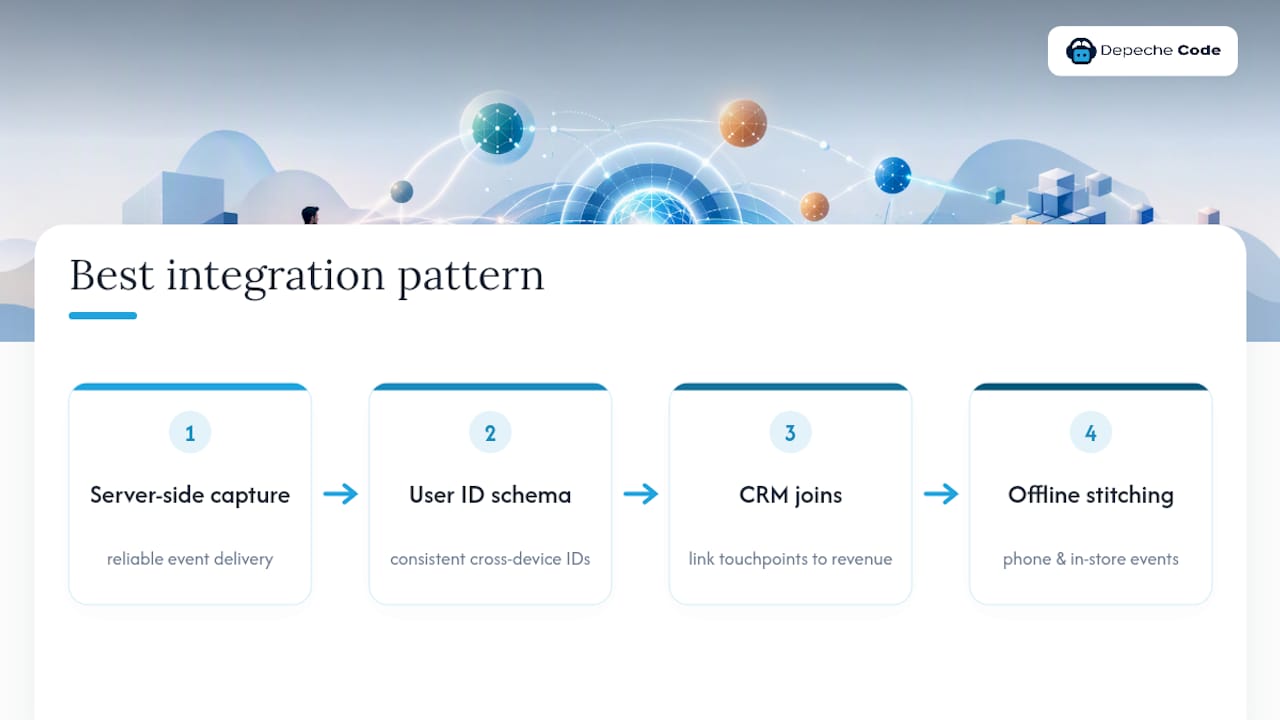
The integration pattern that works best combines server-side event capture with a consistent user ID schema, CRM joins that connect marketing touchpoints to closed revenue, and offline event stitching for phone or in-person conversions. Getting GA4 conversion tracking configured correctly is the foundation nearly every other integration depends on, since a broken conversion setup corrupts every model built on top of it.
When evaluating a vendor or platform, check three things before signing anything: which data sources it natively supports, how explainable its model outputs are (can you actually see why a touchpoint got the credit it did), and whether it can join offline events like phone calls or in-store visits to online journeys.
Pro Tip: Ask any attribution vendor to show you a real example of how they explain algorithmic credit assignment to a non-technical stakeholder. If they can’t produce one, that’s a preview of every internal budget conversation you’ll have to fight through later.
How Depechecode Approaches Attribution for Client Projects
Attribution only works if the underlying tracking is built correctly, and that’s where most projects actually fail. Depechecode’s website development work includes setting up clean UTM governance from day one, configuring GA4 conversion events that match real business goals rather than generic pageview counts, and building CRM joins that connect marketing touchpoints to actual closed revenue.
That foundation matters more than which model a client eventually chooses. A W-shaped model built on messy data produces worse decisions than a simple last-touch report built on clean data. Depechecode treats the tracking stack as the deliverable, not an afterthought bolted onto a new site launch, and works with clients directly on what conversion events and CRM connections their attribution reporting actually needs.
Get Your Attribution Foundation Built Right
Everything in this guide assumes your tracking data is clean, and for a lot of businesses, that assumption doesn’t hold. Broken UTM parameters, missing conversion events, and CRM systems that don’t talk to your analytics platform will undermine even the best-chosen attribution model. Depechecode builds websites with conversion tracking and data structure handled correctly from the first line of code, so the attribution model you eventually pick actually has reliable data to work with.

If your current site is generating attribution reports you don’t trust, that’s usually a foundation problem, not a model problem. Depechecode’s website design and development services include GA4 setup and CRM integration planning as part of the build, so your reporting is trustworthy from launch day rather than something you patch together later. Request a project consult to find out what your current tracking setup is missing.
Sources
- Marketing attribution — models and best practices — Adobe for Business
- What Is Attribution Modeling and Why It’s So Important — HubSpot
FAQ
What Are Attribution Models in Marketing?
An attribution model is the rule set a business uses to assign credit for a conversion across the marketing touchpoints a customer interacted with, ranging from single-touch models like last-click to multi-touch and algorithmic approaches.
Which Attribution Model Is Best?
There’s no universal best model. Data-driven attribution tends to be the most accurate when you have enough conversion volume to support it, but a position-based or W-shaped rule-based model is often the more practical, explainable starting point for most teams.
What Is the Last-Click Attribution Model?
Is First-Touch or Last-Touch Attribution Better?
Neither is universally better; first-touch shows which channels generate new demand, while last-touch shows which channels close deals, and comparing them directly reveals how much credit your middle-of-funnel channels are losing under a single-touch view.
How Often Should You Change Your Attribution Model?
Review your attribution model at least quarterly and immediately after any major campaign, platform migration, or tracking change, since platform defaults and available models can shift without notice.