

No, U.S. law generally does not require an EU-style prior opt-in cookie consent banner. Instead, state privacy laws and the FTC require notice, functioning opt-out mechanisms, and, in many states, automatic honoring of browser signals like Global Privacy Control. Sensitive data categories and information tied to minors are the exception, where several states now demand real opt-in consent.
TL;DR:
- Most US states require websites to provide an opt-out option for data sharing and ensure that trackers are suppressed if visitors choose to opt out, especially where Global Privacy Control signals are honored.
- Florida, Idaho, and Alaska, among others, do not have comprehensive laws requiring automatic GPC enforcement, but most states still demand a visible and functional Do Not Sell or Share link.
- Proper banner design must ensure symmetry, avoid pre-checked boxes, and clearly connect user choices to actual tracker suppression, with accessibility considerations for all users.
- Enforcement focuses on broken links, asymmetric opt-out friction, and mismatched privacy policies, with the FTC willing to penalize deceptive practices even absent specific cookie legislation.
- Ongoing compliance requires regular cookie audits, integrating GPC detection into tags, and assigning responsibility to a single owner to prevent workflow gaps.
Table of Contents
- Cookie Consent Requirements USA: The State Law Map You Need
- What US Cookie Laws Actually Require From Your Website
- Cookie Banner Design Rules That Keep You Out of Trouble
- Technical Checklist: Detecting GPC and Suppressing Trackers
- Where Enforcement Is Actually Heading
- Your Compliance Plan: This Week, This Quarter, Ongoing
- What Most Compliance Projects Get Wrong
- Get Your Cookie Compliance Built Right, Not Just Bolted On
- Sources
- FAQ
Cookie Consent Requirements USA: The State Law Map You Need
The regulatory picture in the U.S. is built state by state, not through one federal statute. As of 2026, 20 states have comprehensive consumer privacy laws in force, each with its own thresholds for which businesses must comply, but almost all share the same opt-out backbone rather than an opt-in one.
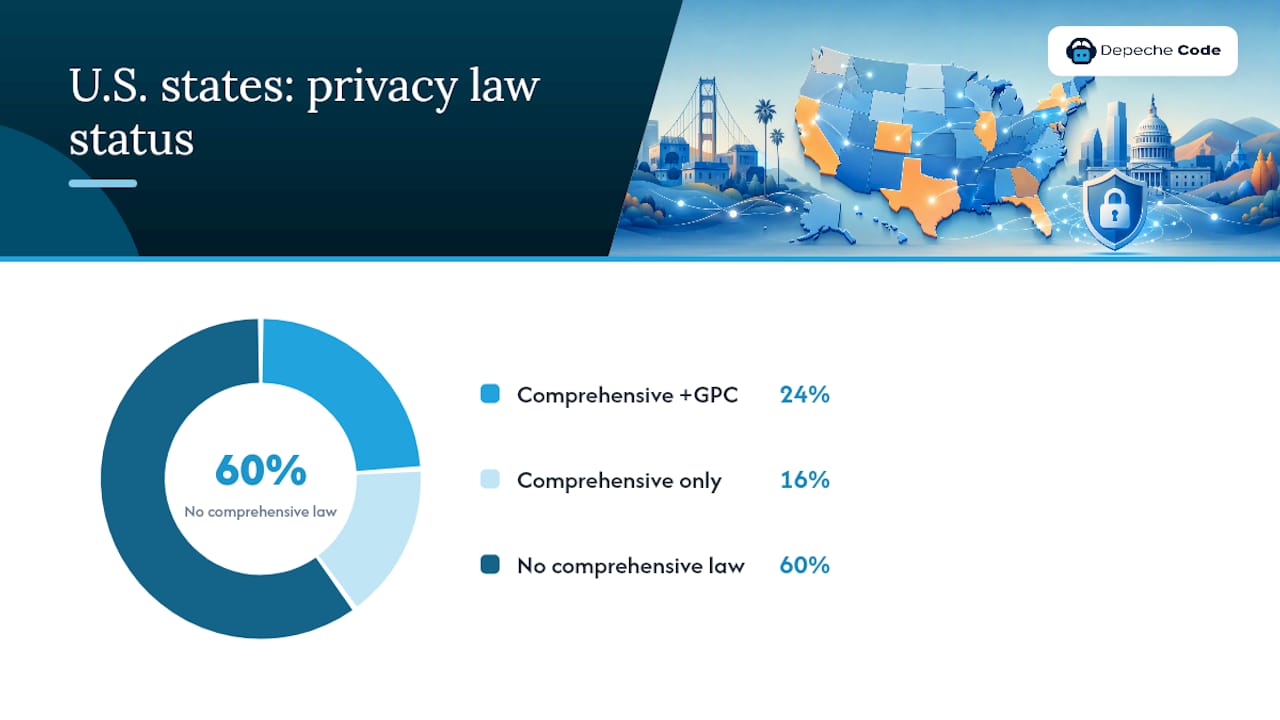
A site is typically “covered” once it crosses a state’s revenue or data-volume threshold, commonly triggered by processing personal data from tens of thousands of state residents annually, or by deriving a defined share of revenue from selling that data. Smaller local businesses often fall under these thresholds, but any site running third-party ad pixels, analytics, or retargeting scripts should assume coverage is possible and check the specific numbers for each state it markets to.
The bigger operational split isn’t which states have a law. It’s which states require you to automatically honor a universal opt-out signal versus which ones only expect you to post a working opt-out link. Twelve states currently require honoring Global Privacy Control or an equivalent universal signal:
- California
- Colorado
- Connecticut
- Texas
- Montana
- New Hampshire
- Nebraska
- New Jersey
- Minnesota
- Maryland
- Delaware
- Oregon
Outside that list, most other states with comprehensive laws still require a clear Do Not Sell or Share link, even without mandatory GPC detection. A handful of state statutes, including Colorado’s and Maryland’s, layer on opt-in requirements specifically for sensitive personal data categories, which is a meaningfully different bar than the general opt-out default.
What US Cookie Laws Actually Require From Your Website
Once you know which state laws apply, the actual obligations break down into three buckets: give people a way to opt out, tell them what you’re doing, and act on their choice fast enough that it means something.
The Do Not Sell or Share link is the most visible requirement. It needs to sit somewhere a reasonable visitor would find it, usually the footer, and it has to actually stop the sale or sharing of data once clicked, not just log a preference that marketing forgets to check. California’s regulations get specific here: the mechanism must be symmetrical in design, meaning opting out can’t require more steps or more friction than opting in did.
Your privacy policy needs to map to what your trackers actually do, not what a template says. That means:
- Categories of personal data collected through cookies and similar technologies
- Purposes for collection, including advertising, analytics, and personalization
- Third parties or categories of third parties data is shared or sold to
- How to exercise opt-out and, where applicable, deletion or correction rights
- Whether the site honors Global Privacy Control
Timelines matter operationally even where a specific statute doesn’t spell out a rigid clock for every state. Rights requests, including opt-outs, are commonly expected to be actioned within a reasonable window measured in business days, and dragging that out invites the same scrutiny as ignoring the request outright.
COPPA still governs sites directed at children under 13 with its own parental consent regime, and several state laws add extra protections for teens between 13 and 17, layering stricter defaults on top of the general opt-out framework.
Cookie Banner Design Rules That Keep You Out of Trouble
A compliant banner in the U.S. looks nothing like the heavy, opt-in-first walls you see on European sites. Most American businesses only need a persistent Do Not Sell or Share link plus a working preference center, not a blocking overlay that stops the page from loading until someone clicks “Accept.”
Where banners cause legal exposure is design, not existence. Regulators have specifically called out banners that make accepting tracking a single click while burying rejection behind multiple submenus. Here’s what keeps you on the right side of the line:
- Match the friction on both sides. If “Accept All” is one click, “Reject All” or “Opt Out” needs to be one click too, per California’s symmetry rule.
- Never pre-check boxes for optional tracking categories. Default states should reflect the visitor’s actual signal, not your revenue goals.
- Connect the visible toggle to the backend. A banner that says “opted out” while ad pixels keep firing is a deceptive practice risk, not just a bug.
- Show opt-in language only to visitors who need it. If you serve EU or UK traffic alongside U.S. traffic, geotarget a GDPR-style consent flow to those visitors specifically rather than applying it site-wide.
Accessibility isn’t optional garnish here either. A banner that a screen reader can’t parse, or that traps keyboard focus, creates a separate compliance problem on top of privacy risk. Reviewing your site’s accessibility alongside your consent flow catches both issues in one pass.
Pro Tip: Run your banner through a screen reader before launch. Regulators care about functional opt-outs, and “functional” includes whether a visually impaired user can actually find and use the reject button.
Technical Checklist: Detecting GPC and Suppressing Trackers
Legal language means nothing if your tag manager fires anyway. This is where most compliance projects actually fail, and it’s almost always an engineering gap rather than a legal one.
Detecting Global Privacy Control is straightforward on the surface: check for the Sec-GPC HTTP header server-side, or read navigator.globalPrivacyControl client-side, and treat a true value as an enforceable opt-out request identical to a manual click on your Do Not Sell link. The harder part is what happens next. Suppressing tags client-side after they’ve already loaded doesn’t count. If your analytics or ad pixel fires on page load and your consent script only “hides” the banner two seconds later, the data has already left your server.
The fix that actually holds up:
- Gate third-party scripts behind a server-side or tag-manager-level check that runs before render, not after
- Build a full cookie inventory mapping every script and pixel to a category in your privacy policy
- Route GPC signals and manual opt-outs into the same consent registry so there’s one source of truth
- Re-scan the site quarterly, since marketing teams add new pixels faster than legal teams find out about them
Treating GPC as your primary opt-out signal rather than a secondary nice-to-have simplifies this considerably, because it means you’re only building one enforcement path instead of a patchwork of state-specific triggers. Automated scanning tools can catch scripts that fire before consent is registered, but staging-environment tests, where you simulate a GPC signal and watch network traffic, remain the most reliable way to confirm suppression actually works before it ships to production. For businesses managing this without in-house engineering support, a secure development process built around testing before deployment catches these gaps before a regulator does.
Where Enforcement Is Actually Heading
Regulators are not waiting for complaints. State attorneys general have run structured sweeps specifically targeting cookie banners, and the pattern in what gets flagged is consistent.
Connecticut’s enforcement report and California’s parallel actions both point to the same failure modes:
- Banners with asymmetric friction between “accept” and “reject”
- Opt-out links that lead to broken or non-functional forms
- Privacy policies that describe data practices the site’s actual trackers don’t match
- GPC signals received but never actually connected to backend suppression
On the federal side, the FTC doesn’t need a cookie-specific statute to act. It brings cases under its general authority over unfair or deceptive practices, and FTC v. Kochava shows the agency is willing to pursue companies over how location and tracking data gets collected and sold, independent of any state law. Penalties in these cases range from consent decrees with ongoing audit requirements to direct financial settlements, and the reputational cost of a public enforcement action often outlasts the fine itself.
Your Compliance Plan: This Week, This Quarter, Ongoing
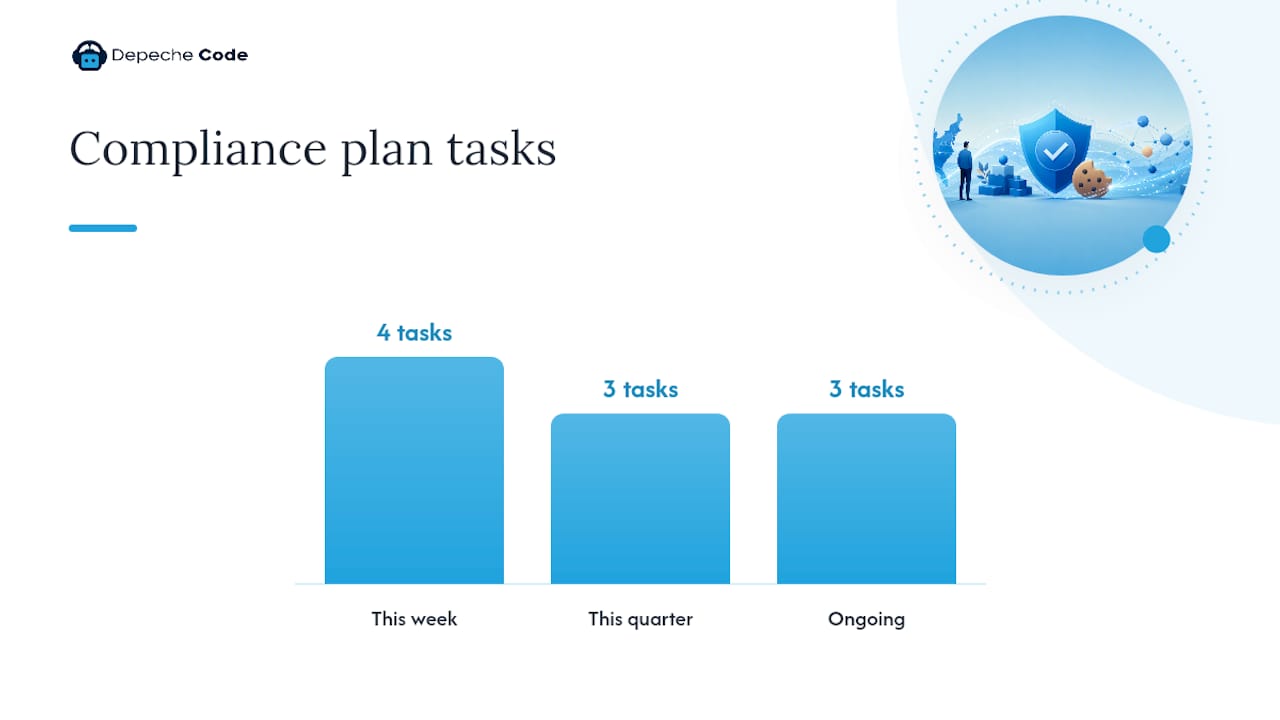
Turning all of this into action doesn’t require a total rebuild. It requires sequencing.
This week:
- Run a full cookie and tag inventory across every page template, not just the homepage
- Add or fix your Do Not Sell or Share link and confirm it’s one click, matching your accept flow
- Update your privacy policy so disclosed categories match what your inventory actually found
- Implement basic GPC detection, even if enforcement isn’t wired up yet
Within one to three months:
- Connect GPC and manual opt-outs to real tag suppression at the tag-manager or server level
- Fix any asymmetry in your banner design so opting out takes no more effort than opting in
- Map every third-party vendor and confirm their data-processing terms match your public disclosures
Ongoing:
- Re-audit your cookie inventory quarterly, since new marketing tools get added constantly
- Keep records of consent and opt-out actions in case a regulator or a rights request asks
- Train whoever manages your marketing tags on what “suppression” actually requires technically
Pro Tip: Assign one person, not a committee, as the owner of your consent stack. Compliance gaps almost always happen in the handoff between legal, marketing, and dev when nobody owns the whole pipeline.
A pre-launch checklist that treats consent as a launch requirement, not a post-launch patch, saves you from redoing this work every time you add a new tracking pixel.
What Most Compliance Projects Get Wrong
The failure pattern is almost always the same: a business buys a consent management tool, drops it on the site, and assumes the legal work is done. It isn’t, because the tool only manages the banner. Nobody checked whether the ad pixels loading in the header actually respect the toggle the visitor just clicked.
That gap between “banner says compliant” and “trackers actually stopped” is where the real risk sits, and it’s a workflow problem more than a legal one. An agency approach that pairs a privacy audit with actual engineering, someone who inventories every script, then rebuilds the tag-loading logic to respect GPC and manual opt-outs before anything fires, closes that gap in a way a plug-and-play banner script never will. The businesses that get burned aren’t the ones with bad intentions. They’re the ones who treated a compliance requirement as a one-time checkbox instead of an ongoing engineering process.
— Donovan
Get Your Cookie Compliance Built Right, Not Just Bolted On
Depechecode is the alternative to guessing your way through consent management. Instead of a generic plugin that hides a banner without actually stopping your trackers, you get a development team that audits your existing scripts, rebuilds the suppression logic at the tag level, and tests it before it ever reaches your visitors.

That means a real cookie inventory mapped to your privacy policy, Global Privacy Control wired into your actual ad and analytics stack, and a preference center that meets California’s symmetry standard instead of skirting it. Depechecode’s website design and development service handles the engineering side of this from audit through deployment, and ongoing SEO and site support plans keep your compliance posture current as vendors and state laws shift. If your current banner has never actually been tested against a live GPC signal, that’s the first thing worth fixing. Reach out to get a site audit scheduled and see exactly where your tracking stack stands today.
This article is general information, not a substitute for advice from a qualified lawyer. Consult a qualified legal professional about your own circumstances before acting on anything here.
Sources
- California Code of Regulations § 7004 (symmetry rules)
- Connecticut AG enforcement report (2025)
- PrivacyLawMap — Cookie consent requirements under US state privacy laws (2026)
FAQ
What Are the Regulations Regarding Cookie Consent in the US?
There’s no single federal cookie law. Instead, 20 states have comprehensive privacy statutes requiring notice, opt-out mechanisms, and, in 12 states, automatic honoring of Global Privacy Control signals.
Can I Refuse to Accept Cookies on a US Website?
Yes. US law entitles you to opt out of the sale or sharing of your data through a Do Not Sell or Share link, and in states that mandate Global Privacy Control, your browser signal must be honored automatically without you clicking anything.
Does CCPA Require Cookie Consent?
The CCPA and its update, the CPRA, don’t require opt-in consent for most cookies. They require an opt-out mechanism, a symmetrical choice interface under California’s regulations, and opt-in consent specifically for sensitive data categories.
Is GDPR Compliance Mandatory in the USA?
No. GDPR is European law and doesn’t apply to a US-only business with no EU or UK visitors. If your site draws traffic from those regions, you need a GDPR-compliant opt-in flow for those specific visitors, but your US traffic still runs on the opt-out model.
What Happens if My Site Doesn’t Honor Global Privacy Control?
In one of the 12 states that mandate GPC recognition, ignoring the signal is a direct statutory violation, and it has already drawn attention in state AG enforcement sweeps targeting banners that collect the signal but never act on it.