

Chatbots reliably increase qualified lead capture, but only when three things are in place: a clear qualification flow, a working CRM handoff, and a human ready to step in for hot prospects. Skip any one of those, and you get a chat widget that annoys visitors instead of converting them. Get all three right, and the bot becomes your best-performing rep for the first sixty seconds of every conversation.
TL;DR:
- A lead generation chatbot’s success depends on a clear qualification flow, effective CRM handoff, and a human ready for hot leads; missing any reduces conversion.
- Effective implementations use progressive profiling, scoring rules, and hot-lead triggers to rapidly identify and alert high-potential prospects.
- High-volume use cases like demo booking, B2B qualification, and lead magnet delivery see the fastest ROI, especially in sales-heavy and appointment-based services.
- Building a chatbot requires thorough planning, testing, and channel-specific scripts, with staged launches and mobile- optimized greetings to improve performance.
- Integration of chatbot data with CRM and automation platforms is essential to turn qualified leads into actual sales opportunities, avoiding duplication and loss of prospects.
Table of Contents
- What Is a Lead Generation Chatbot and How Does It Work?
- What Benefits and Use Cases Justify a Chatbot Investment?
- How Do You Build, Test, and Launch a Lead Chatbot?
- How Do You Connect a Chatbot to Your CRM and Marketing Stack?
- How Do You Measure and Optimize Chatbot Performance?
- What Mistakes Should You Avoid With Lead Chatbots?
- How Depechecode Approaches Chatbot Pilots and Rollouts
- Why Most Chatbot Advice Undersells the Human Part
- Get a Chatbot That Actually Routes to Sales, Not Just a Chat Widget
- Sources
- FAQ
What Is a Lead Generation Chatbot and How Does It Work?
A lead generation chatbot is software embedded on a website, in a Facebook Messenger thread, or inside an SMS flow that asks visitors questions, scores their answers, and passes qualified prospects to a sales team. Some run on fixed decision trees (rule-based bots that follow scripted branches). Others use natural language processing to interpret open-ended replies and adjust the conversation in real time. Most businesses now blend both: a scripted opening for speed, with NLP layered in to handle the messy, unpredictable parts of a real conversation.
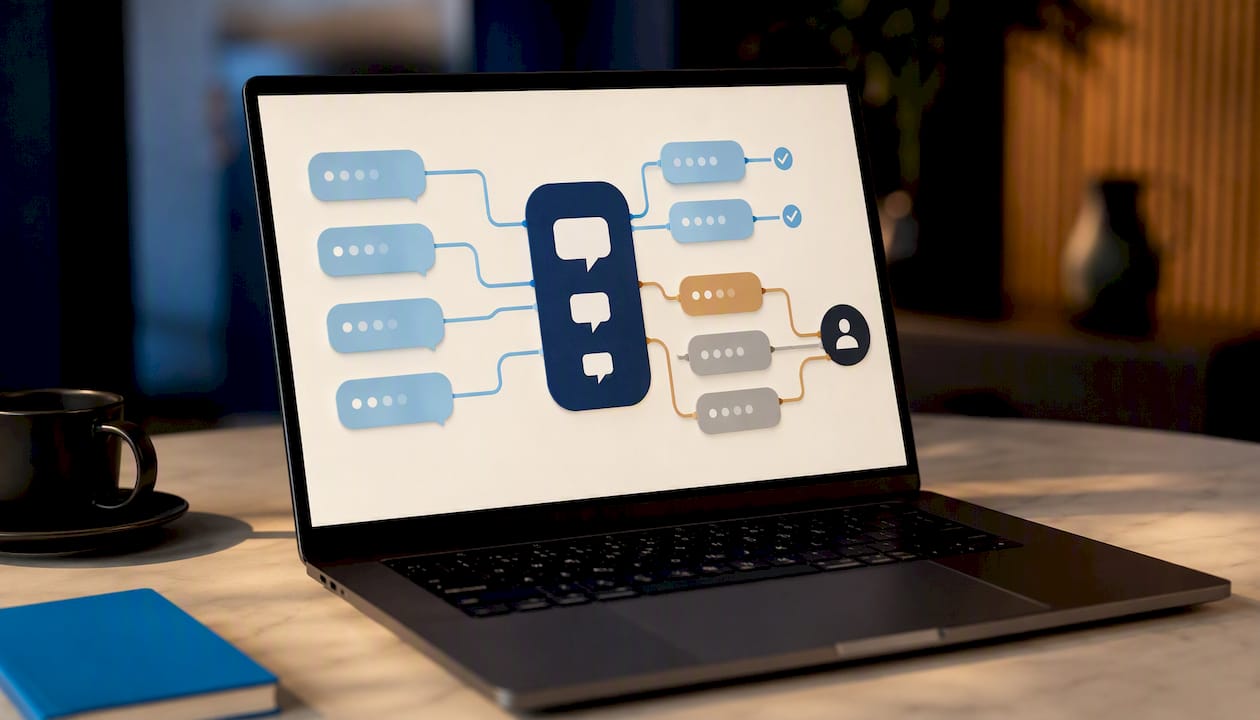
The architecture behind a working bot follows a predictable path. A visitor lands on a page and a widget opens, either automatically after a delay or when they click a prompt. Their first message gets parsed for intent, meaning the system tries to figure out whether they want pricing, support, or a demo. From there, conditional logic branches the conversation: pricing questions might trigger a budget-qualifying question, while support questions route toward a help article or a live agent. Once the bot has enough information, it pushes the data into a CRM or marketing automation platform, often with a calendar link attached so the lead can book a call without waiting for a human to respond. AI-powered chatbots automate this entire loop, capturing visitors, qualifying them against your criteria, and syncing the result for follow-up, which is exactly why they consistently outperform static contact forms.
The qualification layer is where most of the strategic value lives. Three patterns show up again and again in effective deployments:
- Progressive profiling. Instead of asking for name, email, phone, company size, and budget up front, the bot collects one or two data points per exchange, which keeps the conversation feeling like a chat rather than an interrogation.
- Scoring rules. Each answer adds or subtracts points. A visitor who says “just researching” scores low; one who says “ready to buy this quarter” scores high and gets flagged immediately.
- Hot-lead triggers. Specific phrases (budget confirmed, timeline under 30 days, decision-maker title) fire an instant alert to a sales rep instead of waiting for the conversation to end.
That last pattern matters more than most teams realize. A bot that qualifies a visitor and then makes them wait until “someone gets back to you” has thrown away the advantage of catching them while they’re actually paying attention.
What Benefits and Use Cases Justify a Chatbot Investment?
The case for chatbot lead generation comes down to three measurable levers: conversion rate, coverage hours, and cost per lead. A static form only works when a visitor is willing to fill out five fields and wait for a callback. A chatbot lowers that friction by asking one question at a time and responding instantly, which is why conversational capture consistently beats form-based capture on completion rate.
Statistic Callout: One AI-first response platform for local businesses reports higher conversion with 24/7 coverage and near-instant reply times compared to standard follow-up processes. Treat this as a vendor-reported illustration of what fast, always-on response can do, not a universal benchmark every deployment will hit.
Coverage is the part people underestimate. A visitor who lands on your site at 11:40 p.m. isn’t going to wait until 9 a.m. for a callback; they’ll check a competitor instead. A chatbot doesn’t need a shift schedule, which means the highest-intent hours (often evenings and weekends for B2C, and lunch breaks or after-hours research for B2B) stop being dead zones.
The use cases where this pays off fastest share a common trait: high visitor volume paired with a repeatable qualification question set.
- Demo booking for SaaS and B2B software, where the bot asks about team size and use case before offering a calendar slot.
- B2B qualification for service businesses, where budget and timeline questions filter out tire-kickers before a rep spends time on a call.
- Lead magnet delivery, where the bot trades a resource (a checklist, a template) for an email address and a follow-up opt-in.
- Re-engagement for abandoned sessions, where a bot messages a visitor who scrolled a pricing page but didn’t convert.
- Product recommendations for ecommerce, where a quiz-style flow narrows a catalog down to two or three suggested items.
Sales-heavy funnels and appointment-based service businesses (dental practices, law firms, home services) tend to see the fastest return, because every qualified conversation converts directly into a booked call or an estimate request, and pointing the bot at that one goal is straightforward. Companies with longer, more consultative sales cycles still benefit, but the payoff shows up in pipeline velocity rather than instant bookings.
How Do You Build, Test, and Launch a Lead Chatbot?
Building a chatbot that actually generates qualified leads is less about the software you pick and more about the sequence you follow before you ever write a line of conversation script. Skipping steps here is the single biggest reason bots underperform.
- Define goals and KPIs before writing anything. Decide whether success means demo bookings, email captures, or qualified-lead handoffs, and set a target number for each. A bot with no defined success metric will get judged on vibes, and vibes don’t survive a budget review.
- Map the ideal conversation and every handoff point. Sketch the happy path (a visitor who answers every question cleanly) and at least two branches for visitors who go off-script, get impatient, or ask something the bot can’t answer.
- Write the welcome message and qualifying questions. Keep the opening line short and specific to the page the visitor is on. Industry guidance consistently recommends short qualification flows with progressive profiling rather than a long intake form disguised as a chat.
- Implement conditional logic and progressive profiling. Build the branches so a “just browsing” answer leads to a lead magnet offer, while a “ready to buy” answer leads straight to a calendar link.
- Set routing rules, ownership, and escalation. Decide which rep or team owns which lead type, and make sure hot-lead alerts have a named owner, not a shared inbox that three people assume someone else is checking.
- QA every branch with real test scenarios. Run through the flow as an impatient visitor, a confused visitor, and a visitor who tries to break it with a nonsense answer. Fix what breaks before launch, not after.
- Choose your channels and run a launch checklist. Website widget, Facebook Messenger, and SMS all behave differently; confirm the bot reads naturally on each one before turning it on everywhere at once.
Pro Tip: Test your bot’s welcome message on mobile first. A three-line greeting that looks clean on a desktop monitor often gets truncated or forces extra scrolling on a phone screen, and most of your chat traffic will come from mobile visitors.
The QA phase deserves more attention than most teams give it. A bot that works perfectly when you type clean, expected answers will still get broken by real visitors who paste in a phone number with dashes, misspell their company name, or answer a yes/no question with “maybe, depends.” Build a short list of ten to fifteen “weird input” test cases before launch, covering typos, off-topic questions, and abrupt topic changes. If the bot has no graceful fallback (something as simple as “I didn’t quite catch that, want to talk to a person instead?”), visitors will abandon the conversation rather than fight with it.
Channel choice also shapes the entire script. A website widget can afford a slightly longer qualification sequence because the visitor is already reading; SMS needs to get to the point in one or two exchanges because texting feels more personal and less tolerant of a scripted interrogation. If you’re deploying across multiple channels, write separate opening messages for each rather than copying one script everywhere. For a deeper walkthrough of design choices that affect completion rate, Depechecode’s guide to designing an effective chatbot covers the specifics of tone, question length, and fallback design.
Launch in stages if you can. Turn the bot on for a single page or a single traffic source first, watch completion and handoff rates for a week, then expand.
How Do You Connect a Chatbot to Your CRM and Marketing Stack?
The value of a lead-gen chatbot collapses the moment its data sits in a chat log nobody checks instead of flowing into the systems your sales team actually uses. Integration isn’t an optional add-on; it’s the difference between a bot that generates leads and one that generates a transcript.
Start with what actually needs to sync. Name, email, and company are the obvious fields, but the ones teams forget are usually the ones that matter most for follow-up quality:
- Lead score, so reps know instantly whether they’re calling a warm prospect or a cold one.
- Intent signals, meaning the specific phrases or answers that triggered qualification, so the rep’s first call doesn’t start from zero.
- Lead source and session page path, so marketing can see which page or campaign actually drove the conversation.
- Bot conversation ID, so the full chat transcript can be pulled up if a rep needs context.
A practical mapping approach is to sync lead source, session page path, and conversation ID into the CRM at the moment of capture, then run a lead-enrichment job afterward rather than asking the visitor for every detail in-chat. That keeps the conversation short while still giving sales a complete profile by the time they follow up.
Once data lands in the CRM, automation takes over. Lead scoring rules can auto-assign a rep the moment a score crosses a threshold. Calendar integrations let qualified leads book a slot without waiting on a human to send a link. Follow-up sequences in your marketing automation platform can nurture leads who weren’t ready to buy yet, so they don’t just disappear into a spreadsheet. Agentic engagement platforms take this further, using named AI agents to handle channel decisioning and personalization automatically, deciding whether a follow-up should be an email, a text, or another chat prompt based on what worked for similar leads before.
The most common integration failure is duplicate or lost leads, usually caused by a missing unique identifier. If a returning visitor starts a new chat session, the system needs to recognize them by email or a persistent cookie ID, or you’ll end up with three CRM records for one person and a sales team confused about who already made contact. Test this scenario specifically before launch: chat once, leave, come back, and chat again. If that creates a duplicate, fix the identity matching before you scale traffic.
How Do You Measure and Optimize Chatbot Performance?
Five metrics tell you whether a lead-gen chatbot is actually working: capture rate (visitors who start a conversation), qualified-lead rate (conversations that meet your scoring threshold), lead-to-opportunity rate (qualified leads that become real sales conversations), average response time, and ROI attribution back to the bot as a channel.
Statistic Callout: A human-in-the-loop strategy that automates qualification but routes high-intent signals for immediate follow-up consistently increases both trust and conversion compared to a fully automated flow with no escalation path. The lesson isn’t “add more automation,” it’s “automate the filtering, not the closing.”
Optimization works best in short, focused sprints rather than one big redesign every quarter. Running one to two week experiments on a single variable, such as the welcome message, the order of qualifying questions, or the CTA phrasing, gives you a clean read on what actually moved the needle. Testing five things at once tells you nothing, because you won’t know which change caused the shift.
Good candidates for A/B testing:
- Welcome message tone, formal versus conversational, to see which gets more replies.
- Question order, asking budget early versus asking it last, to see which produces higher completion rates.
- CTA phrasing, “Book a demo” versus “See it in action,” to see which drives more calendar clicks.
For nurturing the leads that don’t convert immediately, structured lead nurturing strategies fill the gap between a qualified chat and a closed deal, keeping warm-but-not-ready prospects engaged instead of letting them go cold. A simple dashboard tracking the five core metrics weekly, with a monthly review of one A/B test result, is enough to catch a declining capture rate before it becomes a quarter-long mystery.
What Mistakes Should You Avoid With Lead Chatbots?
The most common failure mode is over-automation: a bot that asks for a phone number, budget, and company size before the visitor has even said what they’re looking for. Visitors abandon these flows fast, because it feels like a form wearing a chat interface as a disguise. Ask one question, get one answer, then decide what to ask next based on that answer.
Human handoff is the second-biggest gap. A bot that qualifies a hot lead and then sits on that information until a rep happens to check a dashboard has wasted the entire advantage of real-time engagement. Set a service-level target, such as a five-minute response window for hot-lead alerts during business hours, and make sure someone actually owns that alert.
- Never ask for sensitive personal information the bot doesn’t need to qualify a lead.
- Always include a clear opt-in for follow-up communication, not a buried assumption of consent.
- Keep the bot’s tone conversational, not corporate; visitors respond better to “What’s your budget range?” than “Please specify your allocated budget parameters.”
- Give every conversation a visible, easy escalation option to reach a human.
Pro Tip: If your bot’s qualification flow takes longer to complete than a phone call would, it’s too long. Time yourself answering your own questions and cut anything that doesn’t directly affect routing.
Privacy matters more than most scripts account for. Collect the minimum personal information needed to qualify and route the lead, state clearly what you’ll use it for, and give visitors an explicit opt-in rather than assuming silence means consent. This isn’t just good practice; it’s what keeps you compliant as data privacy expectations tighten across states and industries. For more on where bots tend to go wrong in practice, Depechecode’s breakdown of chatbot failure modes walks through specific design mistakes that quietly tank conversion.
How Depechecode Approaches Chatbot Pilots and Rollouts
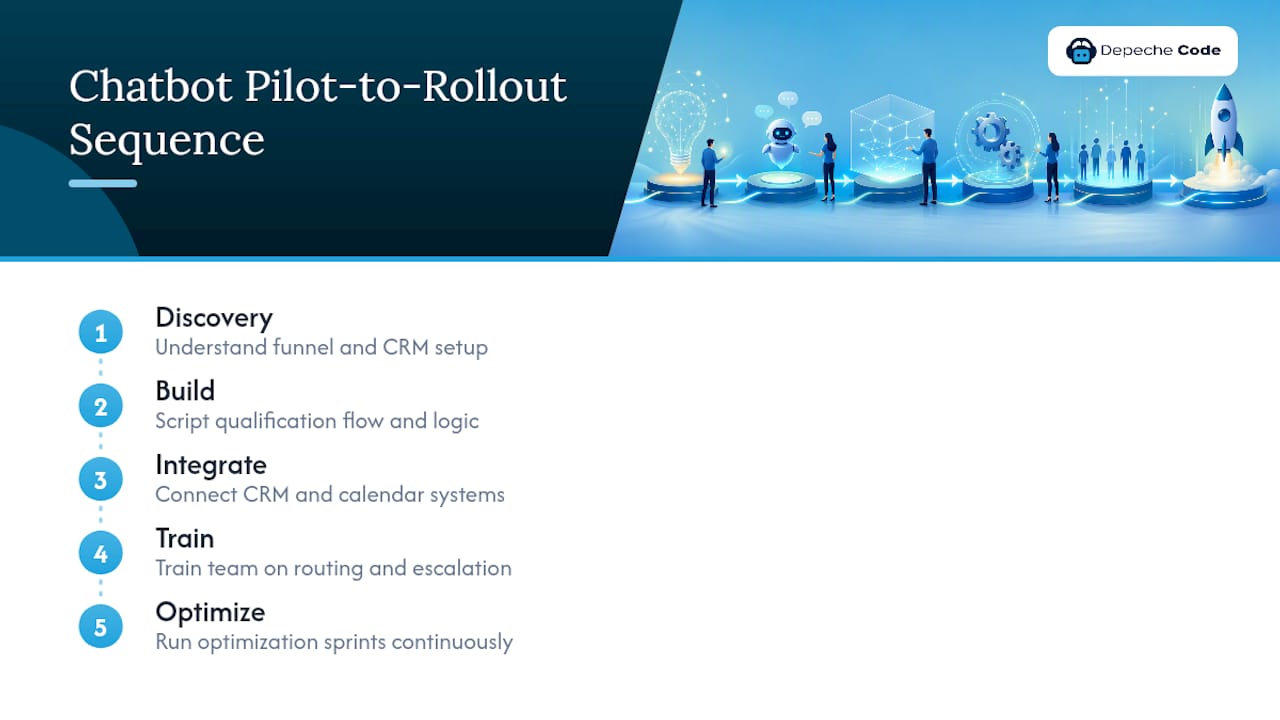
Depechecode runs every chatbot engagement through the same sequence: discovery to understand the client’s funnel and CRM setup, build to script the qualification flow and conditional logic, integrate to connect the CRM and calendar systems, train the team on routing and escalation, and optimize through the sprint cycle described above. That order matters because skipping discovery is exactly how businesses end up with a generic bot that doesn’t match their actual sales process.
The AI Chat Bot Starter and Growth plans reflect two common starting points. Starter fits a business that wants a tested, working chatbot without building qualification logic in-house from scratch. Growth adds deeper integrations, ongoing optimization sprints, and reporting for teams that want the measurement framework above running continuously rather than checked quarterly.
Author note:, and.
Why Most Chatbot Advice Undersells the Human Part
The conventional pitch for chatbots is speed and automation, full stop. That framing undersells the actual lever that determines whether a bot pays for itself: what happens in the thirty seconds after it identifies a hot lead. Most of the advice out there treats human handoff as a footnote, a “you can also route to a rep if you want” afterthought. The research points the other way. Automation without a fast, accountable human handoff doesn’t lose you the automation benefit; it loses you the lead entirely, because a qualified prospect who gets silence after a promising chat assumes nobody’s paying attention.
If you’re prioritizing one thing before you build anything else, prioritize the escalation rule, not the script. A mediocre welcome message with a five-minute hot-lead response time will outperform a brilliant welcome message that dumps leads into an unmonitored inbox. Marketing teams love polishing the conversation; sales teams live or die by what happens after it ends. Build the handoff first, then make the conversation good.
— Donovan
Get a Chatbot That Actually Routes to Sales, Not Just a Chat Widget
Depechecode builds the qualification flow, the CRM handoff, and the escalation rules together, so the bot you launch does more than greet visitors. That’s the gap between a chat widget and an actual chatbot lead generation system: most agencies hand you a script; Depechecode connects it to routing, scoring, and your sales team’s calendar from day one.
The AI Chat Bot Starter plan fits a business launching its first qualification flow without an in-house team to build conditional logic. The AI Chat Bot Growth plan suits teams ready for ongoing optimization sprints, deeper CRM integration, and monthly reporting against the metrics covered above. A kickoff typically starts with a short audit of your current funnel and CRM setup, followed by a mapped conversation flow before any code gets written.
If your website needs more than a chatbot bolted on, a rebuilt website design and development project can give the bot a stronger foundation to convert from. Ready to see what a pilot looks like for your funnel? Reach out to Depechecode to scope a build.
Sources
FAQ
Can ChatGPT Generate Leads?
ChatGPT and similar general-purpose AI models can hold conversations, but they aren’t built for lead capture on their own. They lack CRM integration, scoring logic, and routing rules, so generating leads requires wrapping that AI in a purpose-built chatbot platform connected to your sales stack.
What Are the Best AI Chatbots for Lead Generation?
The strongest options combine natural language understanding with CRM integration, conditional qualification logic, and human handoff rules, rather than a standalone script. Depechecode’s AI Chat Bot Starter and Growth plans build this combination in from the start instead of leaving integration to the client.
What Are the Four Types of Chatbots?
Chatbots generally fall into four categories: rule-based bots that follow fixed decision trees, AI-driven bots using natural language processing, hybrid bots that blend both approaches, and voice-based assistants. Most modern lead-gen deployments use hybrid bots because they combine the flexibility of NLP with the predictability of scripted branches.
Can I Make Money With a Chatbot?
Yes, indirectly: a well-built lead-gen chatbot increases qualified-lead volume and shortens response time, which drives more booked calls and closed deals for the business deploying it. The bot itself doesn’t generate revenue directly; it improves the conversion rate of traffic you’re already paying to attract.
How Long Does It Take to Launch a Lead-Gen Chatbot?
A basic qualification flow with CRM integration typically takes a few weeks from discovery to launch, while a more complex multi-channel deployment with advanced scoring and automation can take longer. Staged rollouts, testing on one page before expanding site-wide, tend to catch problems earlier than a full launch all at once.