

Expect early signals in 3 to 6 months, meaningful traffic and conversions in 6 to 12 months, and durable authority on competitive terms in 12 months or more. Brand-new domains and highly contested head terms usually run longer than that. The rest of this guide breaks down the leading indicators that prove your SEO is working long before revenue shows up.
TL;DR:
- Most sites see early SEO signals like increased impressions and indexed pages within 3 to 6 months, but meaningful traffic and revenue typically take 6 to 12 months.
- New domains and highly competitive keywords can extend the timeline beyond a year, especially if technical issues or limited content depth are present.
- Consistent backlink growth and technical health improvements accelerate progress, while strategy pivoting or inconsistent effort delay results.
- Local businesses can achieve map pack visibility in 2 to 4 months, while larger or more complex sites may need 9 to 14 months for significant results.
- Regular monthly reporting after six months is essential to accurately assess progress and decide whether to continue, adjust, or end the SEO campaign.
Table of Contents
- How Long Does SEO Take To Show Real Results?
- Realistic SEO Timelines By Business Type
- What To Expect Month By Month
- Leading Indicators That Prove Progress Before Revenue Does
- How To Speed Up Results (And Mistakes That Slow Them Down)
- What A Real SEO Case Study Shows About Timing
- An Honest Take On Reporting And Commitments
- Which SEO Path Fits Your Business Right Now
- Sources
- FAQ
How Long Does SEO Take To Show Real Results?
The honest answer depends on where your site starts, not just how much effort you put in. Search Engine Land’s timeline guidance puts early measurable signals at 3 to 6 months, with meaningful organic traffic and revenue growth generally showing up between 6 and 12 months. That range holds up across most industries, but six factors push individual sites toward the faster or slower end.
Domain authority and site history. A domain that’s been live for five years with a clean backlink profile starts with trust Google already recognizes. A brand-new domain has to earn that trust from zero, which is why new sites almost always land on the slower end of every range in this article.
Competition and keyword difficulty. Ranking for “plumber near me” in a mid-sized city is a different job than ranking for “insurance.” Head terms in crowded industries can take a year or more of sustained work, while long-tail and local queries often move in weeks.
Technical health. Crawl errors, slow page speed, and JavaScript rendering issues can quietly cap your results no matter how good your content is. Technical SEO debt often takes weeks or months to repair, and that repair usually has to happen before new content gets any real traction.
Content volume and topical depth. A handful of thin pages rarely rank for anything competitive. Sites that publish a genuine cluster of high-quality, topically connected pages tend to rank faster for the whole category, not just one page.
Backlink capacity. Links compound. A site earning a steady trickle of relevant backlinks over 6 months builds authority in a way that a single link burst never does.
Execution resources. Hours per month and developer availability set your real-world speed limit. More execution hours compress how fast work gets done, though they don’t speed up how fast Google decides to trust you.
Score your own site quickly:
- Is your domain older than 2 years with no penalty history?
- Are your core pages loading in under 3 seconds with no major crawl errors?
- Do you have at least 15 to 20 topically related pages covering your main service or product categories?
- Are you earning new backlinks at least monthly?
- Can your team or vendor commit 10+ hours a month to consistent execution?
More “yes” answers put you toward the front of every timeline below.
Realistic SEO Timelines By Business Type
Not every business is chasing the same kind of win, so “results” means something different depending on your model. Here’s how the ranges typically break down.
- Local, single-location businesses. Map pack visibility and local long-tail terms (“emergency plumber in [neighborhood]”) often move within 2 to 4 months because competition is narrower and Google weighs proximity heavily. Full local dominance across your service area usually takes 6 to 9 months.
- Service and small businesses. Lead-generation metrics like form submissions and calls typically follow the standard 6 to 12 month horizon, since you’re competing on both content depth and trust signals across a broader keyword set.
- B2B companies with complex funnels. Conversions lag because buying cycles are long and decision-makers research before ever filling out a form. Track proxy metrics like demo requests, whitepaper downloads, and returning visitors starting around month 4, since actual closed deals may not show clear SEO attribution until month 9 or later.
- Ecommerce and multi-category retailers. Template issues, duplicate content across product variants, and sheer catalog size push timelines toward the longer end, often 9 to 14 months for meaningful category-wide traffic gains.
- Brand-new domains (any business type). Add 2 to 4 months to whatever range applies to your business type. A new domain has no history for Google to trust yet, and that trust builds gradually regardless of how good the work is.
Google’s own guidance, attributed to former Google Search Quality lead Maile Ohye, frames this as roughly 4 months to a year for implemented improvements to show real business benefit. That’s a useful conservative anchor if a vendor promises faster.
What To Expect Month By Month
A realistic SEO program follows a predictable rhythm, even though the exact pace varies by site.
- Month 0 to 1: Audit and setup. Technical audit, analytics and Search Console configuration, keyword research, and a prioritized backlog of fixes and content topics.
- Months 1 to 3: Fix and publish. Technical issues get resolved first (crawl errors, redirects, speed), and the first wave of prioritized content goes live. Watch for new pages getting indexed in Search Console.
- Months 3 to 6: Scale and connect. Content production accelerates, internal linking ties new pages together, and outreach for backlinks begins. Shopify’s timeline data shows this window is when most sites see their first genuinely measurable results. Expect rising impressions and long-tail rankings, not yet a revenue spike.
- Months 6 to 9: Outreach and optimization. Link building scales up, conversion rate optimization starts on pages already getting traffic, and lead or sales numbers should begin trending upward.
- Months 9 to 12: Compounding returns. Authority built over the prior months starts showing up on harder, higher-value terms. This is typically when the program starts paying for itself.
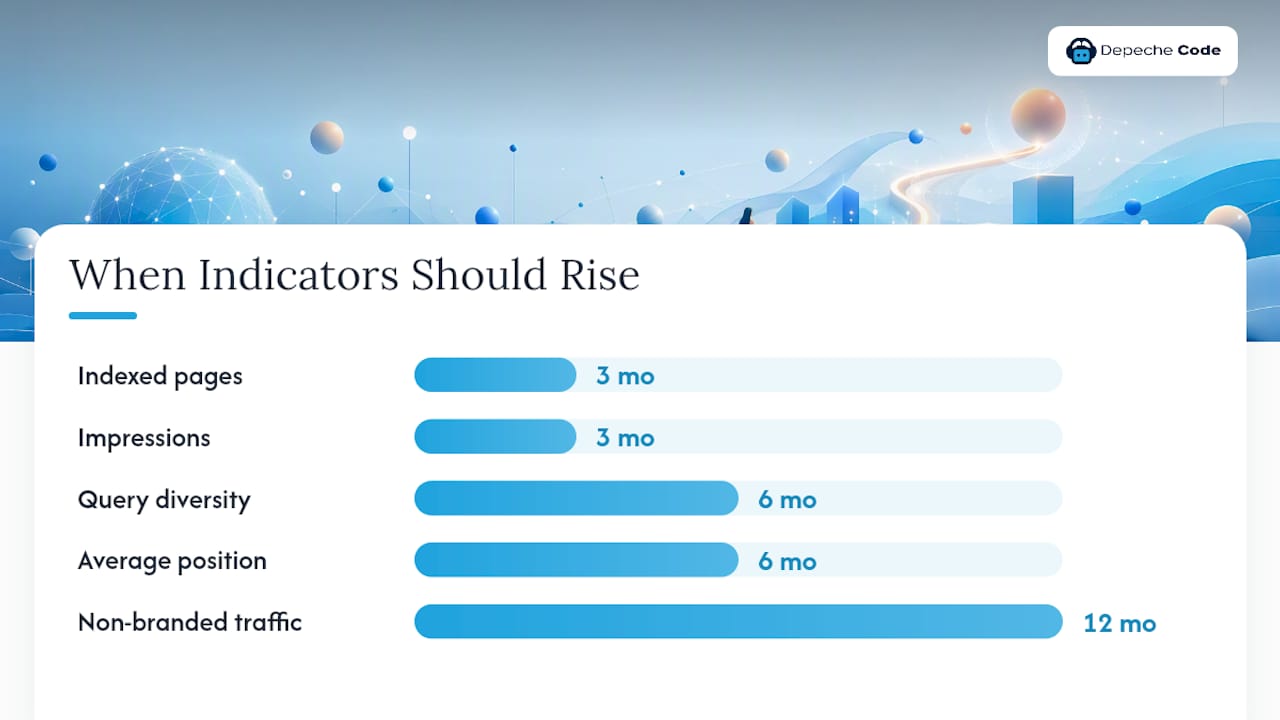
Two checkpoints are worth building into any contract. At month 4, ask your provider to show indexed page growth and impression trends in Search Console, not rankings alone. At month 6, ask for a clear breakdown of non-branded organic traffic and any early conversion movement. If both are flat with no explanation, something in the strategy needs to change.
Leading Indicators That Prove Progress Before Revenue Does
Traffic and revenue lag. The metrics below move first, and they’re the difference between “trust the process” and actually knowing something is working.
- Search Console impressions. Rising impressions with flat clicks means Google is starting to show your pages. That’s a genuinely good early sign, not a disappointment.
- Indexed pages. If new content isn’t showing up in Google’s index within days to a couple of weeks, something technical is blocking it.
- Crawl health. Consistent crawl errors in Search Console signal the kind of technical debt that delays everything else.
- Query diversity. More unique search queries triggering your pages over time shows Google is understanding your site’s topical range.
- Average position. Watch this trend over months, not days. A term moving from position 34 to position 18 is real progress even if it never touches page one.
- Non-branded organic sessions. Traffic from people who didn’t already know your business name is the clearest commercial proxy before conversions catch up.
If indexed pages, impressions, and crawl health are all still flat after 6 months of consistent work, the strategy itself needs a serious second look, not just more patience.
Set rough KPI checkpoints: growing indexed pages and impressions by month 3, rising query diversity and improving average position by month 6, and measurable non-branded traffic gains with early conversion lift by month 12.
How To Speed Up Results (And Mistakes That Slow Them Down)
You can’t rush trust, but you can absolutely rush execution. A few levers actually move the timeline:
- Fix indexing blockers first. Broken sitemaps, misconfigured robots.txt files, and JavaScript rendering issues can keep otherwise great content invisible. Fix these before anything else.
- Target low-competition and local long-tail terms early. Community reporting on SEO forums consistently shows these move in weeks, giving you early wins while bigger terms build.
- Batch your work. Long delays between developer handoffs, one fix here, another there weeks later, quietly stretch a 6 month project into a 10 month one.
- Publish before you promote. Outreach for a page that doesn’t exist yet wastes the relationship. Get content live first, then reach out.
Pro Tip: Execution hours are the dial you control. Google’s trust in your domain is not. Adding more hours per month speeds up how fast work gets done, but it won’t shortcut how long the site takes to earn authority.
Common pitfalls that quietly extend timelines: fragmented reporting that hides whether real progress is happening, ignoring crawl errors because “the content is more important,” pivoting strategy every couple of months before anything has time to work, and committing too few monthly hours to keep momentum going.
What A Real SEO Case Study Shows About Timing
Depeche Code’s own client work offers a documented example instead of a hypothetical. The 748% ROI SEO case study shows a client program where technical fixes and consistent content scale in the early months laid the groundwork for outreach and authority gains that compounded well past the 6 month mark.
The bulk of the return didn’t show up in month one or two. It built steadily as technical fixes, expanded content coverage, and sustained outreach worked together, with the largest gains compounding in the second half of the program.
The pattern lines up with the general timeline: early technical cleanup, content scale through the middle months, and outreach-driven authority gains that paid off well into the second half of the year and beyond. Where this case ran faster than average was execution consistency. Nothing about it skipped the trust-building clock.
An Honest Take On Reporting And Commitments
Month six is the first point where an SEO program’s numbers actually mean something. Anything before that is process, not proof.
— Donovan Wells – Founder and CEO
If you’re evaluating a vendor or your own internal team, insist on monthly reporting that shows indexed pages, impressions, and query diversity, not just rankings for three vanity keywords. Ask for the Search Console data directly, not a summarized screenshot. And when you negotiate a retainer, build in a real checkpoint at month six where either side can honestly assess whether the trajectory justifies continuing, adjusting, or walking away.
Which SEO Path Fits Your Business Right Now
If you’ve read this far, you already know SEO isn’t a switch you flip. It’s a build, and the fastest way through the early months is starting with the right foundation instead of guessing your way there. Depechecode’s SEO Options & Plans lays out tiered engagements built around exactly the milestones covered above: technical fixes first, content scale next, outreach and authority building after that.
For single-location businesses chasing map pack visibility and local long-tail wins, the Local SEO Growth service is built for that faster 2 to 4 month local timeline specifically. An initial consultation typically covers a technical audit, a review of your current indexed pages and Search Console history, and a proposed month-by-month plan matched to your industry’s competition level. If you want a clear-eyed read on where your site actually stands before committing to a timeline, review the SEO services overview and request a proposal built around your specific starting point.
Sources
- How long does SEO take to work? SEO timeline & results explained
- How Long Does SEO Take? Month-by-month results timeline (Shopify)
FAQ
How Long Does SEO Take To Start Working?
Early measurable signals, like rising Search Console impressions and new pages getting indexed, typically appear within 3 to 6 months for most sites.
When Should I Expect SEO To Show Positive ROI?
Many businesses see positive ROI between 12 and 15 months, once compounding authority and conversion gains outweigh the ongoing investment.
Why Do Some SEO Campaigns Take Longer Than 12 Months?
Highly competitive head terms, brand-new domains, and unresolved technical debt all extend the timeline beyond typical ranges in many cases.
What Are The First Signs SEO Is Working?
Growing impressions in Search Console, more indexed pages, and rising query diversity usually appear months before traffic or revenue noticeably increases.
Can I Speed Up How Fast SEO Works?
You can speed up execution, fixing indexing issues quickly and publishing consistently, but you can’t fast-track the trust Google builds in a domain over time.
Does Depechecode Offer Managed SEO With Clear Timelines?
Yes. Depechecode’s SEO Options & Plans outline tiered engagements with month-by-month milestones matched to a business’s competition level and starting point.