

A website maintenance contract is a short, executable service agreement that spells out exactly what upkeep your provider delivers, what you pay, and how emergencies get handled. The fastest path to a solid one is an annotated template covering scope, service-level targets, fees, and termination terms. Depechecode works with clients on exactly this setup, but the framework below applies no matter who signs it.
TL;DR:
- Effective contracts specify exact tasks, response times, and backup testing routines, with clear definitions and measurable SLAs to prevent disputes.
- Most sites experience silent failures due to untested backups or unnoticed background script issues, highlighting the need for active monitoring within scope.
- Fee structures should include rollover caps for monthly retainers, explicit emergency rates, and itemized invoices, with fixed response hours prioritized for mission-critical sites.
- Neglecting client obligations like providing access credentials or timely approvals can cause delays and liability issues, so these responsibilities must be clearly outlined.
- Negotiating a 90-day file handover clause and detailed backup test schedules provides extra security, especially for e-commerce or revenue-dependent websites.
Table of Contents
- What to Include in a Website Maintenance Contract
- Annotated Website Maintenance Contract Template
- Pricing and Billing Models: What to Expect
- How to Negotiate a Website Maintenance Contract
- Field Notes on Website Upkeep Agreements
- Why Most Website Maintenance Contracts Undersell Themselves
- Get Your Contract in Place With Depechecode
- Sources
- FAQ
What to Include in a Website Maintenance Contract
Every credible site support agreement rests on the same five pillars: scope, term, fees, service levels, and liability. Skip any one of them and you’ve written a handshake deal with a letterhead, not a real digital service contract.
Scope of work should read like a job description, not a mission statement. Typical covered tasks include:
- CMS and plugin/theme updates
- Automated and manual security monitoring
- Scheduled backups with retention windows
- Minor content edits (text swaps, image replacements, small layout fixes)
- Uptime monitoring and basic performance checks
Vague scope language is the single most common source of billing disputes. If the contract says “general upkeep” instead of naming tasks, you’ll be arguing about what counts within the first ninety days.
Term and termination clauses follow a fairly standard pattern across the industry. Most agreements run month-to-month or annually with auto-renewal, and either party can exit with written notice, typically about a month. Providers typically reserve the right to terminate immediately for non-payment, lack of cooperation, or revoked access rather than waiting out the notice period.
Fees and billing run through three common models:
- Monthly retainer — a fixed number of hours included per month, with defined rollover rules
- Hourly billing — pay only for work performed, billed in set increments (often 15 or 30 minutes)
- Bank of hours — prepaid hours drawn down over a longer period, sometimes with an expiration date
Service levels (SLA) need actual numbers, not adjectives like “prompt.” A workable severity matrix often includes prompt acknowledgment and remediation targets for issues of varying severity, such as critical outages, partial outages, and minor bugs, with specific time frames negotiated in the contract.
Client obligations matter more than most owners realize. You’re contractually responsible for providing hosting credentials, timely content approvals, and access to third-party accounts (domain registrar, payment gateway, email marketing platform). A contract that never mentions your side of the bargain is a contract that lets the provider blame you for delays they caused.
Backups deserve their own line item: frequency, retention length, and confirmed test restores. Webflow’s maintenance guide notes that security hardening, backups, and performance checks get scheduled at different cadences, weekly for some tasks, quarterly for others, and a contract that treats “backups” as a single undefined bullet point is missing that nuance entirely.
Pro Tip: Ask for a sample maintenance report before you sign. If the provider can’t show you what a monthly or quarterly report looks like, they probably aren’t generating one.
Out-of-scope items need explicit callouts too: full redesigns, new feature builds, and outages caused by your host or a third-party API are standard exclusions. And every agreement should close with liability limits, indemnification, confidentiality obligations, and a named governing law and dispute-resolution process. Skipping that last part is how a $200 billing disagreement turns into a legal headache.
One data point worth building your checklist around: a study of 158 live websites found that 89% had at least one silent failure, a background script or scheduled job breaking while the site looked fully operational. That’s the strongest argument for writing active monitoring into scope rather than assuming “the site is up” equals “the site is working.”

Annotated Website Maintenance Contract Template
Here’s a skeleton you can adapt in an hour, with plain-English notes on the clauses that actually get negotiated.
1. Preamble and parties — Names, addresses, and effective date. Nothing tricky here, but confirm the legal entity name matches your registration paperwork.
2. Definitions — Define “Business Hours,” “Emergency,” “Content Edit,” and “Severity Level” up front. Undefined terms are where disputes hide.
3. Scope of services — List every covered task by name. Sample clause: “Provider shall perform CMS core and plugin updates monthly, conduct weekly automated backups with 90-day retention, and apply minor content edits (defined as changes requiring under 30 minutes of labor) within 2 business days of request.”
4. Fees and payment — Sample retainer wording: “Client shall pay $[amount] monthly for [X] included hours. Unused hours roll over for one billing cycle and expire thereafter. Hours exceeding the monthly allotment bill at $[rate]/hour in 15-minute increments.” Annotation: rollover caps protect the provider from unlimited hour-banking; ask for at least one cycle of rollover before signing.
5. Service levels — Insert the severity matrix from the checklist section above, with exact hour figures. Templates that leave this blank, or say “reasonable effort,” are the ones that generate complaints later.
6. Term and termination — Sample clause: “Either party may terminate with 30 days’ written notice. Provider may terminate immediately upon non-payment exceeding 15 days or revocation of necessary access.” This mirrors what appears in most standard maintenance agreements.
7. Emergency support — Define what qualifies as an emergency and the premium rate that applies. Clear emergency definitions and pricing reduce disputes far more than a general “24/7 support” promise ever does.
8. Backups and disaster recovery — Include an explicit test-restore obligation, not just a backup schedule. A contract that promises backups but never tests restoring them is promising something unverified.
9. Confidentiality, liability, IP, governing law — Standard boilerplate, but confirm the liability cap is a specific dollar figure or multiple of fees paid, not “as permitted by law.”
10. Signatures
| Contract element | Weak version | Strong version |
|---|---|---|
| Scope | “General maintenance” | Named tasks with frequency |
| SLA | “Timely response” | Hour-based severity matrix |
| Backup clause | “Regular backups” | Frequency + retention + test restore |
| Termination | Silent on triggers | 30-day notice + immediate-termination list |
| Fee changes | Unilateral, no notice | 30 to 60-day written notice required |
Pro Tip: If a clause uses the word “reasonable” without a number attached, that’s your cue to ask for a specific figure before signing.
Red-flag phrases to strike on sight: “at Provider’s sole discretion,” “fees subject to change without notice,” and “no liability under any circumstances.” None of those survive a fair negotiation.
Pricing and Billing Models: What to Expect
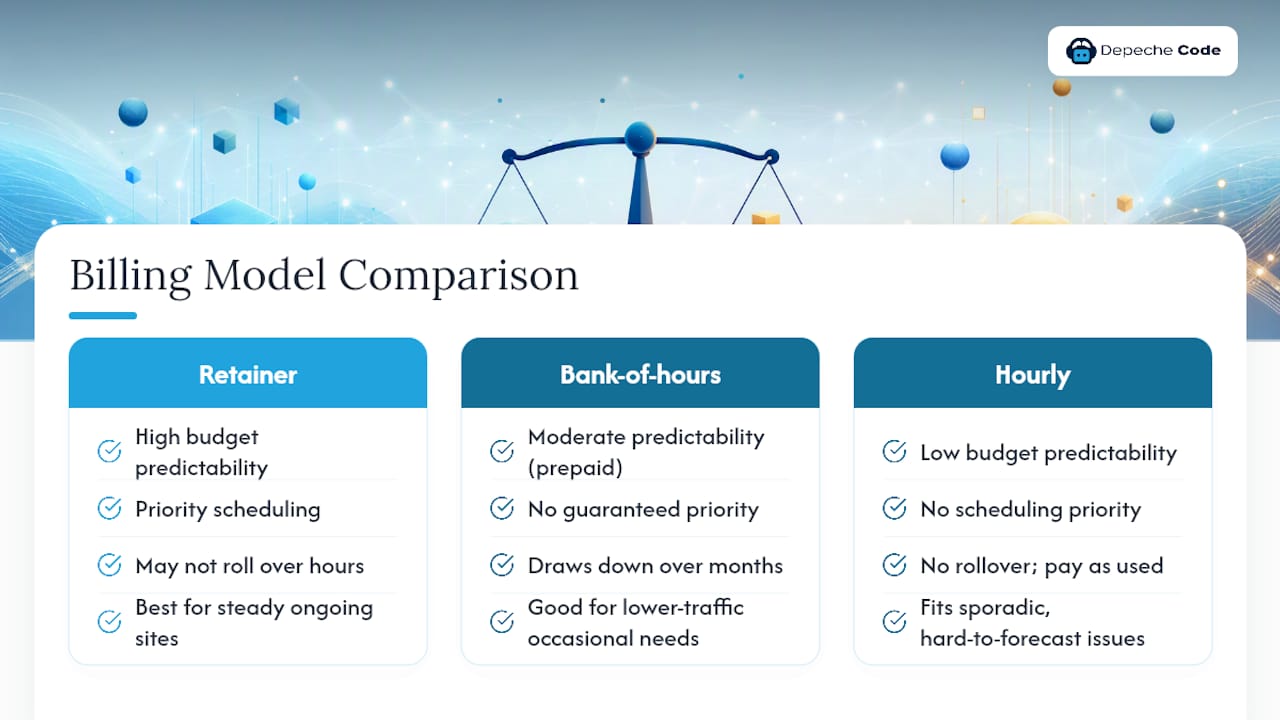
Monthly retainers suit sites needing steady attention. You get predictable budgeting and priority scheduling, but you may pay for hours you don’t use if rollover terms are stingy. Bank-of-hours plans work well for lower-traffic sites with occasional needs, letting you prepay at a discount and draw down over months. Pure hourly billing offers the most flexibility and the least predictability. It fits sites with sporadic, hard-to-forecast issues.
Price bands vary enormously by scope and market, so treat any number as a starting reference rather than a rule. Entry-level plans tend to cover basic updates and monitoring; mid-range plans add proactive security and monthly reporting; enterprise-tier agreements bundle performance optimization, staging environments, and dedicated response staff. The gap between tiers usually comes down to response time and depth of monitoring, not just hours included.
Emergency and after-hours work almost always carries a surcharge. Get that rate in writing and ask for a cap on how many emergency hours can be billed before you’re notified. Watch three details in the fee clause: billing increments (15 minutes is fairer than 60), rollover rules for unused hours, and whether invoices itemize tasks or just show a lump sum. Vague invoices make it nearly impossible to audit whether you’re getting the hosting, security, and technical support you’re actually paying for.
How to Negotiate a Website Maintenance Contract
Approach this like any other digital service contract negotiation: know which terms you can bend and which ones you can’t.
- Prioritize your top three asks — usually SLA response times, backup test frequency, and a liability cap. Don’t spend negotiating capital on font choices in the report template.
- Ask direct questions: What counts as an emergency? Who owns the code if we leave? How often are backups tested, not just taken?
- Watch for red flags: a provider that won’t commit to numeric response times, skips backup testing entirely, or reserves the right to raise fees without notice period.
- For e-commerce or mission-critical sites, negotiate faster SLA tiers (1-hour acknowledgment, not 4) and quarterly test restores instead of annual ones. Test-restore obligations matter more for revenue-generating sites than for a static brochure page.
Pro Tip: Ask for a 90-day file handover clause even if you never plan to leave. It costs the provider nothing to grant and protects you completely.
Field Notes on Website Upkeep Agreements
Industry experts have observed recurring gaps across maintenance handoffs: sites that “look fine” while a cron job silently fails, or clients who discover their only backup lives on a laptop that got replaced last year.
Practical additions worth pushing into any web hosting maintenance agreement:
- Quarterly code and database snapshots, so you’re never locked into one host
- A documented credential handover schedule, reviewed at each renewal
- Scheduled test restores, not just scheduled backups
- A quarterly report of updates, backups, and resolved tickets as your audit trail
For deeper reading on the operational side, Depechecode’s guide on keeping a site secure through routine maintenance and its essential maintenance checklist both expand on these points.
Why Most Website Maintenance Contracts Undersell Themselves
Most advice on this topic treats the contract as legal paperwork, something you sign once and file away. That’s backwards. The contract is the operating manual for the relationship, and the clauses people skip, backup testing, emergency pricing, credential handover, are exactly the ones that matter when something breaks at 2 a.m.
The conventional wisdom says “get everything in writing,” which is true but useless as advice. What actually helps is starting from an annotated template with real numbers already filled in, then negotiating from strength rather than blank-page uncertainty. Readers who copy a severity matrix with exact hours, instead of accepting “we’ll respond promptly,” walk away with a contract that protects them on the one day a year it actually matters.
Prioritize the backup and restore clause above almost everything else. A site with weak SLA language survives. A site with untested backups during a real failure often doesn’t.
— Donovan Wells – Founder and CEO
Get Your Contract in Place With Depechecode
Some providers offer maintenance agreements based on generic templates, which may not always hold up well. Instead of guessing at scope and SLA language, you get a provider that already runs WordPress maintenance plans built around the same checklist covered above: defined update cadences, backup testing, and response-time tiers spelled out before you sign anything.

Effective onboarding typically starts with access handover, a baseline site audit, and an SLA conversation matched to the risk level; for example, e-commerce sites may require faster response tiers than static brochure sites. If you want an annual arrangement instead of month-to-month, the yearly maintenance plan bundles that structure in from day one. Start by reviewing Depechecode’s website design and development services to see how a maintenance agreement fits alongside a new build or an existing site, then request a quote to get your SLA and fee structure drafted this week.
Sources
For sample clause language, see Law Insider’s termination examples and BDC’s contracting advice. Always route liability and governing-law clauses through a lawyer licensed in your jurisdiction.
- BDC — Negotiating the right maintenance contract for your website
- Webflow — Website maintenance guide
- Medium — Study on silent website failures
FAQ
How much should I pay someone to maintain my website?
Costs vary by scope and billing model. Basic monitoring and updates cost less than a plan bundling security hardening, backups, and priority SLA response; get a quote scoped to your specific task list rather than comparing flat rates.
What should be included in a maintenance contract?
A complete contract lists scope of services, fees and billing model, SLA response targets, term and termination, backup and restore obligations, client responsibilities, and liability and confidentiality clauses.
How much does website maintenance cost?
Pricing depends on the billing model, monthly retainer, bank of hours, or hourly, and on how much monitoring, security work, and content editing the scope includes; always request an itemized quote tied to your task list.
What does website maintenance include?
Standard tasks cover CMS and plugin updates, security monitoring, scheduled backups, minor content edits, and uptime checks, with security hardening and performance checks often scheduled on different weekly, monthly, or quarterly cycles.