

Chatbot conversation design is the discipline of scripting how a bot listens, responds, recovers from confusion, and hands off to a person, so the exchange feels purposeful rather than scripted. The single best first move on any project is writing a one-line job statement, something like “Help a returning customer check an order status without logging in,” because it forces the team to decide whether a conversation is even the right interface before anyone builds a flow. This guide covers the principles, the step-by-step process, error repair, handoff rules, and testing that turn that job statement into something people can actually use.
TL;DR:
- Clear, focused job statements and minimal decision points are essential to prevent chatbot flows from becoming overly complex and ineffective.
- Handling errors with reusable repair patterns and ensuring smooth handoffs to human agents improve user experience and build trust.
- Ground answers with trusted sources, enforce privacy, and set transparency expectations to maintain user confidence and ethical standards.
- Building a version-controlled spec that includes KPIs, personas, intents, and flow diagrams helps prevent project drift and facilitates ongoing improvements.
- Regular testing with real transcripts, behavioral metrics, and adversarial scenarios ensures continuous optimization and reduces common project pitfalls.
Table of Contents
- What Makes Chatbot Dialogue Design Effective?
- How Do You Build A Chatbot Conversation Step By Step?
- How Should You Handle Chatbot Errors And Unhappy Paths?
- When Should A Chatbot Hand Off To A Human?
- How Do You Ground Chatbot Answers And Protect User Privacy?
- What Belongs In A Chatbot Conversation Specification?
- How Do You Test And Measure Chatbot Performance?
- Reusable Templates For Chatbot Job Statements And Repair Patterns
- How Do You Research Chatbot Users And Build Personas?
- How Do You Localize A Chatbot For Different Languages And Regions?
- What Ethical Issues Go Beyond Basic Chatbot Safety?
- Which Tools Support Chatbot Conversation Design Work?
- How Do You Keep Improving A Chatbot After Launch?
- Where Conversation Design Actually Goes Wrong
- Get Chatbot Conversation Design Built By Depeche Code
- Sources
- FAQ
What Makes Chatbot Dialogue Design Effective?
Good chatbot dialogue design comes down to a small set of rules that hold up across industries, channels, and model types. Skip any one of them and the bot starts feeling either robotic or, worse, dishonest about what it actually is.
Clarity and brevity come first. Every response should answer one question, use plain words, and avoid stacking three asks into a single message. Users skim; a bot that writes like a contract loses them by the second turn.
Context has to be scoped and it has to expire. A bot that remembers a shipping address from three days ago and applies it to today’s unrelated question creates confusion, not convenience. Decide up front what the bot retains within a session, what it carries across sessions, and when that memory expires.
Persona matters, but only as much as it serves the task. Align tone to what the user is trying to do: a billing dispute needs calm and precise language, not chirpy enthusiasm. Avoid mimicking a human closely enough that people can’t tell they’re talking to software, since that erodes trust the moment they find out.
The deterministic versus reasoned boundary is the principle most teams get wrong. Payments, refunds, account changes, and anything compliance-sensitive belong in locked, deterministic logic, while open-ended discovery and clarification can lean on model reasoning with guardrails.
- Write for the channel: SMS has different affordances than a voice assistant or a web widget with buttons and source links
- Build in accessible input alternatives for users who can’t or won’t type
- State plainly that the assistant is AI, and say what it can and can’t do
Pro Tip: Draft your persona guide and your deterministic action list on the same page. If a flow needs personality AND a hard rule, that’s your signal it belongs in the spec, not left to improvisation.
How Do You Build A Chatbot Conversation Step By Step?
A repeatable process keeps a conversation design project from turning into an endless string of ad hoc Slack decisions. Follow these steps in order:
- Write the job statement. Voiceflow’s conversation design guidance recommends starting with the job, not a script, because naming the job first often reveals that a button or a form would serve the user better than dialog.
- Decide if conversation is the right channel. Some tasks are faster as a menu. Don’t force chat where a UI does the job in one tap.
- Map the happy path in minimal turns. Draft the shortest version that gets a typical user from question to resolution, then annotate every decision point along the way.
- Classify each decision point. For each one, choose whether it needs deterministic logic (locked, auditable) or model reasoning (flexible, guarded).
- Write sample dialogs and reusable repair patterns. Don’t invent a new recovery method for every flow. Build one repair pattern and reuse it.
- Connect flows to real data. Wire the design to knowledge bases and APIs so answers are grounded instead of guessed.
- Produce a version-controlled spec. Hand engineers and trainers something they can build from, not a slide deck that goes stale in a week.
Each flow should define the user’s intent, the information or “slots” required to act, the business action itself, a confirmation step, the resolution, and what happens next. That structure applies whether you’re building a returns bot or a scheduling assistant, and it’s the backbone that keeps a design testable later.
- Skip step 2 and you’ll spend months polishing dialog for a task users wanted to complete in one click
- Skip step 4 and a refund gets processed by a model guessing at intent instead of a rule enforcing it
How Should You Handle Chatbot Errors And Unhappy Paths?
Treat unhappy paths as core product work, not an afterthought bolted on after the happy path ships. Users interrupt, switch topics mid-sentence, give partial answers, go quiet, or ask for something entirely outside scope, and Microsoft’s guidance on conversation flow design recommends planning for interruptions and conversation expiration rather than assuming every user follows a straight line.
Repair should follow one reusable pattern: diagnose whether the failure is ambiguity, missing information, an unsupported request, or a system error, then ask the smallest possible clarifying question, and always preserve what the bot already knows. Never make someone repeat information they already gave three turns ago.
- Offer selectable options instead of open text when a clarifying question has a limited set of valid answers
- Cap retries at two or three attempts before routing to a human
- Preserve collected slots and context across every repair attempt
Nielsen Norman Group’s research on AI chatbot dimensions found that users respond better to honest uncertainty paired with a clear escape hatch than to a bot that confidently repeats the wrong answer. That single finding should shape every fallback message you write.
Pro Tip: Test with real, messy transcripts, not just the clean examples your team wrote. Typos, slang, compound requests, and irritated tone expose brittle assumptions that scripted test cases never catch.
When Should A Chatbot Hand Off To A Human?
Handoff rules need to be explicit and testable, not left to a vague sense that “the bot seems stuck.” Nielsen Norman Group recommends triggering a human handoff when the user explicitly asks for a person, when the bot’s confidence or knowledge falls short, after repeated failed repair attempts, when frustration shows up in the language, or when the issue needs judgment or restricted handling.
The transfer itself carries the weight of whether the handoff actually helps. Package the full transcript, every detail already collected, any uploaded files, and a short case summary so the human agent doesn’t ask the person to start over.
- Track the repeat-information rate: how often users have to restate something the bot already captured
- Measure time-to-transfer from trigger to a human actually engaging
- Survey satisfaction specifically after the handoff, separate from satisfaction with the bot itself
- Show the user a wait estimate and a confirmation that the handoff succeeded
A technically successful transfer can still feel like a reset if the context doesn’t arrive with it, which is exactly why the metrics above matter more than a simple “handoff completed” flag.
How Do You Ground Chatbot Answers And Protect User Privacy?
Grounding, transparency, and privacy aren’t separate checkboxes. They’re the same discipline applied to different risks. Use retrieval from an approved knowledge base for factual answers instead of letting a model generate from general training data, and link back to the source of truth wherever possible.
Nielsen Norman Group’s research on trust calibration treats transparency as a design requirement, not a nice-to-have disclaimer buried in a footer. Identify the assistant as AI, state plainly what it can and cannot do, and make any uncertainty or source limitation visible in the response itself rather than hidden behind confident phrasing.
- Lock payments, refunds, and account edits behind deterministic flows, never open model reasoning
- Set explicit retention rules for anything sensitive the bot collects
- Never let the bot silently carry sensitive state across sessions without the user’s knowledge
- Ground factual claims in a source the team controls, and show users where an answer came from when it matters
Channel context belongs in this same conversation. A voice interface can’t show a source link the way a web widget can, so accessibility and channel-specific design guidance needs to shape how transparency gets delivered on each surface, not just whether it exists.
What Belongs In A Chatbot Conversation Specification?
A version-controlled conversation specification is the single artifact that keeps a project from drifting into inconsistent, undocumented behavior as more people touch it. It’s also the difference between a design a new engineer can build from and one that only lives in the original designer’s head.
| Spec element | What it captures |
|---|---|
| Job statement & KPIs | The task being solved and how success gets measured |
| Personas | Tone, vocabulary, and behavior rules per user type |
| Entry points & intents | Where users start and what they’re trying to do |
| Sample utterances | Real phrasing variations for each intent |
| Flow diagrams | Visual map of decision points and branches |
| Slots & validation | Required data and the rules for accepting it |
| Repair patterns | Reusable recovery logic for ambiguity or failure |
| API actions | Which systems the bot reads from or writes to |
| Handoff rules | Explicit triggers and transfer contents |
| Privacy & safety boundaries | Retention rules and locked-down actions |
| Test cases | Adversarial and scripted scenarios to validate against |
| Analytics events | What gets logged for later measurement |
- Keep the spec in a version-controlled repository, the same way engineers version code
- Ship an MVP with, at minimum, the job statement, one happy path, one repair pattern, and one handoff rule documented before writing a single line of implementation code
- Update the spec every time a repair pattern or intent changes in production, not just at project kickoff
Skipping this step is the most common reason a chatbot project stalls six months in: nobody remembers why a rule exists, so nobody trusts changing it.
How Do You Test And Measure Chatbot Performance?
Optimizing for containment alone, meaning how many conversations the bot resolves without escalating, produces a dashboard that looks great and a user base that’s quietly furious. Nielsen Norman Group’s research recommends evaluating task completion and resolution alongside abandonment, fallback frequency, repeated-question rate, time to resolution, satisfaction, escalation friction, answer accuracy, and business outcomes like qualified leads or completed bookings.
- Track completion and resolution rate, not just conversations closed
- Watch fallback frequency and repeated-question rate as early warning signs of a broken repair pattern
- Pair every quantitative metric with a sampled qualitative review of actual transcripts
Interaction quality deserves its own attention. Recent research from ACL PrefIx argues that pacing, initiative, and confirmation style should count as first-class evaluation targets, not an afterthought behind raw task accuracy, since a bot can technically complete a task while still feeling clumsy to talk to.
Test with adversarial transcripts pulled from real conversations, not only designer-written scripts. Wizard-of-Oz testing, where a human secretly plays the bot before it’s built, and structured A/B tests both surface problems that clean, scripted inputs never will. Route what you learn back into the spec and the training data on a regular cadence, not once a quarter.
Reusable Templates For Chatbot Job Statements And Repair Patterns
Templates save a team from reinventing structure on every project. These are meant to be copied into a working doc and adjusted, not followed word for word.
Three job statement templates:
- Support: “Help a [user type] resolve [specific issue] without needing to call in.”
- Lead qualification: “Identify whether a [visitor type] is ready to buy and capture their contact details.”
- Scheduling: “Let a [user type] book, reschedule, or cancel an appointment in under three turns.”

Two repair pattern snippets:
- Clarify with options: “I want to get this right. Are you asking about [Option A] or [Option B]?” Preserve everything already collected while asking.
- Preserve state on ambiguity: “I didn’t catch that fully, but I’ve still got your [order number/account]. Can you rephrase what you need?”
Handoff summary template for agents: user’s original request, everything collected so far, any files or screenshots shared, number of repair attempts made, and a one-line reason for the transfer.
Minimal spec checklist to copy into project docs: job statement, one happy path diagram, one repair pattern, one handoff trigger with transfer contents, and the three KPIs the team will track first.
Related reading on implementation specifics lives in 10 best practices for designing an effective AI chatbot, which pairs well with the templates above once you’re ready to build.
How Do You Research Chatbot Users And Build Personas?
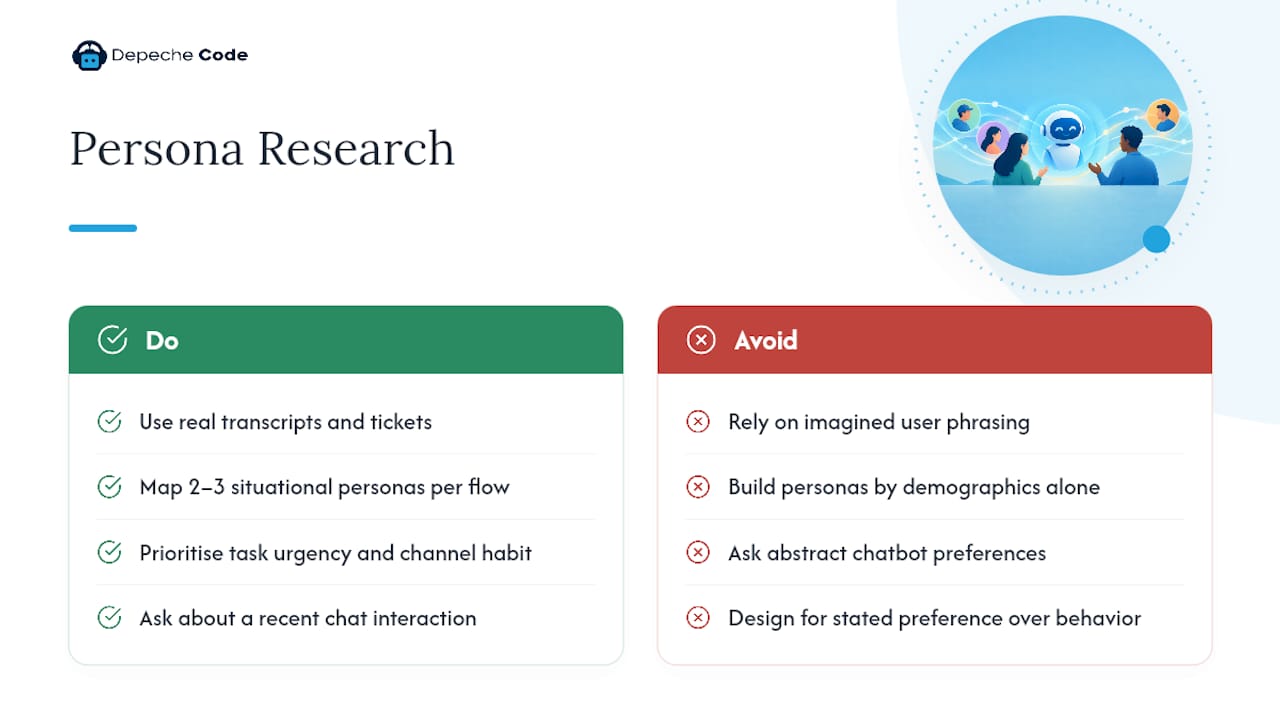
Persona work for a chatbot audience differs from typical UX persona building because the research question isn’t “who is this person” so much as “what will this person type, and when will they get impatient.” Start by pulling real transcripts, support tickets, and search queries instead of guessing at phrasing, since actual user language rarely matches the polished sentences a team writes internally.
Build personas around task urgency and channel habit rather than demographics alone. A user checking an order status on their phone during a commute behaves differently than the same user filing a warranty claim from a desktop at home, even though it’s the identical person. Map at least two or three of these situational personas per major flow, and note what patience level, vocabulary, and device each one brings.
Interview or survey actual users about a specific recent chatbot interaction rather than asking abstract questions about chatbots in general. People struggle to describe hypothetical frustration accurately, but they remember exactly where a real conversation went wrong last week.
Watch for the gap between what users say they want (a “smart assistant that understands anything”) and what actually satisfies them in practice (a fast, honest answer to a narrow question). That gap shows up constantly in usability sessions, and designing for the stated preference over the demonstrated one is a common, costly mistake.
How Do You Localize A Chatbot For Different Languages And Regions?
Localization for a chatbot goes well past translating response copy. Idioms, politeness norms, and even acceptable levels of directness vary enough between languages that a literal translation of an English repair pattern can come across as rude or oddly formal elsewhere.
Build the specification with locale as a first-class variable, not a translation layer applied at the end. Slot validation rules that work for US phone numbers or addresses won’t validate correctly elsewhere, and date formats alone cause a steady stream of support tickets when they’re assumed rather than checked.
Regional expectations around formality shift the persona work, too. Some markets expect a more deferential tone from service bots; others read that same tone as evasive or insincere. Test repair patterns and handoff phrasing separately in each target language rather than assuming a single voice guide translates cleanly.
Time zones and business hours change the handoff logic itself. A bot promising “a human will follow up shortly” needs different wording depending on whether that human’s workday has already ended, and getting this wrong quietly damages trust in markets outside a team’s default working hours.
What Ethical Issues Go Beyond Basic Chatbot Safety?
Safety guardrails stop the obvious harms. The subtler ethical issues live in how a chatbot’s design choices shape user behavior and what happens to the data it collects along the way.
Bias shows up in training data, sample utterances, and even in which user phrasings a team bothered to test against. If your adversarial test set skips certain dialects, accents transcribed to text, or non-native phrasing patterns, the bot will underperform for exactly the users least likely to complain loudly about it.
Privacy deserves scrutiny beyond compliance minimums. A bot that quietly retains sensitive details across sessions, even with good intentions, creates risk the user never explicitly agreed to. Ask what the bot actually needs to remember to do its job, and default to forgetting everything else.
There’s also a manipulation risk worth naming directly: a persona designed to feel maximally human, paired with a tone crafted to build emotional rapport, can nudge people toward decisions, purchases, or disclosures they wouldn’t make with a service that read clearly as automated. Designing for trust is legitimate. Designing for the appearance of trust the bot hasn’t earned is a different thing entirely, and the line between the two is a judgment call every team has to make on purpose, not by accident.
Which Tools Support Chatbot Conversation Design Work?
Conversation design has matured enough that dedicated tooling now exists for most of the workflow, rather than teams stitching everything together in spreadsheets and slide decks.
Flow mapping and prototyping tools let designers sketch decision points and branches visually before anyone writes implementation code, catching structural problems early when they’re cheap to fix. Platforms built specifically for building and training conversational flows, including intent management and slot definition, now handle a meaningful share of the technical scaffolding that used to require a developer for every change.
Framework-level tools aimed at more technical teams support intent classification, dialogue management, and integration with a company’s own knowledge base or APIs, which matters most for the deterministic, consequential flows discussed earlier. Analytics platforms built for conversational interfaces track the KPIs covered in the testing section, fallback rate, completion rate, and satisfaction, in dashboards purpose-built for dialog rather than generic web analytics repurposed for chat.
Choosing a tool matters less than choosing one that supports version control for the spec itself. A tool that makes flows easy to edit but impossible to track changes on will eventually cost a team more time than it saved.
How Do You Keep Improving A Chatbot After Launch?
A launched chatbot isn’t a finished chatbot. The gap between what a team designed and what users actually do with it only becomes visible once real conversations start piling up, which is why the feedback loop matters as much as the initial design.
Review a sample of real transcripts on a fixed cadence, weekly for a new bot, monthly once it stabilizes, rather than waiting for a dashboard metric to dip before investigating. Metrics tell you something broke; transcripts tell you what and why.
Feed what you learn back into three places specifically: the repair patterns that keep getting triggered, the sample utterances that don’t match what users actually type, and the handoff triggers that fire too early or too late. Treat each of those as a living document, not a one-time deliverable from the original spec.
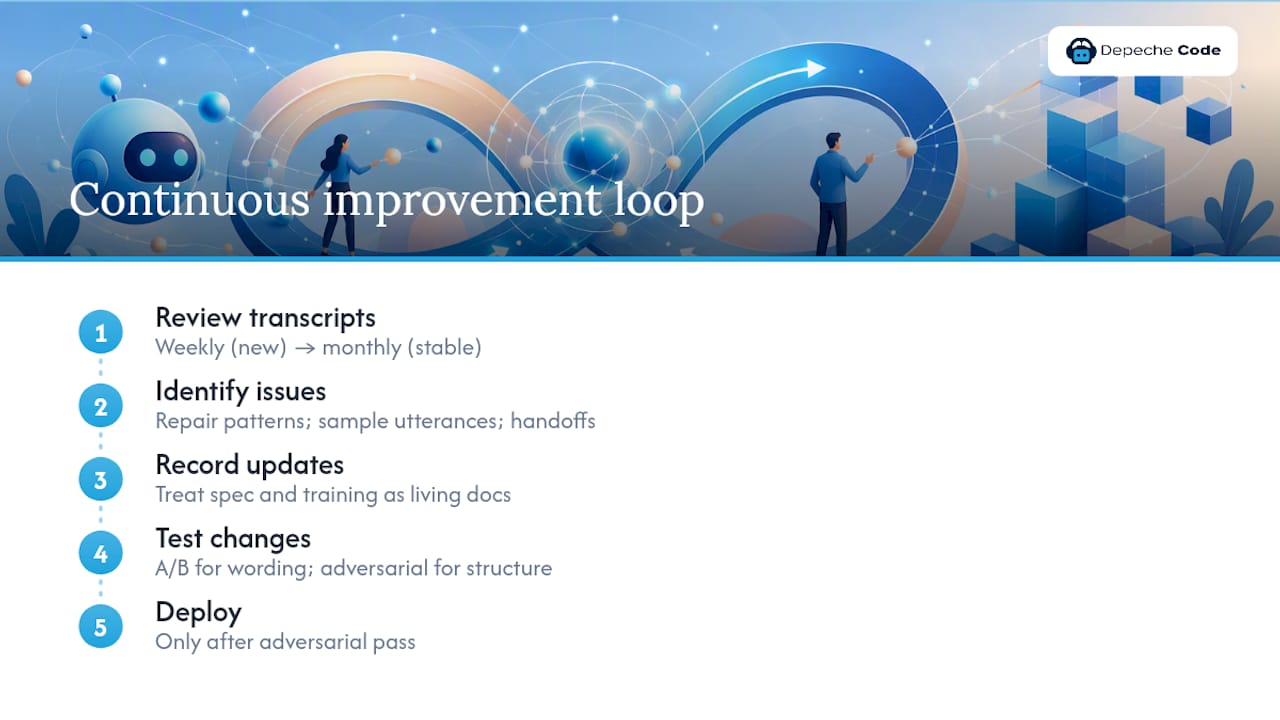
A/B testing works well for incremental wording changes, but structural changes, a new flow, a different persona tone, a new handoff rule, deserve a full round of adversarial testing before they ship, not just a metrics comparison after the fact. Skipping that step is how a well-intentioned fix introduces a new failure mode nobody catches until a user complains.
Where Conversation Design Actually Goes Wrong
Two mistakes show up on nearly every chatbot project before anyone tightens the design. The first is skipping the job statement and jumping straight into a script, which produces flows that are fluent but solve the wrong problem. The second is treating handoff as a fallback instead of a measured event, so teams have no idea whether their “successful” transfers actually felt successful to the person on the other end.
The chatbot engagement process builds every project around a written job statement first, then a version-controlled spec that engineers and trainers both work from, so nothing lives only in one person’s head. Handoff quality gets measured the same way task completion does, not treated as an afterthought once the bot gets stuck.
— Donovan Wells – Founder and CEO
Get Chatbot Conversation Design Built By Depeche Code
A practical alternative to hiring a large agency retainer to get a chatbot flow mapped and shipped is available: using directed AI can speed up delivery, and every deliverable, the spec, the flows, the repair patterns, can be owned by you, not locked in a vendor’s proprietary tool.
Our AI Chat Bots service covers the full path this guide walks through: job statements, deterministic versus reasoned flow mapping, repair pattern design, human handoff rules, and the version-controlled spec your team can hand to any developer. Pricing starts with the Starter plan at $49 per month, scales to Growth at $99 and Prime at $149 for teams that need deeper integration and ongoing optimization, plus a one-time $299 setup and integration fee to get everything connected properly from day one.
We focus on outcomes you can actually measure: speed to deploy, full ownership of every deliverable, and KPIs tracked from launch rather than guessed at after the fact. If your team is ready to move past the whiteboard stage, visit the AI Chat Bots services page to see current plans and get a conversation started about your specific flows.
Sources
- Nielsen Norman Group — Dimensions of AI chatbots
- Microsoft — Bot Service: Design conversation flow
- Voiceflow — Conversation design (blog)
- Conversation Design Institute — Conversation Design topics
FAQ
What Is Chatbot Conversation Design?
Chatbot conversation design is the practice of planning how a bot understands requests, responds, recovers from errors, and hands off to a human when needed. It covers everything from job statements and flow diagrams to repair patterns and version-controlled specs, as outlined by the Conversation Design Institute.
How Long Does It Take To Design A Chatbot Conversation Flow?
Timelines vary by scope, but a single well-defined flow with a job statement, happy path, and one repair pattern can move from spec to testable prototype in a matter of weeks. Complex flows involving multiple deterministic actions and handoff rules take longer because each decision point needs its own validation.
What’s The Difference Between Deterministic And Reasoned Chatbot Flows?
Deterministic flows use fixed, auditable logic for consequential actions like payments or account changes, while reasoned flows let a model handle open-ended discovery with guardrails. Voiceflow’s conversation design guidance recommends deciding this boundary for every flow individually rather than applying one rule project-wide.
How Much Does It Cost To Have A Chatbot Professionally Designed?
Depeche Code’s AI Chat Bot plans start at $49 per month for the Starter plan, with Growth and Prime tiers available for more complex needs, plus a one-time $299 setup fee. Exact scope and pricing depend on the number of flows and integrations required.
What Metrics Matter Most For Chatbot Performance?
Task completion and resolution rate matter more than containment alone, according to Nielsen Norman Group’s chatbot research, which also recommends tracking fallback frequency, abandonment, time-to-resolution, and satisfaction together. Relying on a single metric like handoff rate tends to hide real user frustration.