

A social media content pillar is a high-level theme that ties every post back to a specific audience need or business goal. Start with a few pillars, often three, because this usually provides enough variety to avoid repetition without splitting your team’s attention too thinly, which can otherwise prevent consistent traction. This article gives you the framework, copyable examples, and a scorecard to measure each one.
TL;DR:
- Most teams should start with three content pillars to maintain variety and focus on strategic themes relevant to their audience and business goals.
- Pillars should be regularly reviewed every quarter, using KPIs such as engagement rate or reach, to adjust their formats, cadence, or retire ineffective themes.
- Different platforms require tailored treatment of the same pillar, with longer, search-friendly content on YouTube, native videos on TikTok, and carousel or Stories on Instagram.
- Building pillars involves an audit of past content, clustering top performers into themes, validating with stakeholders, and defining each pillar using a clear template.
- Relying solely on one KPI per pillar and scheduling consistent audits helps teams avoid drifting and ensures content remains aligned with audience needs and business objectives.
Table of Contents
- What are social media content pillars, exactly?
- Pillars vs. buckets, series, and campaigns
- Why content pillars matter for your team
- How many pillars to run and how to build each one
- Plug-and-play pillar stacks you can adapt today
- How to build your pillars: audit to launch
- Matching pillars to platforms and formats
- Measuring pillars: scorecards and decision rules
- How Depeche Code applies pillar thinking for clients
- What most teams get wrong about content pillars
- Turn your pillars into a managed content system
- Sources
- FAQ
What are social media content pillars, exactly?
A content pillar is not a post, a format, or a hashtag. It is the underlying job a piece of content does for your audience and your business, repeated across dozens of posts in different shapes. Think of a pillar as the “why” behind the content, while a series or format is the “how.”
For example, a pillar called “product education” might show up as a carousel breaking down a feature one week, a short video answering a common question the next, and a live Q&A the week after. Same pillar, three different vehicles. Without pillars, teams tend to drift: one week is all memes, the next is all sales pitches, and the account starts to feel unfocused.
- A pillar answers “what job does this content do for the audience or the business?”
- A series or format answers “how do we execute that job this week?”
- Pillars stay stable for months; series and formats can rotate freely underneath them.
Thinking in themes first keeps creative decisions anchored to strategy instead of whatever trend is loudest that day.
Pillars vs. buckets, series, and campaigns
Teams often use these four terms interchangeably, which causes confusion in planning meetings and approval chains. Here’s how to separate them:
- Pillar: the recurring strategic theme (education, proof, community) that a piece of content serves.
- Bucket: often used as a synonym for pillar in looser planning docs; treat it as the same concept to avoid duplicate categories.
- Series: a repeatable format inside a pillar, like a weekly “Ask Us Anything” video that lives under the education pillar.
- Campaign: a short, time-boxed push (a product launch, a seasonal sale) that can borrow from multiple pillars but has its own start and end date.
A practical mapping: your “proof” pillar might run a “Client Spotlight” series every other Tuesday, and during a product launch campaign, that same series gets a temporary boost in frequency before returning to its normal cadence.
Why content pillars matter for your team
Pillars work because they turn scattered posting into a signal set your audience learns to recognize. Research on social content strategy finds that content characteristics, source, and valence jointly shape customer engagement, which in turn affects business outcomes. Pillars give you a repeatable way to control those signals instead of leaving them to chance.
On the operational side, pillars cut down on the “what do we post today” scramble. When a new team member joins, they can look at the pillar list and immediately understand what kind of content is welcome and what is not, which speeds up approvals and reduces back-and-forth with stakeholders.
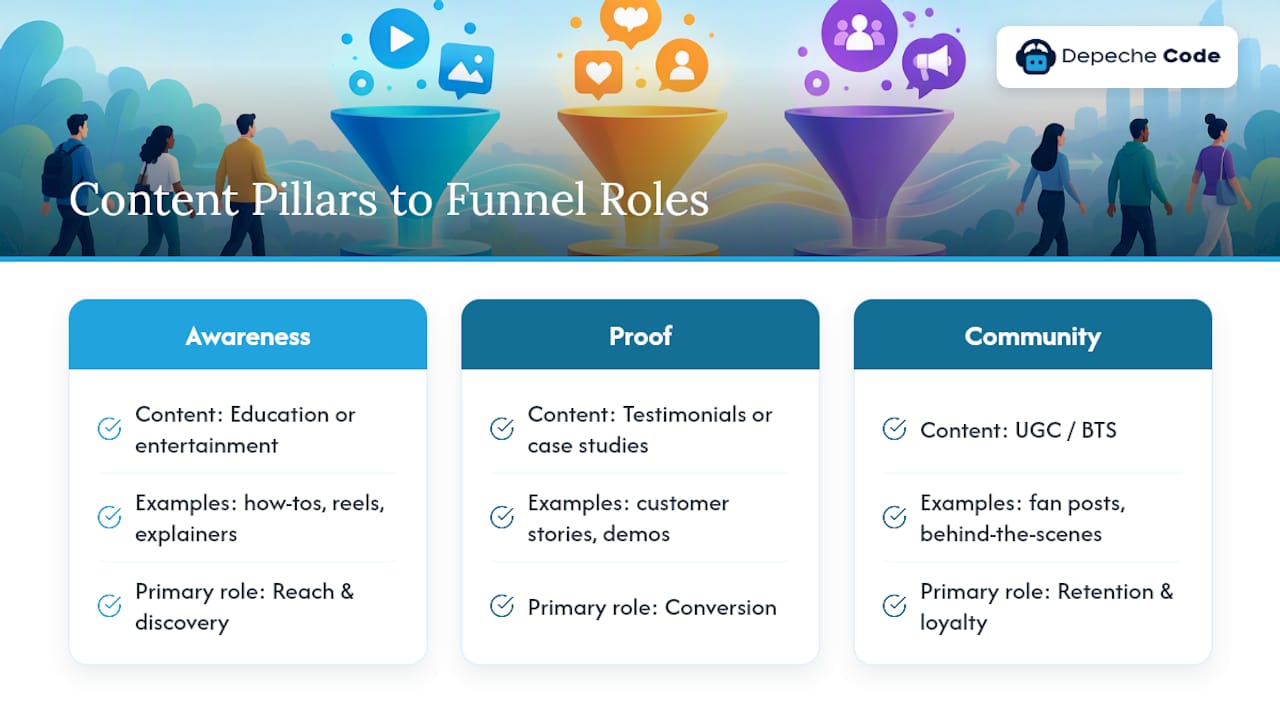
Different pillars also tend to serve different funnel stages. An awareness-focused pillar built around education or entertainment tends to drive reach and discovery. A proof-focused pillar built around testimonials or case studies tends to support conversion. A community-focused pillar built around user-generated content or behind-the-scenes material tends to support retention and loyalty. Mapping pillars to objectives up front makes it much easier to judge whether each one is pulling its weight later.
How many pillars to run and how to build each one
Three pillars is the right starting point for almost every team. It gives you enough range to avoid monotony while keeping production manageable, and it matches the guidance from research on social media maturity, which suggests starting with three pillars in early stages and expanding only once series, governance, and measurement are working smoothly. Expand to four or five pillars only after your first three have clear series, a posting cadence, and at least one full quarter of performance data behind them.
For each pillar, fill out this anatomy before you build a single post:
- Job: what business or audience outcome this pillar exists to serve.
- Audience intent: what the reader wants when they engage with this type of content.
- Formats: the two or three formats that fit this pillar best.
- KPI: the single metric you will check to judge whether the pillar is working.
Before finalizing names, run through a short checklist: does the name mean something to someone outside marketing, does the job map to a real business goal, and can you name three pieces of past content that already fit this pillar.
Pro Tip: Name pillars the way you’d explain them to a new hire in one sentence, not with vague marketing labels like “engagement” or “value.”
Plug-and-play pillar stacks you can adapt today
Different business types tend to gravitate toward different pillar combinations. Here are three stacks built around common use cases, each with sample series and a rough posting mix.
B2B software or services stack:
- Education (how the product or industry works), with series like “Feature Friday” and “Common Mistakes” explainers.
- Proof (client results and case studies), with a recurring “Client Spotlight” series.
- Community (team culture and industry commentary), with a “Behind the Build” series showing internal process.
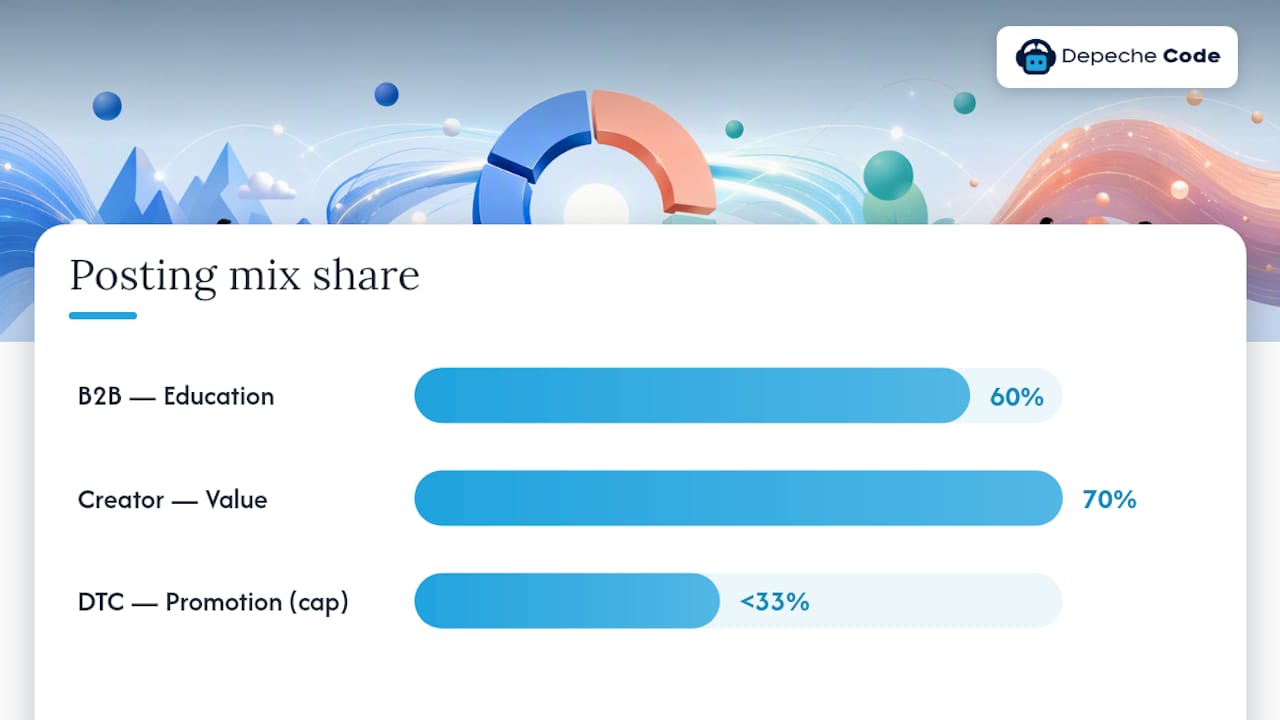
A reasonable cadence for this stack runs close to 60% education, 25% proof, and 15% community, since B2B buyers tend to research heavily before engaging with sales content.
Direct-to-consumer retail stack:
- Inspiration (lifestyle and use-case content), with a “Styled By You” or “In the Wild” series.
- Proof (reviews and unboxings), with a “Real Reviews” series pulling from customer comments.
- Promotion (launches and offers), used sparingly and tied to specific campaigns rather than a weekly slot.
Retail brands can lean harder into promotion than B2B accounts, but even here, promotional posts should stay under a third of total volume to avoid audience fatigue.
Independent creator or personal brand stack:
- Education or expertise (the creator’s core skill or niche knowledge).
- Personality or behind-the-scenes (daily life, opinions, process).
- Community engagement (replies, duets, audience questions turned into content).
A commonly cited posting-mix heuristic, sometimes called 70/20/10, treats most content as value-driven, a smaller share as curated or shared, and a small remainder as promotional. Use it as a flexible starting ratio, not a rule, and adjust it based on what your pillar scorecard tells you after a full quarter.
Voice and evidence type should shift by industry even when the pillar structure stays similar. A B2B brand’s “proof” pillar might lean on case study data, while a DTC brand’s version leans on customer photos and reviews.
How to build your pillars: audit to launch
Building pillars is a sequence, not a brainstorm session. Follow these six steps in order.
- Audit your last two to three months of posts. Pull engagement rate, reach, and saves or shares for each post, then sort by performance to see which topics and formats already resonate.
- Cluster the top performers into themes. Look for patterns: are your best posts mostly answering questions, showing proof, or sparking conversation? Those clusters are your candidate pillars.
- Validate with stakeholders and, where possible, customers. Share the candidate pillars with sales, support, or customer success teams to confirm the themes match what buyers actually ask about.
- Name and define each pillar using the anatomy template from the previous section: job, audience intent, formats, and KPI.
- Operationalize inside your calendar. Give each pillar a label or tag in your scheduling tool, assign it fixed calendar slots, and write two or three approval questions reviewers can use to check whether a draft actually fits its pillar.
- Launch with a 30/60/90 test plan. In the first 30 days, focus on consistency: are you actually publishing each pillar on schedule? At 60 days, start watching engagement rate and reach by pillar to spot early winners and laggards. At 90 days, pull a full pillar scorecard and make your first keep, fix, or retire decisions.
A practical content planning guide can help you turn this sequence into templates your team actually uses week to week, rather than a one-time planning exercise that gets forgotten by month two.
Pro Tip: Run your audit with a spreadsheet before you touch a scheduling tool. Sorting raw numbers by hand surfaces patterns that a tool’s default dashboard often buries.
Matching pillars to platforms and formats
The same pillar needs different treatment depending on where it lives. Platform audiences are large and varied: recent data show [YouTube reaches 84% of U.S. adults and Facebook 71%](https://www.pewresearch.org/internet/2025/11/20/americans-social-media-use-2025/), with Instagram at 50% and TikTok at 37%. Those numbers matter because a pillar that performs well as a short video on TikTok may need a longer, more search-friendly version on YouTube to reach the same audience effectively.
- On YouTube, education and proof pillars translate well into longer explainer or case study videos.
- On Facebook, community and proof pillars often perform well as native video and photo posts with strong captions, given the platform’s broad and older-skewing reach.
- On Instagram, education and inspiration pillars fit carousels and Reels, while community pillars fit Stories and UGC reposts.
- On TikTok, education and personality pillars work best as short, fast-cut native video rather than repurposed content from other platforms.
Cross-posting the exact same asset everywhere usually underperforms a native-first approach, where you keep the pillar’s core message but adjust pacing, length, and captioning to fit how people actually scroll on each app.
Measuring pillars: scorecards and decision rules
Each pillar needs its own KPI, tied back to the job you assigned it. Reach-focused pillars should be judged on reach and impressions, engagement-focused pillars on engagement rate, and conversion-focused pillars on click-through or lead metrics.
A quarterly pillar scorecard keeps this simple: one line per pillar with its job, its primary metric, and a plain verdict of keep, fix, or retire. Guidance on mapping metrics to pillar jobs suggests tracking engagement rate, content volume, and conversion by pillar so you can see at a glance which themes are pulling weight and which are dead weight.
- Keep: the pillar is hitting its KPI target and audience response is stable or growing.
- Fix: the pillar has potential but the formats or cadence need adjustment before the next quarter.
- Retire: the pillar has underperformed for two consecutive quarters with no clear fix in sight.
Pillar-level metrics tracked consistently across a quarterly scorecard give teams the clearest signal for whether to keep, fix, or retire a theme, rather than relying on gut feeling from the most recent viral post.
Run this audit every quarter, not just once a year. Audience interests shift, platform algorithms change, and a pillar that worked in January can go stale by summer if nobody is watching the numbers.
How Depeche Code applies pillar thinking for clients
Donovan Wells, founder and CEO of Depeche Code, has built the agency’s social media management practice around this same pillar-first structure rather than ad hoc posting calendars. That background shapes how the team approaches every new account.
The workflow starts by mapping a client’s business goals to two or three pillar jobs, then builds series and a posting calendar underneath each one. From there, the team applies the same quarterly scorecard logic described above to decide what to keep, fix, or retire. Clients can review the agency’s broader approach through its social media management overview and its social growth services, both of which describe how governance and measurement fit into ongoing account work.
What most teams get wrong about content pillars
Most teams treat pillars as a one-time naming exercise instead of a living system that needs regular review. The three fastest wins are picking three pillars instead of six, giving each one a single measurable KPI, and scheduling a real quarterly audit on the calendar, not just in theory. If you track only one number in your first quarter, make it engagement rate by pillar.
— Donovan Wells – Founder and CEO
Turn your pillars into a managed content system
Building three solid pillars is only the first step. Keeping them fresh, measured, and adapted to shifting audience behavior every quarter is where most teams run out of time or bandwidth. A social media management service can handle ongoing tasks such as building the calendar, tracking pillar-level performance, and adjusting the mix as your audience changes, helping teams avoid manually pulling engagement numbers every few months.
If you already run pillars but need help keeping the scorecard current, or you are starting from scratch and want a team to build the framework with you, visit Depeche Code’s services page to see how social media management fits alongside the agency’s website, SEO, and chatbot work. Reach out to get a plan built around your specific audience and business goals.
Sources
For platform usage data, see the Pew Research Center’s 2025 social media report. For practical pillar categories, Hootsuite’s guide to engaging content and Depeche Code’s own social media guide are useful starting points. For scheduling and trust-building tactics, see this partner guide on building trust online.
- A meta-analysis of the impact of social media content strategies (2026)
- How To Create Content Pillars For Social Media (ClickUp)
FAQ
What are the content pillars on social media?
Content pillars are the recurring high-level themes, such as education, proof, or community, that every post ties back to. They give a team a consistent structure instead of posting whatever feels timely that day.
What are the 5 pillars of social media?
There is no single fixed set of five pillars; the right number depends on your business and audience. A common practical taxonomy includes educate, entertain, inspire, promote, and community or behind-the-scenes content, though most teams should start with three and expand only after testing.
What are the 5 P’s of social media?
Definitions of the “5 P’s” vary across marketing sources and are not a standardized industry framework. Rather than relying on a fixed acronym, focus on building pillars around your specific audience needs and business jobs, as outlined in this guide.
What are the 4 pillars of content?
Like the “5 P’s,” a universal “4 pillars” list does not exist as an official standard. Most practical frameworks land on three to five pillars built around a mix of education, proof, and community, adjusted to fit your specific audience and goals.
How often should I audit my content pillars?
Review your pillar scorecard every quarter, checking engagement rate, reach, and conversion against each pillar’s assigned KPI. This cadence matches the 30/60/90 testing rhythm recommended for newly launched pillars and gives you enough data to make a fair keep, fix, or retire decision.